Description
Instant download of visual.
Created on Canva for eduational purposes
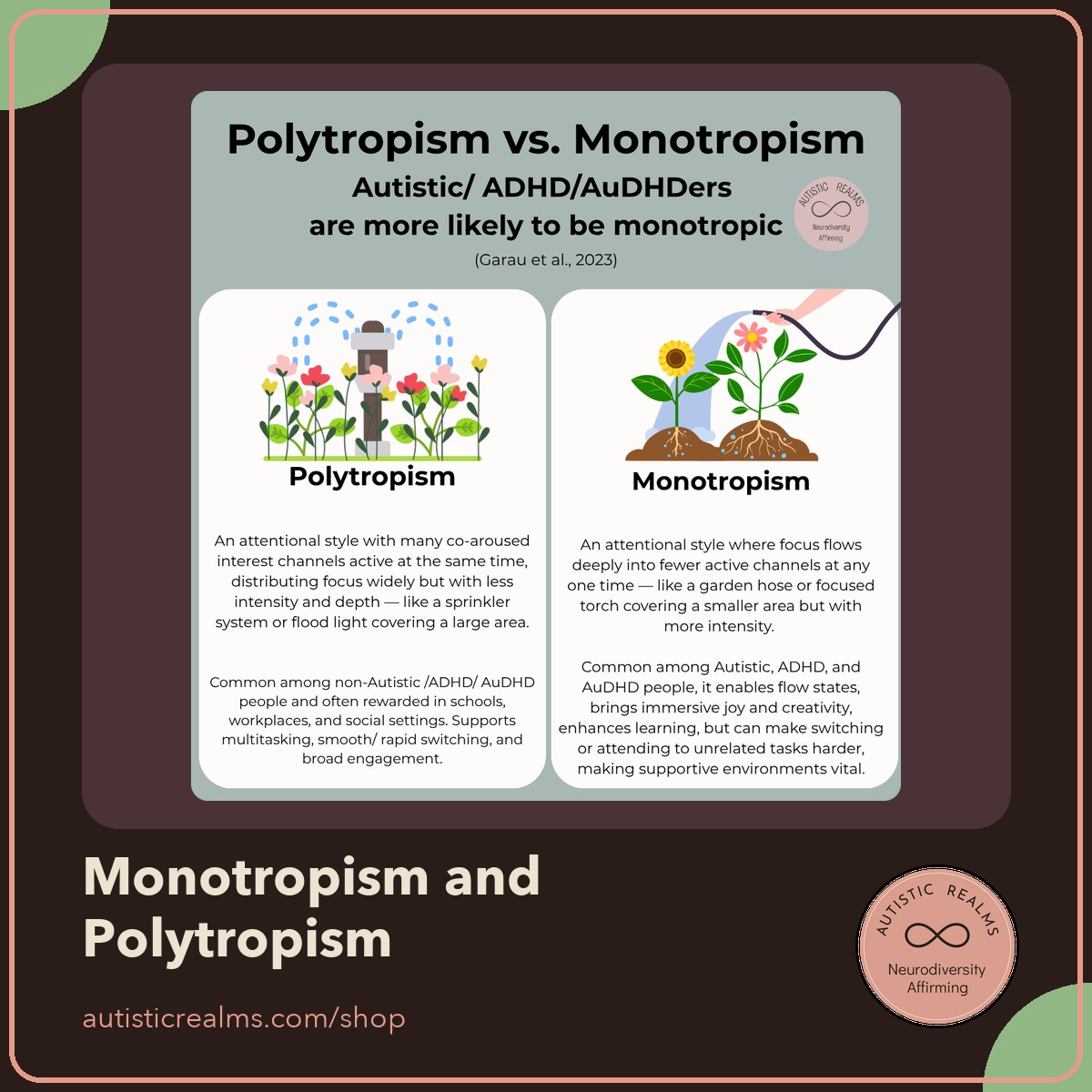
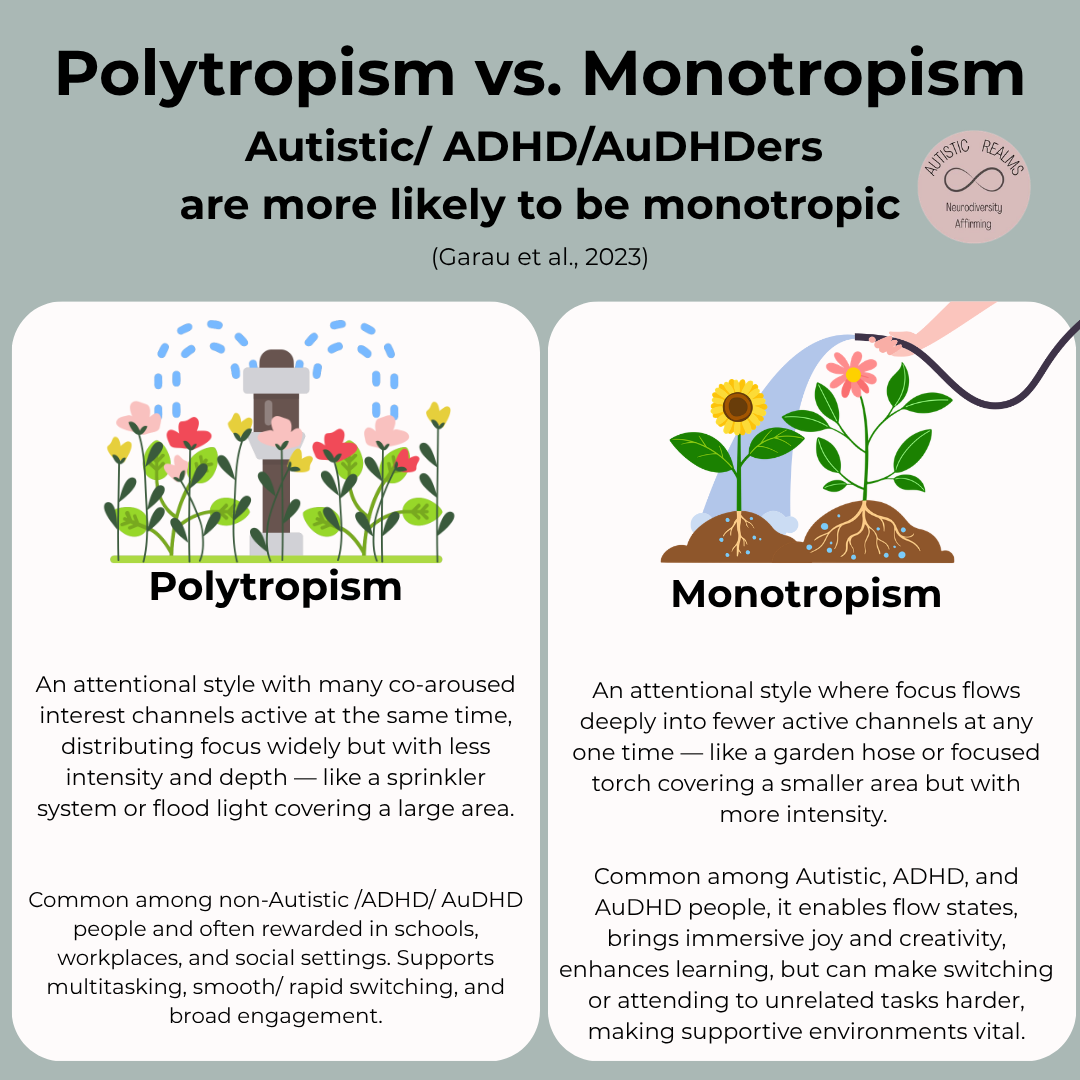
Alt text: Infographic titled “Polytropism vs. Monotropism – Autistic/ADHD/AuDHDers are more likely to be monotropic (Garau et al., 2023).” On the left, under “Polytropism,” there is an illustration of a sprinkler watering many flowers. Text explains polytropism as an attentional style with many co-aroused channels active at once, distributing focus widely but with less depth—like a sprinkler or flood light. It is common among non-Autistic/ADHD/AuDHD people and rewarded in schools, workplaces, and social settings. On the right, under “Monotropism,” there is an illustration of a hand holding a garden hose watering two flowers with deep roots. Text explains monotropism as focus flowing deeply into fewer active channels at one time, like a garden hose or focused torch. It is common among Autistic, ADHD, and AuDHD people, enabling flow states, joy, and creativity, but making task-switching harder without supportive environments. The Autistic Realms logo with the infinity symbol and “Neurodiversity Affirming” appears in the top right corner.
Instant download after checkout. Made in Canva unless stated. Licence: CC BY-NC-ND 4.0: please credit Helen Edgar (Autistic Realms), share it unadapted and for non-commercial use only. Full terms are in my Terms and Conditions of Use.
Read the full explanation: What is monotropism? Monotropism vs polytropism explained.