A plain-English guide for families of Autistic and otherwise neurodivergent children aged 6 to 11 at primary school in the UK, and for the staff who support them. It covers all four UK countries: England, Wales, Scotland and Northern Ireland. Primary school can be full of friendship and learning. It can also be loud, busy and confusing. So let’s start with the most important thing: your child’s needs are not a favour. They have rights.
A note on words
I say “Autistic child” rather than “child with autism”, because many Autistic people prefer identity-first language (Kenny et al., 2016). Please use the words your child and family prefer. I write Autistic and non-Autistic with a capital A, as a word of identity and culture. Your child does not need a diagnosis to get support at school or to be protected by the law.
You can read more in my Neuro-Affirming Glossary.
For more organisations and support, please visit my community signposting page.
What primary school can be like
Bells, hand dryers, the dinner hall, scratchy uniform and crowded corridors can all feel too much. Long spoken instructions and sudden changes are hard too. Playtime and lunch are often the hardest parts of the day, so it helps when school offers a quiet room, a club, a job or a calmer place to eat. Being alone by choice is fine. Being left out is not.
Many Autistic children hide how they feel at school to fit in. This is called masking. It is exhausting, and the feelings often spill out at home. If your child seems fine at school but is very upset at home, this is real. It is not bad parenting. It is a sign the school day needs to change.
How Autistic children communicate
Every child communicates. Speech is one way, not the only way or the best way. Signs, symbols, pictures, objects, gestures, writing and behaviour all carry meaning. Speech can come and go when a child is tired or overloaded, and that is not a choice.
AAC (augmentative and alternative communication) means picture cards, communication books, and apps or devices that speak aloud. There are no tests a child has to pass first (Royal College of Speech and Language Therapists [RCSLT], 2024), and AAC does not stop a child learning to talk. Use it yourself as you talk, keep it with your child all day, and never take it away as a punishment.
Many Autistic children repeat words or lines from films. This is called echolalia, and it often has a purpose, such as asking or answering (Prizant & Duchan, 1981). Answer the meaning. “Gestalt language processing” is a popular idea, but the research behind it is still limited (Hutchins et al., 2024).
Senses
We all have 8 senses: seeing, hearing, touch, taste, smell, balance and moving, body position, and body signals such as hunger, thirst and needing the toilet. Many Autistic children feel some senses more strongly and avoid them, and feel others less and seek more. Stimming, such as rocking, flapping or humming, helps children calm down and focus, so please don’t stop harmless stims. The aim is to change the place and the tools, not the child: ear defenders, movement breaks, a quiet place to go and warnings before bells all help.
Feelings, comfort and hard days
Children learn to calm down by being calmed by someone they trust. This is called co-regulation. A calm adult, a comforter, a key adult at school and a safe place to go without asking are not “giving in”. Make a plan for hard days on a calm day, so it is ready.
Autistic burnout is a deep exhaustion that builds up after coping with too much for too long. Signs include more meltdowns or shutdowns, losing skills for a while, and finding school harder and harder (“can’t”, not “won’t”). Cut demands, protect rest and interests, talk to school early, and ask your GP for help if you are worried. Read more in my guide to Autistic burnout.
If you are worried right now
- 999 if anyone is in danger.
- NHS 111: choose the mental health option (England and Scotland), or press 2 (Wales).
- Lifeline: 0808 808 8000 in Northern Ireland, any time, all ages.
- Childline: 0800 1111, for under 19s, free, any time.
- Samaritans: 116 123, any age, any time.
Every child is more than one thing
Your child is Autistic, and also a girl, a boy or non-binary, from a family with its own culture, faith and languages. Some families also face poverty, racism or more than one disability. These parts meet and shape each other. The word for this is intersectionality (Crenshaw, 1989).
- Autistic girls are often identified later than boys, or missed (Loomes et al., 2017). Gender diversity is more common among Autistic young people (Warrier et al., 2020).
- In English primary schools in 2024/25, pupils with an EHC plan were suspended about 37 times as often as pupils with no SEN (my calculation from Department for Education [DfE], 2026). The data is about SEN, not Autistic children alone.
- Bilingualism does not harm language development in Autistic children (Gilhuber et al., 2023). You do not have to drop your home language.
Your child’s rights at school
Every child who needs extra help to learn has a right to it, and disabled children have a right to reasonable adjustments. No diagnosis is needed for either. Here is a short summary. The pack’s rights guide has the detail, time limits and emails you can copy.
England
Ask the SENCo about SEN support. You can ask the council for an EHC needs assessment yourself, and the council must tell you within 6 weeks whether it will assess. The whole process should normally take no more than 20 weeks. You can appeal to the First-tier Tribunal (SEND) within 2 months of the council’s decision letter, or within 1 month of your mediation certificate, whichever is later. The government has proposed changes to the SEND system (February 2026). These are proposals, not law.
Wales
Talk to the ALNCo. Most children with additional learning needs have an Individual Development Plan (IDP) kept by the school, and some have one kept by the council. You, or your child, can appeal to the Education Tribunal for Wales within 8 weeks of the council’s final decision letter. SNAP Cymru (029 2002 8466) gives free help.
Scotland
Talk to the support for learning or pupil support teacher. A child has additional support needs if they need extra help to benefit from school. Some children, who need significant support from education plus another agency, have a Co-ordinated Support Plan (CSP). Mediation is free, and you can go to the First-tier Tribunal for Scotland (Health and Education Chamber), usually within 2 months. Enquire (0345 123 2303) gives free advice.
Northern Ireland
Talk to the SENCo. Schools record support in three stages, and the Education Authority can make a statement after a statutory assessment, usually within 26 weeks. You can appeal to SENDIST within 2 months of the decision. New SEN rules have been delayed until September 2027. They are not law yet. SENAC (028 9079 5779) gives free help.
Disability law
In England, Wales and Scotland, the Equality Act 2010 says schools must make reasonable adjustments, including auxiliary aids and services, and must not treat disabled pupils unfairly. In Northern Ireland, school disability law is Part III of the Special Educational Needs and Disability (NI) Order 2005 (SENDO). Schools must take reasonable steps, but this duty does not cover auxiliary aids or services. Claims have a 6-month time limit, so get advice early.
If your child can’t get in or is excluded
Sending a child home without a formal exclusion is not allowed in any UK country, even if you agree. If a school asks you to collect your child early or keep them at home, ask for it in writing and get advice.
In England, Wales and Northern Ireland, suspensions can add up to no more than 45 school days in a school year. In Scotland, the council must tell you the same day and write within 8 days with the reasons and your right of appeal. In England, a part-time timetable should only be used in very exceptional cases and should not be used to manage behaviour. It needs your agreement, a clear plan, regular reviews and an end date. If your child is anxious about school, ask for reasonable adjustments and a time-limited phased return, and keep a simple record of each day.
Making a plan that works: using the Autistic Child Bundle
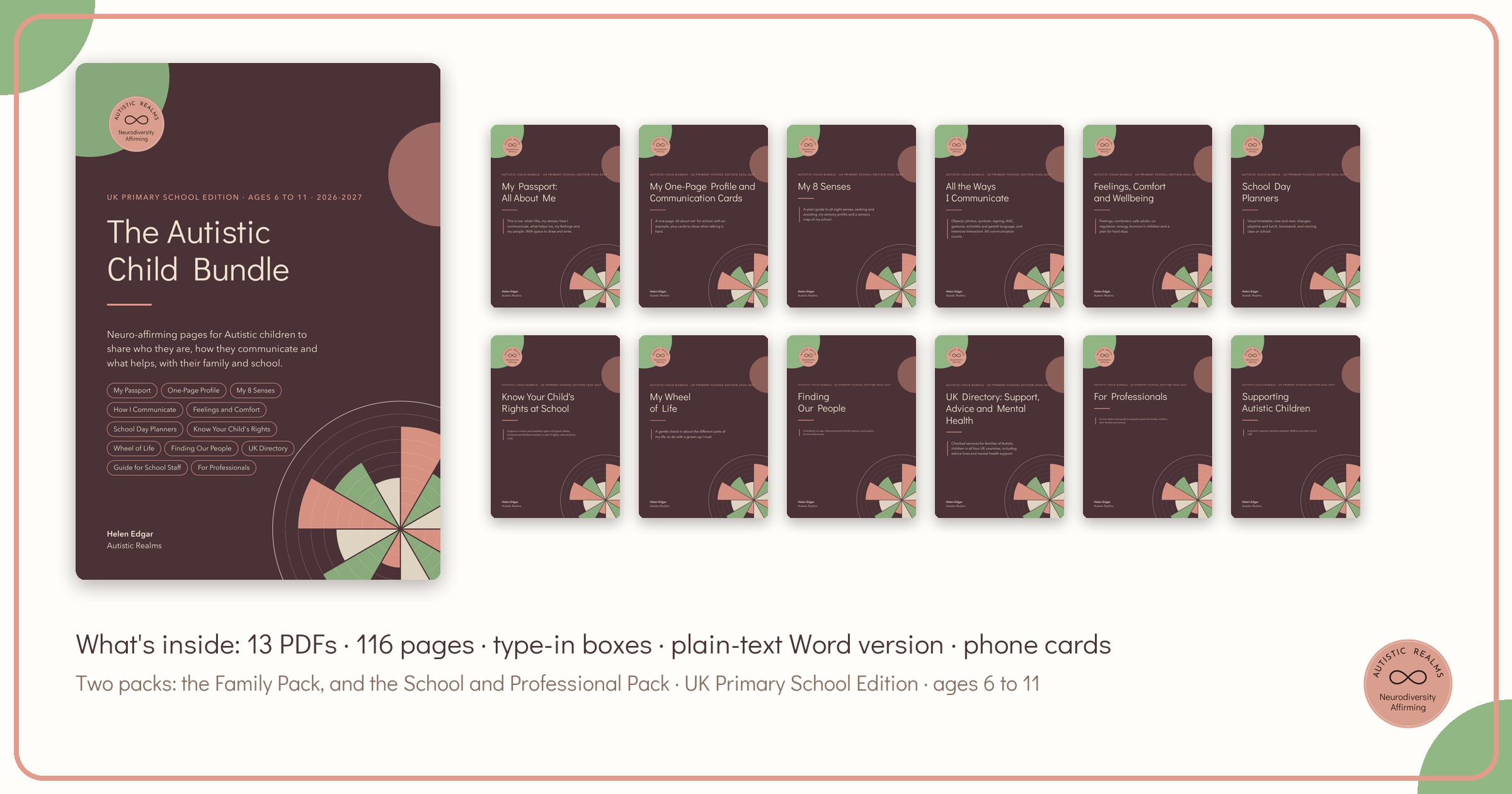
I made the Autistic Child Bundle (UK Primary School Edition 2026-2027) so Autistic children can be understood in their own words. The child’s pages say “I”, with short words, pictures and space to draw. There are 13 PDFs and 116 pages, including My Passport, a one-page profile and communication cards, My 8 Senses, All the Ways I Communicate, Feelings, Comfort and Wellbeing, School Day Planners, Know Your Child’s Rights at School, Finding Our People, a UK Directory, and guides for school staff and professionals.
The Family Pack is for one family, £9.99. The School and Professional Pack comes with a practitioner licence (£49.99 a year) or a site licence for one school (please contact me for prices for a licence for your setting). The checked primary links are free, and there is more in my blog post about the bundle.
Finding your people
Autistic friendships often look different: playing side by side, sharing an interest, or one close friend. Other Autistic children can be easier to be with, because misunderstandings between Autistic and non-Autistic people go both ways (Milton, 2012). Autistic-led groups in the pack include GROVE, Spectrum Gaming, NeuroBears, SWAN and Autistic Parents UK. Contact (0808 808 3555) is a free helpline for parents of disabled children anywhere in the UK.
All the groups, with links, are on the primary school links page.
For school staff and professionals
Thank you for supporting Autistic children. Read the child’s profile and share it with every adult who works with them. Use a picture timetable and warn before changes. Keep AAC with the child all day. Let children move and stim. Never take away playtime, comforters or calming tools, and believe families who say a child is distressed at home. Changes in behaviour can be signs that something is wrong, not “just autism”, so follow your safeguarding policy. The School and Professional Pack works with a practitioner licence or a site licence.
References
- Crenshaw, K. (1989). Demarginalizing the intersection of race and sex: A Black feminist critique of antidiscrimination doctrine, feminist theory and antiracist politics. University of Chicago Legal Forum, 1989(1), Article 8. https://chicagounbound.uchicago.edu/uclf/vol1989/iss1/8/
- Department for Education. (2026). Suspensions and permanent exclusions in England: Academic year 2024/25. Explore Education Statistics
- Gilhuber, C. S., Raulston, T. J., & Galley, K. (2023). Language and communication skills in multilingual children on the autism spectrum: A systematic review. Autism, 27(6), 1516-1531. https://doi.org/10.1177/13623613221147780
- Hutchins, T. L., Knox, S. E., & Fletcher, E. C. (2024). Natural language acquisition and gestalt language processing: A critical analysis of their application to autism and speech language therapy. Autism & Developmental Language Impairments, 9. https://doi.org/10.1177/23969415241249944
- Kenny, L., Hattersley, C., Molins, B., Buckley, C., Povey, C., & Pellicano, E. (2016). Which terms should be used to describe autism? Perspectives from the UK autism community. Autism, 20(4), 442-462. https://doi.org/10.1177/1362361315588200
- Loomes, R., Hull, L., & Mandy, W. P. L. (2017). What is the male-to-female ratio in autism spectrum disorder? A systematic review and meta-analysis. Journal of the American Academy of Child & Adolescent Psychiatry, 56(6), 466-474. https://doi.org/10.1016/j.jaac.2017.03.013
- Milton, D. E. M. (2012). On the ontological status of autism: The “double empathy problem”. Disability & Society, 27(6), 883-887. https://doi.org/10.1080/09687599.2012.710008
- Prizant, B. M., & Duchan, J. F. (1981). The functions of immediate echolalia in autistic children. Journal of Speech and Hearing Disorders, 46(3), 241-249. https://doi.org/10.1044/jshd.4603.241
- Royal College of Speech and Language Therapists. (2024). Augmentative and alternative communication: Position statement. RCSLT.
- Warrier, V., Greenberg, D. M., Weir, E., Buckingham, C., Smith, P., Lai, M.-C., Allison, C., & Baron-Cohen, S. (2020). Elevated rates of autism, other neurodevelopmental and psychiatric diagnoses, and autistic traits in transgender and gender-diverse individuals. Nature Communications, 11, Article 3959. https://doi.org/10.1038/s41467-020-17794-1
What would you add?
If you know Autistic-led groups, research or resources that should be here, especially from people whose voices are often missing, I would love to hear from you.
This guide is for information and self-advocacy. It is not legal or medical advice. Details were checked in November 2026 and can change.