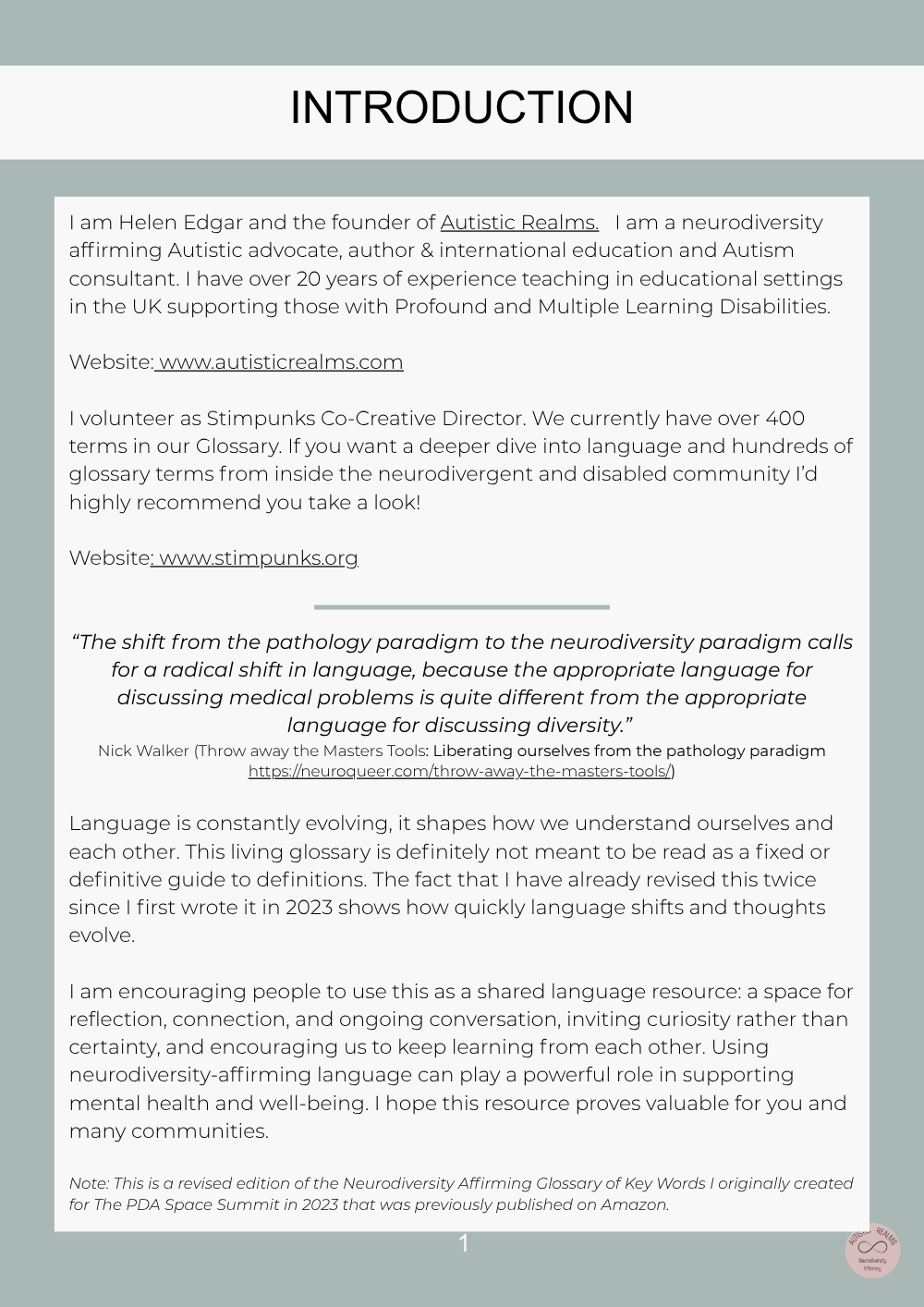
When your child is identified as Autistic, ADHD or PDA, or you begin to wonder about yourself, you walk into a new language overnight. Professionals have to keep up with it too, and get it right in reports and meetings. This glossary is the everyday vocabulary, written plainly from lived experience as an Autistic ADHD adult and parent and twenty years in SEND teaching, and it is neurodiversity-affirming all the way through: nothing here is a deficit. It began as a glossary for The PDA Space Summit in 2023 and has grown since.
This is the Updated 2026 glossary: 191 words and terms, each with its icon from the book. Where there is one, a term links to the guide on this site that goes deeper, and to the same word in the Stimpunks glossary, the biggest shared vocabulary made by neurodivergent people, which I helped to build. For the words of theory and philosophy that More Realms is written in, see its Glossary.
Take the glossary with you
The E-book (Updated 2026)
£9.99
All 191 words and terms with their icons, plus the introduction, neuro-affirming language, abbreviations and signposting. A 45-page A4 PDF.
View in the shop
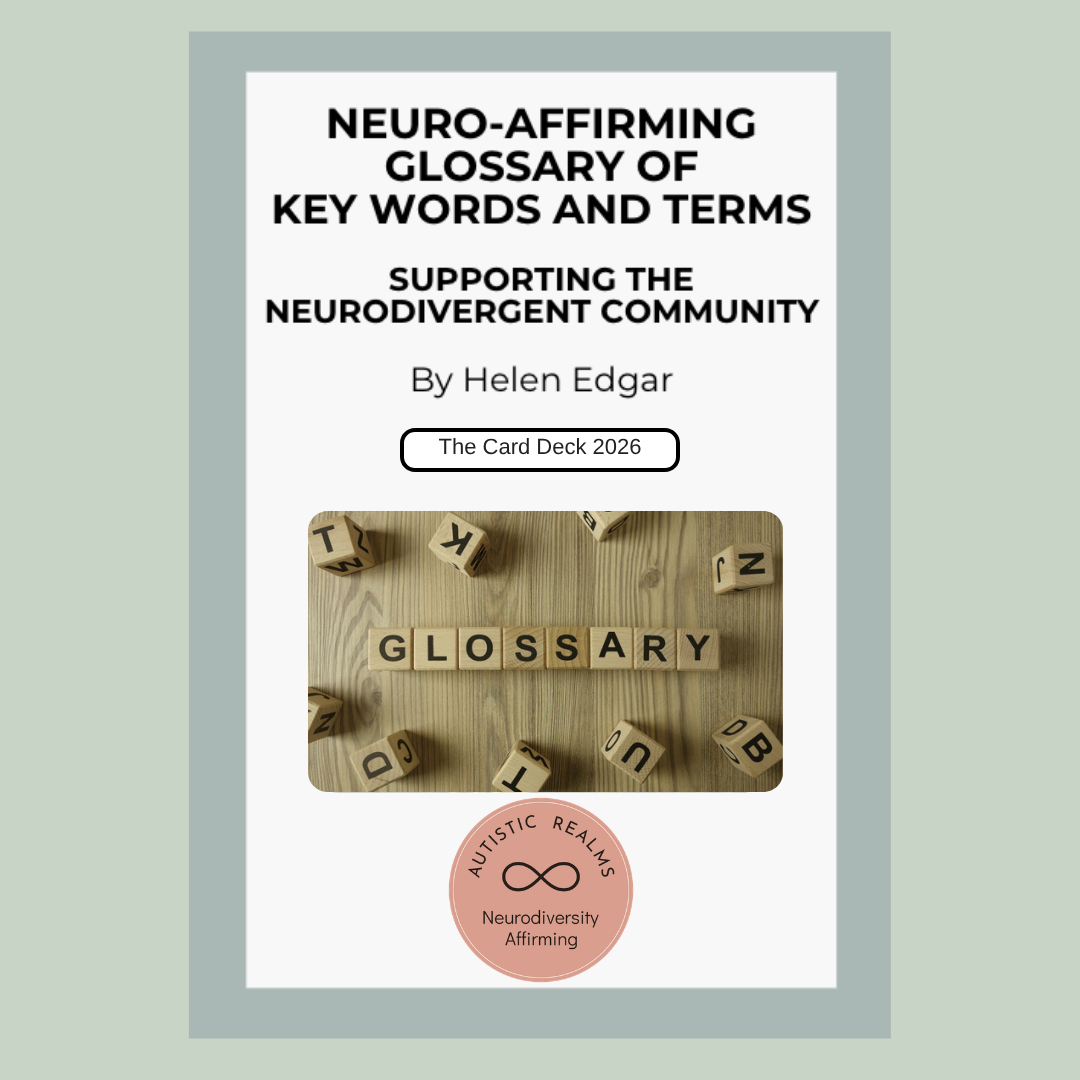
The Card Deck 2026
£9.99
191 square cards, one for every word and term in the book, each with its icon, for teaching, training, reflection and family conversations. Two PDFs for screens (A to N and N to Z) and a print version with 4 cards per A4 page.
View in the shopThe Bundle: E-book and Card Deck
£15
The e-book and the card deck together, including the print version of the cards, for £15 instead of £19.98.
View in the shopLooking for the earlier versions? The 2025 edition e-book and the original Neuro-Affirming Glossary Cards are still in the shop.
Look inside
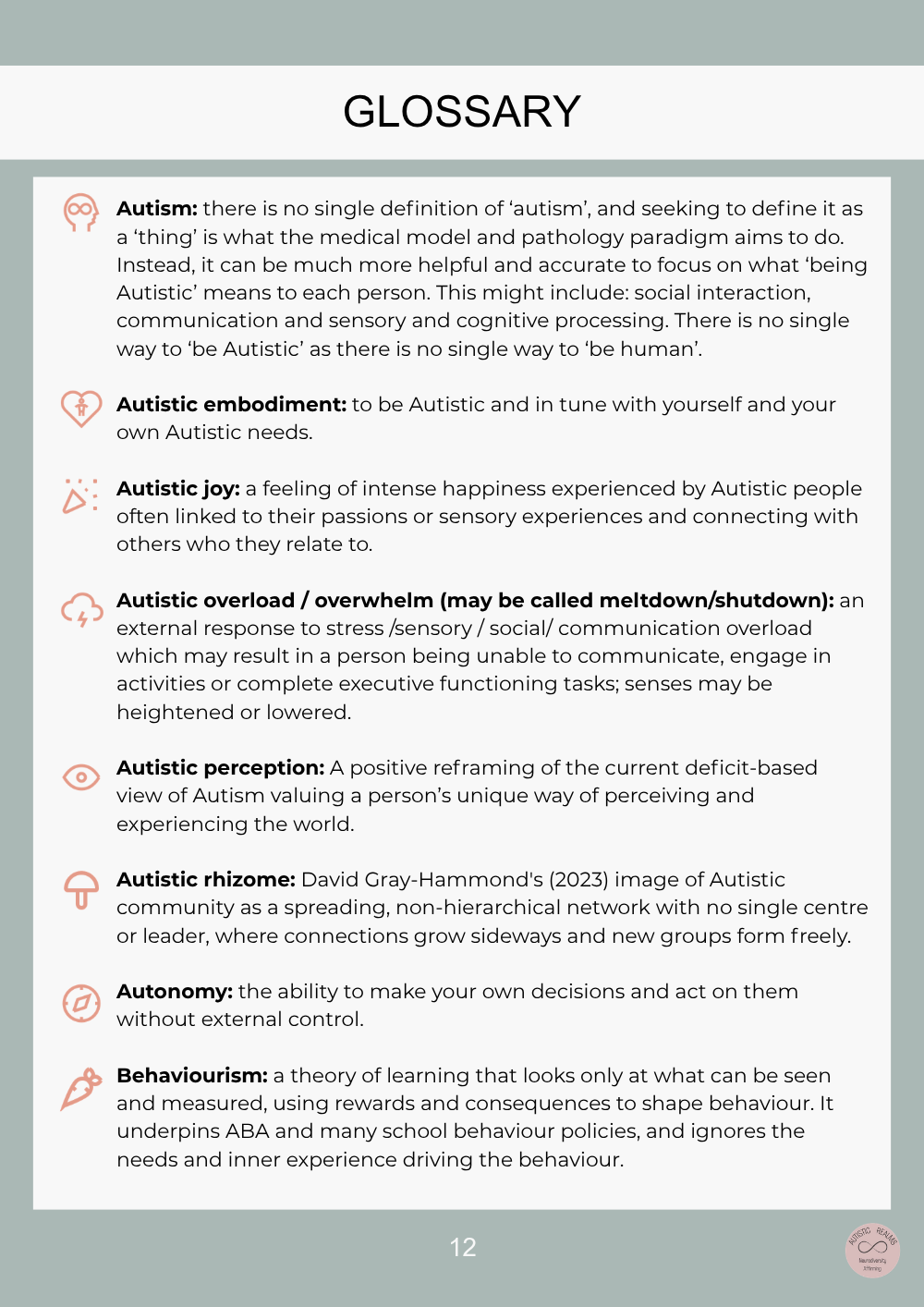
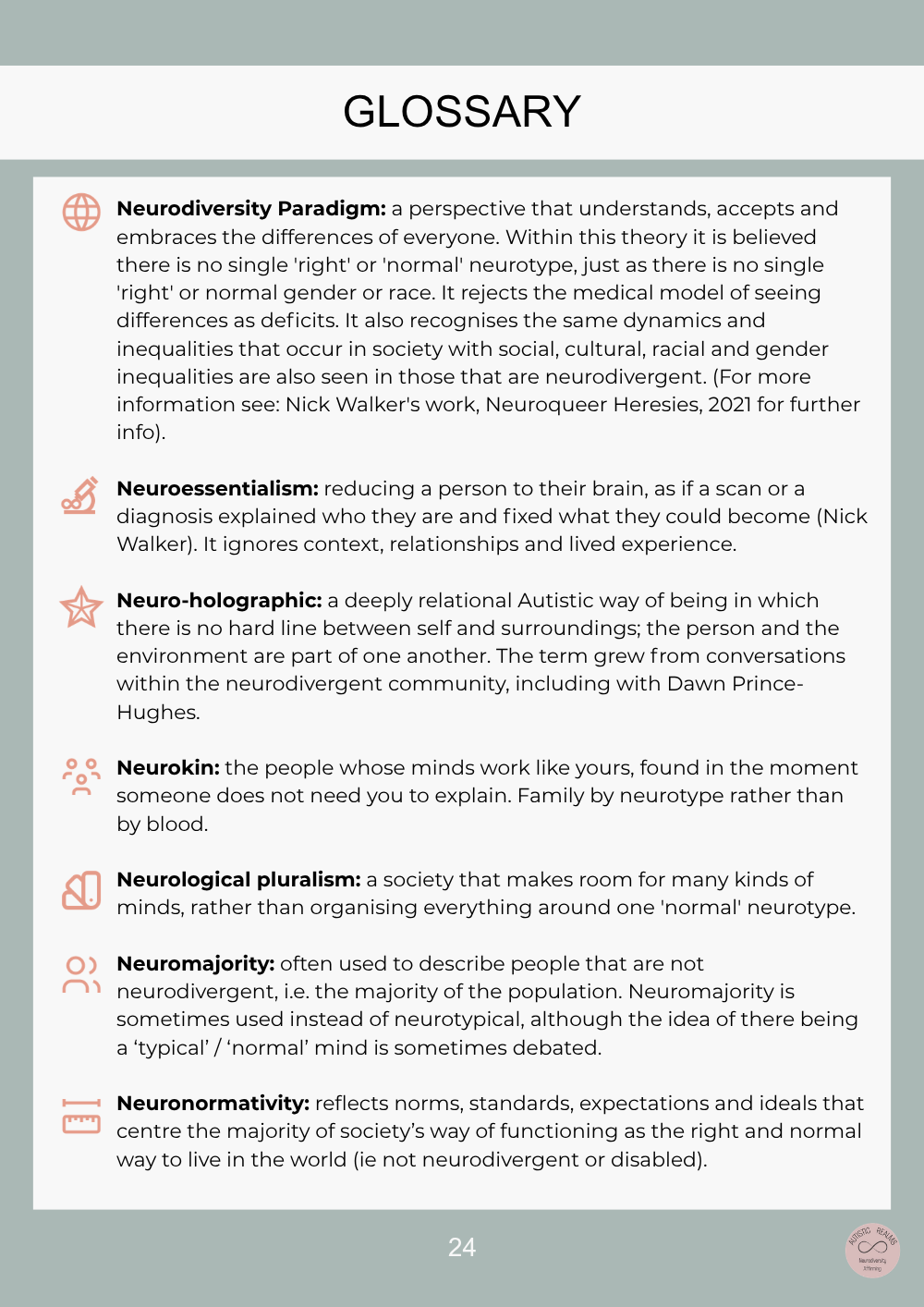
A few pages from the e-book and some cards from the deck. Select an image to see it full size.
The glossary, A to Z
A
Ableism
Discrimination experienced by people who are disabled in favour of those who are more able.
Read more: Standing in solidarity against racism and ableism · Ableism in the Stimpunks glossary
Access intimacy
The ease and relief felt when someone simply understands your access needs, without you having to explain or justify them. Named by disability justice writer Mia Mingus.
Accessibility
The extent to which a place, service or activity can be reached, used and enjoyed by disabled people. Good accessibility is built in from the start, not added later as a favour.
Accommodation
A change to the environment, task or expectations so that a person can take part on equal terms. In UK law these are called reasonable adjustments. The environment changes, not the person.
#ActuallyAutistic
A hashtag and community marker showing that something was made by Autistic people themselves, rather than about them by parents or professionals. It grew as a response to Autistic voices being talked over.
ADHD
Attention Deficit Hyperactivity Disorder – a difference in neurology affecting attention, thinking, processing and impulse.
Read more: Monotropism in ADHD, AuDHD and autism
Affective injustice
When a person’s emotions are dismissed, policed or treated as wrong because of who they are. Autistic distress is often read as ‘behaviour’ rather than a reasonable response to an unfair situation.
Read more: No space is neutral · Affective Injustice in the Stimpunks glossary
Agency
The capacity for people to make their own choices safely.
Alexithymia
Difficulties identifying, understanding and expressing your emotions or those of others.
Read more: Autism, OCD, alexithymia and interoception · Alexithymia in the Stimpunks glossary
Allistic
A person who is not Autistic. An allistic person may still be neurodivergent in other ways (for example ADHD or dyslexic), so ‘allistic’ is not the same as ‘neurotypical’.
Alt text
A short written description of an image so that people using screen readers, or who cannot see the image, still get its meaning. A small act of everyday accessibility.
Alternative and augmentative communication (AAC)
Any way of communicating that adds to or replaces speech, such as letterboards, picture symbols, sign, typing or speech-generating devices. All communication is valid; AAC is not a last resort.
Read more: Total communication · Alternative and Augmentative Communication in the Stimpunks glossary
Anarchism
A political tradition that questions imposed hierarchy and favours free association, mutual aid and shared decision-making. Many neurodivergent communities draw on these ideas when they organise around care rather than control.
Aphantasia
An inability or difficulty to visualise mental images.
Apraxia
Difficulties with motor planning (e.g., gross motor movements to walk / sit and also apraxia of speech).
ARFID
Avoidant/Restrictive Food Intake Disorder, where eating is limited by sensory sensitivity, fear of choking or being sick, or low interest in food, rather than by body image. It is common in Autistic people and needs sensory-informed, not pressured, support.
AuDHD
Used as a label or identity for people who are both Autistic and ADHD.
Read more: Monotropism in ADHD, AuDHD and autism · AuDHD in the Stimpunks glossary
Autism
There is no single definition of ‘autism’, and seeking to define it as a ‘thing’ is what the medical model and pathology paradigm aims to do. Instead, it can be much more helpful and accurate to focus on what ‘being Autistic’ means to each person. This might include: social interaction, communication and sensory and cognitive processing. There is no single way to ‘be Autistic’ as there is no single way to ‘be human’.
Read more: Autistic experiences: questions and answers · Autistic in the Stimpunks glossary
Autistic embodiment
To be Autistic and in tune with yourself and your own Autistic needs.
Autistic joy
A feeling of intense happiness experienced by Autistic people often linked to their passions or sensory experiences and connecting with others who they relate to.
Read more: Glimmers: Autistic joy and monotropism · Autistic Joy in the Stimpunks glossary
Autistic overload / overwhelm (may be called meltdown/shutdown)
An external response to stress /sensory / social/ communication overload which may result in a person being unable to communicate, engage in activities or complete executive functioning tasks; senses may be heightened or lowered.
Autistic perception
A positive reframing of the current deficit-based view of Autism valuing a person’s unique way of perceiving and experiencing the world.
Autistic rhizome
David Gray-Hammond’s (2023) image of Autistic community as a spreading, non-hierarchical network with no single centre or leader, where connections grow sideways and new groups form freely.
Read more: The Autistic rhizome · Autistic Rhizome in the Stimpunks glossary
Autonomy
The ability to make your own decisions and act on them without external control.
B
Behaviourism
A theory of learning that looks only at what can be seen and measured, using rewards and consequences to shape behaviour. It underpins ABA and many school behaviour policies, and ignores the needs and inner experience driving the behaviour.
Read more: Behaviourism: why it is harmful · Behaviorism in the Stimpunks glossary
Belonging
Feeling understood, accepted and valued as you are, without having to perform or explain yourself. Belonging is not the same as being included on condition that you fit in.
Read more: Creating Autistic safety and belonging · Belonging in the Stimpunks glossary
Body Doubling
A strategy used by many neurodivergent people to help maintain focus, flow and give gentle accountability. It involves a person playing or working alongside another at the same or a different task (online or in person).
Read more: Five Autistic love locutions · Body Doubling in the Stimpunks glossary
Body scan
Slowly bringing attention to each part of the body in turn to notice sensations such as tension, hunger or pain. A gentle way to build interoception. Some people find it calming, others uncomfortable, and both are fine.
Bodymind
One word for body and mind together, used because they cannot really be separated (Ken Dychtwald, 1977). What happens in one affects the other, so sensory, emotional and physical needs are all part of the same whole.
Read more: Autistic burnout, bodymind and soul · Bodymind in the Stimpunks glossary
Burnout
A period of intense sensory, social, emotional and physical overwhelm which results in profound exhaustion and difficulties with executive functioning, memory, attention. Burnout impacts energy levels and results in having less resources to regulate sensory input and other external demands. Acute burnout is often the result and accumulation of long periods of unmet needs, masking and a lack of capacity to manage demands. Autistic burnout can lead to anxiety, depression and other mental health difficulties. (More info here: www.autisticrealms.com/guides/burnout/)
Read more: The Autistic burnout hub · Burnout in the Stimpunks glossary
C
Cavendish space
A space designed so that people who are easily overwhelmed can feel safe and do their best thinking, with low sensory load, quiet, choice and no forced interaction. Named by Stimpunks after the scientist Henry Cavendish.
Read more: Reflections from a Cavendish Space workshop · Cavendish Space in the Stimpunks glossary
Caves, campfires and watering holes
Three kinds of learning space described by David Thornburg. Caves for quiet solo work, campfires for listening to someone share, and watering holes for informal exchange. Good environments offer all three and let people choose.
Caves, Campfires, and Watering Holes in the Stimpunks glossary
Challenging behaviour
A deficit term often used to describe the result of unmet needs and great distress.
Read more: Why PBS is harmful
Chosen family
The people you choose to be close to and rely on, whether or not you are related. For many neurodivergent and queer people, chosen family provides the acceptance that birth family could not.
Co-regulation
An embodied presence of togetherness; being with people in a meaningful way helps balance and recharge the sensory system and bodymind. Co-regulation needs trust as a foundation stone. You can’t co-regulate if there is a battle of power dynamics; co-regulating is about being together as humans and connecting at a deeper level, as equals.
Read more: Neurodivergent co-regulation · Co-regulation in the Stimpunks glossary
Cognitive liberty
The right to think, feel and experience the world in your own way, and to decide what happens to your own mind, including the right to refuse interventions aimed at making you more ‘normal’.
Community
People connected by shared experience, identity or purpose who look out for one another. For many Autistic people, finding Autistic community is the first time they feel understood.
Read more: Autistic community: connections and becoming · Community in the Stimpunks glossary
Competency network
The web of people, tools and supports that lets any of us do what we do. Nobody is competent alone. Recognising this makes it easier to ask for and offer support without shame.
Connection
A felt sense of being seen, safe and in tune with another person. Autistic connection may look different (parallel play, shared passions, quiet company) and is just as real.
Read more: Creating belonging and building connection · Connection in the Stimpunks glossary
Created serendipity
Setting up the conditions for happy accidents, such as open time, shared spaces and loose structure, so that useful discoveries and meetings can happen on their own.
D
Disability
Being disabled is not a flaw in a person. People are disabled by barriers in environments, attitudes and systems (see the social model of disability). Many Autistic people are disabled, and ‘disabled’ is not a bad word: it is an identity, a community and a protected characteristic that opens the door to rights and support.
Disability justice
A framework built by disabled people of colour and queer disabled people (including Sins Invalid) that goes beyond rights and access to ask who is still left out. It values interdependence, collective care and the leadership of those most affected.
Read more: Beyond neurodiversity lite · Disability Justice in the Stimpunks glossary
Double Empathy Problem
A concept developed by Damian Milton (2012) that explains the differences in communication and socialisation between Autistic and non-Autistic people. Rather than the previous assumption that Autistic people have no empathy and lack social skills, this concept explains that it is the difference between Autistic and non-Autistic people’s way of communicating and socialising that can cause misunderstandings. Autistic people can, and do communicate well with other Autistic people in their own way. The emphasis is not just on Autistic people to change their communication to be understood by non-Autistic people, rather this goes both ways. The Double Empathy Problem is not restricted to Autistic and non-Autistic people it reflects the difficulties that arise between any differences of lived experience between people (eg race, age, gender).
More: www.tandfonline.com/doi/full/10.1080/09687599.2012.710008
Read more: The double empathy problem: meaning and examples · Double Empathy Problem in the Stimpunks glossary
Dyscalculia
Difficulties related to understanding numbers and difficulties with maths.
Dysgraphia
Difficulties with writing skills, letter formation, can affect spelling and word choice (other fine motor skills may be fine).
Dyslexia
A specific learning disability that means you have significant difficulties with reading, writing and spelling.
Dyspraxia
Differences with balance and coordination, which can also affect the planning and processing of movement. Also called developmental coordination disorder.
E
Echolalia
Repetition of echoing words / sounds back to someone or self.
Read more: Gestalt language processing, monotropism and young people · Echolalia in the Stimpunks glossary
Ehlers-Danlos Syndrome (EDS)
A group of inherited conditions that affect the joints and connective tissues.
Empire of normality
Robert Chapman’s (2023) term for the way capitalism defines a narrow ‘normal’ mind and body, and treats everything else as a problem to fix or a cost to manage.
Energy accounting
Energy accounting is about keeping track of how much energy you have and how much energy different tasks and stressors will use up. Many people like the idea of Miserandino’s Spoon Theory to support energy accounting.
More: butyoudontlooksick.com/articles/written-by-christine/the-spoon-theory
Read more: Spoon theory and autism
Epistemic injustice
Being wronged as a knower (Miranda Fricker, 2007). It covers being disbelieved because of who you are, and lacking the shared words to make sense of your own experience. Autistic people face both.
Read more: The neuronormative paradigm · Epistemic Injustice in the Stimpunks glossary
Epistemic pluralism
Accepting that there are many valid ways of knowing and making sense of the world, not just one. Autistic ways of thinking count as knowledge, not as errors.
Equity
Giving people what they each need to take part fully, which is not the same as giving everyone the same thing. Equality is one size for all; equity fits the support to the person.
Ethodivergence
Ways of being and behaving that depart from what is expected of a species, a culture or a group (Ombre Tarragnat, 2025). It widens neurodivergence from the mind to the whole way a creature lives.
Read more: Ethodivergent hearth building · Ethodivergence in the Stimpunks glossary
Ethodiversity
The natural variety of ways of behaving and living among humans and other animals (Ombre Tarragnat, 2025), in the same way that neurodiversity is the natural variety of minds.
Read more: Mossy minds and monotropism · Ethodiversity in the Stimpunks glossary
Executive functioning
Skills that include the ability to manage yourself, multitask, plan, organise and carry out tasks to achieve an intended outcome, these can be impacted by other demands, energy, capacity and flow.
Read more: Spoon theory and autism · Executive Function in the Stimpunks glossary
F
Fawn
A stress response alongside fight, flight and freeze (Pete Walker), where a person tries to stay safe by pleasing, appeasing and going along with others. Masking is often a form of fawning.
Flow states
A deep immersive state of sensory or cognitive engagement, often linked to monotropism. However, everyone benefits from positive flow states to help them regulate and focus. Some flow states may not always be positive and can be distressing loops of ruminating thoughts.
Read more: Monotropic flow state · Flow in the Stimpunks glossary
Functioning labels
Calling someone ‘high functioning’ or ‘low functioning’. The Autistic community rejects these labels because they hide support needs in some people and dismiss strengths and autonomy in others. Needs change with the day and the environment.
G
Gestalt language processing
Learning language in whole chunks, a line from a film or a phrase an adult uses, before breaking it into single words. Many Autistic children learn to talk this way. Echolalia and scripting are part of it, not a sign of ‘no communication’.
Read more: Gestalt language processing, monotropism and young people
Glimmers
The opposite of triggers, moments, things and experiences that bring joy, a smile and offer a ray of hope in a day.
Read more: What are glimmers? · Glimmers in the Stimpunks glossary
H
Hearing voices
Hearing voices that others do not. The Hearing Voices movement treats this as a meaningful human experience to be understood and lived with, not only a symptom to be silenced.
Hyperfocus
Attention locked all the way into one thing for hours. In monotropic terms it is the attention tunnel at full depth. It can be joyful and restorative, or exhausting when anxiety drives it.
Read more: The monotropism guide
Hyperlexia
Deep fascination with letters and words, accompanied by reading far earlier than peers. Reading skills may far exceed comprehension skills.
Hypermobility Spectrum Disorder (HSD)
A group of conditions related to joint hypermobility (JH).
Hypersensitivity
A more intense / heightened response to sensory stimuli, to the point it could feel very uncomfortable or even painful (e.g., light / sound / taste / touch /smell / movement/pain).
Hyposensitivity
A lower response to sensory stimuli, may be unaware of pain or not as responsive as you may expect (e.g., light / sound / taste / touch /smell / movement/pain).
I
Identity first language
This means putting a person’s identity first. For example, using identity first language, you would use the term ‘Autistic person’ (not ‘person with Autism’ which is person first language). Identity first language is often considered preferable in the Autistic community, but it is always good to ask someone how they prefer to identify and respect their choice.
Read more: Neuro-affirming language · Identity First Language in the Stimpunks glossary
Imposter syndrome
Feeling like a fraud who will be found out, despite evidence of ability. It is common in people who have spent years being told that their way of doing things is wrong.
Read more: Masking, internalised ableism and imposter syndrome · Imposter Syndrome in the Stimpunks glossary
Infodumping
A term often used to describe an Autistic person sharing their deep knowledge and enthusiasm of their special interests, often involving communicating on a single topic for long periods of time.
Read more: Five Autistic love locutions · Infodump in the Stimpunks glossary
Intensive interaction
An approach to connecting with people who communicate without words, by joining in with their sounds, movements and rhythms and letting them lead. It builds trust and communication on their terms.
Read more: Intensive Interaction as relational practice · Intensive Interaction in the Stimpunks glossary
Interdependence
Mutual dependence that may be sensory, cognitive, or social. All humans are interdependent. Interdependence is valid and it is not always appropriate to strive for independence.
Internalised ableism
Turning society’s messages about disability inward and believing you are lazy, broken or too much. Masking teaches it. Unmasking, community and being understood slowly undo it.
Read more: Masking, internalised ableism and imposter syndrome · Internalized Ableism in the Stimpunks glossary
Interoception
Relates to a person’s ability to understand and interpret internal body signals and sensations. If you have difficulties with interoceptive awareness then you may not understand your body signals to know if you are hungry, thirsty, hot, cold, tired, need the toilet or if you are in pain. (further info: see work of Kelly Mahler)
More: www.kelly-mahler.com
Read more: Autism, OCD, alexithymia and interoception · Interoception in the Stimpunks glossary
Intersectionality
Coined by Kimberlé Crenshaw (1989), the term intersectionality conceptualises how an individual’s various identities ‘intersect’ to create unique experiences of oppression or privilege and power eg race/ age/ sex/ gender/ disability.
Read more: Standing in solidarity against racism and ableism · Intersectionality in the Stimpunks glossary
Intrinsic motivation
Doing something because it matters to you or interests you, not for a reward or to avoid a consequence. Autistic learning and passions run on intrinsic motivation; reward charts can kill it.
K
Kinetic cognitive style
Nick Walker’s alternative name for ADHD, describing a mind that works best in motion, with attention that moves fast and finds patterns across subjects, rather than a deficit of attention.
L
Learning Disabilities
Cognitive/ intellectual disabilities that mean a person may need more support to understand and interpret information, have difficulties learning specific skills, expressing themselves, and/or performing daily living tasks.
Read more: Beyond "complex needs"
Limerence
An intense, involuntary preoccupation with another person and a longing for them to feel the same (Dorothy Tennov). It can be overwhelming for people who feel things deeply and may be mistaken for a special interest.
Read more: Monotropism, limerence and Autistic ADHD experiences · Limerence in the Stimpunks glossary
Low demand
A style of interaction (parenting or professional) where you intentionally decrease demands and try to provide an environment that will help reduce stress and anxiety (this includes a low demand use of language and ways of interacting).
Read more: Low-demand parenting
M
Masking
The act of consciously or unconsciously suppressing one’s authentic Autistic identity and needs in an attempt to fit into the social norms of the people around you. Over a long period of time masking is detrimental to mental health. It is important to acknowledge that many Autistic people have to mask for safety for lots of reasons in many situations. Unmasking is not always an easy or safe option.
Read more: Masking, internalised ableism and imposter syndrome · Masking in the Stimpunks glossary
Meerkat mode
A state of heightened alertness and scanning for threat, standing watch like a meerkat, often seen in PDA Autistic people when demands or uncertainty build up. A nervous system response, not defiance (Tanya Adkin, 2023).
Read more: The Map of Monotropic Experiences · Meerkat Mode in the Stimpunks glossary
Meltdowns
State of high distress caused by Autistic people not having enough capacity to manage, often due to unmet needs in environment, which may result in an Autistic person needing an outlet to help them regulate again. Meltdowns are an external expression of a shutdown.
Minority stress
The extra, ongoing stress of living as a stigmatised minority: expecting rejection, hiding who you are and dealing with discrimination (Meyer, 2003). It helps explain the high rates of anxiety and depression among Autistic people, which are not caused by autism itself.
Read more: No space is neutral · Minority Stress in the Stimpunks glossary
Misophonia
A hyper sensitivity to sound stimuli (e.g., hearing someone eating may feel painful).
Monotropic inertia
The difficulty of starting, stopping or switching when attention is deeply pulled into one thing. Getting going can be as hard as letting go.
Read more: The Map of Monotropic Experiences · Monotropic Inertia in the Stimpunks glossary
Monotropic spiral
When an attention tunnel feeds on itself, looping round the same thoughts or worries with growing intensity until it is hard to climb out (Tanya Adkin, 2023). Rest, movement or a trusted person can help break the loop.
Read more: Monotropic interests and looping thoughts · Monotropic Spiral in the Stimpunks glossary
Monotropic split
The strain of being forced to hold attention in more than one place at once, as monotropic people often are at school and work. Over time it drains energy and leads towards burnout (Tanya Adkin, 2023).
Read more: The Map of Monotropic Experiences · Monotropic Split in the Stimpunks glossary
Monotropic Time
When an Autistic/ADHD/AuDHD person is engaged in a deep flow state and loses sense of neuro-normative time.
Read more: Monotropic time · Monotropic Time in the Stimpunks glossary
Monotropism
A neuro-affirming theory of Autism. Autistic /ADHD/ AuDHD people are more likely to be monotropic (Garau et al., 2023). “Monotropic people have an interest-based nervous system. This means they focus more of their attention resources on fewer things at any one time compared to other people who may be polytropic. Things outside an attention tunnel may get missed, and moving between attention tunnels can be difficult and take a lot of energy. Monotropism can have a positive and negative impact on sensory, social and communication needs depending on the environment, support provided and how a person manages their mind and body”. (Community Definition of Monotropism collated by Helen Edgar, 2024) (For further information see: Monotropism.org & Monotropism Resources & signposting on Autistic Realms)
Read more: The monotropism guide · Monotropism in the Stimpunks glossary
Mutual aid
People in a community meeting one another’s needs directly, giving and receiving as equals, rather than waiting on charity or services. Neurodivergent communities run on it.
Read more: Weird pride in a hostile world · Mutual Aid in the Stimpunks glossary
N
Neuro-affirming
Putting the neurodiversity paradigm into practice by starting from needs rather than behaviour, respecting identity, language and autonomy, and never trying to make someone look more typical.
Read more: Avoiding the harm of neurodiversity-lite · Neuroaffirming in the Stimpunks glossary
Neuro-holographic
A deeply relational Autistic way of being in which there is no hard line between self and surroundings; the person and the environment are part of one another. The term grew from conversations within the neurodivergent community, including with Dawn Prince-Hughes.
Read more: Neuro-holographic thoughts · Neuro-Holographic in the Stimpunks glossary
Neurobiology
Connections between the brain, body and sensory systems.
Neuroception
Stephen Porges’s term for the way the nervous system senses safety or danger beneath conscious awareness. Autistic nervous systems may read environments as unsafe that others find neutral, which shapes behaviour before any choice is made.
Neurocosmopolitanism
Nick Walker’s term for a stance that welcomes the whole range of human minds, approaching neurological difference with the curiosity and respect a good traveller brings to other cultures.
Neurodivergent
An individual is ‘neurodivergent’ if they diverge from the dominant societal standards of ‘normal’ (Asasumasu, 2000s; Walker, 2021). Some people may describe themselves as multiply neurodivergent, e.g., Autistic, ADHD and OCD. The term ‘neurodivergent’ was never intended to be anything other than a value-neutral term. It is important it is not used as a synonym for Autistic / ADHD.
Read more: What does neurodivergent mean? · Neurodivergent in the Stimpunks glossary
Neurodiverse
The world and society is ‘neurodiverse’ as everyone is different; an individual cannot be. An individual who differs from the majority of norms can be described as neurodivergent.
Neurodiversity
Neurodiversity is natural and valuable. When we use the term ‘neurodiversity’, we refer to the diversity of human brains and minds and recognises everybody’s differences in a value-neutral way: “diversity of human minds, the infinite variation in neurocognitive functioning within our species”. Neurodiversity itself is just a biological fact! (Walker, 2021).
Read more about the origin of neurodiversity as a concept: The neurodiversity concept was developed collectively. An overdue correction on the origins of neurodiversity theory: Monique Botha, Robert Chapman, Morénike Giwa Onaiwu, Steven K Kapp, Abs Stannard Ashley, Nick Walker, (2024). Walker, 2014: https://neuroqueer.com/neurodiversity-terms-and-definitions and work by Lived Experience Educator, Sonny Jane Wise.
More: journals.sagepub.com/doi/10.1177/13623613241237871
Read more: What does neurodivergent mean? · Neurodiversity in the Stimpunks glossary
Neurodiversity infinity symbol
The rainbow (or gold) infinity loop used by the neurodiversity movement to show the endless variety of human minds, first used by Aspies For Freedom on Autistic Pride Day in 2005. It replaces the puzzle piece, which many Autistic people reject.
Read more: The neurodiversity infinity symbol · Neurodiversity Infinity Symbol in the Stimpunks glossary
Neurodiversity Movement
Social justice movement driving forward the ethos of the neurodiversity paradigm.
Read more: Beyond neurodiversity lite
Neurodiversity Paradigm
A perspective that understands, accepts and embraces the differences of everyone. Within this theory it is believed there is no single ‘right’ or ‘normal’ neurotype, just as there is no single ‘right’ or normal gender or race. It rejects the medical model of seeing differences as deficits. It also recognises the same dynamics and inequalities that occur in society with social, cultural, racial and gender inequalities are also seen in those that are neurodivergent. (For more information see: Nick Walker’s work, Neuroqueer Heresies, 2021 for further info).
Read more: Beyond neurodiversity lite
Neuroessentialism
Reducing a person to their brain, as if a scan or a diagnosis explained who they are and fixed what they could become (Nick Walker). It ignores context, relationships and lived experience.
Neurokin
The people whose minds work like yours, found in the moment someone does not need you to explain. Family by neurotype rather than by blood.
Neurological pluralism
A society that makes room for many kinds of minds, rather than organising everything around one ‘normal’ neurotype.
Neuromajority
Often used to describe people that are not neurodivergent, i.e. the majority of the population. Neuromajority is sometimes used instead of neurotypical, although the idea of there being a ‘typical’ / ‘normal’ mind is sometimes debated.
Neuronormativity
Reflects norms, standards, expectations and ideals that centre the majority of society’s way of functioning as the right and normal way to live in the world (ie not neurodivergent or disabled).
Read more: The neuronormative paradigm · Neuronormativity in the Stimpunks glossary
Neuroqueer
Theory developed by Nick Walker. To neuroqueer is to liberate yourself by subverting neuronormative and heteronormative expectations. You can engage in neuroqueer practice and also be neuroqueer. It is both a verb and an adjective. (Further info see Nick Walker’s work: https://neuroqueer.com/neuroqueer-an-introduction/)
Read more: What would a neuroqueer pedagogy be? · Neuroqueer in the Stimpunks glossary
Neurosupremacy
The belief, stated or assumed, that some neurotypes or some neurodivergent people are better than others, and policing who counts. It can show up inside the neurodivergent community as well as outside it.
Neurotype
A kind of mind. Autistic, ADHD, dyslexic and non-Autistic are all neurotypes; none of them is the default.
Neurotypical
A person whose neurotype fits what society treats as standard. Neurotypical is one neurotype among many, not the norm that everyone else falls short of.
Niche construction
The way living things shape their environment to suit themselves, like beavers building dams. Autistic people do it too, by building routines, spaces and relationships that fit how they work. Support should help people build their niche, not stop them (Thomas Armstrong).
Nonspeaking
A person who does not use speech to communicate, some or all of the time. Nonspeaking is not the same as having nothing to say; many nonspeaking Autistic people communicate richly through typing, letterboards, AAC and the body. Preferred over ‘nonverbal’.
Normal
A statistical average that has been turned into a standard to live up to. Nobody is normal in every way, and treating ‘normal’ as the goal is where much of the harm done to neurodivergent people begins.
O
Obsessive Compulsive Disorder (OCD)
A neurodivergence where a person experiences intrusive obsessive thoughts that trigger compulsions to try and relieve the anxiety caused.
Read more: Monotropism, autism and OCD
Open source
Making the workings of something freely available for anyone to use, learn from and improve. The same spirit of sharing knowledge openly runs through much neurodivergent community work.
P
Parallel play
Being alongside someone, each doing your own thing, with no pressure to interact. It is a valid and often preferred form of Autistic connection at any age, not a stage to grow out of.
Read more: Shared flow · Parallel Play in the Stimpunks glossary
Passions
(also referred to as special interests), an all consuming deep interest that an Autistic or ADHD person may have about a certain topic, activity or sensory experience. Passions can bring great joy and create a monotropic flow state (single channel of thought, which is a natural state for an Autistic bodymind). Engaging in passions/ special interests (SpIns) provides opportunities for Autistic people to regulate, gain deep knowledge or skills in a certain activity / topic and can be a good opportunity to socialise and communicate with others that may share the same passion.
Read more: Monotropism and Autistic play · Special Interest in the Stimpunks glossary
Pathology lite
Using neurodiversity language on the surface while still treating difference as a disorder to be managed. The words change; the deficit thinking does not.
Pathology paradigm
The view that there is one right way for a mind to work, and that any difference from it is a disorder to be diagnosed and treated. Nick Walker contrasts it with the neurodiversity paradigm.
Read more: Beyond the pathology paradigm · Pathology Paradigm in the Stimpunks glossary
PDA
Pathological Demand Avoidance or some prefer Pervasive Drive for Autonomy (coined by Tomlin Wildling), PDA is widely understood to be a profile of Autism, “involving the avoidance of everyday demands and the use of social strategies as part of this avoidance. PDA individuals share Autistic characteristics and also have many of the ‘key features’ of a PDA profile”. (PDA Society definition).
More: www.pdasociety.org.uk
Read more: The PDA Space · Demand Avoidance in the Stimpunks glossary
Peer support
Support from people who share your experience, offered as equals. Autistic-led peer support is often more helpful than professional support because nothing has to be explained first.
Penguin Pebbling
Gifts and acts of kindness shared between people based on their interests (eg. I saw this meme or I found this pebble and thought of you).
Read more: Penguin pebbling · Penguin Pebbling in the Stimpunks glossary
Performative neurodiversity (neurodiversity lite)
Using the language and symbols of neurodiversity for appearance, in marketing or awareness campaigns, without changing practice or sharing power with neurodivergent people (Shain M. Neumeier, 2018).
Read more: Avoiding the harm of neurodiversity-lite · Performative Neurodiversity (Neurodiversity Lite) in the Stimpunks glossary
Pluralism
Recognising that many different ways of being, thinking and living can coexist, engaging with difference rather than merely tolerating it, and not imposing one way on everyone.
Polyvagal theory
Stephen Porges’s model of how the nervous system shifts between states of safety and connection, mobilisation (fight or flight) and shutdown. It helps explain why felt safety must come before learning or communication.
Posthumanism
A way of thinking that questions the idea of a single ‘ideal human’ against whom everyone is measured, and sees people as entangled with their environments, tools and each other.
Privilege
Unearned advantages that come from fitting what society is built for. Neurotypical privilege includes never having to mask, explain yourself, or fight for your needs to be taken seriously.
Problem behaviour
A label placed on a person’s actions by those who find them inconvenient. Looking for the problem in the environment or the unmet need, rather than in the person, changes everything.
Read more: Why PBS is harmful · Problem Behavior in the Stimpunks glossary
Processing time
The time a person needs to take in information, make sense of it and respond. Autistic people often need longer, especially under stress. Waiting, without repeating or rephrasing, is a powerful accommodation.
Progressive education
Approaches to education that start from the learner’s interests and curiosity, value doing over drilling, and treat children as people now rather than adults in waiting.
Proprioception
Also called kinaesthesia, is the body’s ability to sense and understand its location, movements, and actions.
Psychological safety
Feeling safe enough to speak up, ask questions, make mistakes and be yourself without fear of being shamed or punished (Amy Edmondson). It is the foundation of any space where neurodivergent people can thrive.
Read more: No space is neutral · Psychological Safety in the Stimpunks glossary
Puzzle
The puzzle piece symbol for autism, which many Autistic people reject because it suggests they are a mystery to be solved or a missing piece. The infinity symbol is the community’s preferred alternative.
Q
Queer
A reclaimed word for identities outside the expected norms of gender and sexuality, and a way of questioning norms themselves. Many Autistic people are queer, and the two communities share a long history of self-definition.
R
Rejection Sensitive Dysphoria (RSD)
Refers to an intense emotional response related to actual or perceived rejection and heightened sensitivity to criticism or any negative reaction from people due to past traumatic experiences.
Resilience
Often used to tell marginalised people to cope better with harm. Real resilience grows from safe relationships, rest and environments that fit, not from being expected to endure.
Read more: Radical resilience · Resilience in the Stimpunks glossary
Rumination
Going over the same thoughts, worries or past events again and again. It is common in Autistic and ADHD people and is often fed by uncertainty, rejection or unresolved social confusion.
Read more: Monotropic interests and looping thoughts · Rumination in the Stimpunks glossary
S
Safe food
A food that a person can reliably eat and that feels predictable in taste, texture and smell. Safe foods keep people nourished through stress and overwhelm, and should be respected, not challenged.
Read more: Being Autistic and eating · Safe Food in the Stimpunks glossary
Safe space
A place or environment where individuals can freely express their identity and where their needs are met (including sensory needs and psychological safety) without fear of discrimination or harm, providing a place where a person gains a sense of comfort, security, and acceptance as their authentic self.
Read more: No space is neutral · Safe Space in the Stimpunks glossary
Samefood
Eating the same food, or the same few foods, over and over. It is a sensory and regulation preference, not fussiness, and it often changes on its own over time.
Read more: Being Autistic and eating · Samefood in the Stimpunks glossary
School-induced anxiety
Anxiety caused by the school environment itself: its sensory load, demands, social pressure and lack of autonomy. The problem lies in the setting, not the child, which is why ‘school refusal’ is a misleading label.
Read more: Supporting students struggling to attend school · School-Induced Anxiety in the Stimpunks glossary
Scientism
Treating a narrow idea of scientific measurement as the only valid knowledge, while dismissing lived experience. It is how Autistic people’s own accounts get overruled by checklists.
Scripting
This can be a form of masking to try and fit into a social group. However, rehearsing, practising and preparing what to say in advance of a social situation can also be helpful to reduce anxiety.
Self-care
Meeting your own needs for rest, regulation, nourishment and joy. For neurodivergent people it often looks different from the advertised version: stimming, special interests, saying no and being alone can all be self-care.
Self-determination theory
A well-evidenced theory of motivation (Deci and Ryan) which says that people thrive when three needs are met: autonomy, competence and relatedness. Compliance-based approaches undermine all three.
Self-identification
Recognising yourself as Autistic without a formal diagnosis. Diagnosis is a gateway to some support, not a test of whether you are Autistic. Self-identification is valid.
Read more: Think you or your child might be Autistic?
Self-injurious stimming
Stimming that causes harm, such as hitting or biting oneself, usually a sign of extreme overwhelm, pain or unmet need. The answer is to reduce the distress and offer safer sensory input, not to punish the stim.
Sensory avoidance
Intentionally withdrawing from sensory experiences that don’t make a person feel good or gives them discomfort/pain.
Read more: Building a family sensory toolkit
Sensory diet
An occupational therapist may create a ‘sensory diet’ which is an individual programme of ideas and activities to help regulate an individual’s sensory system depending on their needs.
Read more: Building a family sensory toolkit
Sensory processing
An individual’s way of perceiving, interpreting and responding to a wide range of sensory experiences, signals and stimuli.
Sensory seeking
Intentionally searching and engaging in sensory experiences that help make a person feel good and balance their sensory system eg different type of movements, sounds, tastes, textures, sights etc.
Read more: Building a family sensory toolkit
Sensory sensitivity
Depending on an individual’s response to sensory stimuli at the time some senses may be heightened and make the person feel discomfort or pain, this could cause some people to avoid certain situations and stimuli (e.g., sounds may be louder / certain textures may feel painful etc).
Sensory / Social overload/ overwhelm
(sometimes referred to as a meltdown/shutdown), a response to experiencing more social/sensory input than a person can manage. If an Autistic person is experiencing overwhelm, they will need time to rest, regulate and recover in a way that is right and meaningful for them.
Sensory trauma
The lasting harm done by repeated sensory overwhelm with no escape, such as years in a loud classroom (a term from Autism Wellbeing). The body learns that the environment is unsafe.
Shutdown
A response to stress, sensory, social, or communication overload that may result in an Autistic person’s inability to communicate, engage in activities, or complete executive functioning tasks; the senses may be heightened or lowered. Often described as being like an internal meltdown. A shutdown state may also follow a meltdown. There may be no set pattern.
Situational mutism
A person’s inability to produce speech in certain contexts.
Solarpunk
A hopeful vision of the future where technology, community and nature work together, in contrast to dystopian futures. Stimpunks draw on it as an image of a world built for everyone, at a human pace.
Space holder
A person who holds space for others, being present, steady and non-judgemental so that someone can feel, process and be themselves safely (Kay Aldred, 2023).
Special interest
A deep, focused and joyful interest that an Autistic person returns to for regulation, learning and connection. Many prefer ‘passion’ because ‘special’ can sound patronising.
Read more: Monotropism and Autistic play · Special Interest in the Stimpunks glossary
Special needs
A phrase many disabled people reject. Needs are not special; they are human needs that go unmet in environments designed for a narrow range of people. Say ‘support needs’, or name the need.
Spiky profile
Having strengths and support needs that sit far apart. A person can be exceptional at one thing and need a lot of help with another. Averages hide this; good support does not.
Read more: Neuroqueering the spiky profile · Spiky Profile in the Stimpunks glossary
SpInfodump
Sharing a special interest (SpIn) in a joyful outpouring of detail. It is a form of connection and trust, and being on the receiving end is a gift.
Read more: Five Autistic love locutions · SpInfodump in the Stimpunks glossary
Spoon theory
Christine Miserandino’s way of describing limited daily energy as a handful of spoons. Every task costs spoons, and when they are gone, they are gone. It helps explain why ‘small’ things can be too much.
Read more: Spoon theory and autism · Spoon Theory in the Stimpunks glossary
Stigma
Shame and disapproval attached to a difference by society, so that people hide who they are. Stigma, not the difference itself, causes much of the harm Autistic people experience.
Read more: No space is neutral · Stigma in the Stimpunks glossary
Stim listening
Listening to the same song, sound or phrase over and over for regulation and joy (Jim Irion). An auditory stim, not a habit to break.
Stim-watching
Watching the same clip, scene or movement repeatedly for comfort and regulation, such as replaying a favourite video (Jim Irion). A visual stim.
Stimming
Repetitive behaviours, movements and activities that help to regulate the mind and body can bring a sense of joy and a flow state.
Read more: Stimming as embodied sensory language · Stimming in the Stimpunks glossary
Synaesthesia
Describes the mixing or overlapping of the senses (e.g., sound to colour). It is complex and there are many forms of synaesthesia.
T
Theory of mind
The claim that Autistic people cannot imagine other people’s minds. It has been challenged by research and by Autistic people themselves; the double empathy problem shows that understanding breaks down in both directions.
Tics
Repetitive muscle movements that result in sudden movements, body jolts or vocalisations.
Time processing difficulties
Often associated with ADHD where a person has difficulty processing and understanding the passing of normal clock time.
Tourette's Syndrome
Causes a person to make involuntary sounds and movements called tics (some people may also experience internal tics).
Transition
A change from one activity to the next, or from one environment to another.
Read more: Supporting young people through transitions
Trauma
The lasting imprint of experiences that overwhelmed a person’s ability to cope. For many Autistic people, trauma comes from everyday life: sensory overload, masking, bullying and being misunderstood.
Trauma-Informed Approach
The purpose of trauma-informed practice is not to treat trauma-related difficulties, which is the role of trauma-specialist services. It is about addressing the barriers that people may experience when accessing education, health and care services and meeting their needs. “Asking ’What does this person need’? rather than ‘What is wrong with this person’?.”
More: www.gov.uk/government/publications/working-definition-of-trauma-informed-practice/working-definition-of-trauma-informed-practice
Triple empathy problem
An extension of the double empathy problem to healthcare (Shaw and colleagues, 2023), where the gap between Autistic patients and non-Autistic clinicians is widened again by medical culture and language.
Trust
The felt sense that a person or place is safe, reliable and on your side. For many Autistic people trust is earned slowly and lost quickly; honesty and consistency build it.
U
Universal design for learning (UDL)
Planning teaching so that it works for the widest range of learners from the start, by offering many ways to take in information, show learning and stay engaged. It removes the need for most individual adjustments.
Unmasking
The slow, uneven work of letting the natural self back out: stimming, speaking and moving as you are. It is only safe in places and relationships that will hold it.
Unmet needs
Needs that are not being met in the current environment, such as safety, rest, sensory regulation, autonomy or connection. Most distressed behaviour is a signal of an unmet need.
V
Values
What matters most to a person and guides their choices. Starting from a person’s values, rather than from what others want them to do, is the basis of respectful support.
Vestibular
Part of the sensory system that helps people orientate their body in space and supports balance.
W
Weird
A word many neurodivergent people reclaim with pride. Being weird means not fitting a narrow norm, and the world needs weird.
Read more: Weird pride and being weird · W.E.I.R.D. in the Stimpunks glossary
Weirdwashing
Cashing in on the surface signs of strangeness, such as quirky branding, without making any room for real difference (Fergus Murray, 2025).
Wellness
An industry that sells individual fixes for problems caused by society, and mostly serves people who are already well. Real wellbeing for neurodivergent people comes from acceptance, access, rest and community, not from being told to try harder.
Z
Zero-based design
Starting from nothing and justifying every rule and tradition from scratch, as if no school or service existed yet (Ira David Socol). It asks what people actually need, rather than tweaking what is already there.
This glossary is not comprehensive, and it changes as our language does. If a word you have met is missing, tell me and I will add it.
More from Autistic Realms
If this post was useful, these courses, books and resources might help too. Everything in the shop is pay what you can, and many resources are free.
- Building a Positive Autistic Identity: a gentle, self-paced course written for Autistic people.
- Re-Storying Autism course: a video course and workbook with David Gray-Hammond.
- Re-Storying Autism (book): our book, co-written with David Gray-Hammond.
- Neuro-Affirming Glossary (2025 edition): key words for families and professionals.
- Autism and Neurodiversity Starter Pack: free, written with David Gray-Hammond.
- The Autistic Realms shop: over 380 resources, pay what you can and many free.
Social model of disability
People are disabled by environments, attitudes and systems built without them in mind, not by their differences alone. Support means changing environments and expectations, not people.
Social Model of Disability in the Stimpunks glossary