Spoon theory is one of the most useful ideas the disabled community has given the world, and it is one of the most searched-for ideas that brings Autistic people and families to this site. Here is what it means, why it fits Autistic experience so well, how it connects to monotropism and burnout, and how to use it at home, school and work without turning it into another demand. I personally have been using this theory for many years now – literally getting spoons out of my kitchen drawer to demonstrate with my children!
Spoon theory is a way of describing limited energy. Imagine you start each day with a handful of spoons. Every task costs at least one: getting up, showering, getting dressed, travelling, talking to people, making decisions. Non-disabled people rarely count their spoons because they usually have enough. Disabled, chronically ill and neurodivergent people often start with fewer, spend them faster, and have to choose what to leave undone. Christine Miserandino coined the idea in 2003 to explain life with lupus to her best friend in a diner, gathering spoons from the tables and handing her 12 to stand for a day’s energy. She shared it on her blog
But You Don’t Look Sick (Miserandino, 2003).
Why spoon theory makes sense to Autistic people
Autistic people are not short of energy in some vague way. We are often spending it on things that other people don’t even need to worry about. Processing sensory input in environments that are too loud, too bright and too busy. Working out what people mean and what is expected. Masking: monitoring our faces, voices, bodies and interests so that we pass as neurotypical. Coping with uncertainty, transitions and change. Executive tasks such as starting, stopping, sequencing and switching, which can cost more than the task itself. The list goes on!
So a day that looks easy from the outside, with school or work, a meeting, a trip to the shops, can use every spoon an Autistic person has before anything they actually wanted to do. That is why so many Autistic children hold it together all day and fall apart at home, and why so many Autistic adults often have nothing left for friends, hobbies or self-care by the evening.

Spoons and monotropism
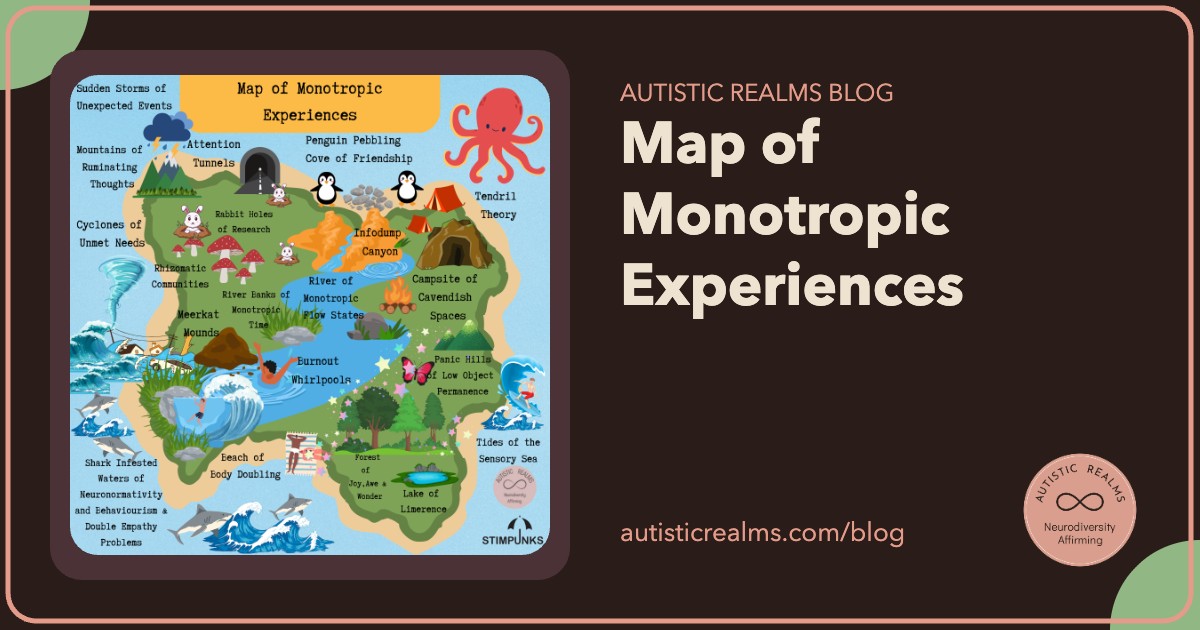
Monotropism (Murray, Lesser and Lawson, 2005) gives spoon theory an Autistic engine. It describes attention as a limited resource that, for monotropic people, pulls strongly towards a few things at a time. Pulled into something that matters to us we go deep, and that depth is restorative: time in monotropic flow is one of the few things that puts spoons back. Pulled out of it, by interruptions, demands and constant switching between channels, we pay heavily, and each switch costs more than it would for someone whose attention is spread more thinly.
That explains something families and schools often find puzzling. A child can spend four hours absorbed in a project and come out calmer, then be floored by a two-minute conversation about shoes straight away. The first was being in an Autistic flow state, which replenishes spoons. The second was a forced switch, which take away spoons. So if not enough time has been spent replenishing spoons then seemingly minor demands or tasks can quickly lead to shutdowns or meltdowns, or just that stuck inertia feeling.
Golden Spoons and Autistic burnout
Running out of spoons is my usual most days! Running out every day, for months, with no way to refill, is how Autistic burnout happens. Raymaker and colleagues (2020) describe burnout as what follows when the demands of life exceed a person’s resources for too long: chronic exhaustion, lost skills and far less tolerance of sensory and social input. In spoon terms, it is what happens when someone is made to keep borrowing against tomorrow’s spoons until there are none left to borrow. The way out is not to try harder with fewer spoons; it is to lower the demands and protect the things that refuel the spoons we DO HAVE, even if it is only one spoon for playing with lego, scrolling social media, taking photos of mushrooms, or stimming – what ever it is that spoon is valuable, like a golden spoon and can be life saving!
Using spoon theory at home, school and work
- Count the real costs. Ask what each part of the day costs more spoons, not what you think it should cost. Assembly, lunch halls and uniform often cost far more than lessons in school, different contexts such as home and work will have their own spoon accounting.
- Cut the spoons that buy nothing. Insisting on eye contact, sitting still, handwriting when typing would do, or finishing a worksheet for its own sake all spend spoons with no return. A low-demand approach is spoon theory in practice.
- Plan for the crash. If school or work takes up every spare moment, the evening is far less likely to also be able to hold things likehomework, clubs, chores, and conversation. Build in quiet, food, and time for interests before anything else is asked.
- Stop spending spoons on masking. Spaces where someone can stim, use their own communication and be visibly Autistic are spaces where spoons last longer.
- Refuel on purpose. Deep interests, sensory comfort and solitude are not rewards to be earned after the hard things. They are how the spoons come back.
- Expect the numbers to change. Illness, hormones, grief, change and burnout all shrink the day’s handful. A good day is not proof that a bad day is a choice.
Where the metaphor runs out
Spoon theory is a starting point. Energy is not one uniform thing: someone can have plenty of physical energy and no social spoons, or be unable to speak but perfectly able to write. Fork theory, which describes the way small stresses accumulate until one more fork is unbearable, is a useful companion. And spoon theory can be turned into another demand, with people expected to manage their spoons better rather than the world asking less of them. The point of the metaphor was always to ask for understanding, not better budgeting. It belongs to the disabled community that made it, and we are indebted to Christine Miserandino whenever it is used. You can read the original, The Spoon Theory, in her own words on her blog.
How to Use Your Spoons
To go with this post I have made a pack of 16 plum spoon cards, eight to an A4 page, each with one chunky gold or silver spoon, big or small, and a line to write a task. There is also a two-page how-to-use guide. Print them, cut them out and write a task on each one, or hold them in your hand the way Christine Miserandino handed spoons to her friend, so the energy a day holds becomes something you can see and count.
Ideas for individuals
Start by counting out today’s spoons before anything else, and write a task on each spoon as you spend it. Keep a spare spoon tucked away for the unexpected, because there is always something. Over time you might notice which tasks give spoons back, such as time with your interests, stimming or rest, and you can notice this gently, without blame. The spoons can also be a quiet burnout check-in: if the handful keeps shrinking day after day, that is useful information rather than a personal failing.
Ideas for families, parents and carers
Use the spoons to make life more manageable, never as something to be earned before rest. Invite your Autistic child or family member to decide with you what spends their spoons and what saves them, and respect the choices they make. Encourage them to check in with their body and mind before spending, and celebrate when they use spoons in ways that help them feel safe, calm and connected. Some days need more care than others, so let kindness and understanding come first.
Ideas for therapists and practitioners
The spoons work well as a strengths-based conversation tool rather than a compliance measure. Work collaboratively and follow the Autistic person’s lead as you explore their spiky profile and monotropic interests, plan supports and practise self-advocacy together. Adapt the examples, language and pace to the person in front of you and respect their communication style and processing needs. This is their system, and your role is to support it, not direct it.
Ideas for educators and workplaces
In a classroom, team meeting or supervision session, spoons offer a shared way to understand energy, sensory needs and wellbeing. They can help people co-create practical adjustments that reduce unnecessary demands and increase inclusion. Most of all, they help build a culture where needing support is normal, where people listen, believe and adapt, and where small changes make a big difference.
Free Downloads
Free guide: download the Spoon Theory how-to-use guide (PDF, 2 pages).
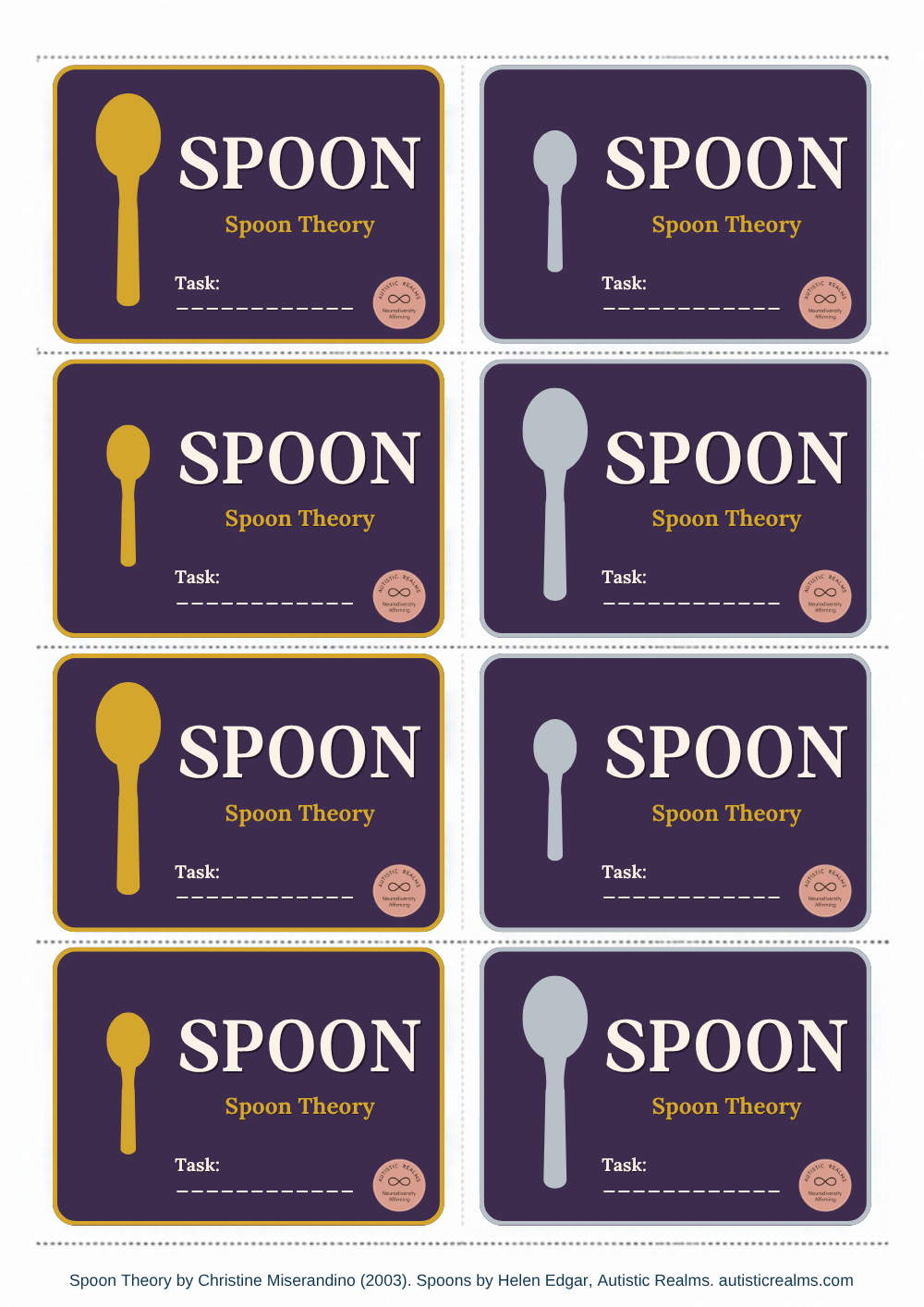
Printable spoons: the full pack of 16 spoons plus the guide is in the shop as pay what you can, with a suggested donation of £2. If money is tight, change the amount to £0 and it is yours for free.
Licence: CC BY-NC-ND 4.0. Please credit Helen Edgar (Autistic Realms) and Christine Miserandino, and share unadapted and for non-commercial use only.
Ticket Theory: another way to think about energy
If spoons don’t feel quite right for you, you might find Ticket Theory helpful! Created by Hilary Knutson and shared by Neuro Pride Ireland (Knutson, 2021), it imagines every task as a funfair ride that needs its own ticket, which explains why some tasks never get a ticket while our interests arrive in generous bundles. I explore how it connects with monotropism, spiky profiles and burnout in Ticket Theory, monotropism & burnout: Autistic ADHD energy accounting, with a free guide and printable tickets.
Where to go next
- Ticket Theory, monotropism & burnout: Autistic ADHD energy accounting
- Autistic Burnout: Signs, Recovery and Resources
- What is monotropism?
- Autistic Burnout in Children: Signs and a Parent Guide
- Printable spoons and guide, the Spoon Theory visual and the Neuro-Affirming Wheel of Life in the shop, pay what you can
- Re-Storying Autism course for families and professionals
References
- Knutson, H. (2021, August 8). Ticket theory [Video]. Neuro Pride Ireland, YouTube. https://www.youtube.com/watch?v=o-bXAUUDCks
- Miserandino, C. (2003). The spoon theory. But You Don’t Look Sick. https://butyoudontlooksick.com/articles/written-by-christine/the-spoon-theory
- Murray, D., Lesser, M. and Lawson, W. (2005). Attention, monotropism and the diagnostic criteria for autism. Autism, 9(2), 139–156.
- Raymaker, D. M., et al. (2020). “Having all of your internal resources exhausted beyond measure and being left with no clean-up crew”: Defining autistic burnout. Autism in Adulthood, 2(2), 132–143.

Resources on Autistic burnout
If this post was useful, these might help too. Many things in the shop are pay what you can, and lots of resources are free.
- Autistic Burnout: A Family Guide: an e-book for parents and carers on recognising and supporting burnout.
- Embracing Monotropism and Preventing Burnout: my book on monotropism and preventing Autistic burnout in young people.
- Embracing Monotropism (paperback): the same book in print.
- Autistic burnout resources and signposting: guides, research and support in one place.
- Burnout resources in the shop: posters, cards and guides, pay what you can.
- Re-Storying Autism course: a video course and workbook with David Gray-Hammond.