So many of us know this feeling. We are exhausted in a way that sleep does not fix. Our joints ache or slip, standing up makes us dizzy, our gut is unhappy, and our pain does not fit neatly into a ten-minute appointment. Then, when we finally ask for help, we are told it is anxiety, or “just being Autistic”.
Research is catching up with what Autistic people have been saying for years. Chronic pain and many physical health conditions are more common for us (Croen et al., 2015; Grant et al., 2022), and hypermobility, dysautonomia and pain often travel together in neurodivergent people (Csecs et al., 2022). Stimpunks Foundation calls this the Chronic Constellation: “The collection of co-occurring conditions that we see common in the hypermobile and autistic community” (Stimpunks Foundation, n.d.).
I have gathered this research into a free ebook and a new guide to Autistic burnout and chronic pain, so you can find it all in one gentle place.
Free ebook: Autistic Burnout and Chronic Pain
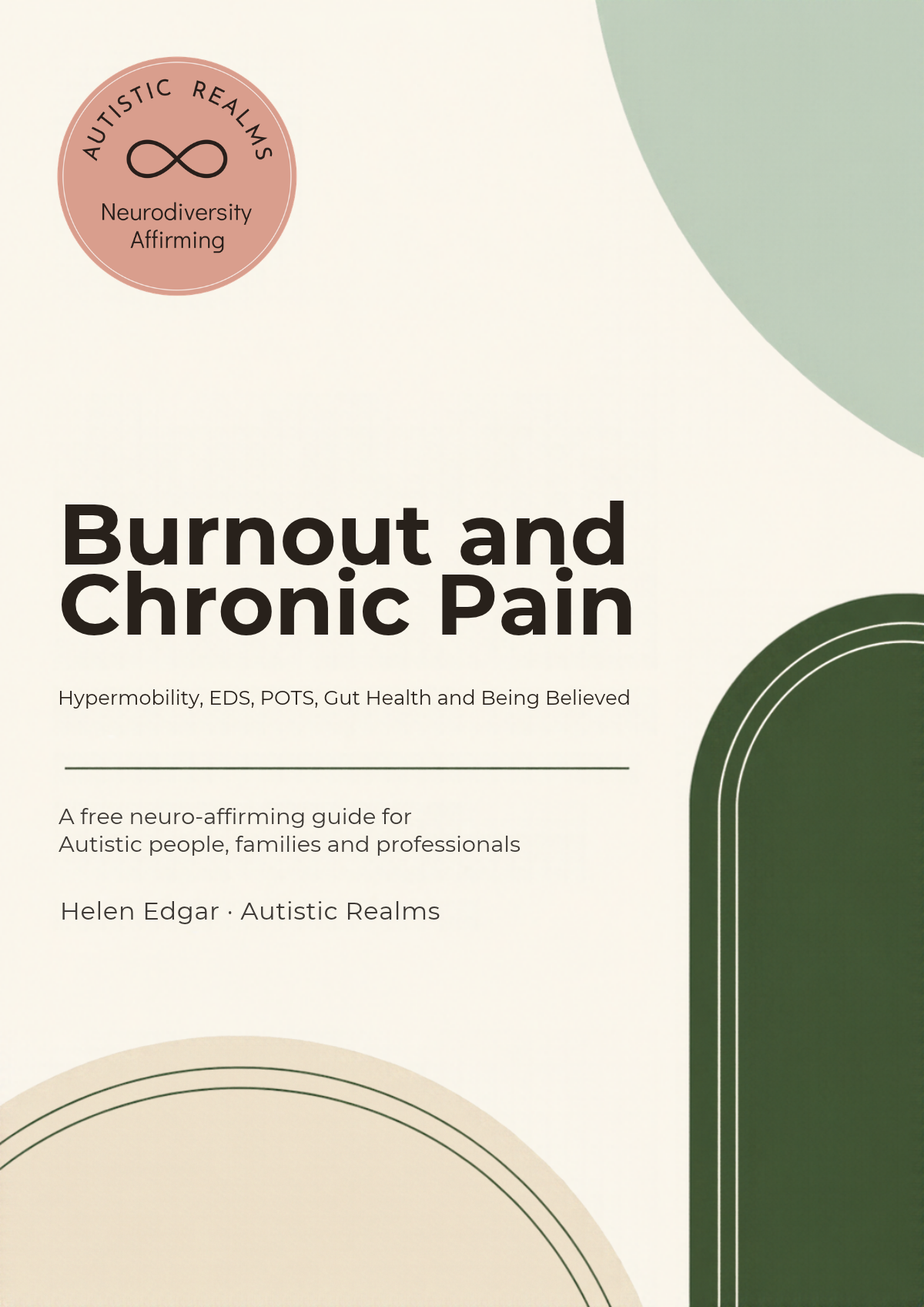
This guide is also a free ebook. You can read it at your own pace, print it, or share it with the people who support you.
What is inside (25 pages):
- Bodies, burnout and pain, and the chronic constellation
- Chronic pain, and why it is so often missed
- Hypermobility, Ehlers-Danlos syndromes, POTS and dysautonomia
- Gut health, fatigue and central sensitivity
- Fibromyalgia, migraine, ME/CFS and period pain
- Interoception, burnout and the body, and being believed in health care
- A printable worksheet, support links and full APA references
A peek inside
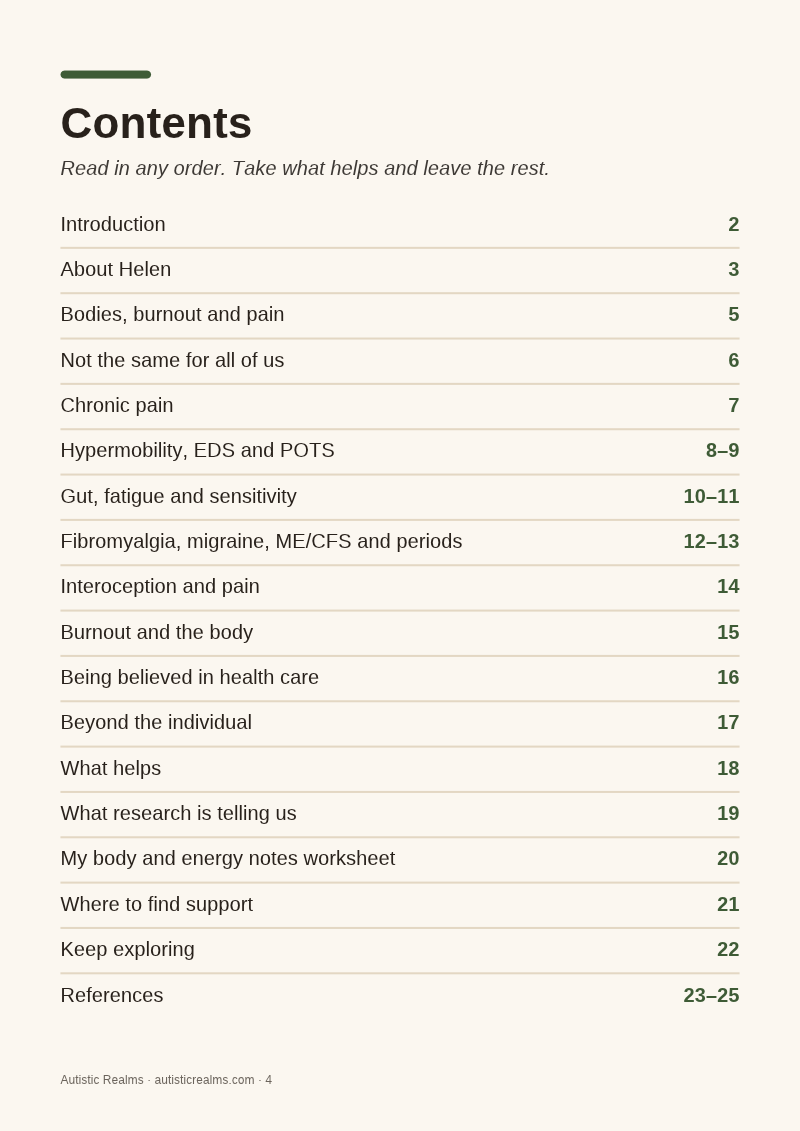
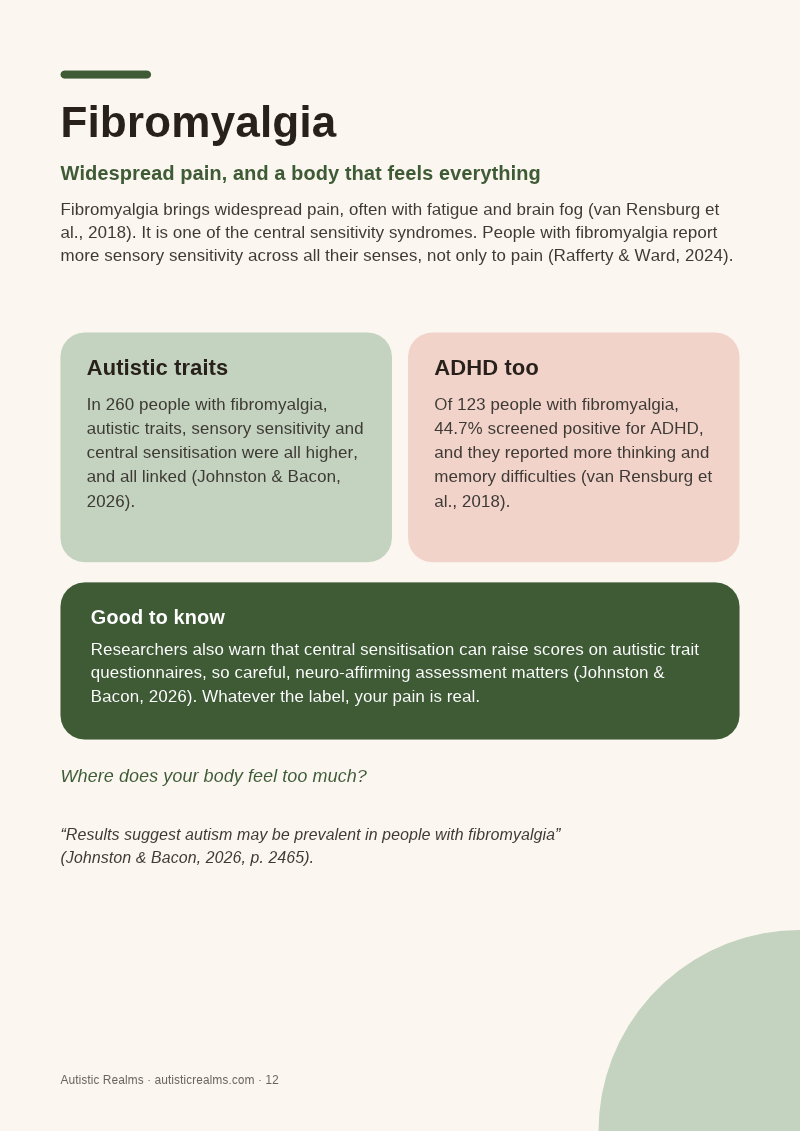
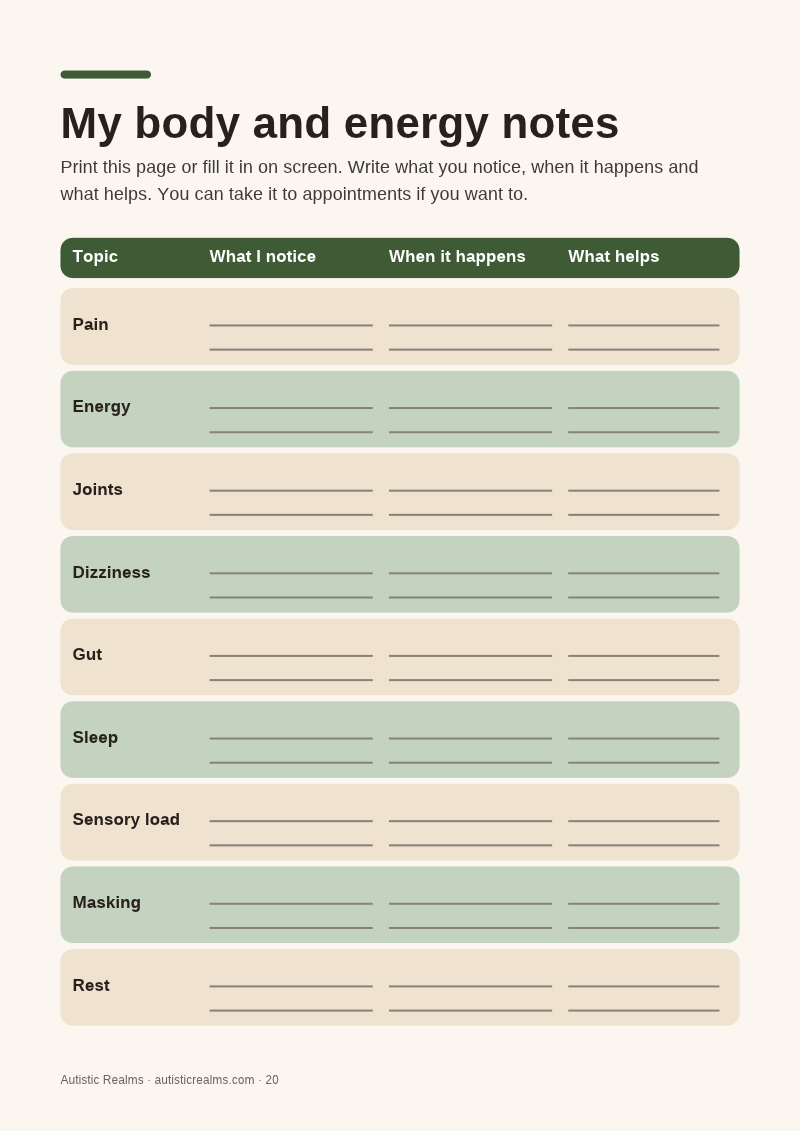
What the research is telling us
- Chronic pain: “A large majority of the women (76.6%) reported chronic pain” in a Swedish study of women diagnosed as Autistic and/or ADHD in childhood (Asztély et al., 2019, p. 2925).
- Hypermobility and EDS: hypermobility spectrum disorders or Ehlers-Danlos syndromes were found in 39% of Autistic people when assessed clinically (Baeza-Velasco et al., 2025).
- POTS and dysautonomia: neurodivergent adults reported more symptoms when upright, and more pain, with hypermobility helping to explain the link (Csecs et al., 2022).
- Gut health: in a review of 144 studies, the median rate of at least one gut symptom in Autistic people was 46.8% (Holingue et al., 2018).
- Sensitivity and fibromyalgia: 60% of 973 Autistic adults scored at or above the cut-off for central sensitivity, and sensory sensitivity and anxiety explained the link (Grant et al., 2022). In people with fibromyalgia, autistic traits, sensory sensitivity and central sensitisation were all linked (Johnston & Bacon, 2026).
- Being believed: 80% of 507 Autistic adults surveyed found visiting a GP difficult, compared with 37% of non-autistic people (Doherty et al., 2022).
Burnout lives in the body too
Autistic burnout involves “chronic exhaustion, loss of skills, and reduced tolerance to stimulus” (Raymaker et al., 2020, p. 132). When pain and fatigue are part of daily life, they use up spoons too. Rest is not giving up. Pacing, sensory care and saying no without guilt are forms of care, not weakness. You can read more about energy in Spoon Theory and Autism and in my Autistic Burnout guide.
Not the same for all of us
Pain and illness are shaped by who we are and how we are treated. Black Americans are “systematically undertreated for pain relative to white Americans” (Hoffman et al., 2016, p. 4296), Autistic women report more central sensitivity diagnoses and symptoms than Autistic men (Grant et al., 2022), and cost, time off and travel can decide who gets assessed at all. Being believed should never depend on how well we can explain our pain.
Gentle steps
- Believe our bodies, and each other. Pain that is shown differently is still pain.
- Rest and pace before the crash.
- Meet sensory needs every day. Sensory care is health care.
- Ask for adjustments in health care, such as text booking, written notes and a quiet place to wait (Doherty et al., 2022).
- Find community who understand, like SEDSConnective and Stimpunks Foundation.
This is information and signposting, not medical advice. If something new or worrying is happening in your body, a GP or specialist can talk it through with you.
Free ebook: Autistic Burnout and Chronic Pain
This guide is also a free ebook. You can read it at your own pace, print it, or share it with the people who support you.
What is inside (25 pages):
- Bodies, burnout and pain, and the chronic constellation
- Chronic pain, and why it is so often missed
- Hypermobility, Ehlers-Danlos syndromes, POTS and dysautonomia
- Gut health, fatigue and central sensitivity
- Fibromyalgia, migraine, ME/CFS and period pain
- Interoception, burnout and the body, and being believed in health care
- A printable worksheet, support links and full APA references
References
- Asztély, K., Kopp, S., Gillberg, C., Waern, M., & Bergman, S. (2019). Chronic pain and health-related quality of life in women with autism and/or ADHD: A prospective longitudinal study. Journal of Pain Research, 12, 2925–2932. https://doi.org/10.2147/JPR.S212422
- Baeza-Velasco, C., Vergne, J., Poli, M., Kalisch, L., & Calati, R. (2025). Autism in the context of joint hypermobility, hypermobility spectrum disorders, and Ehlers-Danlos syndromes: A systematic review and prevalence meta-analyses. Autism, 29(8), 1939–1958. https://doi.org/10.1177/13623613251328059
- Croen, L. A., Zerbo, O., Qian, Y., Massolo, M. L., Rich, S., Sidney, S., & Kripke, C. (2015). The health status of adults on the autism spectrum. Autism, 19(7), 814–823. https://doi.org/10.1177/1362361315577517
- Csecs, J. L. L., Iodice, V., Rae, C. L., Brooke, A., Simmons, R., Quadt, L., Savage, G. K., Dowell, N. G., Prowse, F., Themelis, K., Mathias, C. J., Critchley, H. D., & Eccles, J. A. (2022). Joint hypermobility links neurodivergence to dysautonomia and pain. Frontiers in Psychiatry, 12, 786916. https://doi.org/10.3389/fpsyt.2021.786916
- Doherty, M., Neilson, S., O’Sullivan, J., Carravallah, L., Johnson, M., Cullen, W., & Shaw, S. C. K. (2022). Barriers to healthcare and self-reported adverse outcomes for autistic adults: A cross-sectional study. BMJ Open, 12(2), e056904. https://doi.org/10.1136/bmjopen-2021-056904
- Grant, S., Norton, S., Weiland, R. F., Scheeren, A. M., Begeer, S., & Hoekstra, R. A. (2022). Autism and chronic ill health: An observational study of symptoms and diagnoses of central sensitivity syndromes in autistic adults. Molecular Autism, 13(1), 7. https://doi.org/10.1186/s13229-022-00486-6
- Hoffman, K. M., Trawalter, S., Axt, J. R., & Oliver, M. N. (2016). Racial bias in pain assessment and treatment recommendations, and false beliefs about biological differences between blacks and whites. Proceedings of the National Academy of Sciences, 113(16), 4296–4301. https://doi.org/10.1073/pnas.1516047113
- Holingue, C., Newill, C., Lee, L.-C., Pasricha, P. J., & Fallin, M. D. (2018). Gastrointestinal symptoms in autism spectrum disorder: A review of the literature on ascertainment and prevalence. Autism Research, 11(1), 24–36. https://doi.org/10.1002/aur.1854
- Johnston, H., & Bacon, A. M. (2026). Autistic traits in fibromyalgia are associated with hypersensitivity and central sensitisation. Psychology, Health & Medicine, 31(9), 2465–2481. https://doi.org/10.1080/13548506.2025.2519237
- Raymaker, D. M., Teo, A. R., Steckler, N. A., Lentz, B., Scharer, M., Delos Santos, A., Kapp, S. K., Hunter, M., Joyce, A., & Nicolaidis, C. (2020). “Having all of your internal resources exhausted beyond measure and being left with no clean-up crew”: Defining autistic burnout. Autism in Adulthood, 2(2), 132–143. https://doi.org/10.1089/aut.2019.0079
- Stimpunks Foundation. (n.d.). Chronic constellation. Retrieved November 27, 2026, from https://stimpunks.org/glossary/chronic-constellation/