A gentle, research-informed signposting resource for Autistic people, and for the families, friends and professionals who walk alongside us. Many of us live with burnout and chronic pain at the same time: hypermobility and Ehlers-Danlos syndromes, POTS, gut differences, fatigue, fibromyalgia, migraine and more. Too often we are not believed. Research is now catching up with what Autistic people have been saying for years (Croen et al., 2015; Csecs et al., 2022; Grant et al., 2022).
Free ebook: Autistic Burnout and Chronic Pain
This guide is also a free ebook. You can read it at your own pace, print it, or share it with the people who support you.
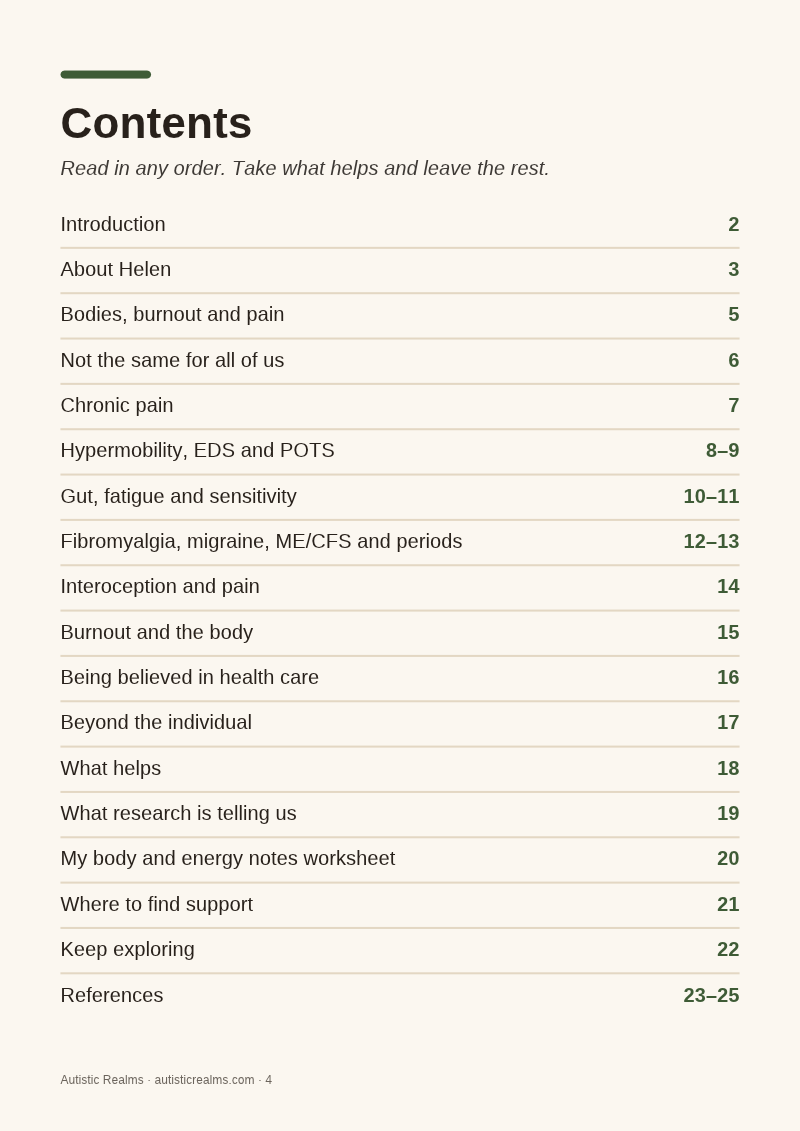
What is inside (25 pages):
- Bodies, burnout and pain, and the chronic constellation
- Chronic pain, and why it is so often missed
- Hypermobility, Ehlers-Danlos syndromes, POTS and dysautonomia
- Gut health, fatigue and central sensitivity
- Fibromyalgia, migraine, ME/CFS and period pain
- Interoception, burnout and the body, and being believed in health care
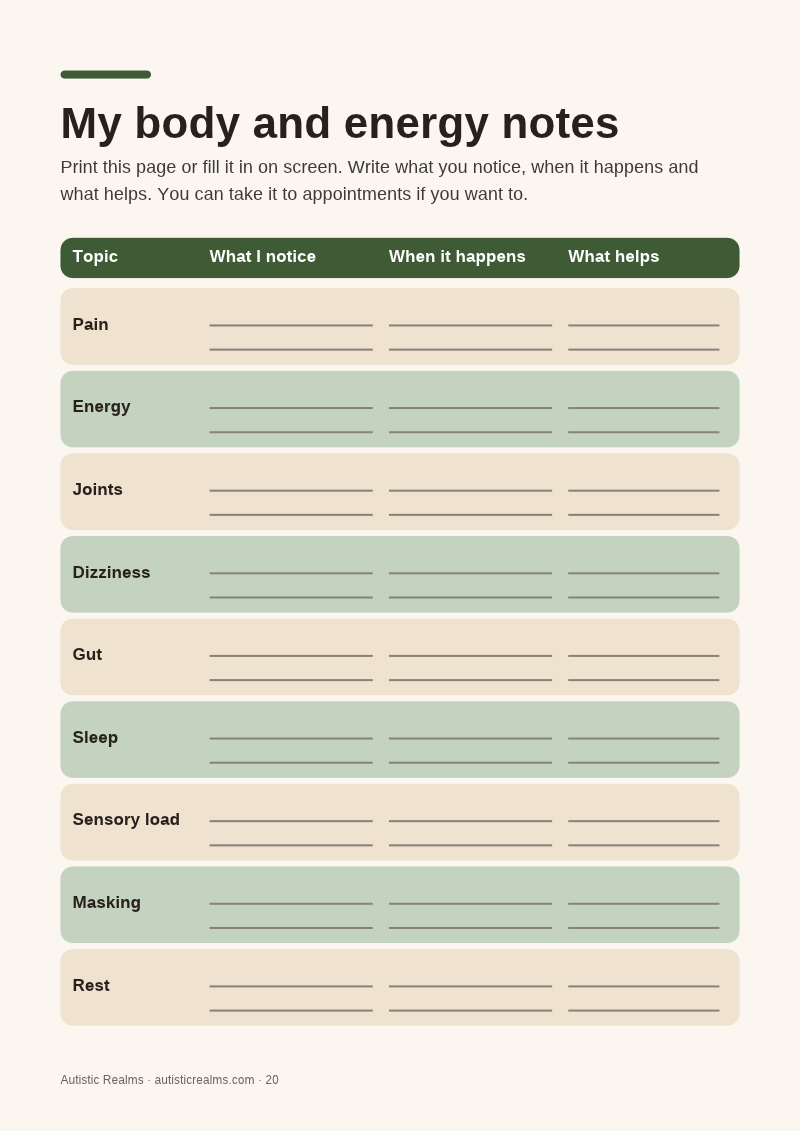
- A printable worksheet, support links and full APA references
A peek inside
For more organisations, practitioners and support, please visit my community signposting page.
Bodies, burnout and pain
Our bodies and minds are not separate. In my Neuro-Affirming Glossary, bodymind is “One word for the body and mind as a single whole, not two parts that affect each other” (Edgar, 2026). Chronic pain and many physical health conditions are more common for Autistic people (Croen et al., 2015; Grant et al., 2022), and hypermobility, dysautonomia and pain often travel together in neurodivergent people (Csecs et al., 2022).
Stimpunks Foundation calls this the Chronic Constellation: “The collection of co-occurring conditions that we see common in the hypermobile and autistic community” (Stimpunks Foundation, n.d.). Naming this is not about collecting labels. It is about being understood, believed and supported.
Chronic pain: common, and often missed
Chronic pain is pain that lasts for three months or more, or keeps coming back. In a Swedish study that followed women diagnosed as Autistic and/or ADHD in childhood, “A large majority of the women (76.6%) reported chronic pain” (Asztély et al., 2019, p. 2925).
Children are affected too. At a children’s pain clinic, 13.7% of 146 young people had scores consistent with clinically significant autistic traits, yet only 4.8% had a diagnosis of autism or ADHD (Lipsker et al., 2018).
Pain can look different in Autistic people. People who co-designed an NHS health check asked for staff training on how difficulties “such as pain, may present differently to non-autistic people” (H. Taylor et al., 2023, p. 1079). Asking about pain in more than one way, in writing, with scales, pictures or AAC, and over time, can help.
Hypermobility and Ehlers-Danlos syndromes
Ehlers-Danlos syndromes (EDS) are “a group of genetic conditions that affect connective tissue, including the joints” (Edgar, 2026). Hypermobility means joints move further than usual, and for some of us it brings pain, injuries and fatigue. As the UK charity SEDSConnective puts it, “EDS is much more than bendy joints” (SEDSConnective, n.d.-a).
- A 2025 review found hypermobility spectrum disorders or EDS in 27.9% of Autistic people across studies, and 39% when assessed clinically (Baeza-Velasco et al., 2025).
- In a Swedish study of 1,771 people with EDS, an autism diagnosis was 7.4 times as likely as in a matched comparison group (Cederlöf et al., 2016).
- Joints and autism are usually seen by different specialists, so the link is rarely made, and there is a “high probability that pain remains disregarded and untreated in people with ASD due to communication and methodological difficulties” (Baeza-Velasco et al., 2018, p. 1).
POTS and dysautonomia
Dysautonomia means the autonomic nervous system, which looks after heart rate, blood pressure, digestion and temperature, is not working smoothly. POTS (postural orthostatic tachycardia syndrome) is one kind, where the heart races on standing, often with dizziness, fatigue and brain fog. Researchers note that “many people with joint hypermobility manifest autonomic abnormalities, typically Postural Tachycardia Syndrome” (Eccles et al., 2015, p. 1).
Neurodivergent adults reported more symptoms of feeling unwell when upright, and more joint and muscle pain, than a comparison group, and hypermobility helped explain the link: “In neurodivergent adults, there is a strong link between the expression of joint hypermobility, dysautonomia, and pain, more so than in the comparison group” (Csecs et al., 2022, p. 1). Stress and anxiety are linked with autonomic symptoms too (E. C. Taylor et al., 2021), which is a reason for calmer, safer places, not blame.
Gut health
Gut differences such as constipation, diarrhoea and tummy pain are common. In a review of 144 studies, the median rate of at least one gastrointestinal symptom in Autistic people was 46.8%, and 22% for constipation (Holingue et al., 2018). Autistic adults aged 65 and over had over five times the odds of gut conditions compared with a matched group (Hand et al., 2020).
Constipation in Autistic adults can show up as sleep changes or distress, not only the usual signs (Smith & Desprez, 2025). Gut signals can be easy to miss, so regular, kind check-ins, safe foods and no pressure can help, and gut pain is always worth checking with a GP.
Fatigue, sensitivity and fibromyalgia
Central sensitivity syndromes (CSS) are linked conditions, such as fibromyalgia, chronic fatigue syndrome and irritable bowel syndrome, thought to involve a more sensitive central nervous system. Of 973 Autistic adults, 21% reported at least one CSS diagnosis and 60% scored at or above the clinical cut-off, with Autistic women reporting more. Sensory sensitivity and anxiety fully explained the link between autistic traits and CSS symptoms (Grant et al., 2022). Sensory care is health care.
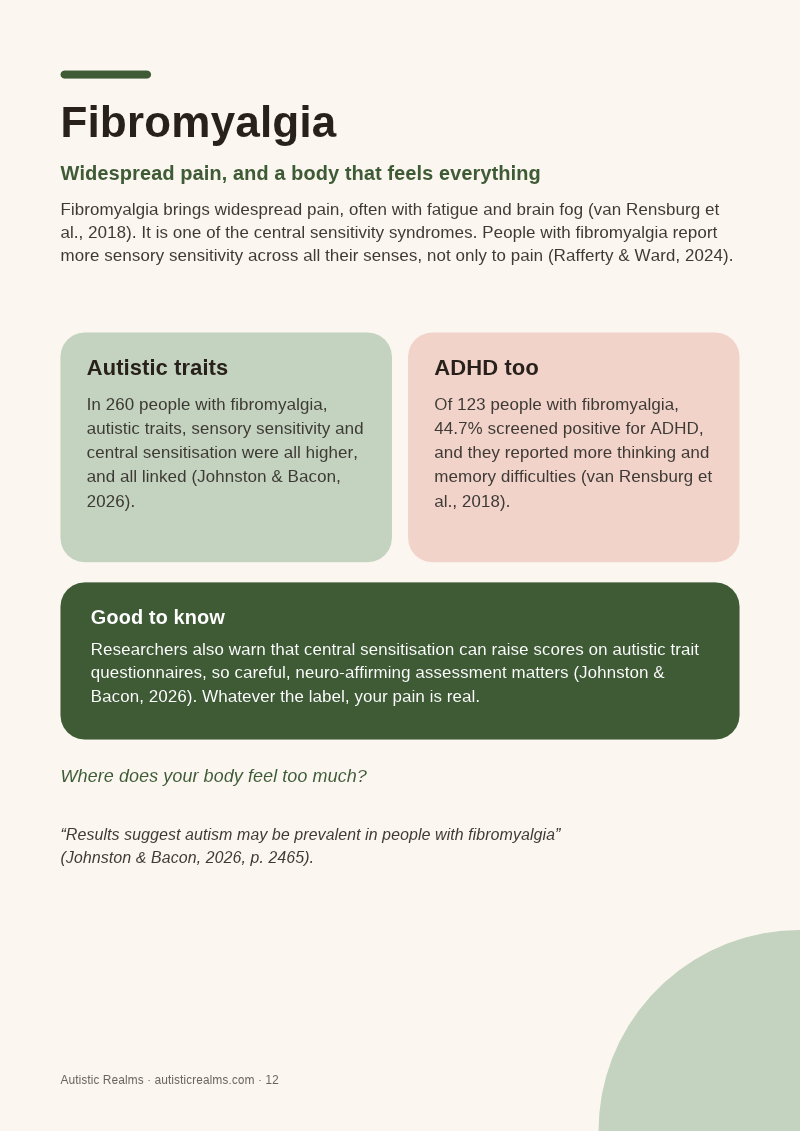
Fibromyalgia brings widespread pain, often with fatigue and brain fog. People with fibromyalgia report more sensory sensitivity across all their senses, not only to pain (Rafferty & Ward, 2024). In 260 people with fibromyalgia, autistic traits, sensory sensitivity and central sensitisation were all higher, and all linked: “Results suggest autism may be prevalent in people with fibromyalgia” (Johnston & Bacon, 2026, p. 2465). The same researchers note that central sensitisation can raise scores on autistic trait questionnaires, so careful, neuro-affirming assessment matters. ADHD is common too: of 123 people with fibromyalgia, 44.7% screened positive for ADHD (van Rensburg et al., 2018).
Migraine, ME/CFS and period pain
- Migraine: in a large US health system, migraine was more common in Autistic patients (3.1% compared with 2.0%). A US children’s survey linked headache with anxiety, depression and bullying (Grant Tejada et al., 2026).
- ME/CFS: ME/CFS and autism share some symptoms, such as fatigue, brain fog, sensory sensitivity and pain, but they are not the same thing (Bileviciute-Ljungar et al., 2018).
- Period pain: “Communication differences, sensory aspects, and social factors contributed to the experience of period pain and treatment uptake for autistic menstruators” (Gray & Durand, 2023, p. 1). If period pain stops you doing everyday things, it is worth asking about, and asking again.
Research on endometriosis and mast cell issues in Autistic people is still catching up, so we will add to this guide as it grows.
Interoception and pain
Interoception is our sense of what is happening inside our bodies. With interoceptive differences, “you may not understand your body’s signals about whether you are hungry, thirsty, hot, cold, tired, need the toilet, or in pain” (Edgar, 2026; see Mahler, 2016). Autistic adults have named “challenges with body awareness” as one barrier to getting good health care (Nicolaidis et al., 2015, p. 824).
Monotropic minds put deep attention into a few things at a time (Murray et al., 2005). When we are deep in focus, we may not notice hunger, thirst or needing the toilet (Garau et al., 2023). Pain and tiredness can slip past us too, building quietly until they feel like they came out of nowhere. A body scan is “A gentle way to build interoception” (Edgar, 2026), and visual pain scales, notes or apps can show what words cannot.
Burnout and the body
Autistic burnout involves “chronic exhaustion, loss of skills, and reduced tolerance to stimulus” (Raymaker et al., 2020, p. 132). It is felt in the body too, bringing “physical and cognitive challenges” (Clarey et al., 2026, p. 1519) and both mental and physical exhaustion (Bory et al., 2026). “Living with hypermobility can mean ongoing pain, exhaustion and energy levels that change day to day” (SEDSConnective, n.d.-c).
In spoon theory, “Every task costs spoons, and when they are gone, they are gone” (Edgar, 2026; see Miserandino, 2003). Pain and fatigue use spoons too. Planning rest before we need it, breaking tasks into smaller parts, and saying no without guilt can all help. Burnout can come back more than once, and “increased awareness and acceptance of autism could be key to burnout prevention and recovery” (Mantzalas et al., 2022, p. 52). You can read more in my Autistic Burnout guide.
Being believed in health care
In one survey of 507 Autistic adults, 80% found visiting a GP difficult, compared with 37% of non-autistic people. Common barriers included deciding whether symptoms were worth a GP visit (72%), booking by phone (62%) and not feeling understood (56%) (Doherty et al., 2022).
Helpful adjustments include online or text booking, emailing our reason in advance, the first or last appointment of the day, and a quiet place to wait (Doherty et al., 2022). It is OK to bring written notes or a pain diary, and to take a support person. As the researchers put it, “Adjustments for autism-specific needs are as necessary as ramps for wheelchair users” (Doherty et al., 2022, p. 1).
Intersectionality: not the same for all of us
Pain and illness are shaped by who we are and how we are treated, including race, culture and age, gender and sexuality, class and money, and being otherwise neurodivergent or disabled. Black Americans are “systematically undertreated for pain relative to white Americans” (Hoffman et al., 2016, p. 4296), so racism can make being believed even harder. Autistic women report more central sensitivity diagnoses and symptoms than Autistic men (Grant et al., 2022), and older Autistic adults have higher rates of many physical health conditions (Hand et al., 2020). Non-binary people are often missing too: one large study had too few non-binary people to include them as a group (Grant et al., 2022). Cost, time off and travel can also decide who gets assessed, and who does not.
What helps: gentle steps
- Believe our bodies, and each other. Pain that is shown differently is still pain.
- Rest and pace before the crash. Rest is not giving up.
- Meet sensory needs every day. Sensory care is health care (Grant et al., 2022).
- Ask for adjustments in health care. They are not special treatment. They make care fair (Doherty et al., 2022).
- Find community who understand. You do not have to do this alone.
For families, carers and professionals
Being believed should not depend on how well we can explain our pain. Research with Autistic adults found that “Further efforts are needed to empower patients, adequately train providers, increase the accessibility of the healthcare system, and decrease discrimination” (Nicolaidis et al., 2015, p. 824).
- Believe us, and offer adjustments before we ask.
- Give clear written information.
- Ask about joints, dizziness and pain together, as they are often linked (Csecs et al., 2022).
- Avoid putting pain down to anxiety or “just being Autistic” without checking, or expecting pain to look a certain way.
This guide is information and signposting, not medical advice. A GP or specialist can talk through assessment and support.
Guides and writing on this site
- Autistic Burnout: Signs, Recovery and Resources
- Spoon Theory and Autism: Energy, Burnout and Monotropism
- Ticket Theory, Monotropism and Burnout: Autistic ADHD Energy Accounting
- Autistic and ADHD Sensory Systems: Research, Support and Resources
- Monotropism: A Plain-Language Guide and Resources
- Hyperemesis, Shutdown, and the Storm After: My Pregnancies Through an Autistic Lens
- Neuro-Affirming Glossary of Key Words and Terms
- Autistic Burnout and Chronic Pain: Our Bodies Deserve to Be Believed
Websites, organisations and community resources
Listed alphabetically.
- Dysautonomia International: information and community for people living with dysautonomia, including POTS.
- Ehlers-Danlos Support UK: UK charity offering information and support for people with EDS and hypermobility spectrum disorders.
- PoTS UK: UK charity with information about postural tachycardia syndrome.
- SEDSConnective: UK hypermobility and neurodivergence charity.
- Stimpunks Foundation: Chronic Constellation: the cluster of conditions common in the hypermobile and Autistic community.
Books
- Clare, E. (2017). Brilliant imperfection: Grappling with cure. Duke University Press.
- Mahler, K. J. (2016). Interoception: The eighth sensory system. AAPC Publishing.
- Piepzna-Samarasinha, L. L. (2018). Care work: Dreaming disability justice. Arsenal Pulp Press.
- Price, D. (2022). Unmasking autism: Discovering the new faces of neurodiversity. Harmony Books.
Research and reading
References in APA style, listed alphabetically. This list is reviewed regularly for new affirming research.
- Asztély, K., Kopp, S., Gillberg, C., Waern, M., & Bergman, S. (2019). Chronic pain and health-related quality of life in women with autism and/or ADHD: A prospective longitudinal study. Journal of Pain Research, 12, 2925–2932. https://doi.org/10.2147/JPR.S212422
- Baeza-Velasco, C., Cohen, D., Hamonet, C., Vlamynck, E., Diaz, L., Cravero, C., Cappe, E., & Guinchat, V. (2018). Autism, joint hypermobility-related disorders and pain. Frontiers in Psychiatry, 9, 656. https://doi.org/10.3389/fpsyt.2018.00656
- Baeza-Velasco, C., Vergne, J., Poli, M., Kalisch, L., & Calati, R. (2025). Autism in the context of joint hypermobility, hypermobility spectrum disorders, and Ehlers-Danlos syndromes: A systematic review and prevalence meta-analyses. Autism, 29(8), 1939–1958. https://doi.org/10.1177/13623613251328059
- Bileviciute-Ljungar, I., Maroti, D., & Bejerot, S. (2018). Patients with chronic fatigue syndrome do not score higher on the autism-spectrum quotient than healthy controls: Comparison with autism spectrum disorder. Scandinavian Journal of Psychology, 59(4), 428–432. https://doi.org/10.1111/sjop.12451
- Bory, P., Fiorentino, M., Bérenguier, L., & Denis, A. (2026). Autistic burnout: Early insights from a systematic review on characteristics, precipitating factors, and protective mechanisms. L’Encéphale. Advance online publication. https://doi.org/10.1016/j.encep.2026.08.011
- Cederlöf, M., Larsson, H., Lichtenstein, P., Almqvist, C., Serlachius, E., & Ludvigsson, J. F. (2016). Nationwide population-based cohort study of psychiatric disorders in individuals with Ehlers-Danlos syndrome or hypermobility syndrome and their siblings. BMC Psychiatry, 16, 207. https://doi.org/10.1186/s12888-016-0922-6
- Clarey, M. M., Ireland, M. J., Abel, S., & Brownlow, C. (2026). Beyond exhaustion: Shame, identity disruption, and functional collapse in autistic burnout. Autism, 30(6), 1519–1531. https://doi.org/10.1177/13623613261444797
- Croen, L. A., Zerbo, O., Qian, Y., Massolo, M. L., Rich, S., Sidney, S., & Kripke, C. (2015). The health status of adults on the autism spectrum. Autism, 19(7), 814–823. https://doi.org/10.1177/1362361315577517
- Csecs, J. L. L., Iodice, V., Rae, C. L., Brooke, A., Simmons, R., Quadt, L., Savage, G. K., Dowell, N. G., Prowse, F., Themelis, K., Mathias, C. J., Critchley, H. D., & Eccles, J. A. (2022). Joint hypermobility links neurodivergence to dysautonomia and pain. Frontiers in Psychiatry, 12, 786916. https://doi.org/10.3389/fpsyt.2021.786916
- Doherty, M., Neilson, S., O’Sullivan, J., Carravallah, L., Johnson, M., Cullen, W., & Shaw, S. C. K. (2022). Barriers to healthcare and self-reported adverse outcomes for autistic adults: A cross-sectional study. BMJ Open, 12(2), e056904. https://doi.org/10.1136/bmjopen-2021-056904
- Eccles, J. A., Owens, A. P., Mathias, C. J., Umeda, S., & Critchley, H. D. (2015). Neurovisceral phenotypes in the expression of psychiatric symptoms. Frontiers in Neuroscience, 9, 4. https://doi.org/10.3389/fnins.2015.00004
- Edgar, H. (2026). Neuro-affirming glossary of key words and terms (2026 ed.). Autistic Realms. https://autisticrealms.com/guides/glossary/
- Garau, V., Murray, A. L., Woods, R., Chown, N., Hallett, S., Murray, F., Wood, R., & Fletcher-Watson, S. (2023). Development and validation of a novel self-report measure of monotropism in autistic and non-autistic people: The Monotropism Questionnaire [Preprint]. OSF Preprints. https://doi.org/10.31219/osf.io/ft73y
- Grant, S., Norton, S., Weiland, R. F., Scheeren, A. M., Begeer, S., & Hoekstra, R. A. (2022). Autism and chronic ill health: An observational study of symptoms and diagnoses of central sensitivity syndromes in autistic adults. Molecular Autism, 13(1), 7. https://doi.org/10.1186/s13229-022-00486-6
- Grant Tejada, M. P., Klomhaus, A. M., Ortiz, R., Tibbe, T. D., & Nwaobi, S. E. (2026). Migraine prevalence and phenotype in autism: A retrospective cohort study using a US National Health Survey and large academic health system electronic health record. Headache, 66(3), 712–724. https://doi.org/10.1111/head.70035
- Gray, L. J., & Durand, H. (2023). Experiences of dysmenorrhea and its treatment among allistic and autistic menstruators: A thematic analysis. BMC Women’s Health, 23(1), 288. https://doi.org/10.1186/s12905-023-02370-8
- Hand, B. N., Angell, A. M., Harris, L., & Carpenter, L. A. (2020). Prevalence of physical and mental health conditions in Medicare-enrolled, autistic older adults. Autism, 24(3), 755–764. https://doi.org/10.1177/1362361319890793
- Hoffman, K. M., Trawalter, S., Axt, J. R., & Oliver, M. N. (2016). Racial bias in pain assessment and treatment recommendations, and false beliefs about biological differences between blacks and whites. Proceedings of the National Academy of Sciences, 113(16), 4296–4301. https://doi.org/10.1073/pnas.1516047113
- Holingue, C., Newill, C., Lee, L.-C., Pasricha, P. J., & Fallin, M. D. (2018). Gastrointestinal symptoms in autism spectrum disorder: A review of the literature on ascertainment and prevalence. Autism Research, 11(1), 24–36. https://doi.org/10.1002/aur.1854
- Johnston, H., & Bacon, A. M. (2026). Autistic traits in fibromyalgia are associated with hypersensitivity and central sensitisation. Psychology, Health & Medicine, 31(9), 2465–2481. https://doi.org/10.1080/13548506.2025.2519237
- Lipsker, C. W., Bölte, S., Hirvikoski, T., Lekander, M., Holmström, L., & Wicksell, R. K. (2018). Prevalence of autism traits and attention-deficit hyperactivity disorder symptoms in a clinical sample of children and adolescents with chronic pain. Journal of Pain Research, 11, 2827–2836. https://doi.org/10.2147/JPR.S177534
- Mahler, K. J. (2016). Interoception: The eighth sensory system. AAPC Publishing.
- Mantzalas, J., Richdale, A. L., Adikari, A., Lowe, J., & Dissanayake, C. (2022). What is autistic burnout? A thematic analysis of posts on two online platforms. Autism in Adulthood, 4(1), 52–65. https://doi.org/10.1089/aut.2021.0021
- Miserandino, C. (2003). The spoon theory. But You Don’t Look Sick. https://butyoudontlooksick.com/articles/written-by-christine/the-spoon-theory/
- Murray, D., Lesser, M., & Lawson, W. (2005). Attention, monotropism and the diagnostic criteria for autism. Autism, 9(2), 139–156. https://doi.org/10.1177/1362361305051398
- Nicolaidis, C., Raymaker, D. M., Ashkenazy, E., McDonald, K. E., Dern, S., Baggs, A. E., Kapp, S. K., Weiner, M., & Boisclair, W. C. (2015). “Respect the way I need to communicate with you”: Healthcare experiences of adults on the autism spectrum. Autism, 19(7), 824–831. https://doi.org/10.1177/1362361315576221
- Rafferty, C., & Ward, J. (2024). Fibromyalgia is linked to increased subjective sensory sensitivity across multiple senses. Perception, 53(4), 276–286. https://doi.org/10.1177/03010066241234037
- Raymaker, D. M., Teo, A. R., Steckler, N. A., Lentz, B., Scharer, M., Delos Santos, A., Kapp, S. K., Hunter, M., Joyce, A., & Nicolaidis, C. (2020). “Having all of your internal resources exhausted beyond measure and being left with no clean-up crew”: Defining autistic burnout. Autism in Adulthood, 2(2), 132–143. https://doi.org/10.1089/aut.2019.0079
- SEDSConnective. (n.d.-a). Ehlers-Danlos syndrome (EDS). Retrieved November 27, 2026, from https://sedsconnective.org/category/hypermobility/understanding-hypermobility/ehlers-danlos-syndrome/
- SEDSConnective. (n.d.-b). Hypermobility & neurodivergence charity [Home page]. Retrieved November 27, 2026, from https://sedsconnective.org/
- SEDSConnective. (n.d.-c). Pain & fatigue. Retrieved November 27, 2026, from https://sedsconnective.org/category/hypermobility/understanding-hypermobility/pain-fatigue-management/
- Smith, W., & Desprez, C. (2025). Symptoms of constipation in autistic adults: A systematic literature review on diagnostic methods and presence of actual symptoms. Autism, 29(4), 850–858. https://doi.org/10.1177/13623613241289114
- Stimpunks Foundation. (n.d.). Chronic constellation. Retrieved November 27, 2026, from https://stimpunks.org/glossary/chronic-constellation/
- Taylor, E. C., Livingston, L. A., Callan, M. J., Ashwin, C., & Shah, P. (2021). Autonomic dysfunction in autism: The roles of anxiety, depression, and stress. Autism, 25(3), 744–752. https://doi.org/10.1177/1362361320985658
- Taylor, H., Ingham, B., Mason, D., Finch, T., Wilson, C., Scarlett, C., Moss, S., Buckley, C., Urbanowicz, A., Raymaker, D., Seiboth, C., Lees, R., Garland, D., Osbourne, M., Lennox, N., Cooper, S.-A., Nicolaidis, C., & Parr, J. R. (2023). Co-design of an NHS primary care health check for autistic adults. Autism, 27(4), 1079–1091. https://doi.org/10.1177/13623613221132921
- van Rensburg, R., Meyer, H. P., Hitchcock, S. A., & Schuler, C. E. (2018). Screening for adult ADHD in patients with fibromyalgia syndrome. Pain Medicine, 19(9), 1825–1831. https://doi.org/10.1093/pm/pnx275
Finding more support
For neuro-affirming organisations, practitioners, education resources and courses, please visit my community signposting page. You can also browse all my neuro-affirming guides.
If you or someone you support is struggling or in crisis, please reach out. My Support and Crisis Lines guide lists helplines, including text and webchat options. In the UK you can text SHOUT to 85258 or contact Samaritans, and Find A Helpline lists services in over 175 countries.
Free resources from communities close to my heart
Everything here is free. These resources come from communities close to my heart: Stimpunks Foundation, which I co-direct with Ryan Boren; Thriving Autistic, the Autistic-led social enterprise in Ireland where I am Communications and Community Lead; Re-Storying Autism, the course and workbook David Gray-Hammond and I created together; and Spectrum Gaming, the charity and community for Autistic young people behind Autism Understood and Barriers to Education, where I have volunteered on several projects, including Barriers to Education and their burnout resources.
The Autism Understood and Barriers to Education pages are written especially for Autistic young people, so they are lovely to share with children and teenagers, or to explore together.
Stimpunks Foundation
- Our Lens: short briefs on the ideas at the heart of Stimpunks.
- Pathology Paradigm: the deficit story we are often handed, and how to step outside it.
- Building Anti-Ableist Learning Space: creating learning spaces that do not ask us to shrink.
- Why Sheets: free advocacy sheets for families and educators.
Thriving Autistic
- Module 6: Internalised Ableism and Self-Advocacy: noticing internalised ableism and building self-advocacy, one small step at a time.
- Module 1: Imposter Phenomenon and Intersectionality: making sense of identification and the feelings that can come with it.
Re-Storying Autism
- Re-Storying Autism free guides: short, free guides on topics such as monotropism, stimming, sensory overload, low-demand approaches and Autistic burnout.
- Free preview lesson: try a lesson from the Autistic-led course and workbook for families, parents, carers and Autistic people, at your own pace.
Autism Understood (for young people)
- Lack of Understanding from Society: how a world that misunderstands us can make life harder.
- Autism Myths: gently unpicking common myths about Autistic people.
- Positives of Autism: the strengths and joys of being Autistic.
- We Do Not Need Social Skills Training: why changing ourselves to fit in is the wrong goal.
Barriers to Education (for young people)
- Affirming Practice: the WARMTH principle of affirming young people as they are.
- Beliefs That Can Make Attendance Harder: beliefs about school absence that can add pressure, and kinder alternatives.
What would you add?
Do you know of research, books, blogs, podcasts or community resources about Autistic bodies, chronic pain and burnout that should be here, especially from people whose voices are often missing? I would love to hear from you, as this guide grows with our community.
Last reviewed: November 2026