Autistic Realms blog: The Autistic Young Person Bundle, neuro-affirming tools for Autistic young people at secondary school in the UK

The Autistic Young Person Bundle: neuro-affirming tools for Autistic young people at secondary school in the UK

Written by Helen Edgar,

When I was a SEND teacher, I sat in a lot of meetings about young people. Very often, the young person wasn’t in the room, or was there but not really asked. Adults talked about them, in adult words, and what the young person actually thought got lost between the report and the plan.

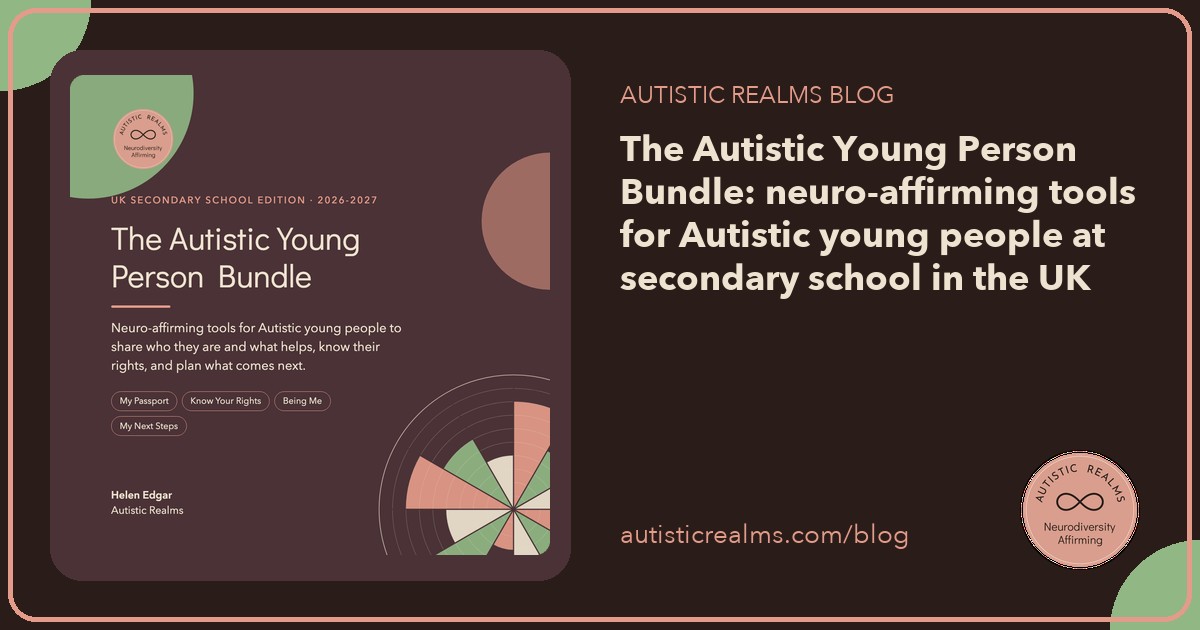
I made the Autistic Young Person Bundle (UK Secondary School Edition) to change that. It is a set of neuro-affirming pages for Autistic and otherwise neurodivergent young people at secondary school, written for them to lead, and to fill in with the people who support them: family, school staff and other professionals.

The young person leads

The pages speak to the young person directly, in plain language, with space to write, type, list or draw. They choose what to share and who to share it with. Every page ends with a small box called “Who supported me”, so it is always clear whose words are on the page and how the young person took part.

My Passport and the One-Page Profile help young people explain who they are and what helps, in their own words, so they do not have to say it again to every new teacher. The communication cards include exam and break cards, and come as phone pictures too.

Being me: identity, masking and telling people

Secondary school is when a lot of Autistic young people start masking hard, and when many first find out they are Autistic. Being Me is about identity, masking, and deciding who to tell, when and how. It has a page called “All of who I am”, on being Autistic and LGBTQIA+, and on intersectionality: how race, culture, faith, gender, sexuality, class and disability meet and shape each other.

Senses, wellbeing and burnout

We have 8 senses, not 5. My 8 Senses covers all of them, including balance and movement, body position and body signals, with a sensory profile and ideas for a busy school day. The Wellbeing, Burnout and Crisis Plan explains Autistic burnout and school distress as “can’t”, not “won’t”, and has a plan for hard days, made on a calm day so it is ready when it is needed, with checked crisis lines for each UK country.

Friendships, online life and finding your people

Autistic friendships often look different, and that is fine. This file covers friendships, online life and staying safe online, and points young people to Autistic-led and LGBTQIA+ groups, mentoring and communities across the UK.

Rights in all four UK countries, and exams

Support at school works differently in England, Wales, Scotland and Northern Ireland: EHC plans, IDPs, CSPs and statements, with different tribunals and time limits. Know Your Rights at School explains each country in plain English, including the rights that move to the young person once they are over compulsory school age, exam access arrangements, disability law, exclusions and part-time timetables, with emails you can copy. Everything was fact-checked against official sources in November 2026.

After secondary school

My Next Steps helps young people plan for what comes after secondary school: choices at 16, sixth form and college, transition plans in each UK country, and work experience. Planning goes best when it is done with young people, not for them.

What’s in the bundle

What's inside The Autistic Young Person Bundle, UK Secondary School Edition: pages from the 14 PDFs
  • My Passport
  • One-Page Profile and Communication Cards
  • My 8 Senses
  • Know Your Rights at School
  • School Planners
  • Being Me: Identity, Masking and Telling People
  • Wellbeing, Burnout and Crisis Plan
  • Friendships, Online Life and Finding Your People
  • My Next Steps: After Secondary School
  • My Wheel of Life (Teen Edition)
  • UK Directory
  • Practitioner Guide and a Guide for School Staff
  • Start Here

That’s 14 PDFs and 115 pages, with a plain-text Word version and phone pictures of the communication cards.

Two packs: young people and families, and schools and professionals

The Young Person’s Pack is for one young person or one family, £9.99. The School and Professional Pack has the same files in a different order, starting with the Practitioner Guide and the guide for school staff, and comes with a practitioner licence (£49.99 a year) or a site licence for a whole school (please contact me for prices for a licence for your setting). For several sites, please get in touch.

For more on identity, exams, rights in each UK country and what comes next, read my guide, Autistic Young People at Secondary School. For younger children, there is the primary school guide, and for later on, my guide for Autistic students at college and university.

Every Autistic young person deserves to be listened to, and to lead the plans that are about them. I hope this bundle helps make that happen.

Helen

Latest Posts

  • Autistic Burnout – Supporting Young People At Home & School

    Autistic Burnout – Supporting Young People At Home & School

    Autistic burnout in young people is real—and recovery starts with understanding. This post offers neuroaffirming ways to spot the signs, reduce demands, and truly support. 💛 #AutisticBurnout #Neuroaffirming #Monotropism #AutisticSupport


  • Monotropic Interests and Looping Thoughts

    Monotropic Interests and Looping Thoughts

    The theory of monotropism was developed by Murray, Lawson and Lesser in their article, Attention, monotropism and the diagnostic criteria for autism (2005). ​ Monotropism is increasingly considered to be the underlying principle behind autism and is becoming more widely recognised, especially within autistic and neurodivergent communities. Fergus Murray, in their article Me and Monotropism:…


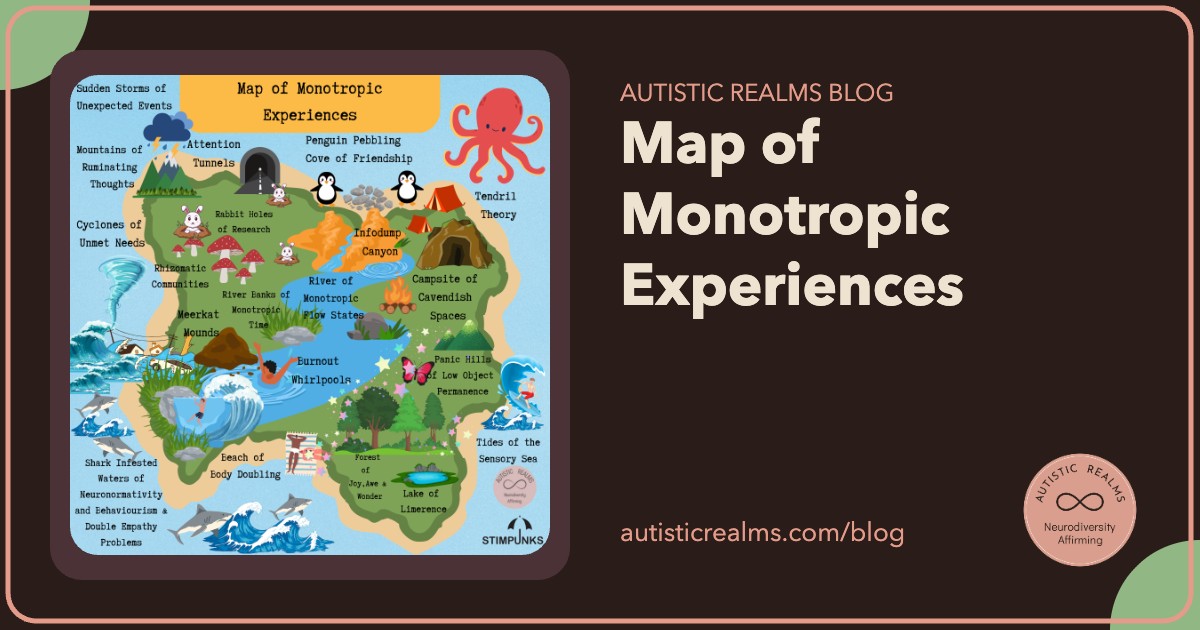
  • Map of Monotropic Experiences

    Map of Monotropic Experiences

    The Map of Monotropic Experiences now has a home of its own. Visit monotropicmap.org to explore each of the twenty areas, mark your own map and find the free training. You can also find the free training and downloads further down this page. Monotropism seeks to explain Autism in terms of attention distribution and interests. …


  • The Double Empathy Problem is DEEP

    The Double Empathy Problem is DEEP

    “The growing cracks in the thin veneer of our “civilised” economic and social operating model are impossible to ignore”, Jorn Bettin (2020). The double empathy problem (Milton, 2012) creates a gap of disconnect experienced between people due to misunderstood shared lived experiences. It is “a breakdown in reciprocity and mutual understanding that can happen between…


  • Top 5 Neurodivergent-Informed Strategies

    Top 5 Neurodivergent-Informed Strategies

    Top 5 Neurodivergent-Informed Strategies By Helen Edgar, Autistic Realms, June 2024. 1. Be Kind Take time to listen and be with people in meaningful ways to help bridge the Double Empathy Problem (Milton, 2012). Be embodied and listen not only to people’s words but also to their bodies and sensory systems. Be responsive to people’s…


  • Autistic Community: Connections and Becoming

    Autistic Community: Connections and Becoming

    Everyone seeks connection in some way or another. Connections may look different for autistic people. In line with the motto from Anna Freud’s National Autism Trainer Programme (Acceptance, Belonging and Connection), creating a sense of acceptance and belonging is likely to be more meaningful for autistic people than putting pressure on them to try and…


  • Monotropism, Autism & OCD

    Monotropism, Autism & OCD

    Exploring similarities and differences between Autistic and OCD monotropic flow states. Can attention tunnels freeze, and thoughts get stuck?


  • Monotropism Questionnaire: Take It and Understand Your Results

    Monotropism Questionnaire: Take It and Understand Your Results

     Post first published 28th July 2023 Over the past few weeks, there has been a sudden surge of interest in the Monotropism Questionnaire (MQ), pre-print released in June 2023 in the research paper ‘Development and Validation of a Novel Self-Report Measure of Monotropism in Autistic and Non-Autistic People: The Monotropism Questionnaire.‘ by Garau, V., Murray,…


  • Penguin Pebbling: An Autistic Love Language

    Penguin Pebbling: An Autistic Love Language

    Penguin Pebbling is a neurodivergent way of showing you care, like sharing a meme or twig or pretty stone to say “I’m thinking of you,” inspired by penguins who gift pebbles to those they care about.


  • The Autistic Young Person Bundle: neuro-affirming tools for Autistic young people at secondary school in the UK

    The Autistic Young Person Bundle: neuro-affirming tools for Autistic young people at secondary school in the UK

    A neuro-affirming bundle for Autistic young people at secondary school: led by the young person, with identity and masking, the 8 senses, burnout, exams, and rights in all four UK countries.


  • The Autistic Child Bundle: neuro-affirming tools for Autistic children aged 6 to 11 in the UK

    The Autistic Child Bundle: neuro-affirming tools for Autistic children aged 6 to 11 in the UK

    A neuro-affirming bundle for Autistic children aged 6 to 11: the child’s own voice, the 8 senses, all the ways children communicate, intersectionality, and rights in all four UK countries.


  • Your access needs, your rights: a guide for Autistic students at UK colleges and universities

    Your access needs, your rights: a guide for Autistic students at UK colleges and universities

    Starting college or university is a huge change for anyone, at any age. For Autistic and otherwise neurodivergent students it often means new sensory environments, new routines, new people and new systems, all at once. Many of us spend the first term masking hard and running on empty, without knowing what we’re allowed to ask…


WordPress Cookie Plugin by Real Cookie Banner