Starting college or university is a huge change for anyone, at any age. For Autistic and otherwise neurodivergent students it often means new sensory environments, new routines, new people and new systems, all at once. Many of us spend the first term masking hard and running on empty, without knowing what we’re allowed to ask for.
So let’s start with the most important thing: your access needs are not a favour. You have rights.
Access needs are just needs
An access need is anything you need to take part fully. That could be slides before a lecture, a quiet place to take exams, written instructions, permission to leave the room, or using headphones in the library. Access needs aren’t about being “less able”. They’re about removing barriers that were never designed with Autistic people in mind.
You don’t have to call yourself disabled to ask for support. But if you’re Autistic, the law will usually treat you as disabled, and that protection is there whenever you need it.
What the law says
In England, Scotland and Wales, the law is the Equality Act 2010. In Northern Ireland, it’s the Special Educational Needs and Disability (Northern Ireland) Order 2005, known as SENDO.
Under these laws, universities and colleges must:
- make reasonable adjustments so disabled students aren’t at a substantial disadvantage, in teaching, assessment, buildings, communication and the way rules are applied
- plan ahead. In all four countries the duty is anticipatory, which means colleges and universities should think about disabled students’ needs before anyone has to ask.
They also must not treat you badly because of something linked to your disability, like needing breaks or missing a seminar during burnout, unless they can justify it. The law on this is worded differently in Northern Ireland and can be harder to use there, so get advice early.
In England, Scotland and Wales the Equality Act says you cannot be charged for a reasonable adjustment. Northern Ireland’s law doesn’t say this in the same words, but a university should not pass the cost on to you. If that happens, contact the Equality Commission for Northern Ireland.
You don’t need a diagnosis to be protected
The legal test is about the effect on your day-to-day life, so you don’t need a formal diagnosis to be protected. In 2024 the Equality and Human Rights Commission published an advice note following the case of University of Bristol v Abrahart. It says the duty to make reasonable adjustments can apply even if a student has no formal diagnosis and hasn’t registered with the disability service, especially where the need is urgent or serious. That advice covers England, Scotland and Wales.
Wherever you study, telling your university in writing gives you the strongest protection.
What universities don’t have to change
Universities don’t have to change a genuine “competence standard”: the level of knowledge or skill your course requires. But how you are assessed, such as a live presentation or a timed exam, is rarely a competence standard in itself, so it can usually be adjusted.
Disabled Students’ Allowance (DSA)
DSA pays for study support you need because of a disability: specialist equipment and assistive software, a specialist mentor or study skills support, and some extra travel costs. It’s based on your needs, not your household income, and you don’t normally pay it back.
A few things to know:
- You need written evidence. For autism this usually means a letter or report confirming your diagnosis. If you’re still waiting for an assessment, ask your disability service what they can put in place now. Adjustments don’t depend on DSA.
- Don’t buy equipment before your needs assessment. You won’t get the money back.
- In England you pay the first £200 towards a new computer, and the range of software DSA covers is being reduced, so check GOV.UK for the latest.
- In Scotland you apply again each year.
- If you can’t get DSA (most international students and degree apprentices can’t), your university’s duty to make reasonable adjustments still applies to you.
Where to apply:
- England: GOV.UK – Disabled Students’ Allowance
- Scotland: SAAS – Disabled Students’ Allowance
- Wales: Student Finance Wales – DSA
- Northern Ireland: Student Finance NI – DSA
Adjustments Autistic students often find helpful
Every Autistic person is different, so these are ideas, not a checklist:
- slides and reading at least 48 hours before sessions, plus recordings and captions
- clear, written instructions and marking criteria, with examples
- not being asked to speak without warning, and being able to contribute in writing
- warning before room changes and fire drills
- exam arrangements such as a smaller room, rest breaks or extra time
- flexible deadlines, or a simple way to get an extension
- an alternative to live presentations
- a quiet flat in halls
- a specialist mentor through DSA.
How to ask
- Contact your university’s disability or inclusion service. You can do this before you start, through UCAS or by email, or at any point during your course.
- Agree a support plan. It might be called a Student Support Plan, Learning Support Plan or Inclusion Plan. Check that it’s shared with your lecturers.
- Tell your module leaders what helps on their modules. A one-page profile saves you explaining everything over and over.
- Review it each term. Your needs can change, and that’s OK.
If phone calls are hard, say so and ask to arrange things by email. That’s an adjustment too.
When things go wrong
Sometimes agreed adjustments don’t reach the classroom. If that happens:
- keep a record: dates, what happened, who you told
- email the person involved, then your disability adviser
- get independent advice from your Students’ Union advice centre, the Disability Rights UK Disabled Students Helpline (England), Lead Scotland (Scotland), the Equality Advisory and Support Service (England, Scotland and Wales) or the Equality Commission for Northern Ireland
- make a formal complaint through your university’s process
- if you’re still unhappy, go to the ombudsman:
These bodies are free, and they can recommend that a university puts things right. They can’t rule that a university broke discrimination law. Only a court can do that, and the deadline is short: a claim must normally be started within six months of what happened, and using the university’s complaints process doesn’t stop the clock. So get advice early.
What the research says
Research is starting to listen to Autistic students, and the same message keeps coming back: the problem is rarely the student. It is whether the right support reaches them.
- Agreed support often isn’t delivered. In a 2025 survey of more than 1,100 disabled students, only 44% said all their agreed adjustments had been put in place, and 63% had gone without support because getting it took too much effort (Disabled Students UK, 2026). Autistic students in England describe having to fight for support that had already been agreed (Dexter et al., 2024).
- Assessment is a big barrier. Oral presentations, group work and unclear briefs come up again and again, and clear structure and smaller tasks help (Gurbuz et al., 2019). Almost half of disabled students (46%) believe they have had a lower mark because an assessment wasn’t accessible (Disabled Students UK, 2026). Researchers argue for designing assessment to be inclusive from the start, rather than relying on individual changes (Tai et al., 2023).
- The experience gap shows up in national data. In the 2026 National Student Survey, disabled students in England were less positive than other students on every theme, especially how courses are organised and whether students feel heard (Office for Students, 2026).
- The gap carries on after graduation. Fifteen months after graduating in 2021/22, 43% of Autistic first-degree graduates were in full-time work, compared with 60% of graduates with no known disability (Toogood, 2025). Researchers point to barriers in recruitment and employer attitudes, and recommend mentoring and careers and disability services working together (Vincent & Ralston, 2024). Full-time work for Autistic postgraduates has been rising (Toogood, 2025).
- You may not need a diagnosis first. 82% of the UK universities that replied to a 2026 Freedom of Information study make adjustments straight away for students who may be Autistic but have no formal diagnosis (Cross, 2026).
A review of research found that support for neurodivergent students exists but often doesn’t match what students need (Clouder et al., 2020). Farrant and colleagues (2022) call on universities to move beyond awareness and celebrate neurodiversity, with flexible teaching, clear briefs and examples, alternative assessments and peer support. You can read more, with all the references, in my guide Autistic Students: A Guide to University and College in the UK.
At college or sixth form
Further education colleges and sixth form colleges have the same duties under the Equality Act (SENDO in Northern Ireland). If you had a plan at school, what happens next depends on your UK country. In England an EHC plan can carry on at college up to 25, and in Wales a college must keep an Individual Development Plan if you have additional learning needs and want one. In Scotland and Northern Ireland school plans end, so ask the college to make its own. You may also be able to get help to stay in learning: the 16 to 19 Bursary Fund in England, or Education Maintenance Allowance in Wales, Scotland and Northern Ireland.
All of who you are
Being Autistic is one part of who you are. Your gender, sexuality, race, culture, faith, age, class and family life shape your experience too. Kimberlé Crenshaw (1989) called this intersectionality: barriers that add up and change each other. Transgender and gender-diverse people are three to six times more likely to be Autistic than cisgender people (Warrier et al., 2020), and Autistic people are more likely to describe themselves as bisexual, gay, lesbian or asexual (George & Stokes, 2018). Women, people of colour and older adults are more likely to be diagnosed late, or missed (Lockwood Estrin et al., 2021). You can ask for your chosen name and pronouns to be used, for your gender identity or sexuality to stay private, and for support that respects your culture and faith. Switchboard (0800 0119 100) is there for LGBTQIA+ people across the UK.
Coming back to learning
Many adults find out they are Autistic in their thirties, forties or later. If that is you, you belong in education too. There are many routes in, including Access to HE Diplomas in England and Wales, SWAP in Scotland, Access courses in Northern Ireland, foundation years and part-time study. Disabled Students’ Allowance has no upper age limit. Ask about recorded lectures, timetables known early and classes grouped onto fewer days if you work, care or travel in.
Looking after yourself
University can be exhausting, and Autistic burnout is real. Researchers describe it as long-term exhaustion, loss of skills and reduced tolerance for sensory input, after chronic stress (including masking) without enough support (Raymaker et al., 2020). Build in rest before you need it, protect time for your interests, and notice the early signs: losing speech, skills slipping, everything feeling louder. Burnout is not laziness and it is not failure. The bundle has a short guide to what Autistic burnout is and how to protect your energy, and a Student Wheel of Life to help you notice which parts of life need attention.
If you’re struggling, your university’s wellbeing service is a good place to start. You can also contact:
- Samaritans: 116 123, free, any time
- Shout: text SHOUT to 85258, free, any time
- England: call 111 and choose the mental health option
- Scotland: call NHS 24 on 111
- Wales: call 111 and press 2
- Northern Ireland: call Lifeline on 0808 808 8000, free, any time. There’s no 111 mental health line in Northern Ireland, so you can also contact your GP or the GP out-of-hours service, or go to an emergency department
- Student Minds – life as a neurodivergent student
In an emergency, call 999 or go to A&E.
Finding your people
There is no right amount of socialising. Some of us want lots of people, some want one or two, and some want time alone most of the time. All of these are fine. Many Autistic people find it easier to connect through a shared interest, side by side, or online first, and many find other Autistic and neurodivergent people easier to be around.
Look at your Students’ Union’s list of societies online before the freshers’ fair, ask whether there is a quiet hour, and ask your disability service or Students’ Union about neurodivergent or disabled students’ networks. Beyond campus, there are Autistic-led groups and meet-ups across the UK, in person and online. Before you join or follow any organisation, check that it supports Autistic people’s rights, sees autism as a difference rather than something to cure, and has Autistic people in real roles. My list of Autistic-led organisations and social media to follow is a good place to start.
The Autistic Student Bundle
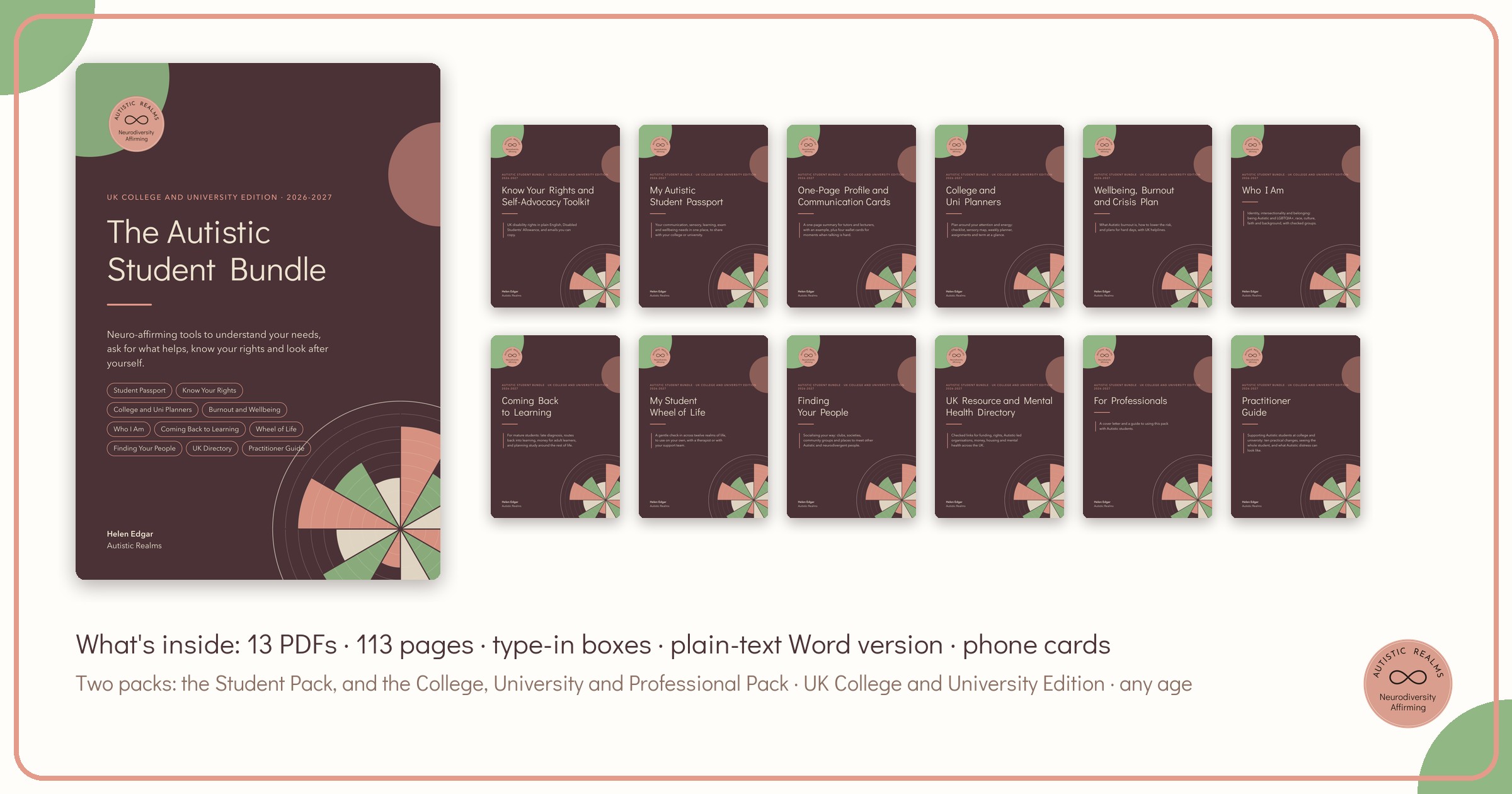
I’ve made a bundle of neuro-affirming tools to help with all of this. It includes the Autistic Student Passport (UK College and University Edition), a one-page profile with a filled-in example, communication cards for your wallet and your phone, a Know Your Rights toolkit with your rights at college in each UK country and emails you can copy, planners built around energy and monotropism rather than just timetables, a guide to what Autistic burnout is and how to lower the risk, a wellbeing and crisis plan, a Student Wheel of Life to use on your own, with a therapist or with your university support team, a new Finding Your People guide to socialising, clubs and community, with checked groups across all four UK countries, two new parts, Who I Am (identity, intersectionality and belonging) and Coming Back to Learning (for mature students), a checked UK resource directory, a Practitioner Guide you can pass on to your tutors and lecturers, and a cover letter and guide for the people who support you. That is thirteen PDFs and 113 pages, with boxes you can type into, notes pages, and a plain-text Word version.
It comes in two packs with the same tools. The Student Pack is ordered for students and costs £9.99, one-off. The College, University and Professional Pack is ordered for staff, starting with the guide for professionals and the Practitioner Guide. It comes with a practitioner licence (£49.99 a year, for one adviser, mentor or tutor to use with the students they support) or a site licence (for one whole site). For a site licence price, or for several sites, please contact me.
Find the Autistic Student Bundle in the Autistic Realms shop →
You deserve to learn in a way that fits how your body and mind work.
Helen
This post is for information and self-advocacy. It isn’t legal advice. Rules and services change, so please check details before relying on them.
References
- Botha, M., & Frost, D. M. (2020). Extending the minority stress model to understand mental health problems experienced by the autistic population. Society and Mental Health, 10(1), 20–34. https://doi.org/10.1177/2156869318804297
- Clouder, L., Karakus, M., Cinotti, A., Ferreyra, M. V., Amador Fierros, G., & Rojo, P. (2020). Neurodiversity in higher education: A narrative synthesis. Higher Education, 80(4), 757–778. https://doi.org/10.1007/s10734-020-00513-6
- Crenshaw, K. (1989). Demarginalizing the intersection of race and sex: A Black feminist critique of antidiscrimination doctrine, feminist theory and antiracist politics. University of Chicago Legal Forum, 1989(1), 139–167.
- Cross, K. (2026, November 4). Autism support without diagnosis is widely offered – but on what terms? Wonkhe. https://wonkhe.com/blogs/autism-support-without-diagnosis-is-widely-offered-but-on-what-terms
- Dexter, S., Grace, K., Quinnell, S.-L., Surrey, A., & Crane, L. (2024). Towards ‘a level playing field’: A participatory study of autistic university students’ experiences with academic support in England. International Journal of Disability, Development and Education, 72(1), 26–41. https://doi.org/10.1080/1034912X.2024.2317475
- Disabled Students UK. (2026). 2025 Access insights report. https://disabledstudents.co.uk/2025-access-insights-report-3/
- Farrant, F., Owen, E., Hunkins-Beckford, F. L., & Jacksa, M. (2022, May 9). Celebrating neurodiversity in higher education. The Psychologist. British Psychological Society. https://www.bps.org.uk/celebrating-neurodiversity-higher-education
- George, R., & Stokes, M. A. (2018). Sexual orientation in autism spectrum disorder. Autism Research, 11(1), 133–141. https://doi.org/10.1002/aur.1892
- Gurbuz, E., Hanley, M., & Riby, D. M. (2019). University students with autism: The social and academic experiences of university in the UK. Journal of Autism and Developmental Disorders, 49(2), 617–631. https://doi.org/10.1007/s10803-018-3741-4
- Lockwood Estrin, G., Milner, V., Spain, D., Happé, F., & Colvert, E. (2021). Barriers to autism spectrum disorder diagnosis for young women and girls: A systematic review. Review Journal of Autism and Developmental Disorders, 8, 454–470. https://doi.org/10.1007/s40489-020-00225-8
- Office for Students. (2026, July 8). National Student Survey 2026 finds students’ views of their experiences of higher education are continuing to improve [Press release]. https://www.officeforstudents.org.uk/news-blog-and-events/press-and-media/national-student-survey-2026-finds-students-views-of-their-experiences-of-higher-education-are-continuing-to-improve/
- Raymaker, D. M., Teo, A. R., Steckler, N. A., Lentz, B., Scharer, M., Delos Santos, A., Kapp, S. K., Hunter, M., Joyce, A., & Nicolaidis, C. (2020). “Having all of your internal resources exhausted beyond measure and being left with no clean-up crew”: Defining autistic burnout. Autism in Adulthood, 2(2), 132–143. https://doi.org/10.1089/aut.2019.0079
- Tai, J., Ajjawi, R., Bearman, M., Boud, D., Dawson, P., & Jorre de St Jorre, T. (2023). Assessment for inclusion: Rethinking contemporary strategies in assessment design. Higher Education Research & Development, 42(2), 483–497. https://doi.org/10.1080/07294360.2022.2057451
- Toogood, C. (2025). What happens next? 2025: A report on the outcomes of disabled graduates from the 2021/22 academic year. Association of Graduate Careers Advisory Services (AGCAS). https://www.agcas.org.uk/Knowledge-Centre/What-Happens-Next-report-2025
- Vincent, J., & Ralston, K. (2024). Uncovering employment outcomes for autistic university graduates in the United Kingdom: An analysis of population data. Autism, 28(3), 732–743. https://doi.org/10.1177/13623613231182756
- Warrier, V., Greenberg, D. M., Weir, E., Buckingham, C., Smith, P., Lai, M.-C., Allison, C., & Baron-Cohen, S. (2020). Elevated rates of autism, other neurodevelopmental and psychiatric diagnoses, and autistic traits in transgender and gender-diverse individuals. Nature Communications, 11, 3959. https://doi.org/10.1038/s41467-020-17794-1
Leave a Reply