
I have always found it easier to understand myself through nature than through clinical language, and trees in particular have taught me a great deal. A tree looks very different in January than it does in July. It responds to light, temperature, water and soil, changing shape and colour as the conditions around it shift. A tree in poor soil, exposed to harsh winds, will struggle however strong its roots may be, while a tree in good conditions can flourish for centuries.
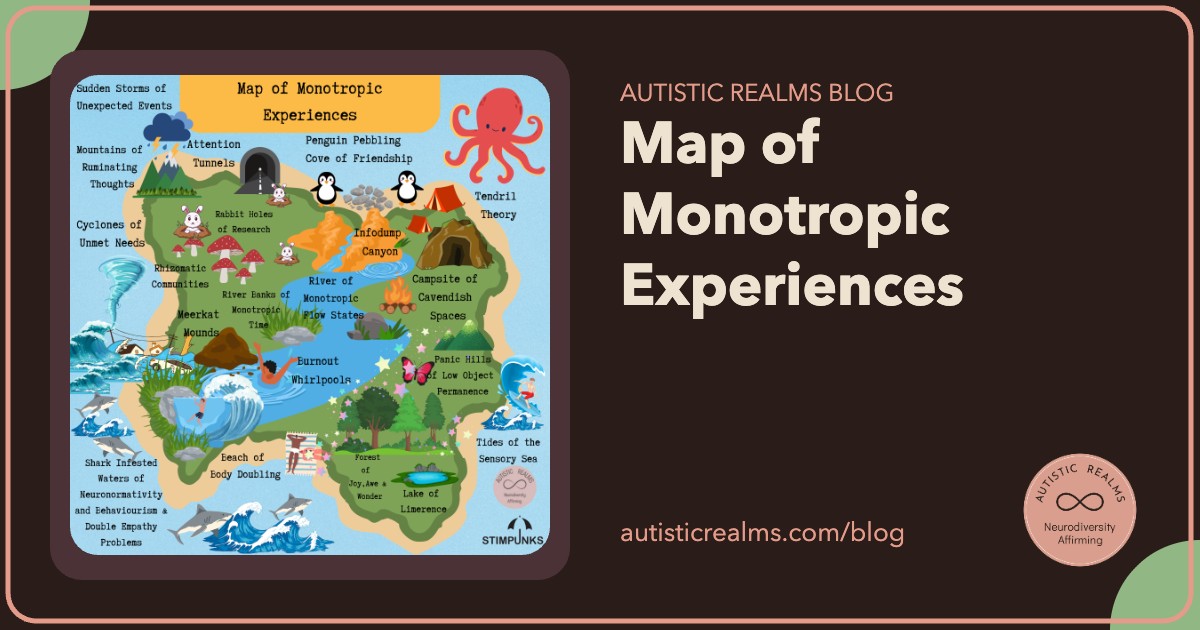
This is why Luke Beardon’s simple equation has stayed with me for so long and is something I share over and over again: Autism + Environment = Outcome (Beardon, 2017). Autism + Environment = Outcome (Beardon, 2017). How Autistic people fare depends enormously on the places, people and pressures around us, and any attempt to understand us in isolation misses most of the picture. When I created my infographic on monotropism and the seasons a couple of years ago, I wanted to bring two ideas together: the attention-based theory of monotropism, and the changing rhythm of the year that shapes all living things. When we shape environments around monotropic needs, Autistic people have a far better chance to thrive.

A Brief Introduction to Monotropism
Monotropism is a theory of autism developed by Dinah Murray, Wenn Lawson and Mike Lesser (Murray et al., 2005). It suggests that Autistic people tend to focus attention intensely on a small number of interests at any one time, drawing our attention resources deeply into whatever matters most to us in that moment. Polytropic people (likely those who are not Autistic or ADHD), tend to spread attention more thinly and evenly across many things at once. Monotropism helps us understand many Autistic experiences, from deep passions and flow states to overwhelm, inertia and burnout, without framing any of them as deficits. It also helps explain why environment matters so much. A monotropic person in a setting that respects their focus will have a very different day than someone who is constantly being pulled in several directions or in a sensory-challenging environment that may be too busy, too loud and just ‘not right’ for them.
Spring: Awakening and Change
Spring is a season of awakening. Buds open, birds return, and the world can seem to change almost overnight. For many monotropic people, this kind of sudden newness feels more unsettling than exciting. When attention is deeply invested in a few channels, an unexpected change asks us to withdraw that attention and redirect it somewhere unfamiliar, and that takes real energy. New timetables, new classrooms, new colleagues and new routines can all land heavily.
Preparation and gradual familiarisation can make a huge difference. Visiting a new place before the first day, looking at photos, talking through what will happen and allowing time to adjust can all help a monotropic person carry their attention into the change at their own pace. Wood (2021) highlights how working with Autistic interests, rather than against them, supports engagement and wellbeing in school. Flexible routines often serve monotropic people better than strict timetables because they leave room for flow and recovery while still offering the predictability many of us need.
Spring also brings a practical challenge that is easy to overlook, because the weather can change from one hour to the next. A cold morning can become a warm afternoon, and heavy, warm clothes that felt right at breakfast can feel unbearable by lunchtime. Interoception, our sense of what is happening inside our bodies, can work differently for Autistic people, so noticing that we are too hot, thirsty or hungry may take longer when our attention is elsewhere. The work of Kelly Mahler and Kieran Rose offers neuro-affirming ways of thinking about interoception. Planning layered flexible clothing, keeping water nearby and building in gentle body check-ins can all help.
Summer: Flourishing and Flow
Summer is the season of flourishing, when trees are full of leaves and life may feel more abundant. It offers a lovely way of picturing what happens when monotropic people are able to follow our passions.
Our monotropic interests are an integral part of who we are and of our Autistic identity, and they are where many of us find joy, meaning, connection and rest.
Rapaport et al. (2024) spoke with Autistic adults about their experiences of becoming fully immersed in tasks. Participants described states that closely matched ideas of flow, hyperfocus and monotropism, and many said that being immersed allowed them to be themselves without pretence. Heasman et al. (2024) have built on this kind of understanding to propose Autistic flow theory, which recognises that Autistic people may be especially well placed to discover and sustain flow. Flow can be deeply regulating. When we are absorbed in something we love, the noise of the world can soften and our nervous systems can settle.
For this to happen, Autistic people need safe spaces where our interests are valued, protected and never used as rewards to be earned. When Autistic people feel safe, have a real sense of belonging and have the opportunity to spend time with our passions, we can thrive. Supporting someone’s summer means protecting their time for flow, joining them in their world with curiosity, and seeing their interests as a genuine source of strength.
Autumn: Letting Go and Transition
Autumn is often described as a season of letting go and fallow fields. Leaves change colour and fall, and the tree begins its slow transition towards winter. Letting go and moving on can be particularly hard for monotropic people.
Many Autistic people experience inertia, a difficulty starting, stopping or switching between tasks or states. Buckle et al. (2021) gathered first-hand accounts of Autistic inertia, and participants described feeling stuck, sometimes for long periods, even when they badly wanted to act.
Inertia is often misread as laziness, defiance or a lack of motivation, and that misunderstanding causes real harm. When a person is repeatedly pushed to switch quickly, or blamed for being unable to start, they may spend huge amounts of energy simply fighting against the way their attention works. Juggling multiple demands in this way, season after season, can lead towards burnout. Exploring monotropism together and validating these experiences as real and understandable is an important part of autumn’s work. Gentle transitions, warnings before changes, visual timers and time to finish something properly can all help a monotropic person move from one tunnel of attention to the next with less distress.
Winter: Rest and Recovery
Winter can be thought of as a time of rest. Trees and fields conserve their energy in the colder months, drawing resources inward and preparing quietly for what comes next.
Being monotropic can be intense, and having to split attention resources across multiple channels day after day is exhausting. Tanya Adkin (2022) describes this as monotropic split, the strain that comes when a monotropic mind is forced to divide its attention again and again without time to recover.
Without meaningful rest, this can lead to Autistic burnout. Arnold et al. (2023) confirmed Autistic burnout as a distinct experience involving chronic exhaustion, a loss of skills and a reduced tolerance to stimulus, often built up through long periods of masking and unmet needs. Rest looks different for monotropic people. For some of us, rest means quiet and darkness. For others it means time immersed in a beloved interest, a familiar film, a favourite stim, a walk along a well-known path, or simply being alone with no demands at all. Sitting still in a busy room can be just as draining as any task if attention is still being pulled in several directions.
Validating Autistic rest is one of the kindest things we can do for one another. We would never expect an oak tree to grow new leaves in December, and in the same way we should not expect Autistic people to keep producing, socialising and switching tasks without time to restore ourselves, regardless of the actual season!
Beneath the Seasons: Roots and Connection
Beneath every season sits a network we rarely see. Trees share nutrients and signals through roots and fungal threads, and Autistic people often find our strength through connection with one another in a similar way. David Gray-Hammond and I have described this as the Autistic Rhizome (Gray-Hammond, 2023; Edgar, 2023), a way of thinking about Autistic community as spreading, interconnected and non-hierarchical. Community can become our soil, offering shared understanding and nourishment whatever the season.
None of us lives in one season all the time. Our lives move through cycles of growth, flourishing, letting go and rest, and those cycles rarely follow the calendar. Someone may be in a deep winter in July, or feel a burst of spring energy in November. Thinking seasonally invites us to ask what each person needs right now, instead of what a timetable says they should be doing. When we shape environments to meet monotropic minds, Autistic people have a far better chance to thrive.
References
Adkin, T. (2022). Guest post: What is monotropic split? Emergent Divergence.
Arnold, S. R. C., Higgins, J. M., Weise, J., Desai, A., Pellicano, E., & Trollor, J. N. (2023). Confirming the nature of autistic burnout. Autism, 27(7), 1906–1918. https://doi.org/10.1177/13623613221147410
Beardon, L. (2017). Autism and Asperger syndrome in adults. Sheldon Press.
Buckle, K. L., Leadbitter, K., Poliakoff, E., & Gowen, E. (2021). “No way out except from external intervention”: First-hand accounts of autistic inertia. Frontiers in Psychology, 12, 631596. https://doi.org/10.3389/fpsyg.2021.631596
Edgar, H. (2023). [Autistic Rhizome: add full reference]
Gray-Hammond, D. (2023, April 21). Neuro-anarchy and the rise of the Autistic Rhizome. NeuroHub Connect. https://neurohubcommunity.org/2023/04/21/neuro-anarchy-and-the-rise-of-the-autistic-rhizome/
Heasman, B., Williams, G., Charura, D., Hamilton, L. G., Milton, D., & Murray, F. (2024). Towards autistic flow theory: A non-pathologising conceptual approach. Journal for the Theory of Social Behaviour. https://doi.org/10.1111/jtsb.12427
Murray, D., Lesser, M., & Lawson, W. (2005). Attention, monotropism and the diagnostic criteria for autism. Autism, 9(2), 139–156. https://doi.org/10.1177/1362361305051398
Rapaport, H., Clapham, H., Adams, J., Lawson, W., Porayska-Pomsta, K., & Pellicano, E. (2024). “In a state of flow”: A qualitative examination of autistic adults’ phenomenological experiences of task immersion. Autism in Adulthood, 6(3), 362–373. https://doi.org/10.1089/aut.2023.0032
Wood, R. (2021). Autism, intense interests and support in school: From wasted efforts to shared understandings. Educational Review, 73(1), 34–54. https://doi.org/10.1080/00131911.2019.1566213