Monotropism is more than a theory. It’s a lived experience for many Autistic people, a key to understanding ourselves, and, for many of us, a route to joy, burnout, and everything in between.
Developed by Dr Dinah Murray, Dr Wenn Lawson and Mike Lesser in the late 1990s, and set out in their 2005 paper (Murray et al., 2005), monotropism offers a framework for understanding how Autistic attention works. It’s a way of describing how some people (especially those who are Autistic or ADHD) experience the world: as a gravitational pull toward one or a few intense interests at a time, rather than a flurry of equally competing tasks.
In this post, inspired by the episode I recorded with the North East Autism Society for their This Is Autism podcast, What is monotropism? (North East Autism Society, 2026), we’ll explore monotropism through seven big questions. We’ll look at how it shows up, how it feels, what the research says, and how we can support each other and our monotropic brains.
What Is Monotropism?
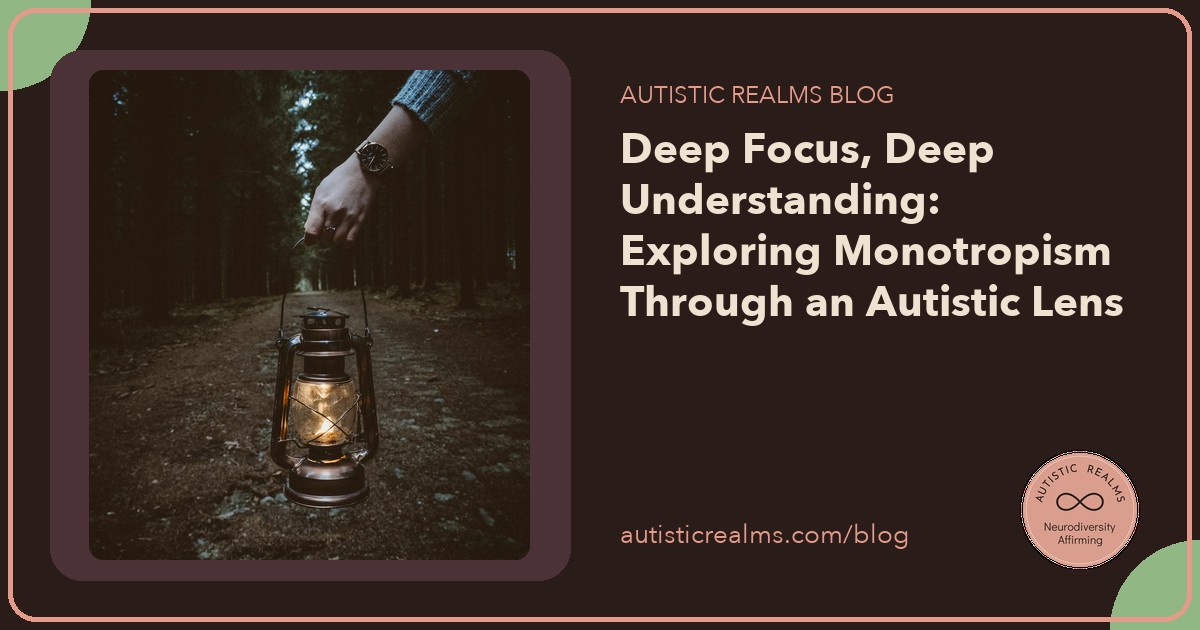
Monotropism is a cognitive style where attention narrows toward one or a few interests, activities, or thoughts at a time, like a laser beam, or a tunnel. It’s more than “strong interest”; it’s being pulled in, intensely and often irresistibly.
Monotropism channels focus in one strong stream, whereas polytropic attention (more common in neurotypical people) spreads and disperses attention across many things at once, often having a wider range but with less depth (Murray, 2018).
This doesn’t mean monotropic thinkers can’t care about more than one thing, but at any given moment, our processing is drawn to depth rather than breadth. This can lead to deep flow states, emotional immersion, and often a web of interconnected interests that evolve and deepen over time, what some may call “constellation thinking.” What others call “obsessing” is often us building meaning through focused energy.
What Does Monotropism Look Like in Daily Life?
Monotropism affects everything, from how we work, learn, play and communicate to how we move through transitions or experience sensory input. It can show up as spending hours immersed in one task or topic (coding, drawing, researching), struggling to switch tasks or stop mid-flow even for important needs like eating, becoming overwhelmed when interrupted or forced to multitask, repeating thoughts or looping through the same ideas until they’re processed, and feeling disoriented after focus is broken, like being “dragged out” of a different world.
This can be misunderstood. A student who doesn’t switch easily between lessons may be seen as inflexible, when they’re actually experiencing cognitive overload. An employee who forgets to eat while working might be viewed as careless, when they’re simply in flow. Rapaport et al. (2024) found that Autistic adults described task immersion as all-encompassing, something deeply valuable that could also make everyday life hard to balance.
These intense focus states can be joyful, but when they clash with chaotic or rigid environments, they can also become painful.
Is Research Into Monotropism Increasing?
Yes, and it’s exciting to see. For a long time, monotropism was mostly discussed only in Autistic-led spaces or in academic circles. That’s changing: a growing body of research is now recognising monotropism as a key part of Autistic cognition, and it is beginning to shape education, health and social care too.
Key developments include the Monotropism Questionnaire, which Garau et al. (2023) developed to measure monotropic attention and which found higher monotropism scores in Autistic people than in non-Autistic people. Research on flow and task immersion links monotropism with intense engagement that can support wellbeing (Heasman et al., 2024; Rapaport et al., 2024), while research on Autistic inertia shows how hard starting, stopping and changing tasks can be (Buckle et al., 2021). Monotropism is also increasingly being used to shape neuro-affirming support in practice (Brosnan & Camilleri, 2025).
Monotropism is far more than a niche idea; it’s becoming central to how we understand Autistic and neurodivergent minds.
What Are the Benefits of Embracing Monotropism?
When supported, monotropism can be a source of immense strength, passion, and joy.
Focus, mastery, and flow. Monotropic minds often develop deep expertise in their areas of interest. When allowed to focus freely, we can enter flow states, where time melts away and creativity flourishes (Csikszentmihalyi, 1990; Heasman et al., 2024). In Rapaport et al.’s (2024) study, Autistic adults described feeling able to “be themselves, with no pretences” when immersed in a task.
Wellbeing and emotional regulation. Monotropic engagement can provide a sense of order, safety, and joy, helping people regulate their emotions in overwhelming environments. Focused activity often reduces anxiety, increases predictability, and offers a grounding sensory experience.
Social connection and authenticity. Sharing a deep interest can lead to authentic social connection, especially in Autistic spaces, where connecting through a passion can feel so much easier than small talk.
Are Autism and ADHD Opposites When It Comes to Attention?
It’s a common myth that Autistic people are monotropic while ADHDers are polytropic, and many people find there is more overlap than contrast. Many ADHDers, and many AuDHDers, describe hyperfocus and difficulty switching tasks, using special interests to reduce anxiety or regulate emotion, and struggling with executive function and overstimulation, all of which fit closely with monotropism. Research is only beginning to explore how monotropism relates to ADHD, and I explore this more in Monotropism vs Polytropism: ADHD, AuDHD & Autistic Attention.
Monotropism helps make sense of this. It’s less about being “distractible” or “obsessed” and more about how attention flows, and what happens when we’re pulled too fast, too far from where our minds naturally sit.
What Are the Challenges for Monotropic Thinkers?
Being monotropic has many strengths, but in the wrong environment without enough support it can leave many people struggling.
Burnout and inertia. Prolonged deep focus without breaks, especially alongside masking and constant demands, can contribute to burnout, a common experience for Autistic people (Raymaker et al., 2020) and for many ADHDers too. Inertia, the difficulty of starting or stopping tasks, is a related challenge, often misunderstood as laziness or defiance (Buckle et al., 2021).
Task switching and transitions. Moving between tasks or environments can feel disorienting, especially when in deep focus, and sudden transitions without warning can be emotionally jarring.
Sensory and social overload. When focus is broken, the flood of external stimuli can feel overwhelming. Social demands often feel incompatible with attention tunnels, leading to missed cues, miscommunication, or withdrawal. Long periods can pass without contact with friends, from focus being elsewhere rather than from lack of care.
How Can We Adapt Environments for Monotropic Thinkers?
Supporting monotropic minds is about listening, adapting, and affirming. Brosnan and Camilleri (2025) argue that neuro-affirmative support should work with an Autistic person’s interests, whether social or non-social, joining them in their attention tunnel rather than pulling them out of it. In practice this might include:
- Low-stimulus environments: quiet spaces, noise-reduction tools, soft lighting, and less visual clutter.
- Time for deep focus: uninterrupted blocks of time for tasks and passions, avoiding frequent switches and respecting focus time.
- Built-in breaks: regular sensory breaks for rest and recalibration that are soothing and person-led, rather than one-size-fits-all.
- Predictable transitions: visual schedules, advance warnings, clear structure, and processing time between activities, mental as well as physical.
- Celebrating deep interests: letting students present projects on their passions, encouraging interest-based collaboration and leadership, and seeing focused engagement as a form of strength.
Monotropism in Schools and Healthcare
In schools, monotropic learners tend to thrive when their attention is supported rather than constantly interrupted. Imagine a student who is completely absorbed in writing a story when the timetable says it is time for maths. Pulling them out abruptly can be genuinely distressing. A ten-minute warning, an agreed point to pause and come back to later, or even weaving some mathematical thinking into the story itself can turn a painful break into a gentler bridge. Learning anchored in a student’s own passions, fewer topics explored in more depth, flexible blocks of time for immersion, and a quiet, low-demand space to recover after intense focus can all make a real difference.
Healthcare can be especially hard for monotropic people. We may have complex needs but struggle to describe them unless we are in the right state, and rapid-fire questions can leave us losing track of what is being asked. Slower, more spacious appointments help, as does the chance to communicate in writing so that we have time to think. Seeing the same clinician where possible builds trust, and calmer rooms support both access and attention. Some of us need to talk briefly about a special interest before we feel safe enough to explain our symptoms, and that can be the doorway into trust. The Autistic SPACE framework (Doherty et al., 2023) offers a helpful structure for healthcare settings, highlighting sensory needs, predictability, acceptance, communication and empathy. Masking can make all of this harder, because many of us have learned to hide our needs in exactly these settings (Pearson & Rose, 2021).
Final Thoughts: Honouring the Monotropic Mind
Monotropism is a way of being rather than a flaw to fix. For many Autistic and ADHD people, it’s the rhythm of our thoughts, the anchor of our wellbeing, the shape of our joy.
To embrace monotropism is to affirm that minds move at different paces and flow in different directions, and that this is okay, and powerful.
Let’s build environments where deep focus is valued, attention tunnels are honoured, and every neurodivergent person is given the space to thrive because of how they think.
References
Brosnan, M., & Camilleri, L. J. (2025). Neuro-affirmative support for autism, the double empathy problem and monotropism. Frontiers in Psychiatry, 16, Article 1538875. https://doi.org/10.3389/fpsyt.2025.1538875
Buckle, K. L., Leadbitter, K., Poliakoff, E., & Gowen, E. (2021). “No way out except from external intervention”: First-hand accounts of autistic inertia. Frontiers in Psychology, 12, Article 631596. https://doi.org/10.3389/fpsyg.2021.631596
Csikszentmihalyi, M. (1990). Flow: The psychology of optimal experience. Harper & Row.
Doherty, M., McCowan, S., & Shaw, S. C. K. (2023). Autistic SPACE: A novel framework for meeting the needs of autistic people in healthcare settings. British Journal of Hospital Medicine, 84(4), 1–9. https://doi.org/10.12968/hmed.2023.0006
Garau, V., Murray, A. L., Woods, R., Chown, N., Hallett, S., Murray, F., Wood, R., & Fletcher-Watson, S. (2023). Development and validation of a novel self-report measure of monotropism in autistic and non-autistic people: The Monotropism Questionnaire [Preprint]. OSF Preprints. https://doi.org/10.31219/osf.io/ft73y
Heasman, B., Williams, G., Charura, D., Hamilton, L. G., Milton, D., & Murray, F. (2024). Towards autistic flow theory: A non-pathologising conceptual approach. Journal for the Theory of Social Behaviour, 54(4), 469–497. https://doi.org/10.1111/jtsb.12427
Murray, D., Lesser, M., & Lawson, W. (2005). Attention, monotropism and the diagnostic criteria for autism. Autism, 9(2), 139–156. https://doi.org/10.1177/1362361305051398
Murray, F. (2018, November 30). Me and monotropism: A unified theory of autism. The Psychologist. https://bps.org.uk/psychologist/me-and-monotropism-unified-theory-autism
North East Autism Society. (2026, July 10). What is monotropism? [Audio podcast episode]. In This is autism. Apple Podcasts. https://podcasts.apple.com/us/podcast/what-is-monotropism/id1644092432?i=1000776254925
Pearson, A., & Rose, K. (2021). A conceptual analysis of autistic masking: Understanding the narrative of stigma and the illusion of choice. Autism in Adulthood, 3(1), 52–60. https://doi.org/10.1089/aut.2020.0043
Rapaport, H., Clapham, H., Adams, J., Lawson, W., Porayska-Pomsta, K., & Pellicano, E. (2024). “In a state of flow”: A qualitative examination of autistic adults’ phenomenological experiences of task immersion. Autism in Adulthood, 6(3), 362–373. https://doi.org/10.1089/aut.2023.0032
Raymaker, D. M., Teo, A. R., Steckler, N. A., Lentz, B., Scharer, M., Delos Santos, A., Kapp, S. K., Hunter, M., Joyce, A., & Nicolaidis, C. (2020). “Having all of your internal resources exhausted beyond measure and being left with no clean-up crew”: Defining autistic burnout. Autism in Adulthood, 2(2), 132–143. https://doi.org/10.1089/aut.2019.0079