Helen Edgar and Ryan Boren · November 2026
Inspired by building the Cavendish Primary Classroom on Stimpunks.World with Ryan Boren in November 2026, and by the chapter on neuroqueer learning spaces we have written together (Edgar & Boren, in press).
Kneeling down
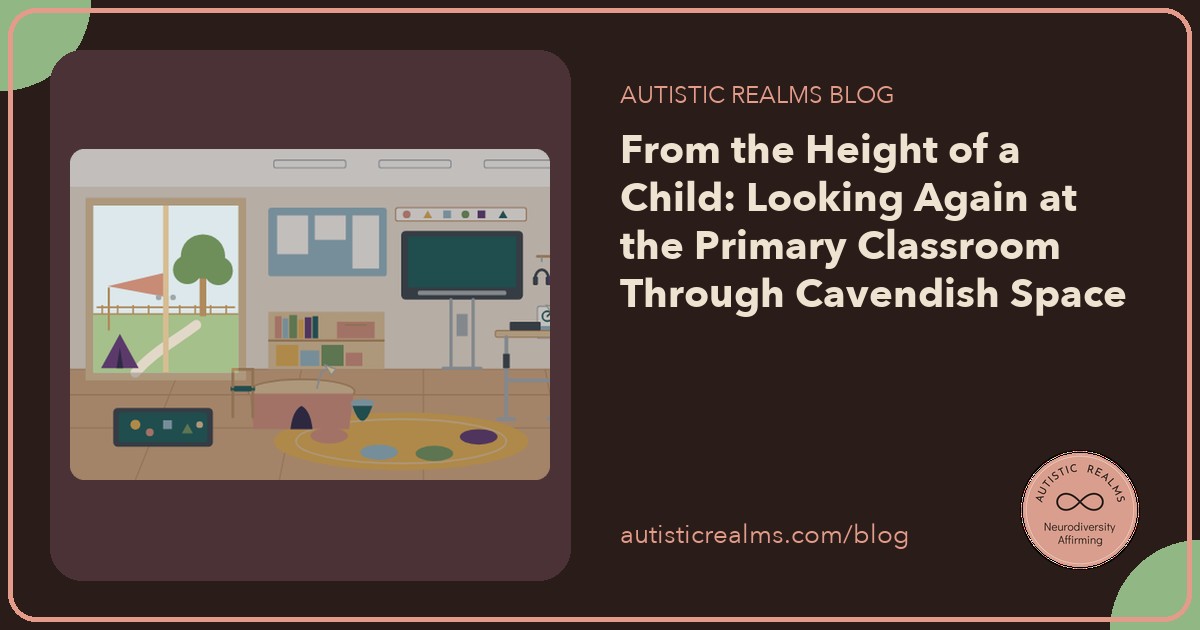
If you kneel on a classroom floor until your eyes are about a metre from the ground, the room changes. The tables are at your chin, the displays are a long way up, the adults are mostly legs and voices, and the door to the outside, if there is one, is the brightest thing you can see. This is the height of a child of seven, and it is the height from which we drew the Cavendish Primary Classroom, an example mainstream room for a class of thirty, built as somewhere for people training to teach to walk around in and argue with.
I come to it as a late-identified Autistic and ADHD person, a parent of neurodivergent children, and a teacher who worked for over twenty years in early years, primary and SEND settings, including with children described as having profound and multiple learning disabilities. I was trained in reward charts and sanctions, and I used them before I knew better. So this is not a neutral review. I helped to make the room, and I want to look at it honestly from four directions: Universal Design for Learning, Cavendish Space, anti-behaviourism and neuroqueer learning spaces. What can each of them see from down here, and what might each of them miss?
What is in the room, and what if the room is small?
The room has garden doors glazed to the floor, lamps on a dimmer that start switched off, blinds, a fan, and walls left mostly bare. There are standing desks, ordinary chairs, wobble stools, beanbags and floor cushions, so that there are more places to be than there are children. There are three caves: a cloth over a frame in the far corner, a den under a table and a small tent in the garden. There is a movement corner with a crash mat, a balance board and a rocking chair. Nobody is drawn in it, because it is set up for whoever comes in.
It is a roomy example, and most classrooms are not roomy. Thirty children fill a room quickly, and I do not think the answer is guilt about floor space. What matters is that every child can reach each kind of place, not that every room holds all of them. The small things can live in every classroom: headphones on a hook, a basket of fidgets, a wobble cushion, a lamp turned down, one nook under a table. The big things can be shared in the hall, a wide corridor, a spare room or outdoors, as long as getting there is easy and nobody has to explain themselves or wait until break.
What Universal Design for Learning can see
Universal design began in architecture, as design that is “usable by all people, to the greatest extent possible, without the need for adaptation or specialized design” (Center for Universal Design, 1997). Universal Design for Learning carries that into teaching, and CAST (2024) asks for multiple means of engagement, of representation, and of action and expression. From a child’s height the room does well by this. Light, sound, seating and place can all be changed, the timetable is in pictures as well as words, captions are on, signing and symbols sit beside speech, and nothing that helps is kept back for children with a label.
There is some research to stand on, and I want to be careful with it. Barrett et al. (2015) studied 153 primary classrooms in England and report that “seven key design parameters have been identified that together explain 16% of the variation in pupils’ academic progress achieved” (p. 118): light, temperature, air quality, ownership, flexibility, complexity and colour. That figure is a share of the range of progress across the classrooms they measured, not a promise about any one room, and the stimulation they recommend is an appropriate level, not the lowest possible, which is a caution against stripping a room bare. Fisher et al. (2014) found that kindergarten children “spent more time off task, and demonstrated smaller learning gains when the walls were highly decorated than when the decorations were removed” (p. 1362), but that was a laboratory classroom, and neither study was about Autistic children.
The evidence for UDL itself is modest. Capp (2017) concluded that it improves the process of learning while an effect on outcomes had not yet been shown, and King-Sears et al. (2023) later found a moderate positive effect on achievement across twenty controlled studies, while Boysen (2024) compares it uncomfortably with learning styles. Flexible seating is thinner still: Attai et al. (2021) found more satisfaction and autonomy and did not report attainment, and Bluteau et al. (2022) found mixed effects on wellbeing. So I do not think we can honestly say this room will raise attainment. I think we can say it widens the ways in. What UDL cannot easily see is who holds the controls, because it is usually something a teacher designs for children, and Hamraie (2017) reminds us that there is a politics to who the “universal” user is imagined to be.
What Cavendish Space can see
Cavendish Space starts from that question. Its shortest version is that “you meet a need by shaping the surroundings, not by changing the person” (Cavendish Space, n.d.-c), and it zones a room into five places: the cave, the campfire and the watering hole, which are Thornburg’s (2014) primordial learning spaces, and the library and the habitat, which complete them. In this room the caves are for being alone and low, the campfire is a small circle on the rug, the watering hole is the tables and the tray of loose parts, the library is the shelf and the picture timetable, and the habitat is the whole room and its garden.
It is also where the room meets sensory difference most directly. Dunn (1997) describes seeking and avoiding as patterns of responding, not kinds of child, and the same child may seek movement and avoid noise within the same hour. The first version of this room was dim, soft and quiet, which suits a child who is overwhelmed and leaves out a child whose bodymind needs more, so the movement corner, the heavy jobs, the chew tools and the garden were added for them. Sensory experience shapes school life for Autistic pupils: Ashburner et al. (2008) found associations between sensory processing and classroom outcomes in a small sample, the parents and teachers in Jones et al. (2020) described distraction and distress, and the young people who spoke with Goodall (2018) described mainstream school as hostile to their senses and asked for simple changes. Mostafa (2014) offers design principles that point the same way. Stimming belongs here too. Autistic adults told Kapp et al. (2019) that it regulates them and that they object to having it trained away, and I have written about it as an embodied sensory language (Edgar, 2026a).
The ethics matter as much as the furniture. A card lies face down until a child turns it, because “The turn is the consent” (Cavendish Space, n.d.-d), and “Nothing here sorts a child. Everything here sorts the room” (Cavendish Space, n.d.-b). The risk I can see from the floor is capture. A cave becomes a time-out the moment an adult sends a child into it, and a crash mat becomes a reward the moment it has to be earned. The furniture cannot prevent that. Only the adults can.
What anti-behaviourism refuses
This is why the room carries a list of things it will not do: no “behaviour” chart, no traffic lights, no taking away play, breaks, the garden or the cave, no rewards for sitting still or looking at the speaker, and no asking permission to drink, move or go to the toilet. The cave is “A retreat, never a time-out” (Cavendish Space, n.d.-a).
Kohn (1993) set out the case against rewards decades ago, and Deci et al. (1999), in a meta-analysis of 128 experiments, found that expected tangible rewards reduced intrinsic motivation, with stronger effects for children. Those were mostly experiments and not classrooms, so I hold them carefully, but they sit beside self-determination theory, in which autonomy, competence and relatedness are needs to be met and not privileges to be earned (Ryan & Deci, 2000). For Autistic children the stakes are higher. Walker (2021, as quoted in Boren & Edgar, 2024) describes freedom of embodiment as an essential element of cognitive liberty, and I have written elsewhere that compliance is not connection (Edgar, 2025a) and that teacher training still leans on behaviourist compliance (Adkin & Edgar, 2025). Stimpunks keeps a growing library of the research on this (Stimpunks Foundation, n.d.).
What the room cannot do is remove behaviourism from a school. A classroom like this inside a school with a points system, public sanctions and attendance rewards is a cave in a storm. Interest-led learning can be captured too, when a child’s passion becomes leverage, something offered after the “real” work, and I have argued that interest-led is not enough without an understanding of monotropism (Edgar, 2025b). So an honest appraisal has to look at the school’s policy as closely as the room’s design.
What neuroqueering asks of us
Neuroqueer learning spaces ask for something more unsettling than good design. Walker (2021, as quoted in Boren & Edgar, 2024) writes that “The classroom must be declared a zone of freedom from the dominant culture’s pervasive requirement that everyone strive to constantly perform neuronormativity” (pp. 152–153), and that conflicts between access needs “should be negotiated in class as part of the learning process” (p. 152). The room makes space for that. When one child needs the lamps up and another needs them down, the answer is a task lamp, a different place and a conversation, not a rule.
Yet a room designed by two adults is still designed by adults. Neuroqueering is a practice, not a floor plan, and I worry about the day a “Cavendish classroom” becomes a checklist, a new “normal” to be inspected. In our chapter we describe the Neuroqueer Space Holder, an adult who is trusted one to one, keeps the whole group safe and co-regulates instead of controlling (Edgar & Boren, in press), and I think regulation grows from those relationships more than from any corner of a room (Edgar, 2026b). Monotropism (Murray et al., 2005) and the double empathy problem (Milton, 2012) are theories that are true to my own life, and there is growing evidence for the second (Crompton et al., 2020), but the people who should be shaping this room are the children in it. Fletcher-Watson et al. (2019) make that case for research, and I think it holds for classrooms.
A day that bends
A room that changes needs a day that can bend. The anchors stay fixed so that the day is predictable, and the middle flexes around the children. This is one example, and the times are approximate.
| Roughly | What happens | How it flexes |
|---|---|---|
| 8:30–9:00 | Soft start: arrive and settle in any place | The register is taken quietly |
| 9:00–9:15 | Campfire: plan the day on the picture timetable | Join from the rug, the edge or a cave |
| 9:15–10:30 | Learning block, with choices of how to work and how to show it | Breaks taken when needed, never earned |
| 10:30–10:50 | Watering hole outdoors | The caves stay open |
| 10:50–12:00 | Interest-led project time | Nobody is moved on mid-flow |
| 12:00–13:20 | Lunch, play and a quiet return | A quiet table, or the classroom with a friend |
| 13:20–14:40 | Learning block, often outdoors, or more project time | A choice of task |
| 14:40–15:15 | Show and share, then a campfire close | Showing is always optional |
Interest-led time follows what I have called the wandering line, which may be the learning itself (Edgar, 2026d), and monotropic attention needs long, unbroken stretches to find flow and wonder (Edgar, 2026c). A flexible day is not a looser day for every child. Some children need the same order every day, and choice can itself be a demand, so changes are warned of in words and pictures and sameness is always on offer.
The whole school as habitat
One classroom is only one example. Children spend their days in corridors, halls, dining rooms and playgrounds, and our chapter asks for caves, campfires and watering holes everywhere, indoors and out (Edgar & Boren, in press). Most schools already have them. A cave might be a nook behind the library shelves, a quiet room off the corridor that is never locked and never a place a child is sent, the edge of the hall during assembly, a willow den or a bench under a tree. A campfire might be a story corner, a small group room, the nurture room’s table, a lunchtime club or a circle of logs at forest school. A watering hole might be the playground, the library at lunchtime, an art room left open or the school garden.
Nair et al. (2009) wrote about solitude as the place where learning is taken in, and McGoldrick et al. (2025) have carried the Autistic SPACE framework into schools. The habitat is then the whole building: quiet routes, no bells, soft light, signs in symbols, staff who have a cave of their own, and a door to the outside wherever one can be had.
What I am still wondering
This is a design argument and not an evaluation. Nobody has measured what happens to children in this room, most of the studies I have leaned on were not about Autistic pupils, and several of the ideas are theories or lived knowledge, not trial findings. I think that is an honest place to begin as long as we say so. I wonder what children would change first. I wonder how belonging, attendance, distress and joy would look after a year, in the children’s own words and ways of communicating. I wonder how much of this survives a curriculum and an inspection system that still ask for stillness and sameness, and what teachers need in order to hold it.
Getting back up
When I get up off the floor, the room looks ordinary again, and I think that is the point. Nothing in it is expensive or new: a cloth over a table, a lamp turned down, a mat in a corner, a door left open, a day with room in it. Universal Design for Learning widens the ways in, Cavendish Space hands over the dial, anti-behaviourism refuses to make any of it conditional, and neuroqueering asks us to keep unlearning what a classroom is for. “Regulation comes before instruction. Environment is curriculum” (Cavendish Space, n.d.-d).
We need schools where every child, whether their bodymind needs less or more, can find a place that fits without having to earn it or explain it. The cards, the guidebooks and Place Explorers are free at cavendish.space. I hope you kneel down in your own room this week and see what is there.
References
Adkin, T., & Edgar, H. (2025, March 24). Neuro-affirming research in practice: Supporting Autistic students, embracing monotropism in the classroom and beyond. Autistic Realms. https://autisticrealms.com/neuro-affirming-research-in-practice-supporting-autistic-students-embracing-monotropism-in-the-classroom-and-beyond/
Ashburner, J., Ziviani, J., & Rodger, S. (2008). Sensory processing and classroom emotional, behavioral, and educational outcomes in children with autism spectrum disorder. American Journal of Occupational Therapy, 62(5), 564–573. https://doi.org/10.5014/ajot.62.5.564
Attai, S. L., Reyes, J. C., Davis, J. L., York, J., Ranney, K., & Hyde, T. W. (2021). Investigating the impact of flexible furniture in the elementary classroom. Learning Environments Research, 24(2), 153–167. https://doi.org/10.1007/s10984-020-09322-1
Barrett, P., Davies, F., Zhang, Y., & Barrett, L. (2015). The impact of classroom design on pupils’ learning: Final results of a holistic, multi-level analysis. Building and Environment, 89, 118–133. https://doi.org/10.1016/j.buildenv.2015.02.013
Bluteau, J., Aubenas, S., & Dufour, F. (2022). Influence of flexible classroom seating on the wellbeing and mental health of upper elementary school students: A gender analysis. Frontiers in Psychology, 13, Article 821227. https://doi.org/10.3389/fpsyg.2022.821227
Boren, R., & Edgar, H. (2024, May 11). Neuroqueer learning spaces manifesto. Stimpunks Foundation. https://stimpunks.org/projects/neuroqueer-learning-spaces/manifesto/
Boysen, G. A. (2024). Lessons (not) learned: The troubling similarities between learning styles and universal design for learning. Scholarship of Teaching and Learning in Psychology, 10(2), 207–221. https://doi.org/10.1037/stl0000280
Capp, M. J. (2017). The effectiveness of universal design for learning: A meta-analysis of literature between 2013 and 2016. International Journal of Inclusive Education, 21(8), 791–807. https://doi.org/10.1080/13603116.2017.1325074
CAST. (2024). Universal Design for Learning guidelines (Version 3.0). https://udlguidelines.cast.org
Cavendish Space. (n.d.-a). Implementation. Stimpunks Foundation. Retrieved November 11, 2026, from https://cavendish.space/implementation
Cavendish Space. (n.d.-b). Place explorers. Stimpunks Foundation. Retrieved November 11, 2026, from https://cavendish.space/place-explorers
Cavendish Space. (n.d.-c). The space. Stimpunks Foundation. Retrieved November 11, 2026, from https://cavendish.space/space
Cavendish Space. (n.d.-d). Why. Stimpunks Foundation. Retrieved November 11, 2026, from https://cavendish.space/why
Center for Universal Design. (1997). The principles of universal design (Version 2.0). North Carolina State University. https://design.ncsu.edu/research/center-for-universal-design/
Crompton, C. J., Ropar, D., Evans-Williams, C. V. M., Flynn, E. G., & Fletcher-Watson, S. (2020). Autistic peer-to-peer information transfer is highly effective. Autism, 24(7), 1704–1712. https://doi.org/10.1177/1362361320919286
Deci, E. L., Koestner, R., & Ryan, R. M. (1999). A meta-analytic review of experiments examining the effects of extrinsic rewards on intrinsic motivation. Psychological Bulletin, 125(6), 627–668. https://doi.org/10.1037/0033-2909.125.6.627
Dunn, W. (1997). The impact of sensory processing abilities on the daily lives of young children and their families: A conceptual model. Infants & Young Children, 9(4), 23–35. https://doi.org/10.1097/00001163-199704000-00005
Edgar, H. (2025a, August 2). Why PBS is harmful for Autistic and neurodivergent young people. Autistic Realms. https://autisticrealms.com/why-pbs-is-harmful-for-autistic-and-neurodivergent-young-people/
Edgar, H. (2025b, October 12). Why “interest-led” isn’t enough: Embracing monotropism & neuro-affirming practice. Autistic Realms. https://autisticrealms.com/why-interest-led-isnt-enough-embracing-monotropism-neuro-affirming-practice/
Edgar, H. (2026a, January 25). Stimming as embodied sensory language. Autistic Realms. https://autisticrealms.com/stimming-as-embodied-sensory-language/
Edgar, H. (2026b, May 14). Building neurodivergent-affirming cultures of regulation: Reflections from a Cavendish Space workshop. Autistic Realms. https://autisticrealms.com/building-neurodivergent-affirming-cultures-of-regulation-reflections-from-a-cavendish-space-workshop/
Edgar, H. (2026c, October 11). Awe, wonder and monotropic attention in neuroqueer learning spaces. Autistic Realms. https://autisticrealms.com/awe-wonder-and-monotropic-attention-in-neuroqueer-learning-spaces/
Edgar, H. (2026d, November 8). Autistic children’s learning: Deligny, desire lines and why Cavendish Space matters. Autistic Realms. https://autisticrealms.com/deligny-desire-lines-cavendish-space/
Edgar, H., & Boren, R. (in press). Neuroqueer learning spaces. In N. Walker (Ed.), Neuroqueer theory and practice. Autonomous Press.
Fisher, A. V., Godwin, K. E., & Seltman, H. (2014). Visual environment, attention allocation, and learning in young children: When too much of a good thing may be bad. Psychological Science, 25(7), 1362–1370. https://doi.org/10.1177/0956797614533801
Fletcher-Watson, S., Adams, J., Brook, K., Charman, T., Crane, L., Cusack, J., Leekam, S., Milton, D., Parr, J. R., & Pellicano, E. (2019). Making the future together: Shaping autism research through meaningful participation. Autism, 23(4), 943–953. https://doi.org/10.1177/1362361318786721
Goodall, C. (2018). ‘I felt closed in and like I couldn’t breathe’: A qualitative study exploring the mainstream educational experiences of autistic young people. Autism & Developmental Language Impairments, 3, Article 2396941518804407. https://doi.org/10.1177/2396941518804407
Hamraie, A. (2017). Building access: Universal design and the politics of disability. University of Minnesota Press. https://doi.org/10.5749/minnesota/9781517901639.001.0001
Jones, E. K., Hanley, M., & Riby, D. M. (2020). Distraction, distress and diversity: Exploring the impact of sensory processing differences on learning and school life for pupils with autism spectrum disorders. Research in Autism Spectrum Disorders, 72, Article 101515. https://doi.org/10.1016/j.rasd.2020.101515
Kapp, S. K., Steward, R., Crane, L., Elliott, D., Elphick, C., Pellicano, E., & Russell, G. (2019). ‘People should be allowed to do what they like’: Autistic adults’ views and experiences of stimming. Autism, 23(7), 1782–1792. https://doi.org/10.1177/1362361319829628
King-Sears, M. E., Stefanidis, A., Evmenova, A. S., Rao, K., Mergen, R. L., Owen, L. S., & Strimel, M. M. (2023). Achievement of learners receiving UDL instruction: A meta-analysis. Teaching and Teacher Education, 122, Article 103956. https://doi.org/10.1016/j.tate.2022.103956
Kohn, A. (1993). Punished by rewards: The trouble with gold stars, incentive plans, A’s, praise, and other bribes. Houghton Mifflin.
McGoldrick, E., Munroe, A., Ferguson, R., Byrne, C., & Doherty, M. (2025). Autistic SPACE for inclusive education. Neurodiversity, 3, Article 27546330251370655. https://doi.org/10.1177/27546330251370655
Milton, D. E. M. (2012). On the ontological status of autism: The ‘double empathy problem’. Disability & Society, 27(6), 883–887. https://doi.org/10.1080/09687599.2012.710008
Mostafa, M. (2014). Architecture for autism: Autism ASPECTSS in school design. International Journal of Architectural Research: ArchNet-IJAR, 8(1), 143–158. https://doi.org/10.26687/archnet-ijar.v8i1.314
Murray, D., Lesser, M., & Lawson, W. (2005). Attention, monotropism and the diagnostic criteria for autism. Autism, 9(2), 139–156. https://doi.org/10.1177/1362361305051398
Nair, P., Fielding, R., & Lackney, J. (2009). The language of school design: Design patterns for 21st century schools (Rev. ed.). DesignShare.
Ryan, R. M., & Deci, E. L. (2000). Self-determination theory and the facilitation of intrinsic motivation, social development, and well-being. American Psychologist, 55(1), 68–78. https://doi.org/10.1037/0003-066X.55.1.68
Stimpunks Foundation. (n.d.). Behaviorism. Retrieved November 11, 2026, from https://stimpunks.org/glossary/behaviorism/
Thornburg, D. (2014). From the campfire to the holodeck: Creating engaging and powerful 21st century learning environments. Jossey-Bass.
Walker, N. (2021). Neuroqueer heresies: Notes on the neurodiversity paradigm, autistic empowerment, and postnormal possibilities. Autonomous Press.