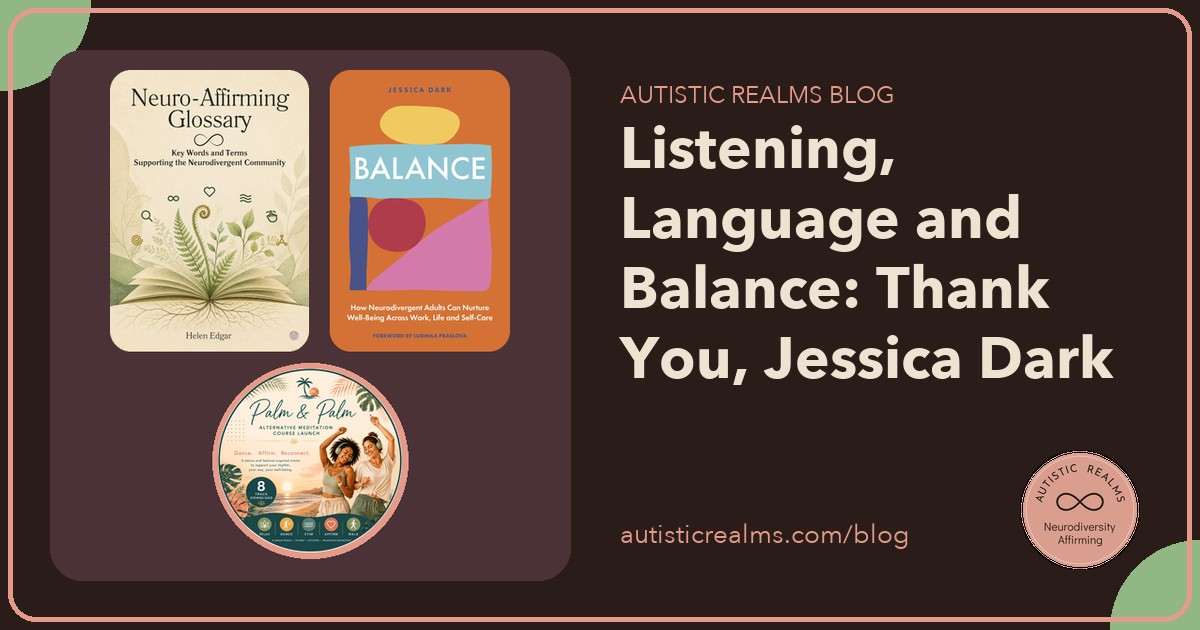
Autistic Realms: Listening, Language and Balance: Thank You, Jessica Dark. The Neuro-Affirming Glossary by Helen Edgar and Balance by Jessica Dark, with Jessica's Palm & Palm alternative meditation course

Listening, Language and Balance: Thank You, Jessica Dark

This week Jessica Dark, founder of ND Perspective, published a thoughtful article, Listening to Our Autistic Communities: Why Language and Lived Experience Matter. In it she writes about my Neuro-Affirming Glossary of Key Words and Terms, and I am so grateful.

Why our words matter

Jessica explores how words shared by Autistic people, such as stimming, masking and monotropism, hold meaning that clinical terms can miss. She draws on the idea of epistemic justice: whose knowledge is believed, and whose is overlooked. She also writes about access intimacy, named by Mia Mingus, and neuro-kinship, the recognition we find in community spaces. Both sit close to Access Intimacy and Neurokin in the Glossary.

About the Glossary she writes: “I particularly value resources such as Helen’s because they create opportunities for practitioners and researchers to engage more meaningfully with autistic community expression.” She is also clear that it is “a starting point for learning rather than a definitive account”. That is exactly how I hope people use it, and why every word is marked Starting point or Going deeper. Our language keeps changing, and it belongs to all of us.

Balance

Jessica’s new book, Balance: How Neurodivergent Adults Can Nurture Well-Being Across Work, Life and Self-Care, is out on 19 November 2026 from Jessica Kingsley Publishers. I was honoured to read it early and to endorse it:

“Jessica Dark offers a radically affirming guide to the fluctuating realities of being neurodivergent. She explores energy, focus, flow, communication, sensory and executive functioning needs. Balance moves beyond neuronormative expectations, grounding practical strategies for work, home, and self-care in lived experience and community knowledge – for a life of thriving and belonging. Highly recommended. I wish I’d read this years ago!”

Helen Edgar, Founder, Autistic Realms

For me, the Glossary and Balance fit together. The Glossary gives us shared words for our experiences. Balance helps us carry that understanding into everyday life: energy, sensory needs, planning, stress and support, at work, at home and in self-care.

Join the launch

Jessica is hosting A Day of Balance online on Saturday 28 November 2026: three one-hour sessions (9am, 2pm and 6pm GMT), with recordings afterwards. An all-day pass is £5, or £20 with a signed copy. She has also just launched Palm & Palm, an alternative meditation course set to dance and festival beats for busy brains. Move, stim, dance or simply listen.

Find out more

Thank you, Jessica, for listening, and for helping more people to listen too.

Latest Posts

  • Autistic Burnout – Supporting Young People At Home & School

    Autistic Burnout – Supporting Young People At Home & School

    Autistic burnout in young people is real—and recovery starts with understanding. This post offers neuroaffirming ways to spot the signs, reduce demands, and truly support. 💛 #AutisticBurnout #Neuroaffirming #Monotropism #AutisticSupport


  • Monotropic Interests and Looping Thoughts

    Monotropic Interests and Looping Thoughts

    The theory of monotropism was developed by Murray, Lawson and Lesser in their article, Attention, monotropism and the diagnostic criteria for autism (2005). ​ Monotropism is increasingly considered to be the underlying principle behind autism and is becoming more widely recognised, especially within autistic and neurodivergent communities. Fergus Murray, in their article Me and Monotropism:…


  • Map of Monotropic Experiences

    Map of Monotropic Experiences

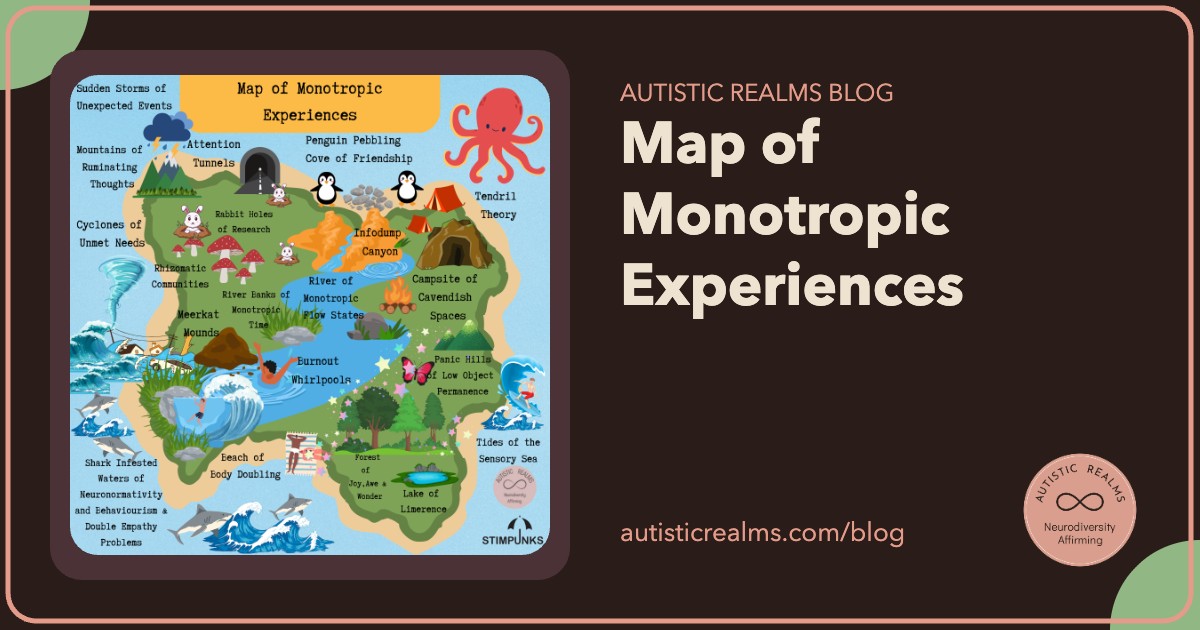
    The Map of Monotropic Experiences now has a home of its own. Visit monotropicmap.org to explore each of the twenty areas, mark your own map and find the free training. You can also find the free training and downloads further down this page. Monotropism seeks to explain Autism in terms of attention distribution and interests. …


  • The Double Empathy Problem is DEEP

    The Double Empathy Problem is DEEP

    “The growing cracks in the thin veneer of our “civilised” economic and social operating model are impossible to ignore”, Jorn Bettin (2021). The double empathy problem (Milton, 2012) creates a gap of disconnect experienced between people due to misunderstood shared lived experiences. It is “a breakdown in reciprocity and mutual understanding that can happen between people…


  • Top 5 Neurodivergent-Informed Strategies

    Top 5 Neurodivergent-Informed Strategies

    Top 5 Neurodivergent-Informed Strategies By Helen Edgar, Autistic Realms, June 2024. 1. Be Kind Take time to listen and be with people in meaningful ways to help bridge the Double Empathy Problem (Milton, 2012). Be embodied and listen not only to people’s words but also to their bodies and sensory systems. Be responsive to people’s…


  • Autistic Community: Connections and Becoming

    Autistic Community: Connections and Becoming

    Everyone seeks connection in some way or another. Connections may look different for autistic people. In line with the motto from Anna Freud’s National Autism Trainer Programme (Acceptance, Belonging and Connection), creating a sense of acceptance and belonging is likely to be more meaningful for autistic people than putting pressure on them to try and…


  • Monotropism, Autism & OCD

    Monotropism, Autism & OCD

    Exploring similarities and differences between Autistic and OCD monotropic flow states. Can attention tunnels freeze, and thoughts get stuck?


  • Monotropism Questionnaire: Take It and Understand Your Results

    Monotropism Questionnaire: Take It and Understand Your Results

     Post first published 28th July 2023 Over the past few weeks, there has been a sudden surge of interest in the Monotropism Questionnaire (MQ), pre-print released in June 2023 in the research paper ‘Development and Validation of a Novel Self-Report Measure of Monotropism in Autistic and Non-Autistic People: The Monotropism Questionnaire.‘ by Garau, V., Murray,…


  • Penguin Pebbling: An Autistic Love Language

    Penguin Pebbling: An Autistic Love Language

    Penguin Pebbling is a neurodivergent way of showing you care, like sharing a meme or twig or pretty stone to say “I’m thinking of you,” inspired by penguins who gift pebbles to those they care about.


  • Listening, Language and Balance: Thank You, Jessica Dark

    Listening, Language and Balance: Thank You, Jessica Dark

    Jessica Dark writes about the Neuro-Affirming Glossary and why Autistic community language matters, and her new book Balance is out on 19 November 2026.


  • Rewriting My Story: Understanding Myself Through Monotropism

    Rewriting My Story: Understanding Myself Through Monotropism

    How discovering I am Autistic and monotropic in my 40s has helped me restory burnout, masking, deep focus and a lifetime of books, with kindness and curiosity.


  • Whose “Normal”? Reimagining Connection and Belonging for Children with Profound and Multiple Learning Disabilities

    Whose “Normal”? Reimagining Connection and Belonging for Children with Profound and Multiple Learning Disabilities

    What would relational ecosystems look like if they began with children with profound and multiple learning disabilities? Helen Edgar reads five PBS and ABA blind spots through the lens of PMLD, sensory being and love.


WordPress Cookie Plugin by Real Cookie Banner