When Teo from SendWise Hub asked me, “How are you rewriting your story now that you know you’re Autistic?” I thought, oooooh, interesting!
It isn’t a question with a simple answer. It keeps unfolding and spiralling, opening and closing. Just when I think I’ve grasped something solid, another layer reveals itself. It feels a bit like trying to remember and put words to hazy things I have always known but never had the language for, and then suddenly the lights start coming on.
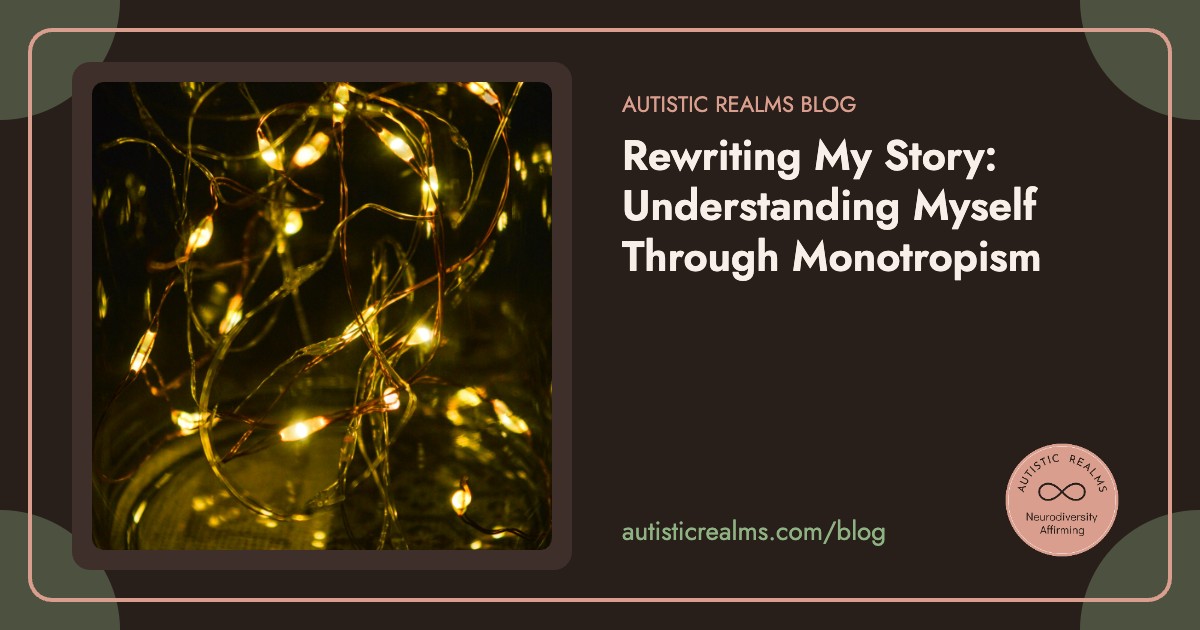
Since discovering I’m Autistic, it has been like a tangled string of fairy lights slowly lighting up inside me. I remember describing this feeling back in 2021, when I first joined Kieran Rose’s Inside of Autism course (which was amazing and life changing!). I wrote in the chat that it felt like the Blackpool Illuminations inside my head. I had sudden clarity; it was unexpected, a bit overwhelming and somehow familiar all at once. It wasn’t that everything suddenly made complete sense or that I had an answer for everything, but everything started to feel like it could make sense. It felt like I was finally on the right path.
For most of my life, I didn’t know I was neurodivergent. I just knew I was somehow different. I was often exhausted, often overwhelmed, often elsewhere. I thought I was just bad at coping: too intense, too sensitive, too distant, either too talkative or too quiet. My stress always seemed to show up as chronic throat infections and migraines, and I had repeated cycles of depression, which I now know were tangled up with increasingly deep spirals of Autistic burnout (Raymaker et al., 2020).
Understanding the theory of monotropism, a neuro-affirming theory of Autism developed by Dinah Murray, Mike Lesser and Wenn Lawson (Murray et al., 2005), has given me a deeper insight into how my bodymind (Dychtwald, 1978) works. The way my attention narrows and immerses, the way I live through deep focus, is a different way of experiencing the world. It is not a deficit and there is nothing wrong with it. Since being identified as AuDHD in my 40s and discovering monotropism, I have been slowly revisiting and re-storying my past through this new lens.
Restorying
As a child, a teenager (and for the majority of my adult life!) I read the same books and poems over and over again. I had all my books alphabetised, complete with a handwritten library catalogue in my bedroom. Some people may call this obsessive, or an example of “restricted and repetitive behaviour”, but for me it was comforting and brought me great joy. It gave me structure, grounding and a sense of clarity in a world that often felt chaotic. Now I understand it as a monotropic trait and a part of who I am: a focused, immersive way of connecting with what mattered most to me, books and other worlds (perhaps as a way to escape this world, or to re-world it). I have written more about this in Monotropic Interests and Looping Thoughts.
For so long, I tried to make sense of the exhaustion I carried. I thought it was just part of being an adult, a normal part of being a parent and of the stress of being a teacher. I thought it was the same exhaustion everyone was juggling, but I couldn’t work out how everyone else seemed to juggle it so much better than me, without the burnouts, the depression and the daily crashes. I have realised it was more than that. It was the cost of masking, and the cost of trying to keep up with the demands of a world that was at odds with my inner flow and needs. My burnouts were an inevitable result of a life lived out of alignment with those needs. My late identification gave me a mirror and a map to help me navigate and re-story things, and listening to and reading other people’s stories of similar experiences has been really validating.
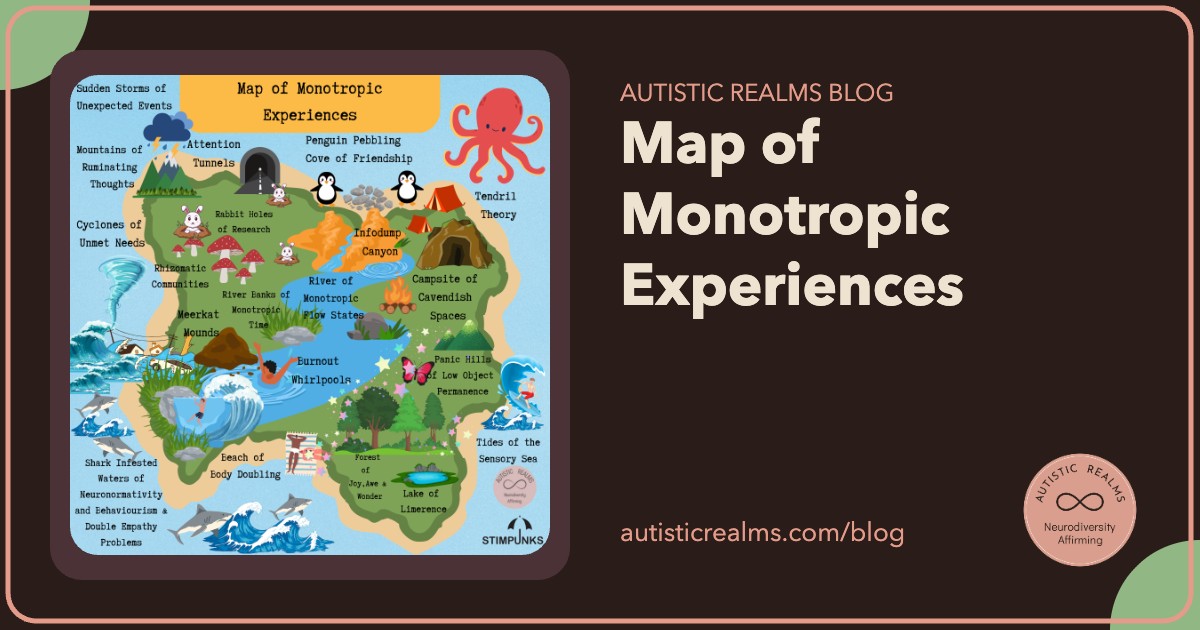
Monotropism has given me a language for experiences I had no words for. It helped me understand why I find transitions so hard, why I get stuck between tasks, and why interruptions can feel like being torn in two. It isn’t that I can’t cope; it’s that my attention flows differently (Murray et al., 2005). Understanding my neurodivergence didn’t change who I was. In many ways it gave me a way to bring coherence to a life that had always felt scattered across other people’s expectations, and it helped me see why I lived so intensely in other people’s fictional worlds. If you want a visual way in, The Map of Monotropic Experiences and My Monotropic Galaxy are both good places to start.
Rewriting as Reclaiming
Rewriting my story isn’t about erasing the past; it’s about reclaiming it. It’s about returning to the moments that were once clouded by shame, confusion or silence, and trying to see them again with more kindness and curiosity.
I’m no longer trying to fix myself or force myself into shapes that don’t fit. Instead, I’m gently weaving together the parts of me that were once overlooked or misunderstood: my sensory needs, my spiralling, rhizomatic thought patterns, and my need to deep-dive and fully immerse myself in whatever holds my attention. I’m learning to honour my need for space, stillness and solitude without guilt. These aren’t things to hide or overcome; they are central to who I am as a monotropic person.
So many of us are discovering our neurodivergence later in life, and with that comes the work of reweaving our stories. There is something deeply connective about sharing our journeys, because it makes space for others to see themselves more clearly too. This is part of what David Gray-Hammond (2023) calls the Autistic rhizome, a community that grows sideways, with many ways in. Bit by bit, we are not only rewriting our own narratives but reshaping the wider understanding of what it means to be Autistic.
For many late-identified Autistic, ADHD and AuDHD people, discovering monotropism can be a real lightbulb moment. It can offer a way of making sense of how your bodymind experiences and responds to things, and ways to help you manage your flow and energy. It may be a starting point for restorying your own life in an affirming way.
Find out more about the theory at monotropism.org, and check out SendWise Hub’s Substack too!
References
Dychtwald, K. (1978). Bodymind. Jove Publications.
Gray-Hammond, D. (2023, April 21). Neuro-anarchy and the rise of the Autistic rhizome. DGH Neurodivergent Consultancy. https://dghneurodivergentconsultancy.co.uk/2023/04/21/neuro-anarchy-and-the-rise-of-the-autistic-rhizome/
Murray, D., Lesser, M., & Lawson, W. (2005). Attention, monotropism and the diagnostic criteria for autism. Autism, 9(2), 139–156. https://doi.org/10.1177/1362361305051398
Raymaker, D. M., Teo, A. R., Steckler, N. A., Lentz, B., Scharer, M., Delos Santos, A., Kapp, S. K., Hunter, M., Joyce, A., & Nicolaidis, C. (2020). “Having all of your internal resources exhausted beyond measure and being left with no clean-up crew”: Defining autistic burnout. Autism in Adulthood, 2(2), 132–143. https://doi.org/10.1089/aut.2019.0079