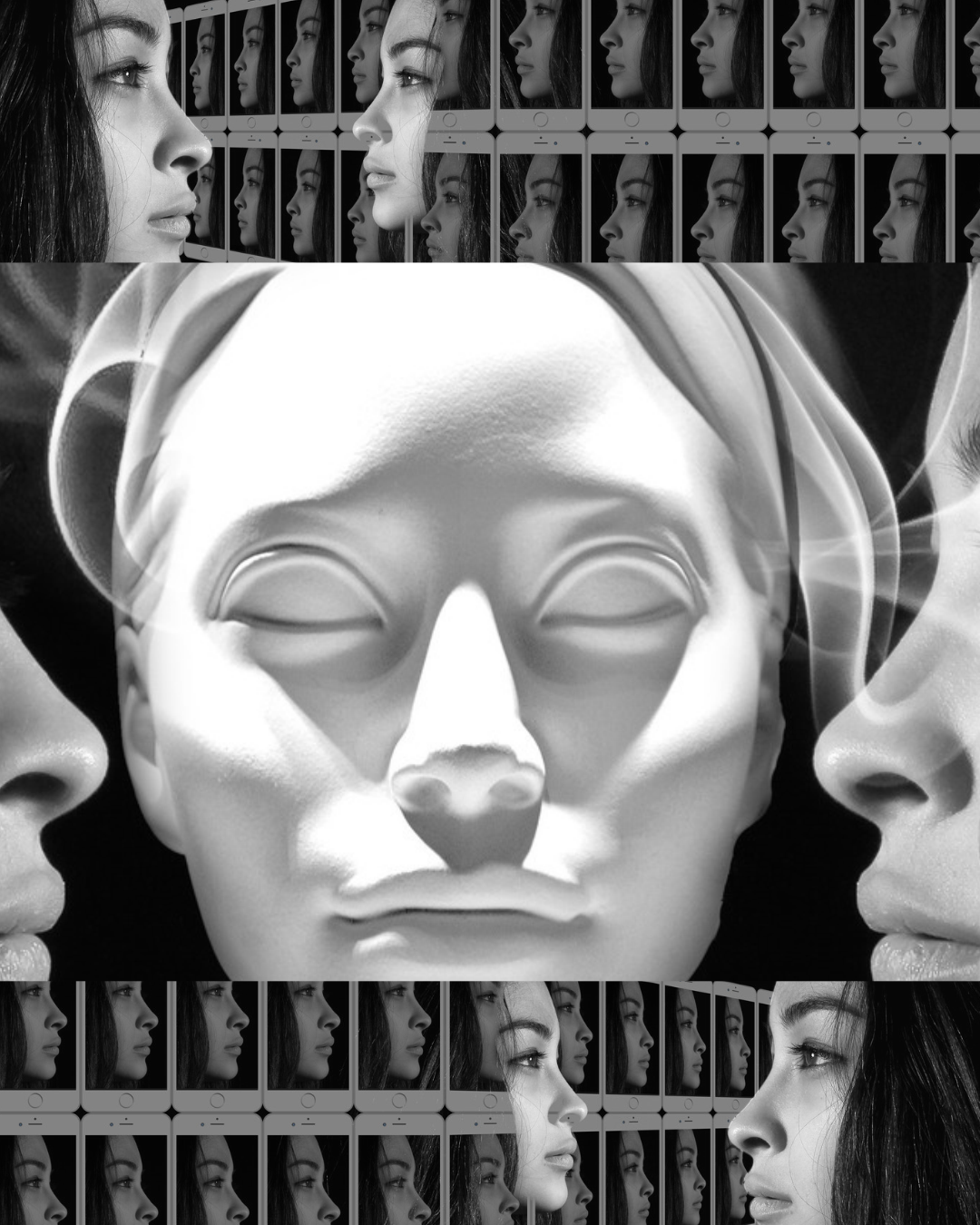
Many neurodivergent and disabled people grow up learning, often very early, that being ourselves is not always safe. We learn this through small moments and big ones: being corrected, laughed at, ignored, punished, medicalised, or praised only when we “fit in.” Over time, closely connected survival patterns can develop: masking, internalised ableism and imposter syndrome. They are related, but they are not the same. These are common experiences for many people, especially late-identified Autistic people, and before we talk about them we need to start with the wider landscape that shapes our Autistic lives: ableism.
Ableism: The Ground We Stand On
Talila A. Lewis (2022) describes ableism as a system that assigns value to people’s bodies and minds based on constructed ideas of normalcy, productivity, intelligence and desirability. It privileges those who fit neuronormative ideals and punishes those who don’t.
Autistic people do more than encounter ableism; I often feel like I am drowning in ableism. Our communication, sensory experiences, and ways of socialising and thinking are routinely pathologised. We are expected to bend ourselves into shapes that soothe other people’s discomfort, and we often have to mask to fit in or be further stigmatised.
In her TED talk, I’m Not Your Inspiration, Thank You Very Much, Stella Young (2014) describes how disabled people are either pitied or held up as “inspiring” for surviving in environments not designed for us, while the system that disables us goes unquestioned. She called this inspiration porn. We are framed as projects of individual perseverance rather than people oppressed by design and by neuronormative society. Inspiration porn is as harmful as superhero-type messages, because both deny the hard-lived reality.
As the Disability Justice movement reminds us (Sins Invalid, 2015), the problem lies in systems that treat neuronormative bodies and minds as the default and everyone else as a deviation, rather than in our differences. Mia Mingus (2018) describes disability justice, solidarity, access and access intimacy as other words for love, and the work of liberation as “a practice of love”.
Disability Justice shifts the focus from individual deficit to structural and systemic oppression, emphasising intersectionality, interdependence, access intimacy and safety, collective access, and growing competency networks from those most impacted. Sins Invalid (2015) describes collective access as treating access needs as a group responsibility, so that no one has to sacrifice their autonomy to be part of a community.
This framework is liberating for Autistic people because it reinforces that we are not broken, we don’t need fixing, we are disabled by society, and some people are further disabled by their bodies and additional healthcare needs too. We need to take into account intersectionality, the need for interdependence, collective access and safety, and grow what David Gray-Hammond and Tanya Adkin have described as a network of neurodivergence competency rooted in safety (Gray-Hammond, n.d.). Debra Ruh’s ableism iceberg is a helpful picture of how much of ableism sits below the surface.
Masking: What We Do to Survive
Masking is about what we do in order to cope in environments that are not designed for us. It can look like adapting your behaviour to fit in, hiding or suppressing stims and movements, forcing eye contact or small talk, pushing through sensory overload, pretending you are “fine” when you are not, and ignoring your need for rest, quiet, or support.
Often, masking is not a conscious choice. It develops slowly, shaped by experience. We learn that when we are fully ourselves, things often go badly, and when we perform “normally”, we are safer. So we adapt, camouflage and mask. Masking is a form of protection that helps us stay safe. It is something many people learn in order to avoid harm, rejection, or exclusion, and it may be a trauma response. However, masking comes at a cost. Long-term masking can lead to exhaustion, burnout (Raymaker et al., 2020), disconnection from the bodymind, and a sense of losing touch with who you really are.
Internalised Ableism: What We Are Taught to Believe
Internalised ableism is about what we believe about ourselves. It develops when negative social messages about disability and difference become part of our inner voice; it is what happens when the hostile environment colonises your self-perception. As Stimpunks puts it, internalised ableism is when the ableist world controls your self-talk (Stimpunks Foundation, n.d.).
It can sound like “I should be able to cope like everyone else,” “I’m too sensitive,” “I’m lazy,” “Other people manage, so why can’t I?”, “My sensory needs are burdensome,” “I’m too intense, too literal, too emotional, too quiet,” “My interests are childish,” “I shouldn’t need accommodations,” “My needs are unreasonable,” or “I’m a burden.”
These thoughts do not appear by accident. They are shaped by systems that prioritise productivity, independence, and “normality,” while treating difference as a problem to be fixed, and over time those messages sink in. As Sophia K at Neurodiverging (2022) notes, internalised ableism convinces us that the traits we were born with are somehow wrong and need to be fixed. It leads to self-doubt and blame, often for having disability-related needs at all or for making other people “work too hard” to meet them, and it affects our wellbeing.
For Autistic people, this can lead to chronic masking and burnout, punishing self-sufficiency, shame around meltdowns or shutdowns, and believing you must earn rest, support, or belonging. The result is that many people face ableism from the outside and also carry it inside themselves.
Imposter Syndrome: A Different Wound
Imposter syndrome may feel similar on the surface, but it arises from another direction. Imposter syndrome is the belief that your achievements and accommodations are undeserved, that you’ve fooled everyone into thinking you’re capable. You may even doubt that you are Autistic ‘enough’, and feel like you don’t deserve to be in the Autistic community or to advocate for your needs.
It’s about conditional belonging. Autistic imposter syndrome may sound like “If they knew how much I struggled with sensory overload, they’d think I was incompetent,” “I’m only keeping up because I’m masking; the real me isn’t acceptable,” or “My achievements don’t count because they don’t look ‘typical.’” We are judged by how closely we mimic neuronormativity rather than by our abilities. No wonder we may feel fraudulent, if our authenticity has been framed as a risk.
Where internalised ableism says “My Autistic self is wrong,” imposter syndrome says “My success or my needs don’t belong.”
How They Connect: The Autistic Double Bind
Masking, internalised ableism and imposter syndrome often feed each other. If you believe your needs are wrong, you are more likely to hide them, and if you constantly hide who you are, you may start to believe that your real self is unacceptable. This can create a painful cycle of self-erasure and self-blame. Together, these forces create an Autistic double bind:
To belong, I must hide who I am,
but if I hide who I am, the person who belongs is not me.
This is a predictable response to a world designed without us in mind, rather than a personal failing.
Moving Towards Gentler Ways of Being
Unlearning masking, internalised ableism and imposter syndrome happens slowly. Rather than suddenly “being confident” or “just being yourself”, it means building safer spaces, inside and outside yourself. It can involve learning that your needs are valid, finding community and shared language, allowing yourself to rest, practising self-compassion, and naming systemic barriers instead of blaming yourself.
Disability Justice invites us to reject the idea that legitimacy must be earned through imitation. Autistic culture, our depth, our rhythm, our passion, our ways of knowing and perceiving, is different, and that is ok. Unlearning internalised ableism means recognising that our needs are valid, that our communication is real communication, that our sensory world is a way of perceiving rather than a defect, and that our interests are portals rather than obsessions. Challenging imposter syndrome means refusing erasure.
You are not broken, and you have not been pretending. You adapted to survive in a world that did not always make room for you, and that adaptation deserves understanding, not shame. Every one of us living as ourselves is evidence that another way of being is possible, and that, quietly, is a revolution. Healing begins when survival is no longer your only option.
Free resources for Autistic adults
If this post has stirred things up for you, or you would like to keep exploring at your own pace, the Thriving Autistic Discovery Programme has free, self-guided resources for Autistic adults. There are six modules, covering the imposter phenomenon and intersectionality, masking and burnout, sensory systems, monotropism and attention styles, relationships, empathy and communication, and internalised ableism and self-advocacy. Each one has video guides, downloadable resources and practical tools made by and for the Autistic community, and it is open to anyone who is recently identified, whether through a formal identification or through self-identification.
I co-authored the Discovery Programme with Thriving Autistic and I have also helped facilitate it since 2024, so many of the ideas in this post about masking, internalised ableism and imposter syndrome run through those sessions too. If you find your way there, I hope it feels like a gentle place to land.
I was also project lead on two short animations that grew out of the programme, Discovering You’re Autistic and Lightbulb Moments: Being Autistic, which have been recognised at several 2026 film festivals. You can watch them below or on the Thriving Autistic animation page, and you can read more about the programme, the animations and the people who made them in my post on the Thriving Autistic Discovery Programme.
References
Gray-Hammond, D. (n.d.). Creating Autistic suffering, Autistic safety, and neurodivergence competency. https://www.davidgrayhammond.co.uk/p/creating-autistic-suffering-autistic-safety-and-neurodivergence-competency
Lewis, T. A. (2022, January 1). Working definition of ableism: January 2022 update. https://www.talilalewis.com/blog/working-definition-of-ableism-january-2022-update
Mingus, M. (2018, November 3). “Disability justice” is simply another term for love. Leaving Evidence. https://leavingevidence.wordpress.com/2018/11/03/disability-justice-is-simply-another-term-for-love/
Neurodiverging. (2022). What is internalized ableism? Neurodivergent people need to know. https://www.neurodiverging.com/what-is-internalized-ableism-neurodivergent-people-need-to-know/
Raymaker, D. M., Teo, A. R., Steckler, N. A., Lentz, B., Scharer, M., Delos Santos, A., Kapp, S. K., Hunter, M., Joyce, A., & Nicolaidis, C. (2020). “Having all of your internal resources exhausted beyond measure and being left with no clean-up crew”: Defining autistic burnout. Autism in Adulthood, 2(2), 132–143. https://doi.org/10.1089/aut.2019.0079
Sins Invalid. (2015). 10 principles of disability justice. https://www.sinsinvalid.org/blog/10-principles-of-disability-justice
Stimpunks Foundation. (n.d.). Internalized ableism. https://stimpunks.org/glossary/internalized-ableism/
Young, S. (2014). I’m not your inspiration, thank you very much [Video]. TEDxSydney. https://www.youtube.com/watch?v=8K9Gg164Bsw