
Exploring Helen De Cruz’s philosophy of awe and wonder and the potential of neuroqueer learning spaces
Helen Edgar, Autistic Realms | More Realms | July 2026
A short plain language version of this is available on Autistic Realms.
Introduction
At an online memorial event held on 24 June 2025 to celebrate the life of philosopher and artist Helen De Cruz, host Georgi Gardiner asked us: “If Helen De Cruz designed a learning space, what would it look like?“
It is a question that has stayed with me, because Helen De Cruz’s work offers a very different way of thinking about learning and really resonates with me. In her book, Wonderstruck: How Wonder and Awe Shape the Way We Think (2024), she argues that wonder and awe are not merely emotions that accompany knowledge; they are central to the process of creating knowledge.
Wonder gathers attention. Awe transforms understanding. Together, they describe learning as a process of being changed by what we encounter, rather than the passive absorption of information.
This essay follows that thread through the lens of neurodivergent ways of knowing. It explores the radical possibility that wonder is itself a way of knowing, and that monotropic attention may create conditions in which wonder can deepen into transformative learning and change how we relate to the world, especially for Autistic and ADHD people.
De Cruz does not write specifically about neurodivergence or monotropism. Monotropism, Dinah Murray, Mike Lesser and Wenn Lawson’s (2005) theory of Autistic attention, describes how attention gathers around a smaller number of interests at a time, rather than spreading thinly. Being monotropic is a trait that is increasingly resonating with ADHD and AuDHD people too (Garau et al., 2023), and it can leave fewer resources for other processes, cognitively and sensorily.
As an Autistic ADHD person myself, her account of wonder raises a question that feels especially important to me. It made me think about what happens when a monotropic person’s attention is already inclined towards depth, immersion and sustained engagement. Could monotropic attention provide some of the very conditions that wonder requires, deepening those feelings and enriching a person’s life even more? Are wonder and awe even more important for monotropic people?
I come to these questions as someone who has spent a lifetime experiencing exactly the kind of attention De Cruz describes, moments of wonder and awe in daily life. Moments that have so often been misunderstood, dismissed, seen as weird and not valued. It led me to suppress some of my own feelings of wonder, masking and withdrawing from life a bit to appear more “normal” and “fit in”. Leaning into my own monotropic ways of being and neurodivergent identity has enabled me to return to these moments of wonder, to dwell in the possibilities of awe. I am able to fully immerse myself in the little glimmers that life offers. I feel more creative, more connected, and more in tune with my real self and the world around me. I hope this essay offers some glimmers for others as I draw on the theory of monotropism (Murray et al., 2005), and on wonder and awe, to explore radically alternative learning spaces.
I will explore how an understanding of monotropic attention may support the gathering of attention that wonder depends upon. I will consider how educational environments can protect these processes, or interrupt and even harm them. I will then look at the double empathy problem (Milton, 2012), which helps explain why different ways of attending and knowing are so often misunderstood, and at how neuroqueering (Walker, 2021; Yergeau, 2018) offers a way to reimagine learning spaces built around different bodyminds rather than a single idea of normality.
Finally, I will turn to two projects that have shaped how I think about all of this in practice, not just in theory: Neuroqueer Learning Spaces and Cavendish Space, which I’ve spent several years building with Ryan Boren and the Stimpunks Foundation. This is my attempt to translate these philosophical ideas into educational design: environments built to let curiosity, wonder and awe actually take root, in ways that include neurodivergent people and benefit everyone.
Wonderstruck and Education

I didn’t know Helen De Cruz personally, but her work has shaped mine in ways that continue to inspire me. I was fortunate to take part in a reading group hosted by The Philosopher 1923, exploring Wonderstruck. In the final week, De Cruz joined us, and I remember talking with her about Nick Walker’s (2021) neuroqueer theory and the projects I was developing with Stimpunks, particularly Neuroqueer Learning Spaces and the idea of Cavendish Space. We talked about how her thinking resonated with what we were creating and with my work for Nick Walker’s upcoming neuroqueer anthology, which I co-authored with Ryan Boren. Those brief conversations have stayed with me, and it has taken me almost two years to find a way of bringing some of those thoughts together in this essay!
This piece is both a tribute to De Cruz’s work and a conversation alongside it. I want to explore where these ideas illuminate one another, and what they suggest about creating learning environments where wonder can flourish. De Cruz argues in Wonderstruck that wonder and awe are epistemic emotions: emotions that shape what and how we come to know, rather than simply how we feel while learning. Wonder is therefore an essential part of the process through which understanding and learning develop, far from an optional extra to education.
Drawing on Descartes’ description of wonder as a “sudden surprise of the soul”, De Cruz shows how wonder arises before we evaluate or judge anything. It gathers attention around something unexpected, something not yet understood. It invites us to remain in uncertainty long enough for new ways of knowing to emerge. I think this matters because how we feel and how we think are not separate processes; they are entangled like our bodyminds. Wonder and awe influence what we notice, how we feel, what we sense, and how long we stay with something. They affect how open we are to having our existing assumptions disrupted, and they shape whether we can tolerate uncertainty long enough to dive down the rabbit hole of curiosity until new knowledge can form. This is a profound reframing of education, because many settings and classrooms are structured around the assumption that learning moves in orderly steps from known to unknown, from a teacher holding all the information to be passed to a child, through a curriculum designed to measure progress towards externally defined outcomes.
De Cruz’s philosophy suggests that some of the most transformative learning happens at the threshold, in the liminal space where our existing understanding stretches, reorganises and sometimes gives way entirely, creating space for awe to form and restructure our thoughts. Awe, as Keltner and Haidt (2003) describe it, happens when something is sufficiently vast or significant that it requires us to restructure our existing frameworks. Learning, in this sense, is the process of becoming someone who can see and feel differently, rather than simply adding more information to what we already know.
The current UK education system makes this kind of learning increasingly difficult to access, particularly for neurodivergent people whose attention, communication, sensory experiences or ways of engaging with the world fall outside dominant norms and expectations. Wonder is often treated as a detour or a distraction from learning, something that can happen after the “real work” is complete, rather than being recognised as the very process through which meaningful learning so often begins.
The question running through this essay goes deeper than how we can be more inclusive for neurodivergent learners within our existing systems, or which neuro-affirming strategies and accommodations we can bolt onto a school setting. I am considering what happens when we reimagine and design learning spaces that foster the conditions for wonder to survive, and for people to be transformed through awe-inspiring moments.
If wonder requires attention to gather, then I think we need to consider what kinds of attention our environments protect, and what kinds they interrupt or harm. This may be even more pertinent for Autistic and ADHD learners whose attention may be processing monotropically.
Wonder, Awe and Firstness

Distinguishing three related but different states
Communities have been discussing wonder and awe through art, science, philosophy, ritual and magic throughout time. De Cruz describes the importance of cultural scaffolding, in which wonder is something communities can intentionally nurture and create together, as well as an intimate internal feeling. The environments we create matter enormously, and they matter even more for neurodivergent people whose sensory and attentional experiences may differ from the expected norm. The conditions we build, or fail to build, shape whether wonder has the chance to emerge at all.
I think it will help to clarify what I actually mean by wonder, firstness and awe, through the lens of De Cruz’s philosophy. Wonder is the opening, the moment attention gathers around something that exceeds expectation. De Cruz (2024) calls the quality of this opening Firstness: meeting the world as though for the first time, whether or not it is literally new or has seemingly been experienced hundreds of times before. Awe follows when wonder is given enough time to deepen and expand. Drawing on Keltner and Haidt (2003), De Cruz describes awe as a response to something vast, sensorially, conceptually, relationally or aesthetically, that stretches our existing ways of understanding until they reorganise themselves, so that we are in a process of becoming, full of new possibilities.
In developmental terms, this is closest to what Piaget (1952) called accommodation, not assimilation. To explain this a bit, we can think of a young child who already knows what a dog is. If they see a different type of dog, a breed they’ve never met before, they can just fit it into what they already know, into the category of dogs. Assimilation is the addition of a new example to an existing category without changing the category itself. However, if that same child sees a cat and calls it a dog, and someone explains that cats and dogs are actually different things, they have to change the category itself to make sense of what they’re seeing, which is accommodation.
For Piaget, this was something quite ordinary. Most people do this all the time, revising their understanding as new experiences come in. From my own experience teaching people with profound and multiple learning disabilities, though, I’d add that it isn’t always so quick or simple. Understanding doesn’t always generalise easily from one context to another; a concept learned with one object in one context doesn’t always transfer automatically to a slightly different one. It may take many more repeated experiences across many different contexts before that new understanding truly settles. That doesn’t mean wonder isn’t there for people with profound and multiple learning disabilities. I think it often is, just expressed and noticed differently, through the body, through sound, and through what someone returns to again and again in a sensory way, rather than through the kind of verbal or conceptual restructuring Piaget was describing.
What I want to borrow from Piaget is narrower, though. I think awe might be accommodation at its most intense: a moment where everything you already understood gets rearranged all at once, rather than one category shifting to fit a cat. For me, it feels like it recalibrates my whole sensory system and bodymind. New knowledge changes the shape of what we know and how we know, feel and sense, making room for something new.
Wonder catches our attention and opens our bodyminds. Awe transforms us and restructures our bodyminds. In many educational settings, both are interrupted before they’ve had a chance to do their work.
However, wonder on its own isn’t enough, as it can lead us towards mistaken ideas just as easily as true ones. Things like conspiracy theories and pseudoscience are often fuelled by real, genuine curiosity, not a lack of it. What makes wonder worth trusting is whether we have enough time, safety and support to test that feeling against the world, rather than mistake it for an answer.
Keltner’s (2023) research suggests awe more often leads to humility, connection and care for others than to certainty or rigid belief. Making space for wonder isn’t the same as giving up on critical thinking; it may be one of the conditions that let critical thinking actually happen, which is worth considering when we think about the learning environments our children are in.
De Cruz’s earlier work on awe in scientific practice (2020) similarly argues that these emotions focus attention, encourage open-mindedness, reduce self-centred thinking and help learners value what they are investigating. Rachel Carson, whom De Cruz (2024) draws on throughout Wonderstruck, saw a child’s sense of wonder as something to be protected above almost everything else.
Sadly, this feels like exactly what our current education has let slip away. Our education systems are organised around curriculum progression, standardised assessment and measurable outcomes, which often leave little room for sustained curiosity. Wonder is often seen as a diversion from learning rather than as a potential for learning in its own right. Even in early years settings, where children’s wonder and joy of discovery through play and exploration are more readily embraced, expectations remain shaped by neuronormativity. Children are expected to learn and play in the “right” way, and any departures from that path are too often treated as problems to be corrected, rather than as learning unfolding in its own way.
For me, this highlights a significant gap in our education system. The focused, monotropic ways many Autistic and ADHD people engage with the world are still too often interpreted as deficits to manage, rather than valuable ways of learning in their own right. Instead of trying to redirect or normalise those forms of attention, educators need to recognise, protect and build upon them. If we don’t protect wonder and awe throughout life, we risk more than just limiting learning. We risk harming people’s wellbeing, damaging their identity, and closing off the transformative experiences and real joy that learning can bring.
Monotropism and the Interrupted Threshold

Why monotropic attention can get misread
I’m Autistic, ADHD, monotropic and multiply neurodivergent in many other ways. I think about attention the way De Cruz thinks about wonder: as something that gathers, that has its own ecology, and that can be nurtured, or dismantled and harmed, by the environments we live and learn in.
I’m reading De Cruz’s ideas through the lens of monotropism because it helps to make sense of my own life and the lives of people I support who are also Autistic and ADHD. I’ve chosen De Cruz because her account of wonder as an epistemic emotion really resonates with me, treating it as a way of knowing rather than just a feeling that accompanies knowing.
When De Cruz writes about wonder as seeing the world with “firstness”, it really struck a chord with me. That excited joy I feel, and so often have to mask and suppress, such as when I find a mushroom in the forest, or a pebble that looks and feels “just right” in my hand, or a website that has just the right tones of colour in dark mode that lead to a million other sensations and ideas. The little glimmers I’m often told are weird, the things we’re told from childhood not to be distracted by, so we focus instead on what other people expect. For many monotropic people, wonder isn’t rare or fleeting; it’s intensely woven into how we experience the world every day, whenever we feel safe enough for our attention to flow. Deep curiosity and moments of awe are part of how we think and feel, and they influence how we learn, connect and make sense of our lives.
Monotropic attention gathers, and when it’s given room to stay gathered, it can widen into wonder, and then flow into the awe that De Cruz sees as central to real inquiry. A child transfixed by light moving across a floor isn’t necessarily drifting away from their learning; they might be right at the beginning of it. The difference between wonder and awe may help explain what deep engagement actually feels like for some Autistic and ADHD people. Wonder is the moment when something catches us and pulls us in, and awe comes once we’ve stayed with something long enough for our thinking and sensory systems to shift and form new connections. Both can feel all-consuming for me, and everything else around me often slips away.
Everyone can experience wonder and awe. I can’t claim Autistic and ADHD people feel it more or less often, or in a different way, because we’re monotropic. I don’t think anyone can honestly claim to know that yet. But I know when I am in burnout, it is really hard to hook into those glimmers; my attentional resources are always being redirected into survival mode. When I am feeling safer and more regulated, I feel a sense of wonder intensely, and it can lead me into deep experiences of awe where all I want to do is research, connect ideas and create things.
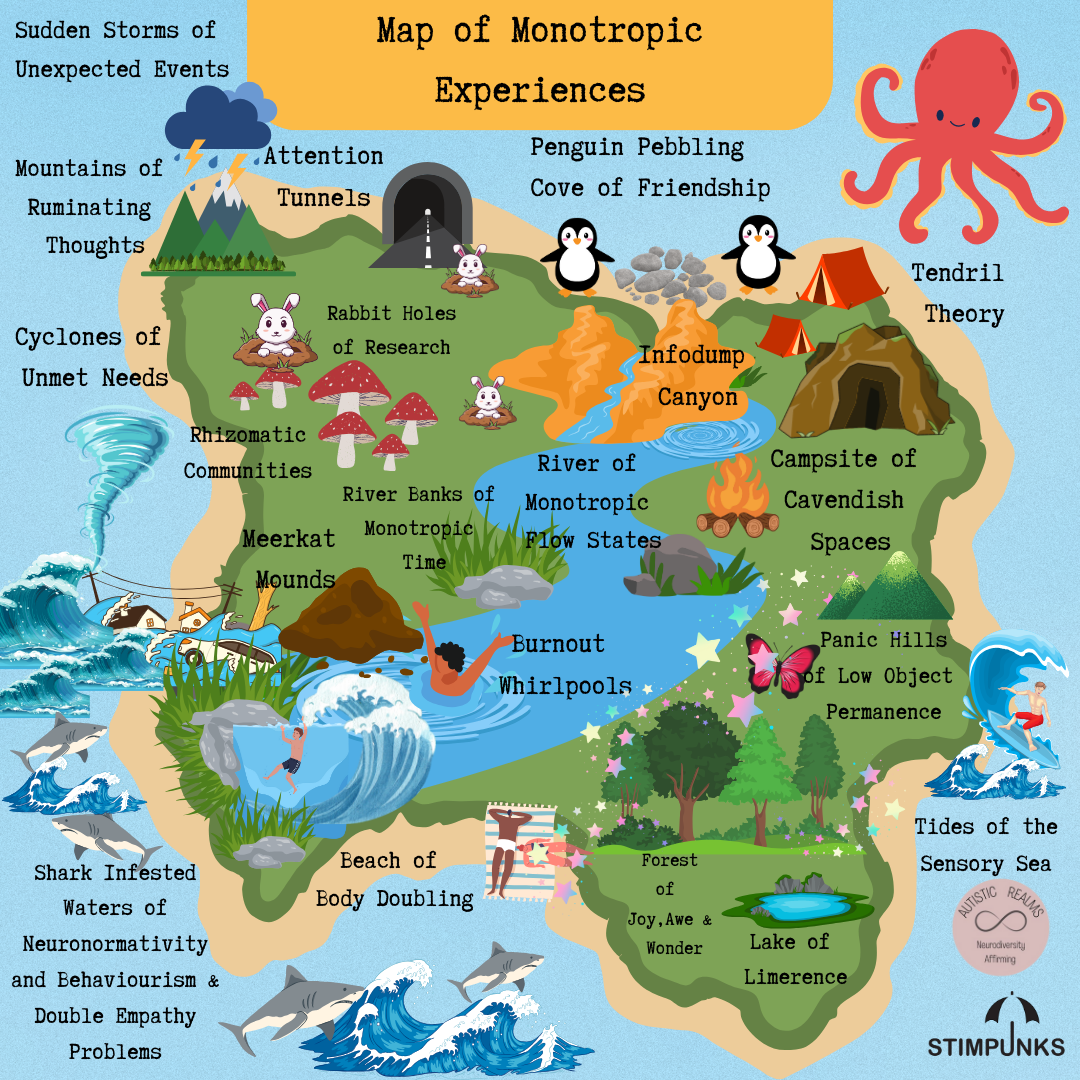
I think it could really help educators to understand the theory of monotropism from a lived-experience perspective. For monotropic attention to do the things wonder needs, gathering, staying and going deep, we need to feel safe and regulated. Monotropic attention doesn’t move linearly. I think it is better understood as a constellation of intensities (Edgar, 2026). Being monotropic for me is like having an ever-shifting arrangement of sensory, cognitive and relational ways of being; everything is always in motion, always connecting. Wonder and awe are part of that constellation. For many monotropic people, they are points of real intensity in an ever-forming pattern rather than experiences to be measured against some mythical average, which is why they deserve to be honoured rather than managed away.
Awe, in De Cruz’s account, is a reorganisation: your bodymind being restructured by what you meet and how you respond. That’s not always a comfortable thing, though, and it may be even more difficult for monotropic people to transition into awe if they are not in the right space, or if their bodymind is hyper- or hypo-aroused. Monotropism is defined by attention being pulled towards a smaller number of interests, and the same pull that lets wonder deepen may also resist reorganisation. Autistic inertia, which I come back to later, is one way I think this happens; the depth that makes attentional pooling possible is sometimes the very thing that makes it hard to be moved by what you encounter once you’re inside it. None of this undoes what I’ve said about monotropic attention and wonder, but it may not always lead to awe. You may get into more of a stuck state (Edgar, 2025a) than a flow state, or the thing that sparked your wonder may lead to more looping, ruminating thoughts of anxiety (Edgar, 2024) rather than new knowledge.
For wonder and awe to take hold and lead to new, inspiring possibilities and knowledge, people need time, psychological safety, and environments that support rather than fight their sensory and cognitive needs. Deb Dana’s (n.d.) work on regulation, the same work glimmers are drawn from, is built on the idea that safety is rarely something we create by ourselves; it’s co-regulated and co-created, and I think wonder needs that same starting point.
Before anyone can gather their own attention around something that catches their eye on a walk, they may need someone else’s regulated state nearby to make that gathering possible in the first place. If you are in a state of dysregulation, you won’t have enough attentional resources to notice the glimmers and wonders around you, as all your attentional resources will be redirected into survival mode. This is why interruptions can feel so painful and so dysregulating for monotropic people. Far from being small distractions, they can stop a whole process of thinking mid-unfold, splitting and fragmenting the attention tunnel just as wonder starts to grow and awe begins to emerge.
Wonder needs time to grow, and awe needs time to transform how we understand and relate to something. Getting asked to stop, switch tasks or redirect attention too soon can cause the process to be lost, and finding the way back into it can take more energy than many of us have to spare. It isn’t just a matter of a teacher or parent saying “Put that object down” or “We can come back to this later.” Once the attention tunnel has been broken, the moment is often gone. That liminal threshold, where awe-inspiring ideas, creativity and new understanding were just beginning to take shape, doesn’t wait to be picked back up. Over time, this can have a detrimental effect on learning and also wellbeing.
Most education systems aren’t built to protect these moments of deep engagement; they don’t let us dwell on the glimmers. Constant demands and redirection, such as “Come back to the carpet”, “Eyes this way” and “Let’s focus on what we’re all doing”, all impact flow, split the attention tunnel, and can be highly dysregulating.
These responses from teachers and caregivers are rarely meant to cause harm, and are often driven by the responsibility a teacher feels. They reflect the pressures of local authorities, school management and long-held ideas about accountability and what learning should look like. When a person follows their curiosity somewhere unexpected or becomes deeply absorbed, it’s too often read as misbehaviour or a distraction rather than being recognised as the learning it actually is.
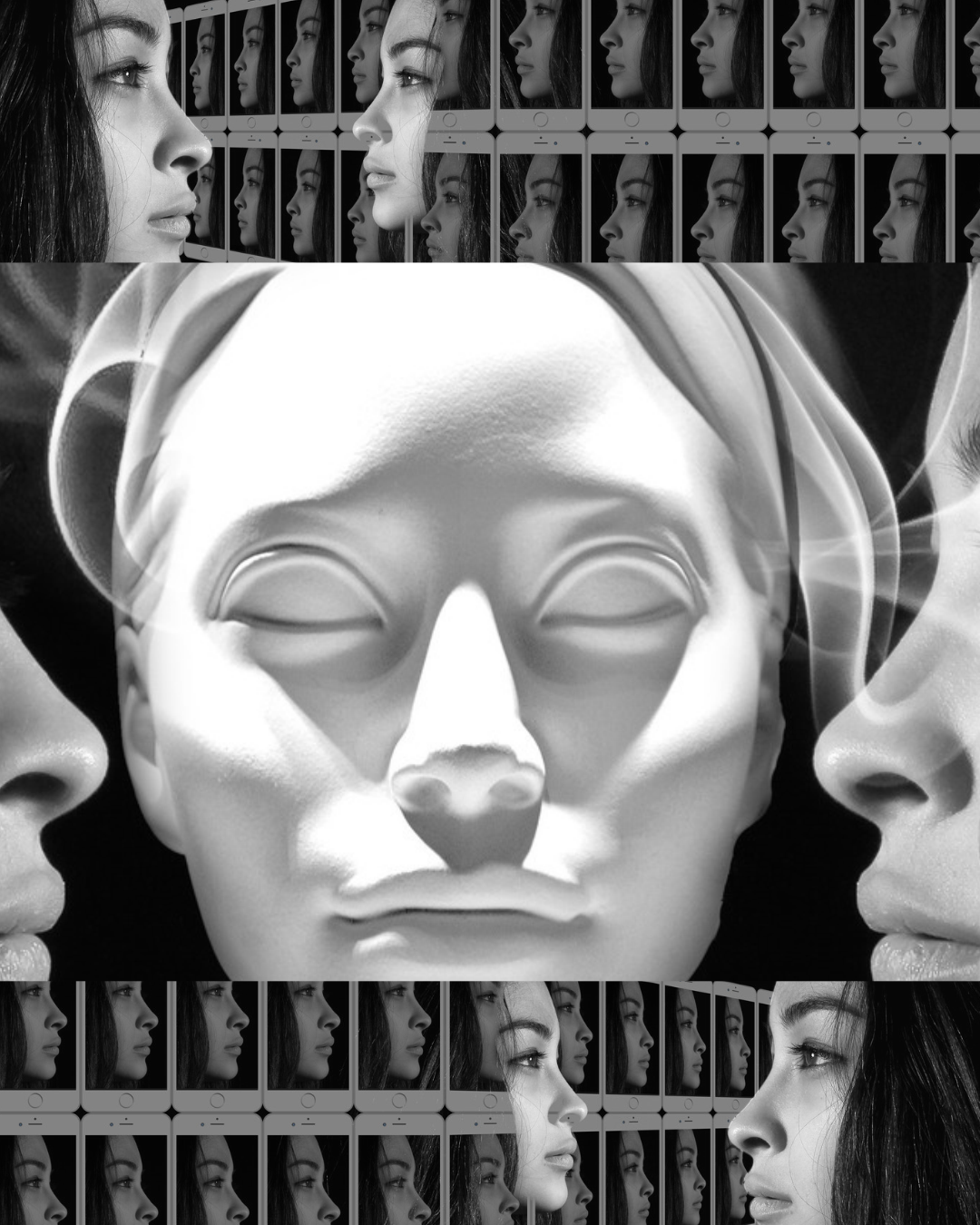
Milton’s (2012) double empathy problem helps explain why these moments so often get missed or misread. It suggests that misunderstandings between Autistic and non-Autistic people happen because two people with very different ways of experiencing the world can find it genuinely hard to relate to and connect with each other, in either direction, rather than one side simply failing to understand the other. I suspect a version of this shows up between any two groups whose lived experience differs enough, which is my own extension of Milton’s idea, but it’s the pattern I keep noticing. So what looks like disengagement from the outside can actually be deep engagement, simply misread.
I think part of why this happens is that so many of our ideas about “normal” attention and learning aren’t as timeless as they feel. As Fergus Murray (2024) explains on the Weird Pride website, the statistical idea of “normal” only emerged in the nineteenth century, and the bell curve became a way of describing human difference, with what was most common quietly slipping into being treated as what was best, even though the maths itself never claimed that. Robert Chapman (2023) offers one account of how this myth of the “normal” mind didn’t emerge by accident. It was formed by the needs of capitalism, which required a productivity-based standard against which bodies and minds could be sorted, valued and controlled. What looks like a neutral, statistical “normal” has always been doing political work: deciding whose attention, pace and way of thinking gets to count.
That political bias and privilege shows up everywhere in our schools. It shapes how a teacher expects a child to respond, how quickly they’re meant to complete their work, the way attention should be shown, and how smoothly everyone is expected to move through the same lesson, at the same pace, with the same sensory regulation. These standards are biases, ableism built into what counts as normal, and they happen to fit some of us far better than others. This is close to what Miranda Fricker (2007) calls epistemic injustice: a wrong done specifically to someone in their capacity as a knower, where their understanding or testimony is dismissed because of who they are and how they attend to the world rather than because it’s wrong. Monotropic ways of knowing are, I think, often on the receiving end of exactly that kind of injustice.
Schools don’t invent these expectations alone. Standardised assessments, accountability measures, funding and timetables all make it hard to build in the time and flexibility wonder actually needs. Even educators who strongly value curiosity are often working inside systems that make protecting it genuinely difficult. I’ve written more about this through the SPACE-TIME Framework for neuro-affirming education. Protecting wonder is also about the structures we build around education and what those structures choose to value, measure and make possible, as well as what happens between a teacher and a child. What actually needs to change in funding, teacher training or the national curriculum is an important piece of work for another time; this essay stays with the philosophy and the practice.
None of this is new, and none of it started with the neurodiversity movement. Nearly a hundred years ago, Hermann Hesse argued that universities had become more interested in measuring and categorising knowledge than in nurturing wonder, describing education as valuing “counting and measuring over delight, sobriety over enchantment” (Hesse, as cited in Popova, 2023). What’s different for monotropic people may be that this loss is far from incidental; it’s the difference between a space that can hold attention and one that breaks it.
Neuroqueer theory pushes this critique further. Walker (2021) describes neuroqueering as challenging the expectation that everyone should think, learn and communicate in neurotypical ways, the ways treated as standard within a given culture, while Yergeau (2018) asks us to rethink whose ways of knowing and communicating even get recognised as valid in the first place. Together, they invite us to ask who our education system is designed for, and whose interests, attention and learning we actually value.
This same resistance to a single, imposed “normal” shows up in what’s often labelled demand avoidance, too. Some in the neurodivergent community have started reframing demand avoidance as a pervasive drive for autonomy rather than resistance for its own sake, a need to protect a way of thinking that’s already deeply engaged (see also Woods, 2019). I find this a genuinely useful way of seeing it, though it’s still a live, contested idea within the community rather than settled fact. When a learner pushes back against an instruction or a redirection, it can be an attempt to hold onto the conditions and safety where wonder is beginning to grow, rather than a wish to disrupt or defy. What that resistance actually protects is worth looking at more closely: the fragile, unfolding process by which curiosity becomes wonder, and wonder becomes awe.
From Curiosity Through Wonder to Awe

The science of awe, flow and deep learning
Curiosity, wonder and awe are part of the same unfolding learning journey, a life formed by glimmers and encounters with where our attention dwells. Heylighen (2024) describes curiosity as the awareness that something doesn’t quite fit with what we already know, the liminal gap that draws us to ask questions. Wonder invites us to stay with that space rather than rushing to close it. Awe deepens the process further, changing the way we make sense of the world rather than simply adding new facts to what we already know. Throughout this essay, I use “transformative learning” to describe these moments when understanding itself is reorganised and we come to know differently, as well as knowing more. Rather than treating curiosity, wonder and awe as separate ideas, I think it may help to follow a single moment through all three.
Picture a child crouched next to a puddle after rain. They notice the surface holding a perfect upside-down sky. That’s curiosity: the small snag of something not quite fitting what they expected. They stay. They dip a finger into the water and watch the sky break apart, then slowly reform. That’s wonder, in De Cruz’s (2024) sense of firstness: encountering the ordinary as though for the very first time. If they linger a little longer, if nobody moves them on, something deeper may happen. They may begin to understand reflection, stillness, and why the sky only appears whole when the water is calm. That’s awe, in Keltner and Haidt’s (2003) sense of an experience vast enough to reorganise what they thought they knew.
This feels especially significant for monotropic learners. From the outside, deep engagement can look like distraction, repetition or becoming “stuck”. A child rereading the same page for the tenth time, lining up the same toy cars in slightly different arrangements, or becoming silent after asking a question may appear to have disengaged. Yet what looks like being stuck is often a bodymind still exploring, still making connections, and still allowing understanding to settle and process in its own time. Research with children aged four to nine has found that awe seems to increase their desire to explore rather than shutting it down (O’bi & Yang, 2024).
The Autistic child who spends every rainy playtime working out exactly how a puddle drains isn’t failing to move on to the next activity. They aren’t being antisocial or “obsessive”. They’re doing precisely what their monotropic attention invites when it’s given space: staying, observing, experimenting, and letting their understanding of water, gravity, time and movement deepen. Critical thinking, mathematics, physics, biology: all of it may begin somewhere nobody hurried them away from.
In the early years, schemas are often embraced. A schema, in Athey’s (2007) sense, is a repeated pattern of behaviour a child returns to again and again: a way of thinking made visible through action rather than a bad habit to be redirected, with each repetition forming another layer of how the child understands the world. The same drain, the same tipping and pouring, the same lining up of objects are a thread of thinking, followed on purpose. Follow the schema, and you’re following the thinking; interrupt it, and you interrupt the thought mid-sentence. It’s the same reason interest-led learning tends to run so much deeper than anything handed down from outside. Motivation founded in genuine interest and autonomy simply produces more durable understanding than tasks imposed by someone else’s timetable (Deci & Ryan, 2000), and for a monotropic learner, whose attention already gathers so readily around what feels meaningful, this may be even more important.
Given enough room, that gathering can deepen into something even more sustained: flow. Flow, based on the work of Csikszentmihalyi (1990), is a state of full absorption in which concentration, motivation and a person’s sense of time itself fold into one; for me it takes over completely, body and mind together. Autistic people often describe their experiences of flow in ways that resonate with each other, talking about the intensity of focus, the disappearance of self-consciousness, and a sense of time falling away (Heasman et al., 2024). For monotropic people, though, I think that state tends to arrive through whatever’s genuinely meaningful rather than through a task carefully pitched at the “correct” difficulty. An afternoon spent building an entire imagined world out of Lego may do more of that work than any worksheet ever could for a monotropic child who loves Lego.
Autistic inertia is when people find it difficult not just to enter a flow state, but to leave one once they’re inside it. Buckle et al. (2021) describe this as something that can often only really be interrupted by outside intervention, since the pull to stay is rarely something a person can simply switch off from within. This is, I think, the sharpest version of the tension I named earlier: the same depth that lets wonder take hold can also make it genuinely hard to be reorganised by what comes next, even when that reorganisation is awe itself. Being pulled out abruptly, right as wonder is deepening into awe, can be actively painful, not just inconvenient. It’s the same feeling as being pulled out mid-thought, right when something was about to resolve. That pain doesn’t stay contained to the moment it happens. Raymaker et al. (2020) describe how repeated differences between what a person needs and what their environment keeps demanding build up over time into something much larger, and can lead to Autistic burnout. One interruption is a small cost, but a whole childhood of being denied the opportunity for monotropic flow could be detrimental to an Autistic or ADHD person’s mental health.
Protecting the conditions for flow means making space to enter it and respecting how hard and how costly it can be to leave. This is a question schools rarely think to ask, but one that becomes impossible to avoid the moment you start designing a Neuroqueer Learning Space around monotropic attentional styles, and the needs of everyone else too.
Glimmers: Small Fires of Knowing

Sensory regulation and Autistic and ADHD joy
De Cruz (2024) argues that wonder doesn’t simply happen by chance. Across cultures, people have always created ways to invite it through stories, rituals, art, music and shared experiences. However, once wonder begins, it also needs to be sustained. For many Autistic and ADHD people, particularly during deep monotropic engagement and flow, that sustaining often comes through something more personal, embodied and sensory.
I think of these moments as glimmers (Edgar, 2025c), although I owe the word itself to Deb Dana, who first used it to describe the tiny cues that tell a nervous system it is safe: the opposite of a trigger, a moment that gently invites the body back towards regulation. I’ve borrowed her term because nothing else quite captures what happens when monotropic attention begins to gather around something that feels quietly significant, when wonder is beginning to deepen but has not yet become awe. A glimmer is like an anchor, or perhaps a root: the small, steady thing that allows deep attention to remain grounded instead of tipping into overwhelm. It holds the moment open, creating the conditions for wonder to continue unfolding. A glimmer is a moment of joy.
Some glimmers arrive through our senses: the light reflected on water I’ve kept returning to throughout this essay, the satisfying crunch of gravel beneath your feet, or a hand tracing the same seam of clothing again and again. From the outside, these moments may appear repetitive or insignificant, but they are often rich sensory worlds in themselves, encountered with De Cruz’s sense of firstness, as though meeting something familiar for the very first time. Here, firstness arrives through the body as much as through thought.
Other glimmers are cognitive. They might be the moment a number sequence suddenly clicks into place, or when exactly the right word arrives while writing a poem. Heylighen (2024) describes curiosity as the recognition of a gap between what we know and what we are beginning to understand. For me, a cognitive glimmer is the quiet flicker that comes when that gap starts to close: the small though unmistakable feeling that a pattern has finally settled into place.
Whether sensory or cognitive, glimmers may sustain wonder as well as accompany it. They give wonder somewhere safe to remain while it reaches towards something larger than itself. Following Keltner and Haidt (2003), it is this reaching that stretches our existing understanding until it has to reorganise. In that sense, glimmers are part of the liminal threshold where wonder begins to deepen towards awe, much more than little pleasant moments.
I’ve written elsewhere that monotropic memory rarely moves in straight lines. Rather than a neatly ordered shelf of stored events, it often resembles a rhizome, branching, looping and folding back on itself (Edgar, 2025b). Wonder and awe seem to move in much the same way. They are less a linear progression than a continual return, revisiting the same object, the same piece of music, and finding something different each time because we ourselves have changed.
I think this is what T. S. Eliot was reaching towards in “Little Gidding”: that our exploring brings us back to where we started, only now able to know the place as if for the first time (Eliot, 1943/2001), which is also where I started my exploration of More Realms, in “Middle Entrance” (Edgar, 2023b). Glimmers work in this way too. A stone, a scarf, a word, a memory: none exists in isolation, everything is entangled and interconnected. Each becomes another point in a living constellation of meaning, connecting across time whenever we are given the chance to dwell in wonder long enough for those connections to emerge.
Guarding the Embers
Masking, intensity and burnout
Many of us were taught to see our Autistic intensity as something to manage. We were told we were too much or not enough, too hyper-focused, too obsessive, too interested in the same subjects, books or conversations. What was experienced as joy and deep engagement from within was often interpreted from the outside as a problem to solve.
Yet the pooling of attention that characterises monotropic experience, the returning, the staying, the revisiting of the same book, the same music, the same project, is precisely the kind of sustained attention that De Cruz’s account of wonder requires if it is ever to become transformative. Wonder begins when attention gathers rather than skims across the surface of experience. Asking a monotropic learner to spread their attention more thinly, to split across other channels, or to move on before they are ready, does not make them calmer, more balanced, or a better learner.
The glimmers that sustain this process, a child absorbed by a shifting pattern of light, by the hum of the classroom, or by rain tracing a path down a window, are often the very moments our education system is quickest to interrupt and quickest to undervalue. I’ve written previously about how the Early Years Foundation Stage still tends to make more room for such moments (Edgar, 2023a). Child-led play is more trusted, practitioners are encouraged to follow children’s interests, and moments of unexpected curiosity are regularly celebrated. When I worked in early years settings, we literally recorded these as “wow moments”, capturing them on post-it notes because they mattered.
Sadly, much of that spirit disappears during the transition into Year One and beyond. The wonder of those wow moments, the magic of becoming completely absorbed in something, is gradually replaced by desks, busy timetables, pre-determined objectives, attendance data and measurable outcomes. Teachers don’t stop caring, and children don’t stop wondering; rather, the system increasingly stops making room for wonder, because it is seen as less important than the “real learning” that supposedly prepares children for examinations, productivity and employment.
This is why I think glimmers are important, and there is something quite radical about protecting them. Wassell (2025) argues that Autistic joy carries revolutionary potential because it points towards a different way of living within the world, rather than seeking to change it through force. It asks what becomes possible when support works with Autistic and monotropic ways of being rather than against them, allowing people to flourish on their own terms rather than simply survive.
This resonates strongly with Walker’s (2021) concept of neuroqueering: refusing the assumption that one way of attending, communicating or experiencing the world should define what counts as normal. Seen in this light, a child’s wonder deserves more than an affectionate “look how fascinated they are” before they are redirected back to the lesson, and it should never be treated as distraction, non-compliance or behaviour to manage. It is a small but significant act of resistance every time it is allowed to survive.
Reimagining education does not necessarily require tearing down the entire system overnight. It can begin with one child, one glimmer, and one adult willing to pause. A child noticing the raindrops catching the light on a classroom window is given time to look and experience it through their senses. If the child is open to it, a teacher could gently extend the moment rather than interrupt it, following the child’s attention instead of redirecting it. Given enough time, sensing becomes wondering, wonder becomes awe, and new ways of being and new knowledge emerge.
If we want more of these instances, the object that feels exactly right in your hand, the number sequence that suddenly makes sense, the raindrop that becomes a question about light, gravity and glass, we need more invitations to wonder, not fewer. We need those invitations to continue well beyond the early years. Wonder shouldn’t be an occasional reward for finishing the “real work”, or only left for playtimes and home time. Awe lives in the questions children ask and in the pauses in their play, when they are given enough time and safety to explore for themselves and when adults are in tune enough to pick up on their engagement, signals and curiosity.
None of this can depend on individual teachers alone, however committed they may be to their profession. Teachers work within systems shaped by timetables, accountability measures, assessment frameworks and productivity-driven expectations. Protecting wonder requires more than goodwill. It needs learning environments designed around psychological, sensory and somatic safety, where glimmers, wonder and awe are recognised as the very heart of learning. This leads us to why Neuroqueer Learning Spaces and Cavendish Space could be so transformative.
Cavendish Space and Neuroqueer Learning Spaces
Building neuroqueer learning spaces
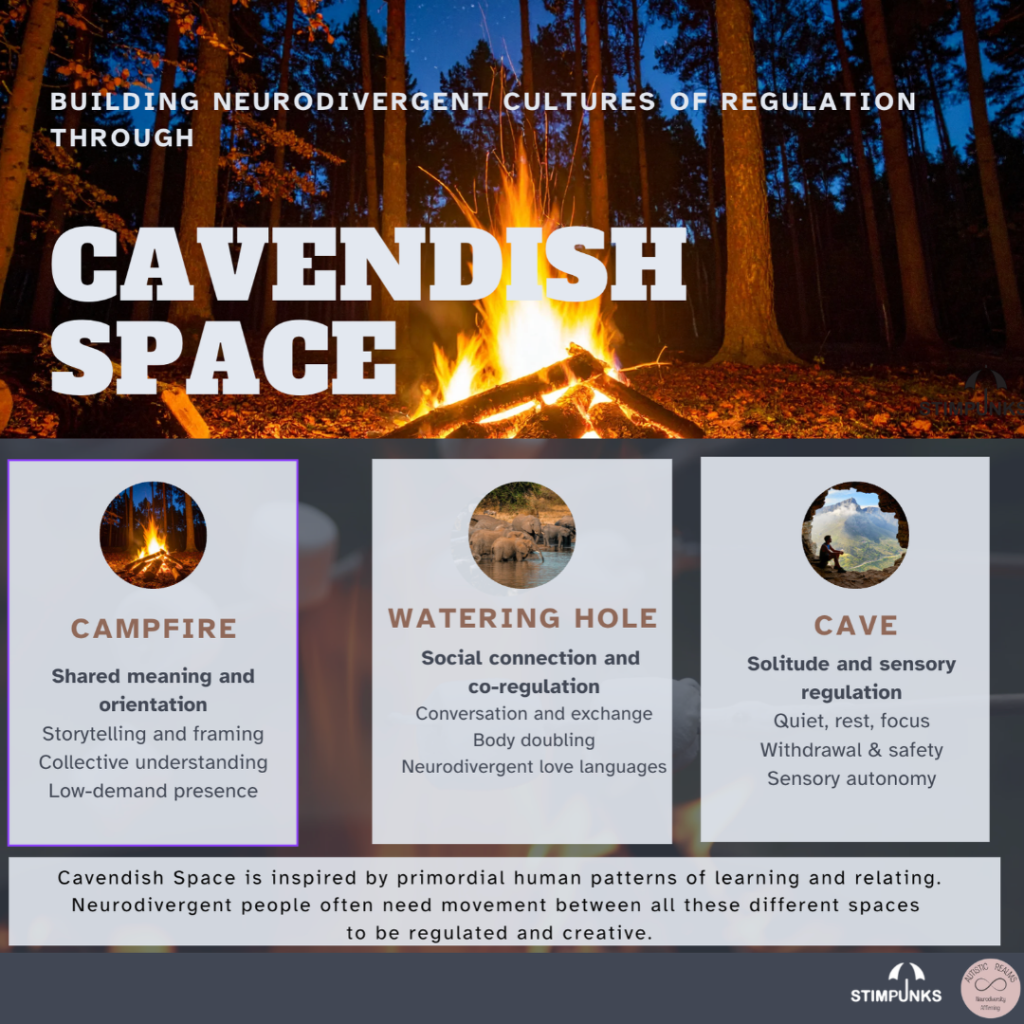
Neuroqueer Learning Spaces (Edgar & Boren, 2024) and Cavendish Space (Boren & Edgar, 2022), which Ryan Boren and I developed together through the Stimpunks Foundation, existed before this essay, as practice built well ahead of this particular theory. What De Cruz’s account of firstness adds is a sharper account of what each space is actually for. Caves are where firstness gets room to happen without being immediately named, judged or redirected. Campfires are where one person’s wonder can be witnessed closely enough by someone else that it starts to become shared, without being flattened into a lesson. Watering holes are where something one person noticed can become something awe grows out of collectively, because more than one bodymind is now reorganising around it together. De Cruz’s philosophy gives us a more precise account of why each of the three spaces needs to exist as its own distinct thing, rather than as three flavours of the same “safe space” idea.
If wonder is an epistemic emotion, as De Cruz (2024) argues, and if monotropic attention creates the conditions in which wonder can deepen into awe, then learning environments should protect that process rather than interrupt it.
Cavendish Space takes its name from Henry Cavendish, the eighteenth-century scientist whose life is often discussed today in relation to traits many Autistic people recognise: profound sensory sensitivity, a preference for routine, and an extraordinary capacity for sustained attention (Silberman, 2015). We cannot diagnose historical figures, and that has never been the point. Cavendish’s life doesn’t prove that Autistic people are valuable because some make exceptional discoveries. Rather, it illustrates something far more universal: when people are supported to think, feel and learn in environments that genuinely fit them, they are far more able to flourish in their own ways.
The framework organises learning around three interconnected kinds of space (Boren & Edgar, 2022), each supporting a different aspect of how attention, wonder and learning unfold.
Caves provide spaces for solitude, sensory regulation, deep immersion and uninterrupted thought. They acknowledge that learning often begins internally, with the quiet gathering of attention that De Cruz describes as wonder.
Campfires are spaces of trusted relationships, where stories, ideas and discoveries are shared. Wonder rarely remains entirely private; it grows through conversation and co-regulation, allowing one person’s curiosity to spark another’s.
Watering holes support collaborative exploration and collective sense-making. Awe, after all, is not always solitary. Sometimes the deepest learning happens when someone turns to another person and says, “Look at this.” The puddle becomes something investigated together rather than simply observed alone.
Underlying all three is what Walker (2021) calls cognitive liberty and somatic liberty: the freedom to think, move, stim, regulate and communicate in ways that genuinely meet one’s needs rather than performing neuronormative expectations. Running through the entire framework is what we describe as attentional sovereignty: the right to have agency over how attention gathers, deepens, shifts and returns. Rather than assuming attention should always be externally directed and constantly redirected, attentional sovereignty recognises that deep learning often depends on uninterrupted immersion, supported by thoughtful relationships, sensory safety and, above all, time.
Seen through De Cruz’s philosophy, these design principles go beyond accommodations for neurodivergent learners. They are conditions that protect wonder itself. If wonder is a way of knowing, then classrooms should be organised around creating opportunities for attention to gather, deepen and sometimes transform into awe, rather than around constant interruption.
Nietzsche was writing about something narrower than this in “Schopenhauer as Educator”, the unfolding of individual genius rather than neurodivergence, and I don’t want to claim more kinship than is really there. But one part of his argument travels well. True educators, he wrote, do not attach “artificial limbs”, ready-made ways of thinking imposed regardless of fit (Nietzsche, 1874/1997). Education, instead, is an act of removing the obstacles that prevent a person’s own nature from unfolding. That move, clearing obstacles rather than fitting a mould, is what Cavendish Space is also trying to do, even if whose “nature” got to unfold was a far narrower question for Nietzsche than it is for the neurodiversity movement. Cavendish Space is an attempt to create environments where different ways of knowing can emerge, flourish and contribute, rather than a blueprint for making people think differently.
Wonderstruck: Protecting the Gathering of Attention
What a neuroqueering learning space could look like
Georgi Gardiner’s question has followed me through this whole piece: “If Helen De Cruz had designed a campus or learning space, what would it look like?”
I don’t think there’s one answer. But if the account of firstness I’ve traced through Cavendish Space above is right, then part of the answer is a place built around the conditions De Cruz describes: enough time to stay with what has captured our attention, enough safety to remain open to uncertainty, and enough freedom for understanding to be changed by what we encounter. If wonder gathers attention and awe transforms understanding, then learning spaces should be about the conditions that allow learning itself to become transformative, as well as what children are learning.
Being neuro-affirming is essential, and it is the foundation of much of my own work. Recognising difference, making space, and respecting different bodyminds all matter. But affirmation alone can still leave the underlying structure untouched. One way of being can remain positioned as the default, while everyone else is welcomed only as an exception to it. Neurodivergent people can be supported within a system that still does not fully recognise their ways of knowing. In that kind of system, glimmers are often still missed, wonder is still likely to be interrupted before it has time to deepen, and awe never gets the space or time it needs to develop at all.
This is why neuroqueering matters. Walker (2021) argues that neuroqueering goes beyond making existing structures more inclusive; it questions the assumption that there was ever one correct way of thinking, learning, communicating or being. A neuroqueering learning space doesn’t just invite different bodyminds into an unchanged environment. It asks whether the environment itself was ever neutral, and what might become possible if it were rebuilt around multiple ways of knowing.
A neuroqueering learning space may look like an environment where children are not quietly measured against a narrow idea of normality, where Chapman’s (2023) productivity-shaped version of “normal” no longer acts as the invisible standard. It may look like Cavendish Space: caves, campfires and watering holes woven into everyday learning rather than added afterwards. Places for deep immersion, places for shared discovery, places where someone notices a glimmer and has the patience to stay with it. It may look like cognitive and somatic liberty as standard, and attentional sovereignty understood as a right rather than a reward. It may look like sensory autonomy, bodily autonomy, psychological safety and co-regulation being recognised as foundations that allow everyone to learn, rather than as additional supports for some learners.
I’ve called a lot of this good “for everyone”, and what I can really stand behind is something narrower: this is universal design built outward from the neurodivergent margin. Whether it actually serves everyone equally is a bigger question than this essay answers, and I’d rather leave it open.
None of it can be built by accident, though. Wonder was never something simply waiting to be discovered, it is something we create the conditions for together, through the time we are willing to protect, the safety we build around each other, the relationships that make co-regulation possible, and the different forms of knowledge we choose to value.
The child pausing as light moves across the floor has not stepped away from learning; they are already, wonderfully, inside it: inside a glimmer, inside wonder, inside awe. De Cruz (2024) might say they are discovering a way to know the world, far more than experiencing a passing feeling. Stay curious!
References
Athey, C. (2007). Extending thought in young children: A parent-teacher partnership (2nd ed.). SAGE Publications.
Boren, R., & Edgar, H. (2022). Cavendish space: Caves, campfires, and watering holes for dandelions, tulips, and orchids. Stimpunks Foundation. https://stimpunks.org/projects/cavendish-space-project/
Buckle, K. L., Leadbitter, K., Poliakoff, E., & Gowen, E. (2021). “No way out except from external intervention”: First-hand accounts of autistic inertia. Frontiers in Psychology, 12, Article 631596. https://doi.org/10.3389/fpsyg.2021.631596
Chapman, R. (2023). Empire of normality: Neurodiversity and capitalism. Pluto Press.
Csikszentmihalyi, M. (1990). Flow: The psychology of optimal experience. Harper & Row.
Dana, D. (n.d.). Glimmers. Rhythm of Regulation. https://www.rhythmofregulation.com/glimmers
De Cruz, H. (2020). Awe and wonder in scientific practice: Implications for the relationship between science and religion. In M. Fuller, D. Evers, A. Runehov, K.-W. Sæther, & B. Michollet (Eds.), Issues in science and theology: Nature and beyond (pp. 155–168). Springer.
De Cruz, H. (2024). Wonderstruck: How wonder and awe shape the way we think. Princeton University Press.
Deci, E. L., & Ryan, R. M. (2000). The “what” and “why” of goal pursuits: Human needs and the self-determination of behavior. Psychological Inquiry, 11(4), 227–268. https://doi.org/10.1207/S15327965PLI1104_01
Edgar, H. (2023a, January 3). Education crisis: Neurodiversity affirming teacher training needed. Autistic Realms. https://autisticrealms.com/education-crisis-neurodiversity-affirming-teacher-training-needed/
Edgar, H. (2023b, June 25). Middle entrance. More Realms. https://morerealms.com/middle-entrance/
Edgar, H. (2024, December 19). Monotropic interests and looping thoughts. Autistic Realms. https://autisticrealms.com/monotropic-interests-and-looping-thoughts/
Edgar, H. (2025a, February 5). Autism & the map of neuronormative domination: Stuck states vs flow states. Autistic Realms. https://autisticrealms.com/autism-the-map-of-neuronormative-domination-stuck-states-vs-flow-states/
Edgar, H. (2025b, May 7). Monotropism, spiral time, and the rhizome of memories. More Realms. https://morerealms.com/monotropism-spiral-time-and-the-rhizome-of-memories/
Edgar, H. (2025c, July 26). Glimmers: Autistic joy and monotropism. Autistic Realms. https://autisticrealms.com/glimmers-autistic-joy-and-monotropism/
Edgar, H. (2026, July 18). The constellation of intensities: Neuroqueering the spiky profile. Autistic Realms. https://autisticrealms.com/the-constellation-of-intensities-neuroqueering-the-spiky-profile/
Edgar, H., & Boren, R. (2024). Neuroqueer learning spaces. Stimpunks Foundation. https://stimpunks.org/projects/neuroqueer-learning-spaces/
Eliot, T. S. (2001). Four quartets. Faber & Faber. (Original work published 1943)
Fricker, M. (2007). Epistemic injustice: Power and the ethics of knowing. Oxford University Press. https://doi.org/10.1093/acprof:oso/9780198237907.001.0001
Garau, V., Murray, A. L., Woods, R., Chown, N., Hallett, S., Murray, F., Wood, R., & Fletcher-Watson, S. (2023). Development and validation of a novel self-report measure of monotropism in autistic and non-autistic people: The Monotropism Questionnaire [Preprint]. OSF. https://osf.io/ft73y/
Heasman, B., Williams, G., Charura, D., Hamilton, L. G., Milton, D., & Murray, F. (2024). Towards autistic flow theory: A non-pathologising conceptual approach. Journal for the Theory of Social Behaviour, 54(4), 469–497. https://doi.org/10.1111/jtsb.12427
Heylighen, F. (2024). Curiosity, awe and wonder: The emotions that open our mind. Center Leo Apostel. https://cris.vub.be/ws/portalfiles/portal/120201456/Curiosity_Awe_Wonder.pdf
Keltner, D. (2023). Awe: The new science of everyday wonder and how it can transform your life. Penguin Press.
Keltner, D., & Haidt, J. (2003). Approaching awe, a moral, spiritual, and aesthetic emotion. Cognition and Emotion, 17(2), 297–314. https://doi.org/10.1080/02699930302297
Milton, D. E. M. (2012). On the ontological status of autism: The “double empathy problem”. Disability & Society, 27(6), 883–887. https://doi.org/10.1080/09687599.2012.710008
Murray, D., Lesser, M., & Lawson, W. (2005). Attention, monotropism and the diagnostic criteria for autism. Autism, 9(2), 139–156. https://doi.org/10.1177/1362361305051398
Murray, F. (2024, March). Weird vs. normal. Weird Pride Day. https://weirdpride.day/normality
Nietzsche, F. (1997). Untimely meditations (R. J. Hollingdale, Trans.; D. Breazeale, Ed.). Cambridge University Press. (Original work published 1874)
O’bi, A., & Yang, F. (2024). Seeing awe: How children perceive awe-inspiring visual experiences. Child Development, 95. https://doi.org/10.1111/cdev.14069
Piaget, J. (1952). The origins of intelligence in children. International Universities Press.
Popova, M. (2023, July 6). How to be more alive: Hermann Hesse on wonder and the proper aim of education. The Marginalian. https://www.themarginalian.org/2023/07/06/hermann-hesse-wonder-butterflies/
Raymaker, D. M., Teo, A. R., Steckler, N. A., Lentz, B., Scharer, M., Delos Santos, A., Kapp, S. K., Hunter, M., Joyce, A., & Nicolaidis, C. (2020). “Having all of your internal resources exhausted beyond measure and being left with no clean-up crew”: Defining autistic burnout. Autism in Adulthood, 2(2), 132–143. https://doi.org/10.1089/aut.2019.0079
Silberman, S. (2015). NeuroTribes: The legacy of autism and the future of neurodiversity. Avery.
Walker, N. (2021). Neuroqueer heresies: Notes on the neurodiversity paradigm, autistic empowerment, and postnormal possibilities. Autonomous Press. https://neuroqueer.com/
Wassell, E. (2025). Experiences of autistic joy. Disability & Society, 41(1), 236–261. https://doi.org/10.1080/09687599.2025.2498417
Woods, R. (2019, April 12). An updated interest based account (monotropism theory) & a demand avoidance phenomenon discussion [Conference presentation]. Disability Research Forum, Sheffield Hallam University, Sheffield, UK.
Yergeau, M. R. (2018). Authoring autism: On rhetoric and neurological queerness. Duke University Press. https://doi.org/10.1215/9780822372189
Plain language version: Plain Language: Wonder, Awe & Monotropism (Autistic Realms). [Add link once live.]