If you have searched for what neurodivergent means, you are in good company: it is one of the most-searched words that brings people to this site. Here is a plain-language answer, where the word comes from, who it includes, what it is not, and why the way we use it matters.
Neurodivergent describes a person whose brain and nervous system process, think, learn, feel and respond to the world in ways that differ (diverge) from what society treats as typical. Being neurodivergent is not an illness or a deficit. It is a way of being, and part of the natural diversity of human minds.
Neurodivergent, neurodiversity, neurotypical: what is the difference?
These words are often mixed up, so it helps to keep them apart.
- Neurodiversity is the fact that all human minds differ, in the same way that biodiversity describes the variety of life. It describes groups, not individuals: a classroom or a family is neurodiverse, a person is not. The word grew out of the online Autistic community in the 1990s and was popularised by Judy Singer in 1998.
- Neurodivergent describes a person whose mind diverges from the dominant norm. The word was coined by Kassiane Asasumasu, a multiply neurodivergent activist, in 2000, and she was clear that it was meant as a wide umbrella rather than a short list.
- Neurotypical describes someone whose ways of thinking and processing sit within the range society expects and is built around.
- Neurodivergence is the state of being neurodivergent, and multiply neurodivergent means having more than one neurodivergence, for example being Autistic, ADHD and dyslexic.
Who is neurodivergent?

There is no official list, and that is deliberate. The word is most often used to describe people who are Autistic, ADHD, dyslexic, dyspraxic, dyscalculic or dysgraphic, people with Tourette’s or tics, OCD, hyperlexia or synaesthesia, and people with learning disabilities. Many people also include ways of being that are shaped by mental health, trauma, epilepsy, acquired brain injury, bipolar or schizophrenia. Some neurodivergences are lifelong and some are acquired.
Whether a particular experience “counts” is not something a professional decides for you. The word belongs to the people who use it, and the only question that really matters is whether it helps you understand and describe yourself.
Is neurodivergent a diagnosis?
No. Nobody is diagnosed as neurodivergent. It is a descriptive, identity-based word, not a medical category, so you do not need a piece of paper to use it. Many of us, especially women, people of colour, and anyone who learned to mask early, reach adulthood without any diagnosis at all. For a lot of people, finding the word neurodivergent is the first step in understanding themselves, and a formal assessment, if they want one, comes much later or not at all.
If you are wondering about yourself or your child, you might find Think you or your child might be Autistic? Explore next steps a gentle place to start.
What neurodivergent is not
- It is not a polite way of saying “a bit quirky”. For many of us it describes real, sometimes disabling, differences in how we experience the world.
- It is not a replacement for naming specific neurotypes. Lots of Autistic people would rather you said Autistic plainly than hid it behind a softer word.
- It is not “neurodiverse person”. A person is neurodivergent; a group is neurodiverse.
- It is not a deficit. The neurodiversity paradigm (see Nick Walker’s work) rejects the idea that there is one right kind of mind and everything else is a disorder. If a workplace or school uses the language but keeps treating difference as a problem to be fixed, that is what I call neurodiversity-lite.
Neurodivergent and disabled: can you be both?
Yes, and many of us are. Being neurodivergent and being disabled are not opposites. The social model of disability helps here: much of what disables neurodivergent people is the mismatch between our needs and environments that were never designed with us in mind. Naming ourselves as disabled is not a negative thing. It is how we access support, adjustments and community, and it is how we push for the world to change rather than expecting people to change themselves.
Why the language matters
Words shape how people treat us and how we treat ourselves. When difference is framed as deficit, the goal becomes making the person look more typical, which is where approaches such as masking, compliance-based behaviour programmes and “fixing” come from, and where a great deal of Autistic burnout begins. When difference is framed as diversity, the goal becomes understanding needs, adapting environments and valuing people as they are. That is what neuro-affirming practice means.
You may notice that I write Autistic with a capital A. Like Deaf, it signals an identity and a community rather than a medical label. You can read more about the words used on this site in my neurodiversity-affirming glossary.
Where to go next
- Neurodiversity-affirming glossary: the key words explained for families and professionals.
- Neurodivergent Person infographic: the image above, to print or share, pay what you can.
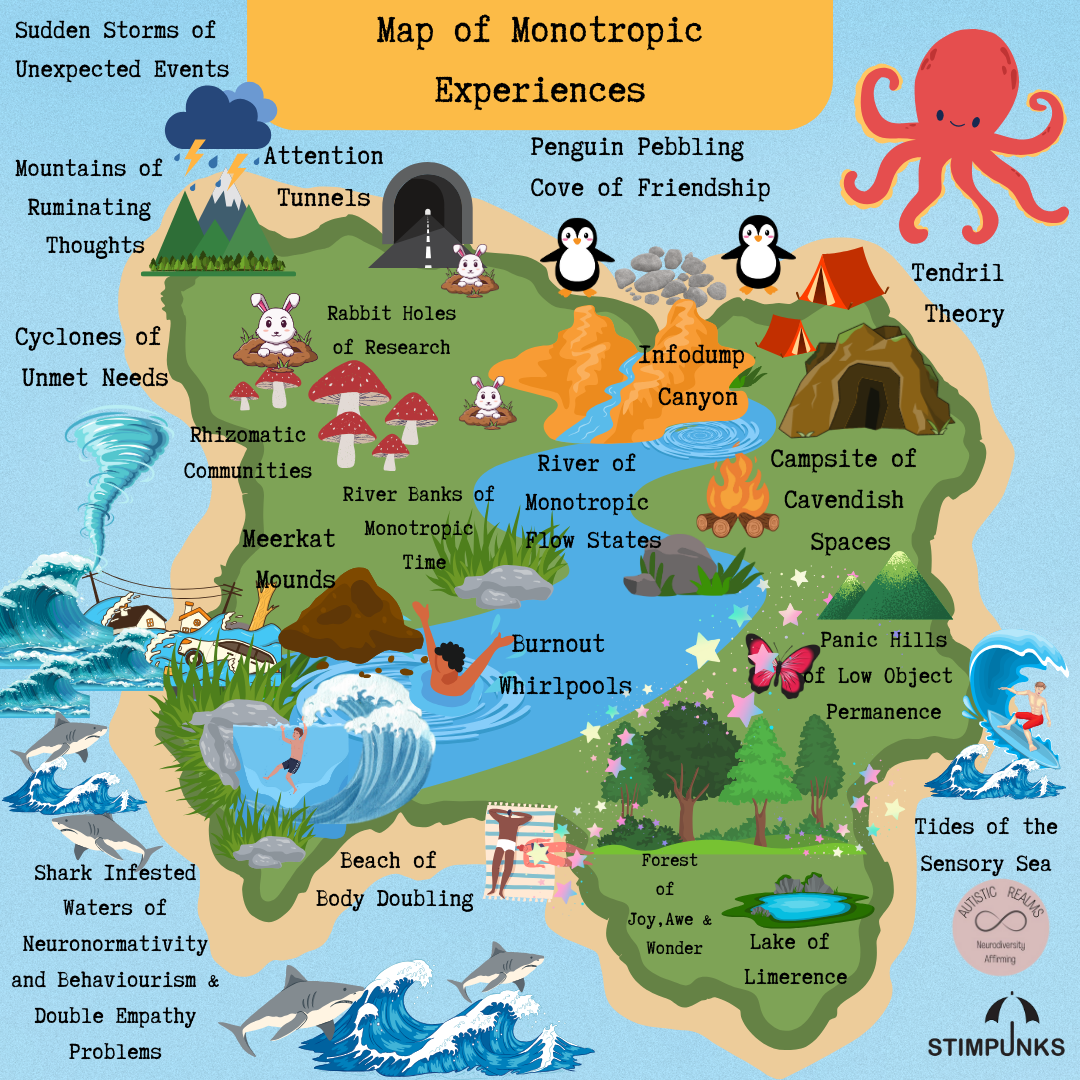
- What is monotropism?: a theory that explains a great deal about Autistic and ADHD attention.
- Building a Positive Autistic Identity: a self-paced course for Autistic people who are getting to know themselves.
- Re-Storying Autism: a course and workbook for families and professionals who want to leave the deficit story behind.
References
- Asasumasu, K. (2000). Coining of neurodivergent and neurodivergence, Sherlock’s Flat Affect (blog).
- Singer, J. (1998). Odd People In: The Birth of Community Amongst People on the Autistic Spectrum. Honours thesis, University of Technology Sydney.
- Walker, N. (2021). Neuroqueer Heresies: Notes on the Neurodiversity Paradigm, Autistic Empowerment, and Postnormal Possibilities. Autonomous Press.
- Murray, D., Lesser, M. and Lawson, W. (2005). Attention, monotropism and the diagnostic criteria for autism. Autism, 9(2), 139–156.
More from Autistic Realms
If this post was useful, these courses, books and resources might help too. Everything in the shop is pay what you can, and many resources are free.
- Building a Positive Autistic Identity: a gentle, self-paced course written for Autistic people.
- Re-Storying Autism course: a video course and workbook with David Gray-Hammond.
- Re-Storying Autism (book): our book, co-written with David Gray-Hammond.
- Neuro-Affirming Glossary (2025 edition): key words for families and professionals.
- Autism and Neurodiversity Starter Pack: free, written with David Gray-Hammond.
- The Autistic Realms shop: over 380 resources, pay what you can and many free.