
Awe, Wonder and Monotropic Attention in Neuroqueer Learning Spaces
A plain language companion to Awe, Wonder and Monotropic Attention in Neuroqueer Learning Spaces.
Full length essay is available Awe, Wonder and Monotropic Attention in Neuroqueer Learning Spaceson Autistic Realms
Key words
Wonder: The moment something catches your attention because it surprises you or doesn’t quite fit what you expected.
Monotropism: A theory of Autistic attention. Attention tends to gather deeply around a few interests at a time, rather than spreading thinly across many (Murray et al., 2005). Many ADHD people relate to it too.
Firstness: Meeting something as though for the very first time, even if you have seen it many times before (De Cruz, 2024).
Awe: What can happen when wonder deepens. Something feels so big or meaningful that it changes how you understand the world (Keltner & Haidt, 2003).
Glimmers: Small moments that help your body feel safe and calm, the opposite of a trigger (Dana, n.d.).
Flow: Being so absorbed in something that time seems to fall away (Heasman et al., 2024).
Autistic inertia: Finding it hard to start, stop or switch between things (Buckle et al., 2021).
Cavendish Space: A way of designing learning around three kinds of space. Caves are for quiet focus, campfires are for sharing with people you trust, and watering holes are for exploring together (Boren & Edgar, 2022).
Neuroqueering: Questioning the idea that there is one correct way to think, learn or be (Walker, 2021).
Where this started

In June 2025, I joined an online memorial for the philosopher Helen De Cruz. The host, Georgi Gardiner, asked us a question that has stayed with me ever since: if Helen De Cruz designed a learning space, what would it look like?
In Wonderstruck (2024), De Cruz argues that wonder and awe are part of how we come to know things. They shape what we notice, how long we stay with something, and whether we are open to changing our minds. As an Autistic ADHD person, I wanted to explore what this means for people whose attention already works in deep, focused ways.
Following one moment

Picture a child crouched beside a puddle after rain. They notice the water holding a perfect upside-down sky, and that small surprise is curiosity. They dip a finger in and watch the sky break apart and slowly come back together. Seeing something ordinary as if for the first time is wonder. If nobody hurries them along, they might begin to understand reflection, stillness and why the sky only looks whole when the water is calm. That shift in understanding is awe.
For many monotropic people, this kind of deep attention is part of everyday life. A pebble that feels just right in your hand, a pattern of light on the floor, or a number sequence that suddenly makes sense can pull us all the way in. I can’t say that Autistic and ADHD people feel wonder more than anyone else, and I don’t think anyone knows that yet. What I do know is that when I feel safe and regulated, wonder carries me into awe, and all I want to do is research, connect ideas and create. When I am in burnout, those glimmers are much harder to reach, because my energy goes into getting through the day.
Why interruptions matter

Wonder needs time to grow, and awe needs even longer. For monotropic people, being asked to stop, switch or “come back to the carpet” can break a whole line of thinking just as it was taking shape. Autistic inertia can make it hard to get into that deep state in the first place, and hard to come out of it once we are there. Being pulled out suddenly can feel painful, and finding the way back takes energy many of us don’t have.
Teachers rarely mean any harm by this. They work within busy timetables, targets and long-held ideas about what learning should look like. Still, when a child stays with something for a long time, it is too often read as distraction, when it may be the deepest learning happening in the room. Milton’s (2012) double empathy problem helps explain how deep engagement gets misread by people who experience the world differently.
When I worked in early years, we wrote “wow moments” on sticky notes because they mattered. Much of that spirit fades once children move into Year One and beyond, and I would love to see it carried all the way through education.
What could help
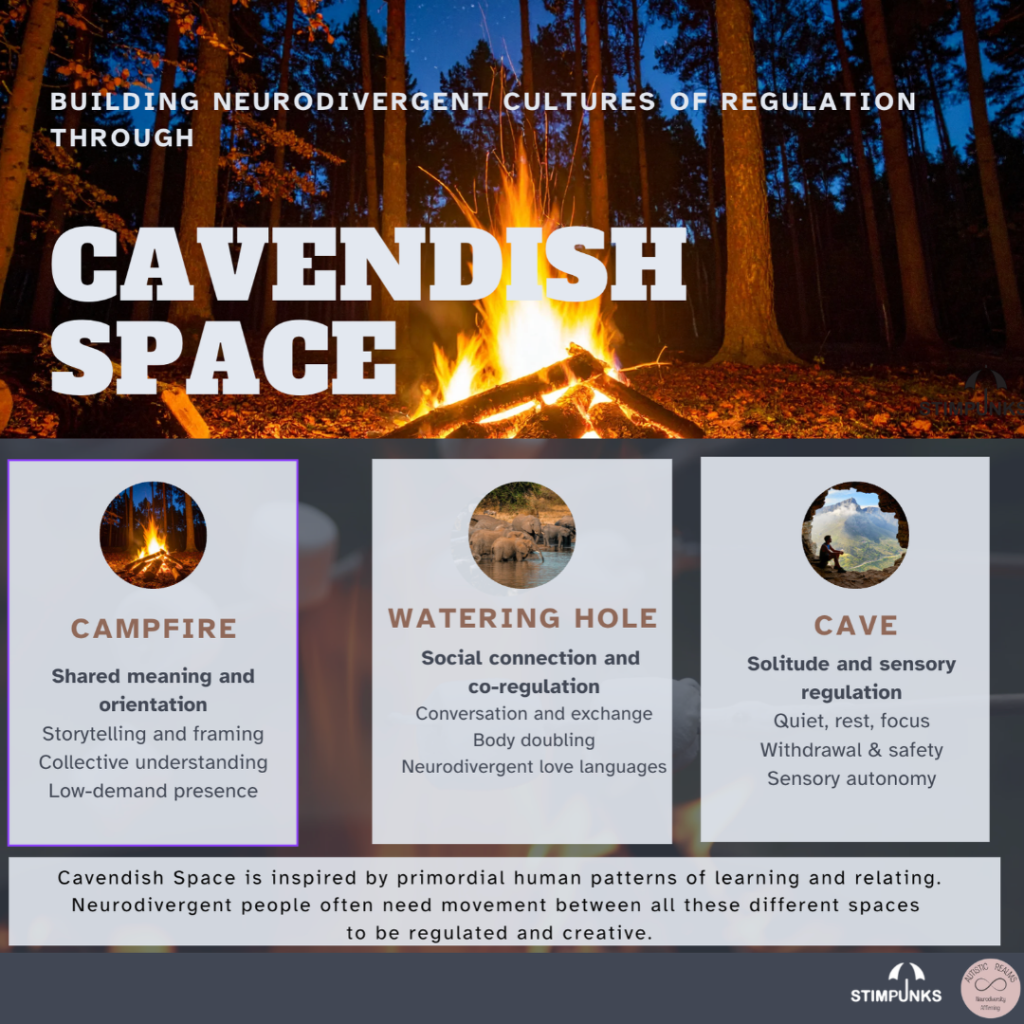
With Ryan Boren and the Stimpunks Foundation, I have been developing Cavendish Space and Neuroqueer Learning Spaces (Edgar & Boren, 2024). Caves give people quiet time to focus without being interrupted. Campfires let people share what has caught their attention with someone they trust. Watering holes let wonder become something a group explores together, so the puddle turns into a shared investigation.
Underneath all of this is the freedom to think, move, stim and regulate in the ways our bodyminds need (Walker, 2021), and some say over how our attention gathers and shifts. We call this attentional sovereignty.
Change doesn’t have to happen all at once. It can begin with one child, one glimmer and one adult willing to pause. The child watching light move across the floor hasn’t stepped away from learning. They are already inside it.
Read the full essay on Autistic Realms: Monotropism, Wonder & Awe in Neuroqueer Learning Spaces.
References
Boren, R., & Edgar, H. (2022). Cavendish space: Caves, campfires, and watering holes for dandelions, tulips, and orchids. Stimpunks Foundation. https://stimpunks.org/projects/cavendish-space-project/
Buckle, K. L., Leadbitter, K., Poliakoff, E., & Gowen, E. (2021). “No way out except from external intervention”: First-hand accounts of autistic inertia. Frontiers in Psychology, 12, Article 631596. https://doi.org/10.3389/fpsyg.2021.631596
Dana, D. (n.d.). Glimmers. Rhythm of Regulation. https://www.rhythmofregulation.com/glimmers
De Cruz, H. (2024). Wonderstruck: How wonder and awe shape the way we think. Princeton University Press.
Edgar, H. (2025, July 26). Glimmers: Autistic joy and monotropism. Autistic Realms. https://autisticrealms.com/glimmers-autistic-joy-and-monotropism/
Edgar, H., & Boren, R. (2024). Neuroqueer learning spaces. Stimpunks Foundation. https://stimpunks.org/projects/neuroqueer-learning-spaces/
Heasman, B., Williams, G., Charura, D., Hamilton, L. G., Milton, D., & Murray, F. (2024). Towards autistic flow theory: A non-pathologising conceptual approach. Journal for the Theory of Social Behaviour, 54(4), 469–497. https://doi.org/10.1111/jtsb.12427
Keltner, D., & Haidt, J. (2003). Approaching awe, a moral, spiritual, and aesthetic emotion. Cognition and Emotion, 17(2), 297–314. https://doi.org/10.1080/02699930302297
Milton, D. E. M. (2012). On the ontological status of autism: The “double empathy problem”. Disability & Society, 27(6), 883–887. https://doi.org/10.1080/09687599.2012.710008
Murray, D., Lesser, M., & Lawson, W. (2005). Attention, monotropism and the diagnostic criteria for autism. Autism, 9(2), 139–156. https://doi.org/10.1177/1362361305051398
Walker, N. (2021). Neuroqueer heresies: Notes on the neurodiversity paradigm, autistic empowerment, and postn
https://autisticrealms.com/monotropism-wonder-awe-in-neuroqueer-learning-spaces

Resources on monotropism
If you would like to go further with monotropism, these might help. Everything in the shop is pay what you can, and many resources are free.
- An Introduction to the Theory of Monotropism: a free e-book.
- My Monotropic Map workbook: map your own interests, flow and attention.
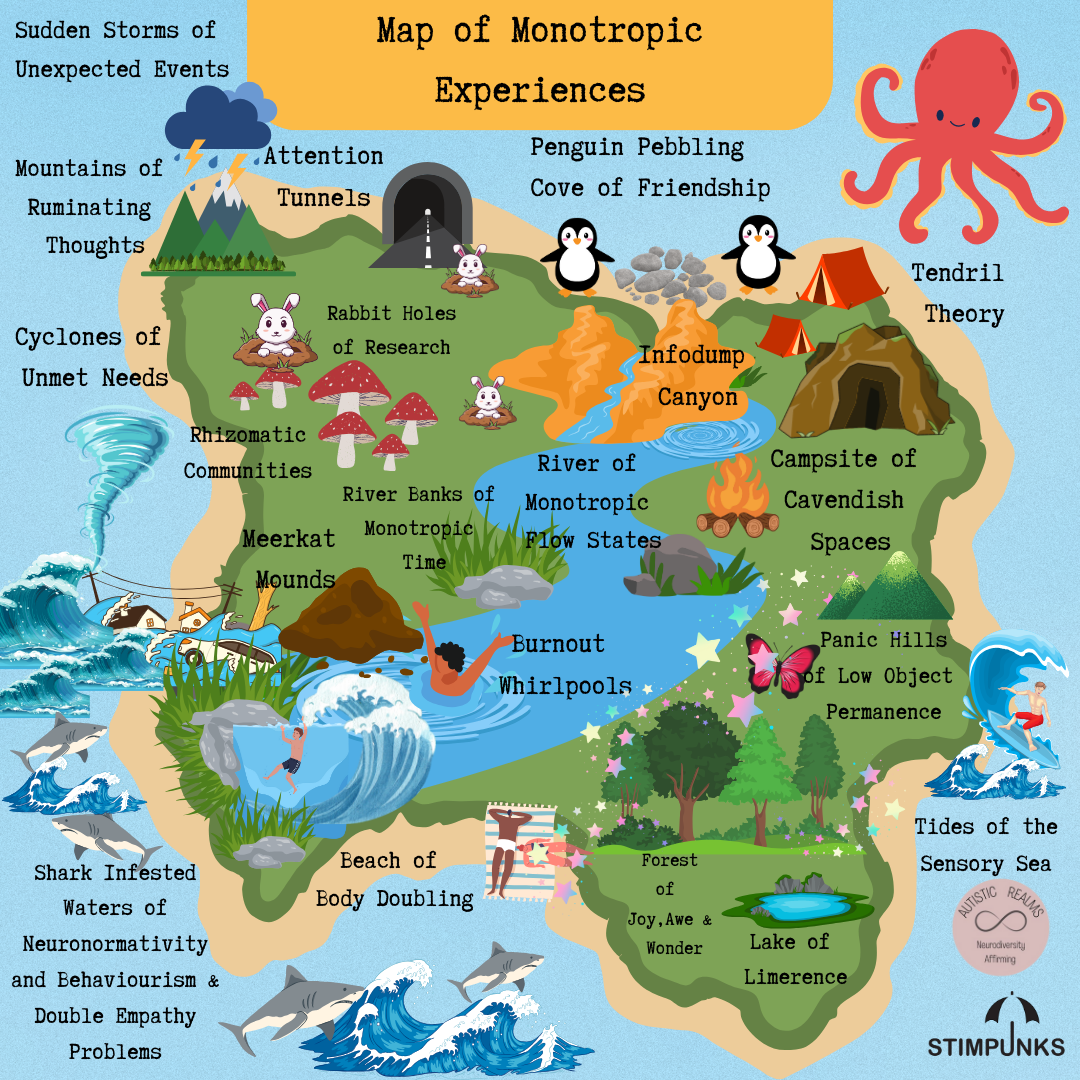
- The Map of Monotropic Experiences: explore monotropic attention, interests and flow.
- Embracing Monotropism and Preventing Burnout: my book on monotropism and preventing Autistic burnout in young people.
- Embracing Monotropism (paperback): the same book in print.
- Monotropism resources in the shop: posters, cards and guides, pay what you can.