By Helen Edgar | Autistic Realms
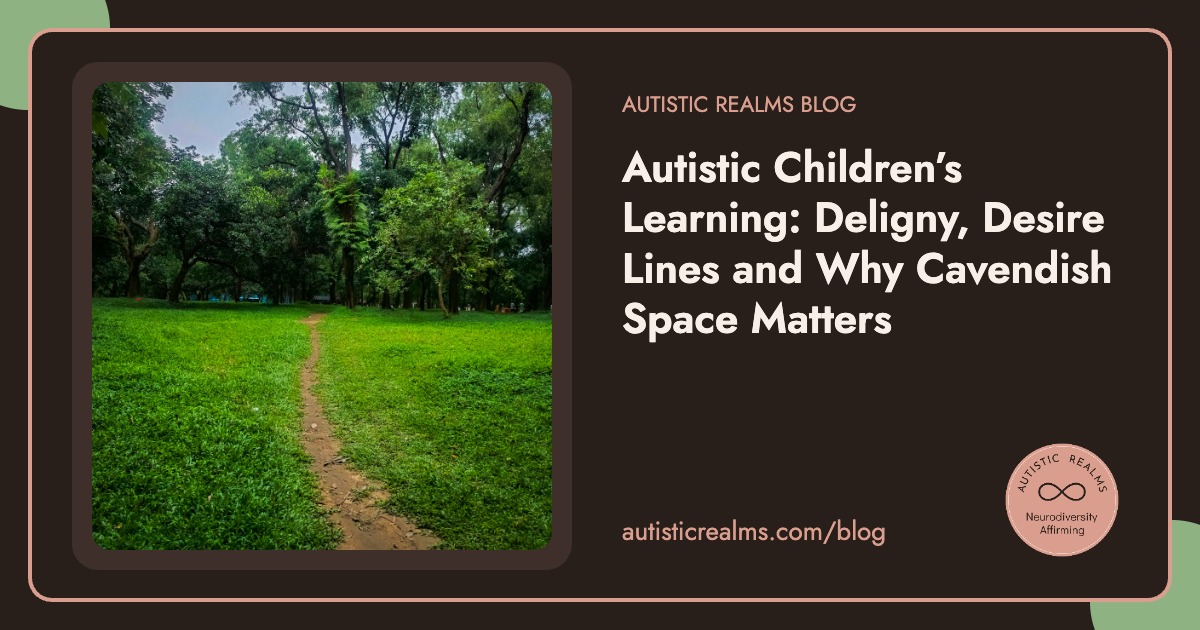
There is a path across the grass outside my house, going towards the bus stop and the corner shop. It doesn’t follow the pavement. It cuts diagonally across the corner, worn into the ground by hundreds of people who decided the official route was wrong and walked where it actually made sense to walk. Nobody planned it and nobody designed it; it just appeared, because people followed where their feet wanted to go. Landscape architects call these desire lines. They are the paths we make when we stop following a route that was designed without our actual needs in mind, and start following ourselves.
Fernand Deligny and Autistic Children
In 1967, the French educator and writer Fernand Deligny set up an informal network of care for Autistic children in the Cévennes, in the south of France, which carried on into the 1990s (Deligny, 2015). Rather than placing the children in an institution, Deligny and a small group of non-professional adults he called “close presences” lived alongside them, day and night, watching, moving with them and paying attention. Many of the children were non-speaking, and many had been described as having what would today be called ‘challenging behaviour’. They didn’t fit into society’s expectations of how children ‘should’ be.
What Deligny noticed was that the children walked along routes with no obvious destination. They returned to the same spots again and again, tracing patterns through the space that looked purposeless from the outside but held meaning for them. Their movement had no fixed goal, yet it was far from aimless (Milton, 2016). Something was happening when the children had the freedom to move and their own autonomy over the spaces they lived in. They were getting something from it; nobody could say exactly what, but that didn’t mean it was nothing. Deligny called their paths lignes d’erre: wandering lines, or wander lines.
The adults carefully traced the children’s movements onto maps, not to interpret or redirect them, but to honour what they could see was happening. Over time they noticed that the wandering wasn’t random at all. The children were responding to their environment: to objects placed around the space, and to the places where adults went about everyday tasks like fetching water, cooking or chopping wood. Their lines kept returning to these meeting points. The space itself carried information that held meaning for them, drawing their attention and meeting their sensory needs.
Wandering Lines in a World of Fixed Routes
Most schools, even specialist settings, are not designed for Autistic people or for wandering. They are designed for following instructions. Children are expected to follow a strict timetable, with the day marked out by loud bells, room changes and changing subjects and teachers. They constantly have to split their attention to follow instructions and produce evidence that they have met the goals and outcomes set out in the curriculum.
The Autistic child who needs to move before or while they think is often told to sit down. The child whose attention has been drawn into one deep interest is told to move on to the next topic before they have reached their own conclusions or been allowed to see where that interest might lead. The child who needs to stim, or who needs a calmer environment, is often told off and read as a problem when they become dysregulated. Even the quiet child may be seen as avoidant if they feel unable to speak up and answer questions in the right way at the right time.
All of this has made me wonder: what if the wandering line is the learning itself, the engagement in flow, what Deleuze and Guattari (1987), who drew directly on Deligny’s maps, called a line of flight? What if the path that looks like it goes nowhere is actually heading somewhere that really matters for that child, somewhere the map doesn’t show yet?
Our Autistic children are often excluded, or forced to withdraw from our education systems, before they even get the chance to explore their own bodyminds (Dychtwald, 1978), their creativity and their potential. Many reach burnout and mental health crisis before they reach adulthood. Deligny seemed to understand what neurodivergent people often instinctively know: the map of neuronormativity that we are born into governs our educational spaces, and it can cause a great deal of harm to Autistic people.
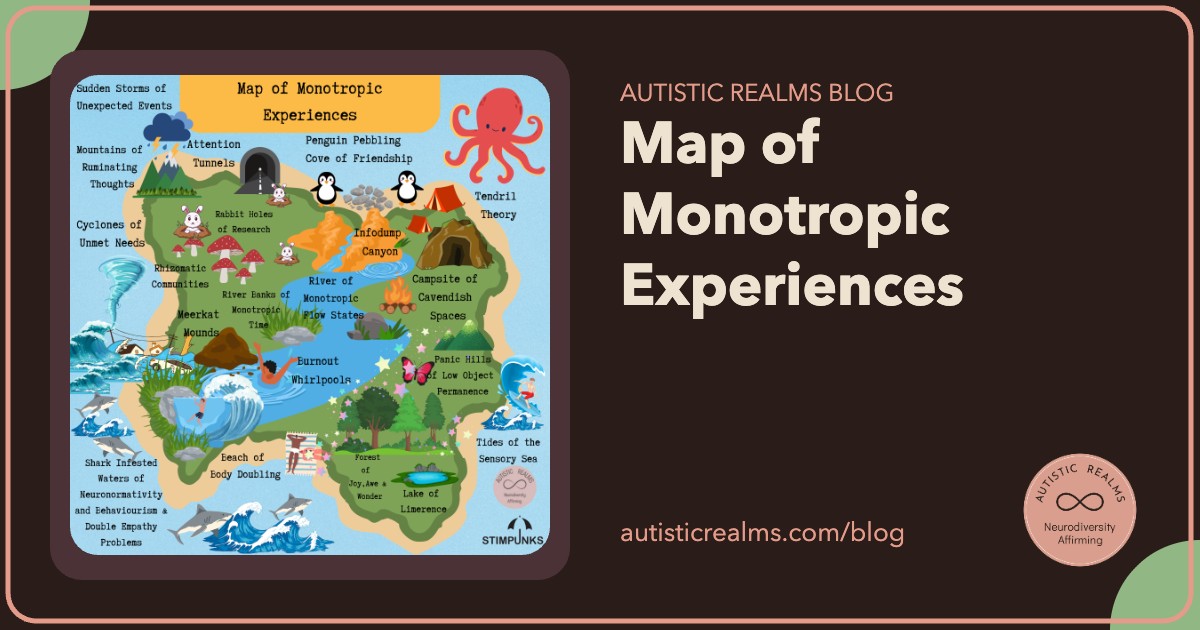
Cavendish Space
Cavendish Space, conceptualised by Ryan Boren at Stimpunks Foundation and developed together with me through our Neuroqueer Learning Spaces project, is a direct response to the problems we have seen in our own families (Stimpunks Foundation, n.d.). It is a way of designing environments, whether classrooms, community spaces, workplaces or homes, so that all kinds of people can follow their own lines without being constantly redirected.
Cavendish Space has three zones. Each one offers a different kind of space for a different bodymind need, depending on a person’s capacity, energy and needs in that moment.
The Cave is for deep, quiet, uninterrupted focus and regulation. It is the place where your wandering line can flow, and where you can go very deep into your passions without fear of being pulled back to the surface. It is a space to meet your sensory needs, and to rest and recover by yourself.
The Campfire is for gathering gently with others in small groups, around something of shared interest, and learning from each other. It is a gathering with room to contribute in different ways and at different paces, and to share knowledge.
The Watering Hole is for community, the unstructured, in-between space between the Campfire and the Cave. It is a space where you can simply exist alongside other people without having to be productive or prove yourself. This is where body doubling and parallel play happen, which can be really valuable for Autistic people.
Between the zones are lily pads, small pause points that make moving from one space to another more manageable. Transitions are hard for everyone, and especially for monotropic Autistic people, whose attention flows very strongly into one thing at a time and produces deep focus that doesn’t shift easily (Murray et al., 2005). A sudden move from a quiet Cave to a group discussion at the Campfire can feel like being dropped into cold water. The lily pads turn that transition into something you can gently step through in your own time, rather than risk falling in.
In Cavendish Space, each person holds their own relay switch. They decide which zone they need and when to move. Agency and autonomy are built into the whole framework rather than treated as extras to be earned. When we understand what drives desire, how monotropism works and how important flow is, especially for Autistic people, we can build spaces where people have genuine cognitive, psychological and sensory liberty over their own bodyminds and ways of learning.
Trusting the Path
Deligny spent decades alongside Autistic children as they created their own paths through a space designed to hold them safely, rather than to constantly redirect them. He didn’t try to fix their wandering. He honoured their movements and trusted that they were going somewhere valuable for them.
Deligny was not Autistic himself, and his work holds real tensions. He saw the children as living outside language and preferred to call them mute, whereas today we know how important it is to presume competence and to honour every form of communication, including AAC. Autistic scholar Damian Milton (2016) offers a thoughtful reading of Deligny’s legacy that keeps these tensions in view, and it is through Autistic voices like his that I want to carry Deligny’s wandering lines forward.
Cavendish Space honours our Autistic needs and authentic ways of being. It affirms that our way of moving through the world makes sense, and it can hold us safely. We need to give children the safety and freedom to explore their interests and follow their own lines, without fear of punishment, redirection, or being told that their way of moving through the world is wrong.
👉 Read next: Building Neurodivergent-Affirming Cultures of Regulation: Reflections from a Cavendish Space Workshop
👉 Read next: Awe, Wonder and Monotropic Attention in Neuroqueer Learning Spaces
👉 Read next: Child-Led Play and Monotropism in Gestalt Language Processors
👉 Read next: Fernand Deligny: The Buried Root of Cavendish Space (Stimpunks)
👉 Explore: Cavendish Space in the Stimpunks glossary
This piece draws on the work of Fernand Deligny and the Cavendish Space framework developed collaboratively by Ryan Boren and Helen Edgar at Stimpunks Foundation. Helen Edgar is Co-Creative Director at Stimpunks Foundation and runs Autistic Realms.
References
Deleuze, G., & Guattari, F. (1987). A thousand plateaus: Capitalism and schizophrenia (B. Massumi, Trans.). University of Minnesota Press.
Deligny, F. (2015). The Arachnean and other texts (D. S. Burk & C. Porter, Trans.). Univocal Publishing.
Dychtwald, K. (1978). Bodymind. Jove.
Milton, D. (2016). Tracing the influence of Fernand Deligny on autism studies. Disability & Society, 31(2), 285–289. https://doi.org/10.1080/09687599.2016.1161975
Murray, D., Lesser, M., & Lawson, W. (2005). Attention, monotropism and the diagnostic criteria for autism. Autism, 9(2), 139–156. https://doi.org/10.1177/1362361305051398
Stimpunks Foundation. (n.d.). Cavendish Space. https://stimpunks.org/space/cavendish/