By Helen Edgar (Autistic Realms) and Cathy Shilling (The Speech Den)
Based on the presentation we gave at the Gestalt Language Processing Conference in October 2025.
There is not yet much research on how monotropism and Gestalt Language Processing (GLP) fit together, so in this post we share some of our own insights, along with ideas that have grown out of the neurodivergent community, about how understanding monotropism can help us support Gestalt Language Processors (GLPs). Not every monotropic person is a GLP, but for those who are, we hope this offers some light and some gentle ways to support your child or young person.
Child-led play sits at the heart of all of this. When we meet children where they are, and join them in their flow and their attention tunnel, we build the most meaningful connections.
Keywords: Monotropism, Gestalt Language Processing, child-led play, neuro-affirming practice, Autistic communication, attention, flow, sensory regulation.
Rethinking Attention and Connection
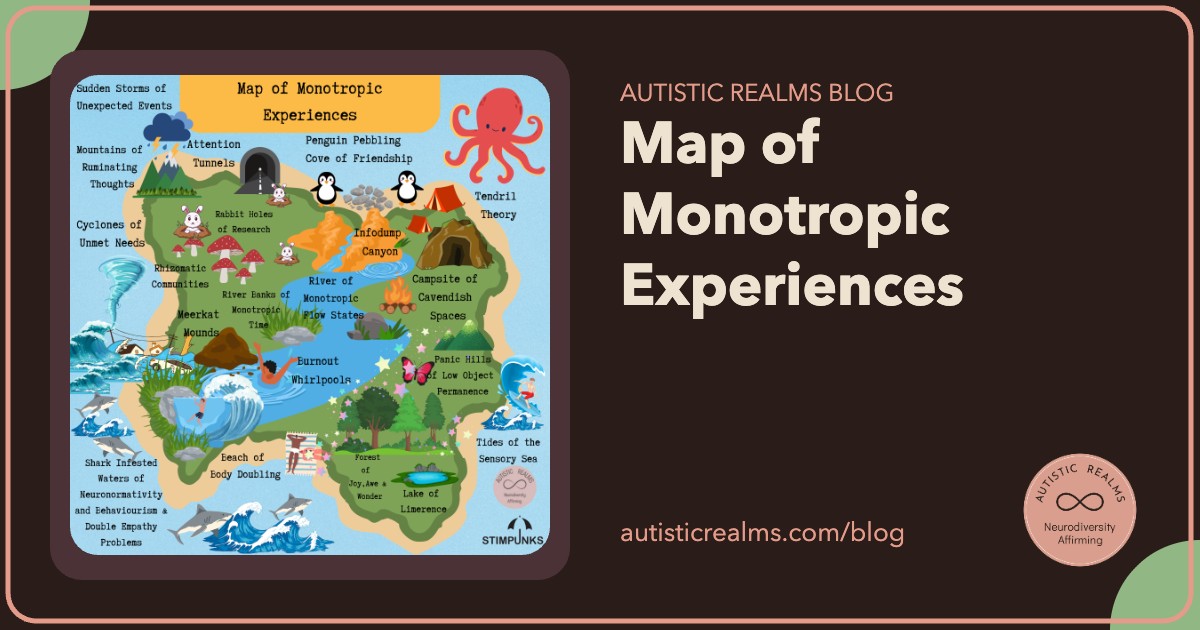
Monotropism offers a neuro-affirming way of understanding Autistic and ADHD experience through how we use our attention. It was first developed by Dinah Murray and Wenn Lawson, and later expanded with Mike Lesser (Murray et al., 2005). The theory describes how monotropic minds focus intensely on a small number of interests at any one time.
Where some people see Autistic people as “stuck in repetitive patterns and behaviours”, we often see Autistic and ADHD people in flow: deeply engaged, motivated and connected to what matters most to them (D. Murray, 1996; F. Murray, 2018; Heasman et al., 2024).
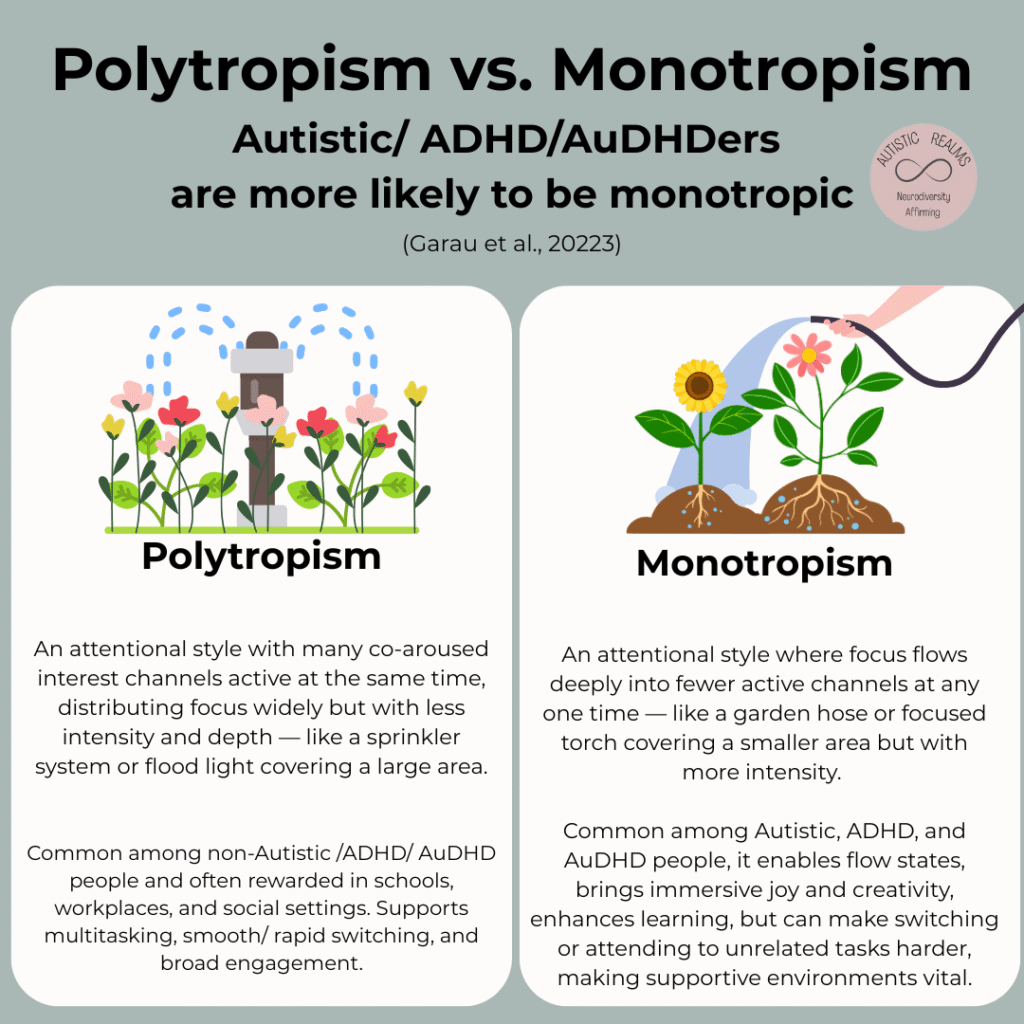
Polytropic attention, which is more common in non-Autistic and non-ADHD people, spreads more evenly across several channels at once. This makes multitasking and switching between tasks smoother, and most school structures have been designed around it. Understanding this difference helps us support Autistic learners to thrive and to develop communication in their own way.

Try This: Supporting Monotropic Learners
- Offer extra transition time and avoid sudden changes or unexpected events.
- Create quiet, low-demand spaces for re-regulation.
- Join a child in their interest, or play alongside them, rather than redirecting them to something you feel they ‘should’ be doing or learning.
- Use predictable sensory cues such as music, objects or photos to reduce anxiety, reinforce the events of the day and develop language.
- Remember that deep focus is engagement, which may explain why a child cannot always listen and do another task at the same time.
👉 Read next: Monotropism vs Polytropism: ADHD, AuDHD & Autistic Attention
👉 Download the e-book: Monotropism: Supporting Young Autistic People with Transitions
Monotropism and Gestalt Language Processing
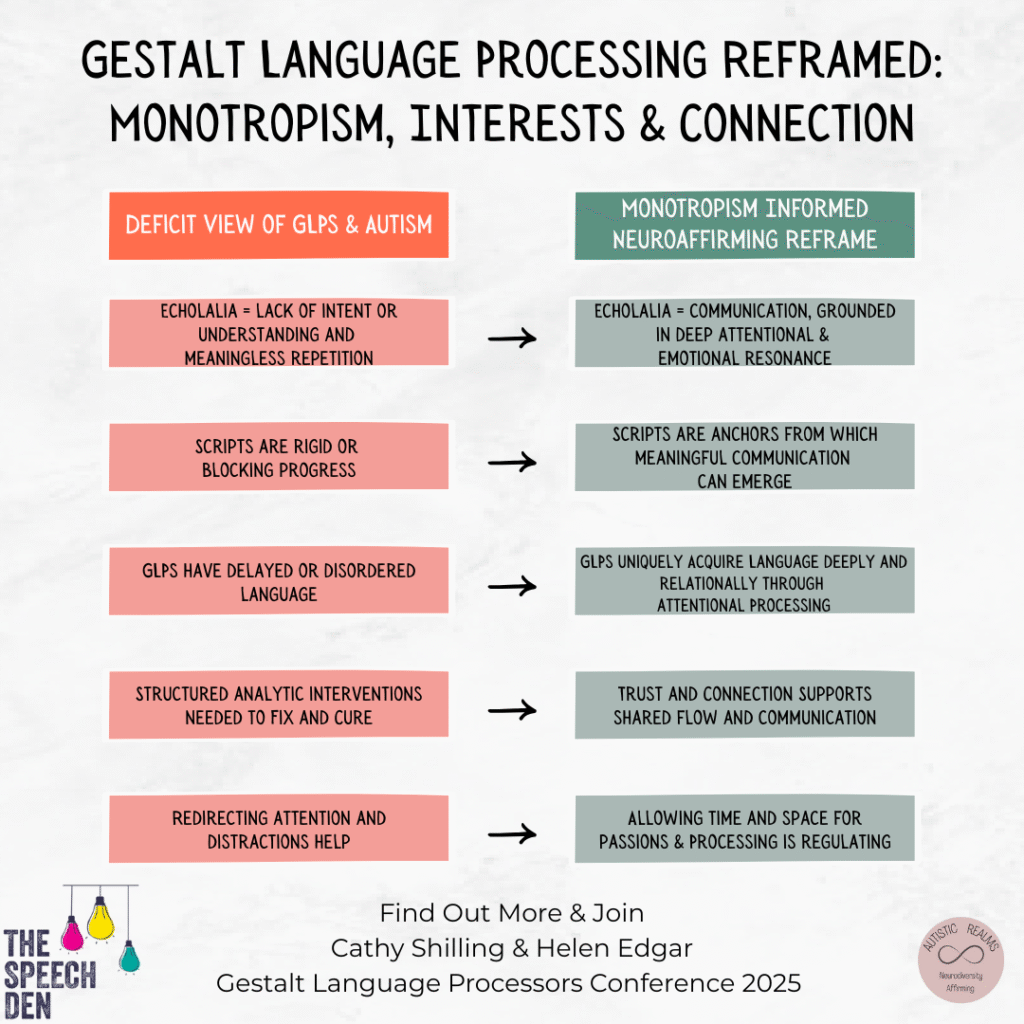
Gestalt Language Processing describes a natural pathway of language development in which children learn language in meaningful chunks, or gestalts, before breaking them down into single words. Marge Blanc’s Natural Language Acquisition framework maps out these stages (Blanc et al., 2023), and Meaningful Speech has a helpful guide to the stages of GLP.
Many Autistic and ADHD children show strong overlaps between GLP and monotropic attention. Language often grows in an embodied way, through flow, emotion and sensory immersion in play, and through learning that follows a child’s own interests.
Try This: Supporting Gestalt Language Processors
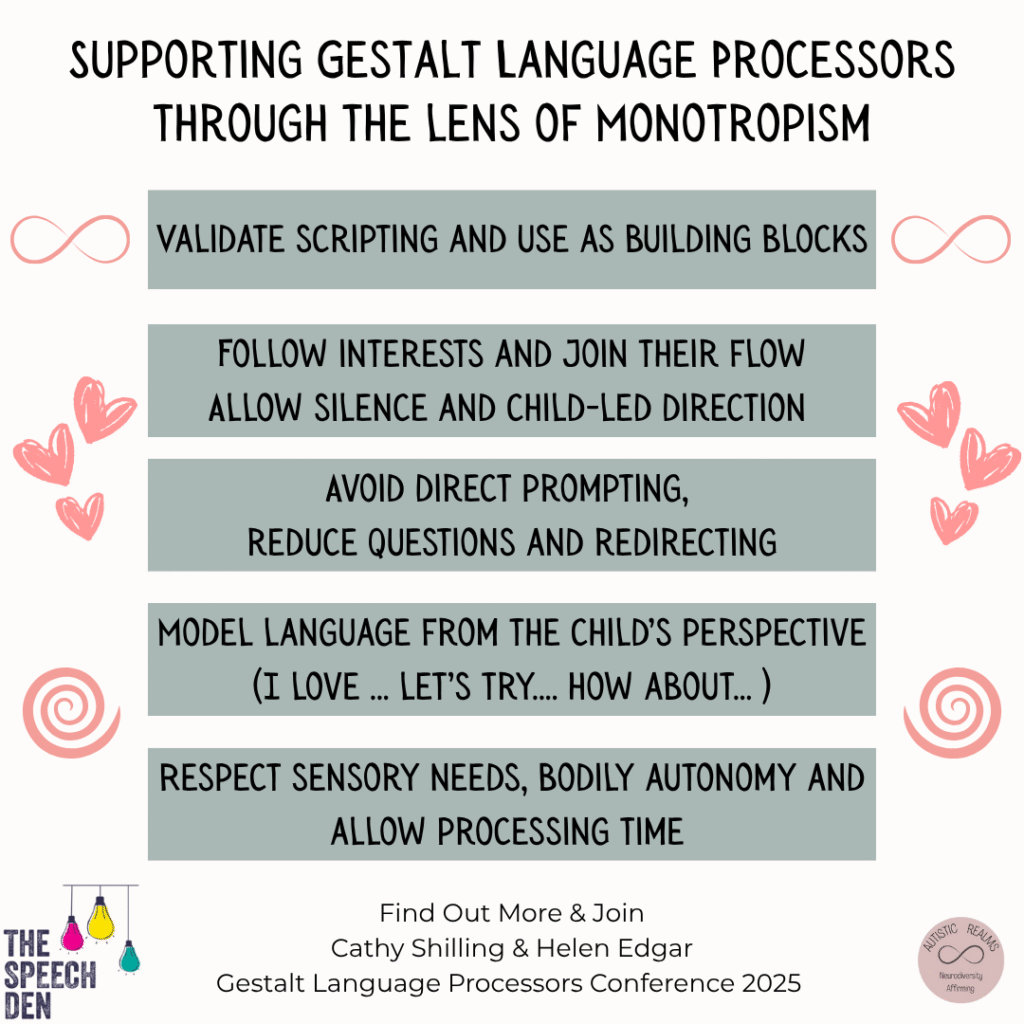
- Treat repeated phrases as meaningful communication and as ways to connect.
- Listen for the emotional and sensory context. Be a gentle detective, wondering when, why and how a phrase or sound might be meaningful for your child and what it could signify.
- Echo softly when the time feels right. If a child says “Time for Bluey”, you might reply “Yes, Bluey time feels calm and happy.”
- Allow processing pauses and time for silence.
- Avoid prompting that disrupts flow.
👉 Read next: Gestalt Language Processing, Monotropism & Young People
Deep Focus, Flow and Regulation
Time for deep focus helps Autistic people to regulate and to learn. Many behaviours once labelled “restricted” help to keep the nervous system and sensory system in balance, through rhythm, repetition, sensory grounding and the chance to dive fully into an attention tunnel.
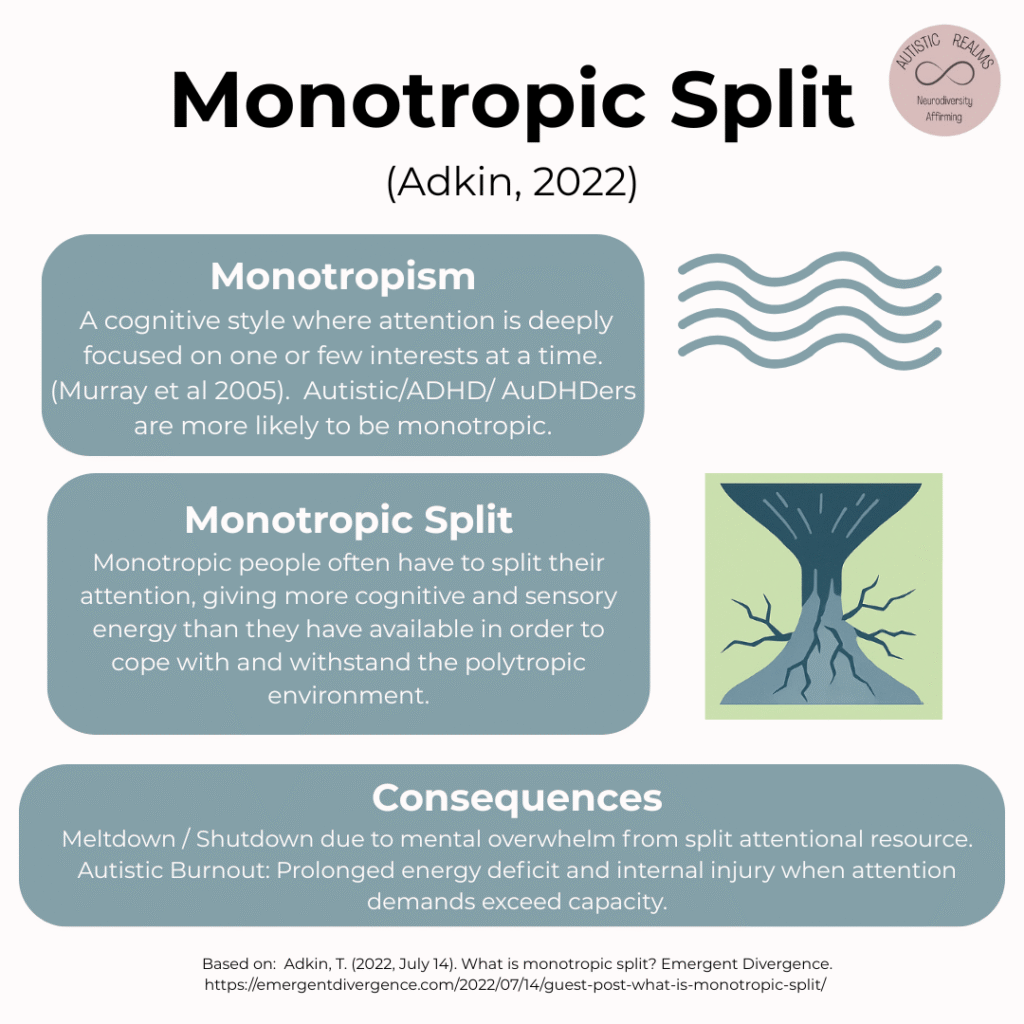
When attention has to stretch across too many channels at once, such as sensory input, sounds, instructions and social demands, energy fragments and splits. Tanya Adkin (2022) calls this monotropic split. Over time, splitting attention like this without enough recovery can lead to exhaustion and Autistic burnout (Arnold et al., 2023).
Try This: Reducing Monotropic Split
- Limit background noise, visual clutter and sensory overload.
- Keep routines flexible and predictable, adding sensory cues when needed.
- Build in more time before and after transitions.
- Build in more time for a child’s special interests and passions.
- Model co-regulation with a calm tone and real presence.
- For practitioners, ask families and young people, “What supports their flow?” Find out more about a child’s interests, even if they may not match your own or what you feel they ‘should’ be learning about.
👉 Read next: What Is Monotropic Split? (Adkin, 2022)
👉 Read next: The Double Empathy Problem is DEEP
Honouring Scripts and Shared Meaning
For GLPs, scripts are emotional anchors and valid ways of communicating. A phrase like “Time for Bluey” might express joy one day, and the next day be a way of seeking comfort or telling us about overwhelm.
When we join in, or play alongside in parallel with curiosity, we spend less energy translating and more time connecting. Neuro-affirming practice values a child’s own ways of communicating and does not correct children to fit neurotypical expectations. We can still support language and communication while respecting a child’s autonomy (Haydock et al., 2024).
Try This: Joining Scripts
- Join in or play alongside with curiosity rather than correcting.
- Notice what a familiar script seems to mean today, as the same words can carry different feelings.
- Let scripts be building blocks for shared meaning.
👉 Read next: Shared Flow: Turning Attention To Support Children Together
👉 Read next: Why “Interest-Led” Isn’t Enough: Embracing Monotropism & Neuro-Affirming Practice
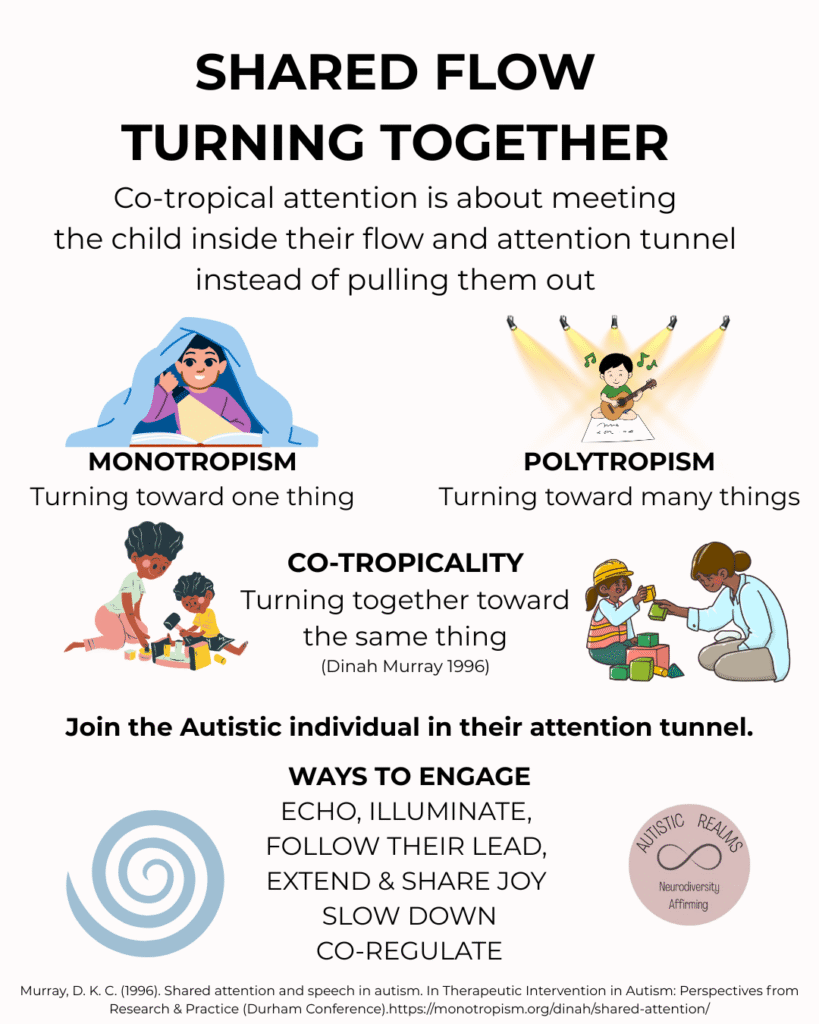
Child-Led Play: A Journey of Unlearning
Child-led play means following a child’s cues, interests and lead, and letting go of our own predetermined goals. Real autonomy lets play unfold naturally, at the child’s own pace.
Many common behaviourist programmes, such as rigid use of PECS, Attention Autism and corrective Social Stories, can suppress a child’s authenticity and harm their wellbeing, because underneath them sits a message that the child’s authentic identity is flawed and needs correcting. We can change the environment, and the way we build relationships with children, so that neurodivergent children are not asked to squeeze themselves into neurotypical expectations. As Luke Beardon (2022) puts it, autism + environment = outcome.
Try This: Child-Led Play in Action
- Mirror rather than direct.
- Join their flow by humming, echoing or sharing sensory joy.
- Pause before helping and wait for an invitation.
- Respect repetitive play, which builds safety and confidence.
- Avoid turning passions into token rewards.
- Avoid sticker charts or praise systems that only reward neuronormative expectations.
👉 Read next: Monotropism and Autistic Play
👉 Read next: Why PBS is Harmful for Autistic and Neurodivergent Young People
👉 Read next: What Works for Autistic Children by Luke Beardon
👉 Explore next: Diverse Pathways


Transitions and Protecting Flow
Transitions can feel like painful interruptions for monotropic people. Gentle, sensory-based cues can help a child feel safe as they move from one focus to the next. Tanya Adkin (2025) describes this softer way of moving between focuses as lilipadding, which helps to reduce the distress that abrupt transitions can cause.
Try This: Gentler Transitions
- Use songs, visuals or tactile signifiers.
- Avoid rigid reliance on countdown timers, and check what actually helps.
- Try lilipadding, moving between focuses softly rather than abruptly (Adkin, 2025).
- Work with families to design personalised transition supports.
👉 Download the e-book: Monotropism: Supporting Young Autistic People with Transitions
👉 Read next: Lilipadding for Autistic People: Reducing Transitional Trauma for Monotropic Minds
Play Schemas and Sensory Flow
Children often show consistent play patterns, such as transporting, spinning or lining things up, that reflect their sensory curiosity. These patterns are ways of exploring the world, and they deserve the same respect as any other kind of play. Playworker and artist Max Alexander (2025) maps eight common patterns of Autistic play in The Joys and Shapes of Autistic Play, which makes a joyful companion to this section.
Try This: Supporting Sensory Play
- Notice recurring sensory themes.
- Offer open-ended materials such as water, sand and fabric.
- Match their rhythm by echoing sounds or movements.
- Avoid interrupting, and stay beside rather than above.
- Reflect aloud: “Round and round, the light’s spinning!”
👉 Explore further: Play Radical by Max Alexander
👉 Read next: A Playful Manifesto by Max Alexander
👉 Buy the book and zine: The Joys and Shapes of Autistic Play and A Playful Manifesto from the Play Radical store
Reframing Language and Practice
Professionals are increasingly recognising GLP and monotropic focus as valid developmental pathways (Haydock et al., 2024; Hagen & Kalandadze, 2025). Neuro-affirming practice moves our goal away from fixing and towards understanding, and away from compliance and towards connection.
Reflection Prompts for Parents and Practitioners
- When I redirect play, what message does it send about autonomy?
- Do I value silence and repetition as learning opportunities?
- How might neuronormative expectations shape my reactions?
- When was I last in flow, and what can that teach me?
- How can I adapt the environment to meet my child’s attention style?
👉 Further reading: Protecting the Meaning of Neuro-Affirming Practice

From Unlearning to Re-Learning
Child-led play is a mindset more than a strategy, and it asks us to reframe what we think play ‘should’ look like. When we protect a child’s flow, we affirm their authentic neurodivergent identity, and when we honour scripts, we join their rhythm. Every Autistic way of attending, playing and communicating is valid, and there is no single right way to play or to communicate.
Find Out More
Visit The Speech Den and find out about The Gestalt Language Processors Conference 2025: Building on Knowledge, Reflecting on Progress, Empowering Every Voice. You can also download our presentation slides below.
References and Further Reading
Adkin, T. (2022, July 14). Guest post: What is monotropic split? Emergent Divergence. https://emergentdivergence.com/2022/07/14/guest-post-what-is-monotropic-split/
Adkin, T. (2025, June 7). Lilipadding for Autistic people: Reducing transitional trauma for monotropic minds. Emergent Divergence. https://emergentdivergence.com/2025/06/07/lilipadding-for-autistic-people-reducing-transitional-trauma-for-monotropic-minds/
Aldred, K., & Aldred, D. (2023). Embodied education: Creating safe space for learning, facilitating and sharing. GirlGod Books.
Alexander, M. (n.d.). A playful manifesto [Zine]. Play Radical. https://playradical.com/a-playful-manifesto/
Alexander, M. (2025). The joys and shapes of autistic play. Max Alexander. https://playradical.com/store/
Arnold, S. R., Higgins, J. M., Weise, J., Desai, A., Pellicano, E., & Trollor, J. N. (2023). Confirming the nature of autistic burnout. Autism, 27(7), 1906–1918. https://doi.org/10.1177/13623613221147410
Beardon, L. (2022). What works for autistic children. Sheldon Press.
Beardon, L. (2024). Reasonable adjustments for autistic children: How to make their world better. Sheldon Press.
Blanc, M., Blackwell, A., & Elias, P. (2023). Using the Natural Language Acquisition Protocol to support gestalt language development. Perspectives of the ASHA Special Interest Groups, 8(6), 1279–1286. https://doi.org/10.1044/2023_PERSP-23-00098
Buckle, K. L., Leadbitter, K., Poliakoff, E., & Gowen, E. (2021). “No way out except from external intervention”: First-hand accounts of autistic inertia. Frontiers in Psychology, 12, Article 631596. https://doi.org/10.3389/fpsyg.2021.631596
Dwyer, P., Sillas, A., Prieto, M., Camp, E., Nordahl, C. W., & Rivera, S. M. (2024). Hyper-focus, sticky attention, and springy attention in young autistic children: Associations with sensory behaviors and cognitive ability. Autism Research, 17(8), 1677–1695. https://doi.org/10.1002/aur.3174
Garau, V., Murray, A. L., Woods, R., Chown, N., Hallett, S., Murray, F., Wood, R., & Fletcher-Watson, S. (2023). Development and validation of a novel self-report measure of monotropism in autistic and non-autistic people: The Monotropism Questionnaire [Preprint]. OSF Preprints.
Hagen, A. M., & Kalandadze, T. (2025). Unmasking inclusion: Reclaiming neurodivergent childhoods in Scandinavian early childhood education. Topics in Early Childhood Special Education. https://doi.org/10.1177/02711214251371621
Haydock, A., Harrison, L., Baldwin, K., & Leadbitter, K. (2024). Embracing gestalt language development as a fundamental neurodiversity-affirmative practice. Autism, 28(5), 1055–1059. https://doi.org/10.1177/13623613241234598
Heasman, B., Williams, G., Charura, D., Hamilton, L. G., Milton, D., & Murray, F. (2024). Towards autistic flow theory: A non-pathologising conceptual approach. Journal for the Theory of Social Behaviour, 54(4), 469–497. https://doi.org/10.1111/jtsb.12427
Milton, D. E. M. (2012). On the ontological status of autism: The ‘double empathy problem’. Disability & Society, 27(6), 883–887. https://doi.org/10.1080/09687599.2012.710008
Murphy, K. (2023). A beginner’s guide to self-directed neurodivergent play. Tapestry. https://tapestry.info/self-directed-neurodivergent-play/
Murphy, K. (2025). Neurodiversity-affirming practices in early childhood: An empowering guide to diverse development and play. Routledge.
Murray, D. K. C. (1996). Shared attention and speech in autism. In Therapeutic intervention in autism: Perspectives from research and practice (Durham Conference). https://monotropism.org/dinah/shared-attention/
Murray, D., Lesser, M., & Lawson, W. (2005). Attention, monotropism and the diagnostic criteria for autism. Autism, 9(2), 139–156. https://doi.org/10.1177/1362361305051398
Murray, F. (2018, November 30). Me and monotropism: A unified theory of autism. The Psychologist. https://www.bps.org.uk/psychologist/me-and-monotropism-unified-theory-autism
Nakamura, J., & Csikszentmihalyi, M. (2009). The concept of flow. In S. J. Lopez & C. R. Snyder (Eds.), Oxford handbook of positive psychology (2nd ed., pp. 195–206). Oxford University Press.
Pearson, A., & Rose, K. (2021). A conceptual analysis of autistic masking: Understanding the narrative of stigma and the illusion of choice. Autism in Adulthood, 3(1), 52–60. https://doi.org/10.1089/aut.2020.0043
Walker, N. (2021). Neuroqueer heresies: Notes on the neurodiversity paradigm, autistic empowerment, and postnormal possibilities. Autonomous Press.