By Helen Edgar, Autistic Realms
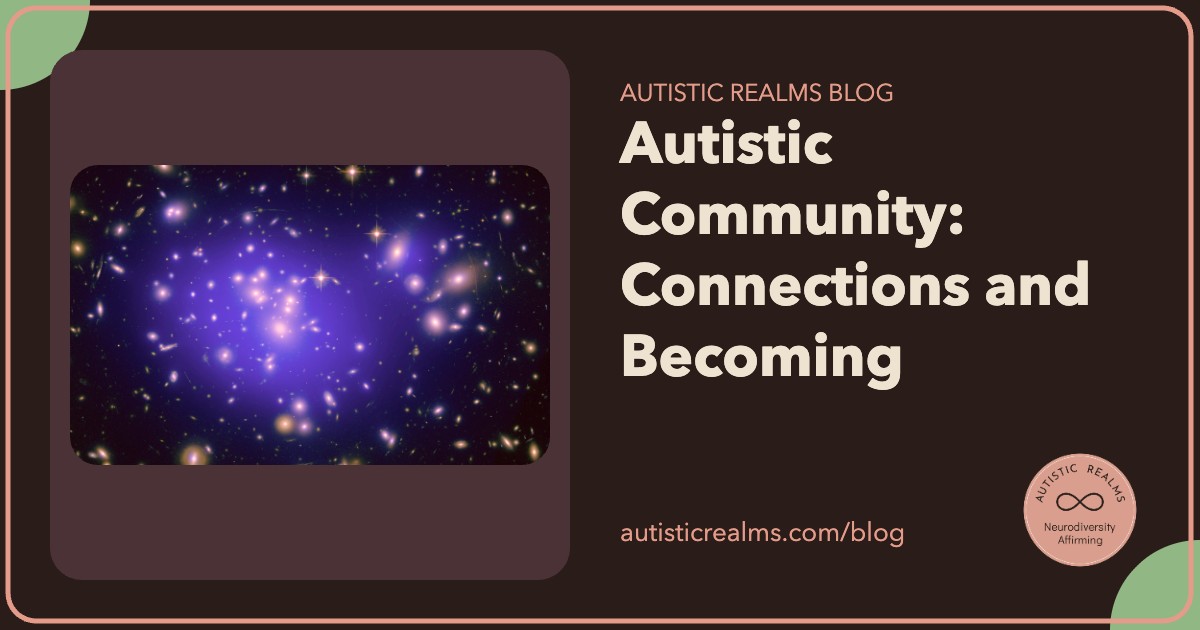
Back in the summer of 2026 I looked up into the sky and the sheer number of stars, the ones I could see and the ones I knew were there beyond sight, just felt totally wonderous and inspiring. I felt very small and very connected at the same time, as if the distance between me and the universe had suddenly become less certain. Looking back, I know that feeling was awe, and I have come to believe that awe may be one of the most deeply Autistic experiences there is.
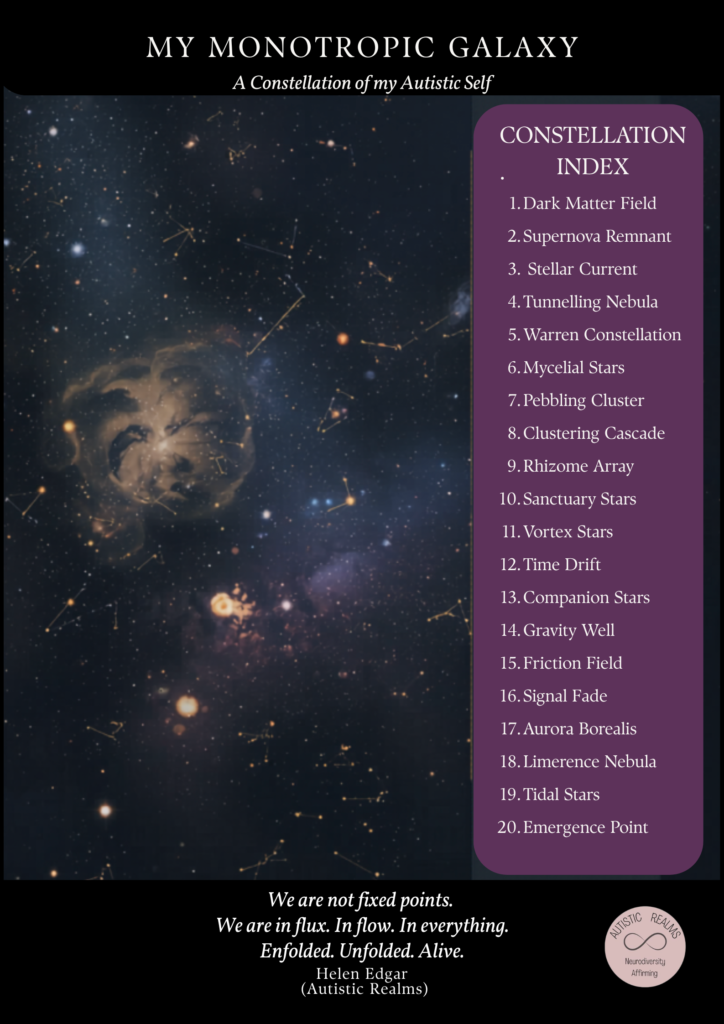
That night became the beginning of My Monotropic Galaxy, a map of my inner life drawn in the language of the cosmos. It is a deep-space image overlaid with constellation lines, alongside an index of twenty named stars and clusters, each one a part of how I experience the world as an Autistic ADHD person. This post is a shorter, gentler introduction to the map. If you would like to travel further, the full piece, with all twenty constellations and the ideas from physics and philosophy that shaped it, lives on More Realms.
👉 Read the full piece on More Realms: My Monotropic Galaxy: A Constellation of My Autistic Self
A Map of a Place I Had Always Lived
Monotropism describes how many Autistic people have their attention drawn more strongly to fewer things at a time, going deep rather than wide (Murray et al., 2005). When I first came across the theory, it felt like being handed a map of somewhere I had always lived but had never been able to describe. I was identified as Autistic and ADHD in my forties, while my children were going through their own assessments, and what followed was a long, tender process of re-storying my whole life.
My galaxy grew out of that re-storying. Some of its constellations I have lived in for decades, and others I have only recently found words for. None of them stand alone, they pull on each other, drift and change, and I guess the map will always be a little behind who I am becoming.
Awe, Wonder and Flow
Philosopher Helen De Cruz (2024) describes wonder as a kind of opening in how we come to know things, a moment when our usual categories loosen and we begin to notice what we had learned to filter out. That is very close to how monotropic flow feels to me. When something truly captures my attention, my whole body and nervous system settle into it, and I meet it as if for the first time, even when I have met it a hundred times before.
At the heart of my galaxy is the Stellar Current, the deep flow state where everything in me comes into coherence and I move with what matters most. Many of us learned as children that this kind of absorption was a problem. We were told to hurry up when we stopped to look closely at a mushroom, or to stop fussing when we wanted to feel the sea against our toes. Naming the Stellar Current is my way of honouring everything that was so often hurried past.
Love You Down to Your Star Stuff
The phrase Love You Down to Your Star Stuff grew out of my work with Ryan Boren and Stimpunks Foundation (Boren & Stimpunks Foundation, 2026). It reaches back to Carl Sagan’s reminder that the atoms in our bodies were forged inside ancient stars. To love someone down to their star stuff is to love their core way of being, with no conditions about masking, performing or being easy for the world to read.
Much of Autistic life is weighed down by what I call the Dark Matter Field: the heavy pull of neuronormativity, ableism, behaviourism and every system that measures us against a map that was never ours. Star stuff love is the counterweight. It lives in the Companion Stars who orbit close and never need me to perform, in the Sanctuary Stars where I do not have to translate myself, and in the Mycelial Stars, the underground networks of care and mutual aid that keep so many of us going. It lives, too, in the Autistic Rhizome (Gray-Hammond, 2023; Edgar, 2023), our community that grows sideways in every direction, with no centre and many ways in.
A Few Stars From My Galaxy
- Tunnelling Nebula is monotropic attention going deep rather than wide, transforming everything it touches.
- Warren Constellation holds my rabbit holes of research and the joy of following a question wherever it leads.
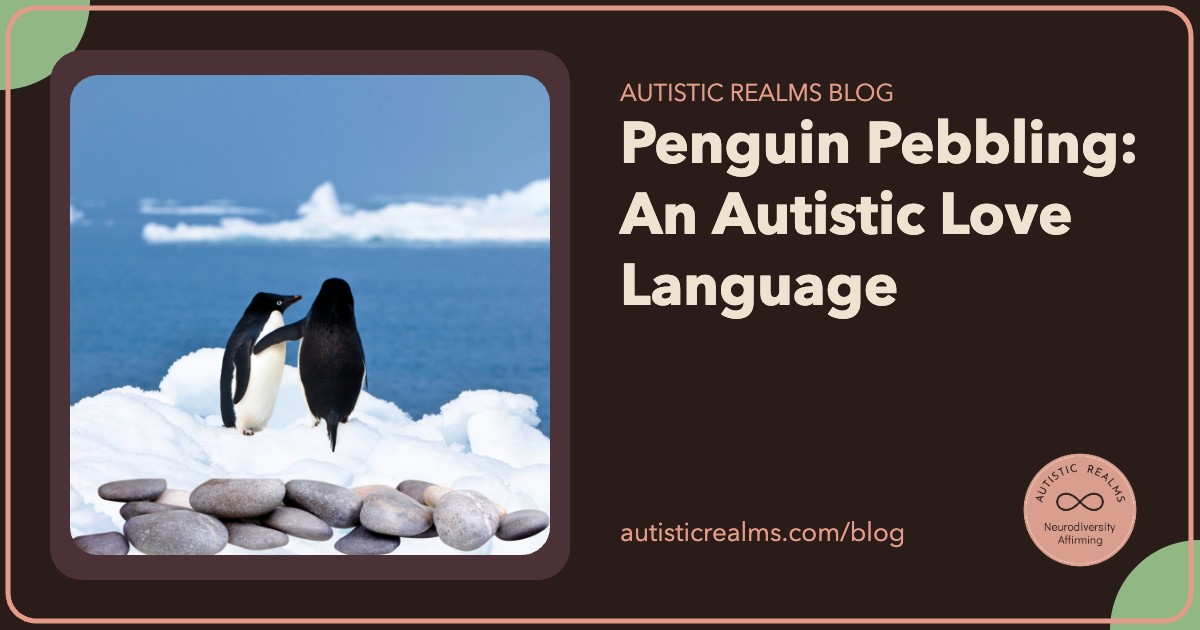
- Pebbling Cluster is how I show love, offering small glimmers the way penguins offer pebbles: a twig I found, a song or a meme that says “I thought of you.”
- Clustering Cascade is my infodumping, the deep need to share my passions at length with people I feel safe with.
- Supernova Remnant is burnout, and the new self that slowly forms from everything it scatters.
- Emergence Point is where ideas surface when they are finally ready, in their own time and on their own terms.
You can find all twenty, including Time Drift, Signal Fade, the Limerence Nebula and the Aurora Borealis of Autistic joy, in the full piece on More Realms.
Drawing Your Own Galaxy
This map is only mine, one small constellation in a universe of Autistic ways of being. Some of my stars may feel familiar to you, and others may not be part of your sky at all. If it sparks something, you might like to try drawing your own. You could name the places where you find flow, the people who orbit close, the weights you carry and the moments of joy that make your whole self light up. There is no right way to do it, and it never has to be finished.
My galaxy is also at the heart of my chapter in UNIQUE, a book edited by Mark Stancombe and Lisa Nel that is coming out in 2027. It gathers neurodivergent people’s own constellation maps of who they are. If you would like to find out more about the book, you can email Mark and Lisa at book@vicarious-traumatisation.com.
We are not fixed points.
We are in flux.
In flow.
In everything.
Enfolded.
Unfolded.
Alive.
👉 Continue the journey: My Monotropic Galaxy (full piece) on More Realms
👉 Read next: Awe, Wonder and Monotropic Attention in Neuroqueer Learning Spaces
👉 Read next: The Autistic Rhizome: Community, Liminal Spaces & Belonging
👉 Read next: The Constellation of Intensities: Neuroqueering the Spiky Profile
References
Boren, R., & Stimpunks Foundation. (2026). Love you down to your star stuff. Stimpunks Foundation. https://stimpunks.org/star-stuff/
De Cruz, H. (2024). Wonderstruck: How wonder and awe shape the way we think. Princeton University Press.
Gray-Hammond, D. (2023, April 21). Neuro-anarchy and the rise of the Autistic rhizome. DGH Neurodivergent Consultancy. https://dghneurodivergentconsultancy.co.uk/2023/04/21/neuro-anarchy-and-the-rise-of-the-autistic-rhizome/
Murray, D., Lesser, M., & Lawson, W. (2005). Attention, monotropism and the diagnostic criteria for autism. Autism, 9(2), 139–156. https://doi.org/10.1177/1362361305051398
Stimpunks Foundation. (2023). Autistic rhizome. In Stimpunks glossary. https://stimpunks.org/glossary/autistic-rhizome/