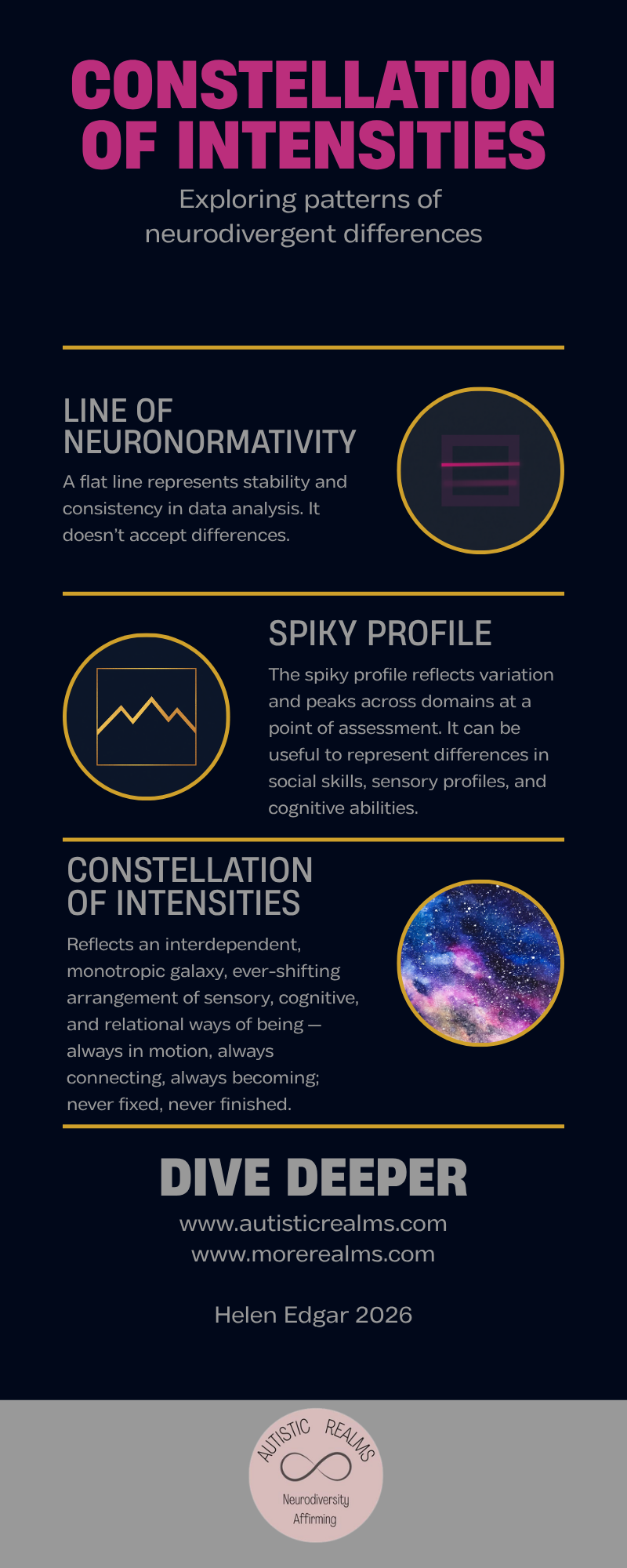
Dark navy infographic titled 'Constellation of Intensities: Exploring patterns of neurodivergent differences,' by Helen Edgar, 2026. Three sections, each with a gold-outlined circular icon: 'Line of Neuronormativity' — a flat pink line icon, described as representing stability and consistency in data analysis that doesn't accept differences. 'Spiky Profile' — a jagged amber zigzag line icon, described as reflecting variation and peaks across domains at a point of assessment, useful for representing differences in social skills, sensory profiles, and cognitive abilities. 'Constellation of Intensities' — a circular image of a purple and pink galaxy nebula, described as reflecting an interdependent, monotropic galaxy, an ever-shifting arrangement of sensory, cognitive, and relational ways of being — always in motion, always connecting, always becoming, never fixed, never finished. Below, text reads 'Dive Deeper: www.autisticrealms.com, www.morerealms.com.' At the bottom, a grey banner with the Autistic Realms logo — an infinity symbol inside a pink circle, labelled 'Autistic Realms, Neurodiversity Affirming

The Constellation of Intensities: Neuroqueering the Spiky Profile

I used to think the shape of my own bodymind was something like a spiky profile — a way of picturing uneven ability across different areas, real peaks and real troughs, instead of one flat line running across the whole of who I am.

The term has helped give language to something many of us lived long before we could name it: that being brilliant at one thing and genuinely unable to do another isn’t laziness, and it isn’t a contradiction — it’s how a neurodivergent bodymind is put together (Autism Understood, 2023). It pushed back against the flattening habit of “if you can do X, you should be able to do Y,” and made room for the truth that a peak and a trough and ways of ebbing and flowing can belong to the same person without either one cancelling the other out (The Neurodiversity Directory, 2026). It even carries a small history of resistance in its own naming — Damian Milton chose “spiky profile” specifically because he didn’t want “islets of ability” or “uneven profile,” terms that framed difference as scattered fragments rather than a real, whole pattern (Stimpunks Foundation, 2022).

It’s a better reflection of neurodivergent ways of being than a flat line of neuronormativity, but it is still a profile that measures us against ‘something’. It still needs axes and edges, and that’s exactly where I want to push further, because it still doesn’t quite capture how it feels to be this shifting and multidimensional. A spiky profile isn’t static or one-dimensional; it’s affected by everything and everyone around us. Our sensory, communication, and cognitive profiles are always moving, always in relationship with our environments — never fixed long enough to be pinned to a single chart.

As neuroaffirming as the spiky profile can feel, it’s still asking something of us. It still wants a domain to plot against another domain, a percentile against a percentile, a standard deviation between this peak and that trough. It still needs a grid to be spiky on, even the most generous, strength-based version of the profile is still a chart — still comparing us to a norm, still asking how far we sit from an average we never agreed to be measured against. The edges haven’t gone anywhere; they’ve just been redrawn a little more kindly.

This is where I think we need to neuroqueer the spiky profile rather than simply defend it. Neuroqueering isn’t about finding a nicer position within the existing grid, it’s about asking whether the grid was ever the right container to begin with.

What I recognise, when I try to map myself, isn’t a chart at all. It’s a constellation of intensities — an interdependent, monotropic galaxy. It is more like an ever-shifting arrangement of sensory, cognitive, and relational ways of being, always in motion, always connecting, always becoming; never fixed, never finished. Some intensities I’ve lived in for decades, others shift by the moment, but none of them sits on a defined axis. They belong to the same ever-expanding galaxy that reflect my monotropic ways of being — we are all made of star stuff.

A constellation doesn’t ask how far you are from average. It doesn’t need a baseline to make sense of itself — only relationships, motion, and the space to keep forming. We aren’t uneven versions of a flat line.

We were never a line.
We are made of stardust.
We are multidimensional and always in a process of becoming.
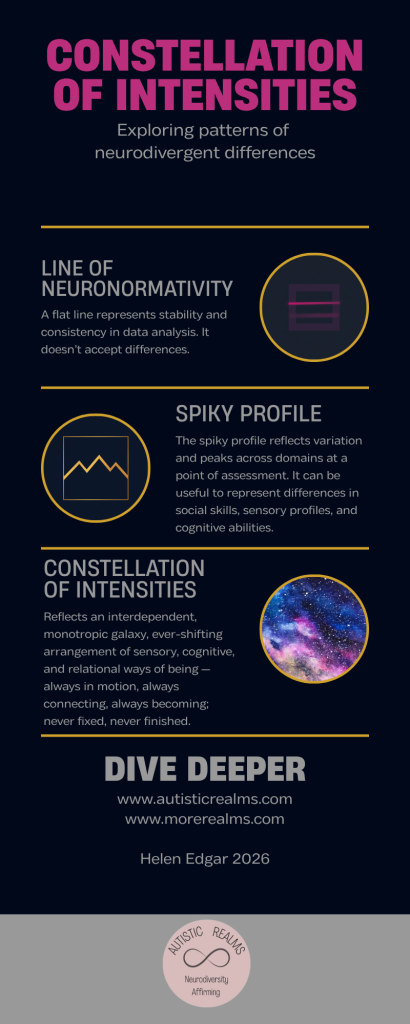
Dark navy infographic titled 'Constellation of Intensities: Exploring patterns of neurodivergent differences,' by Helen Edgar, 2026. Three sections, each with a gold-outlined circular icon: 'Line of Neuronormativity' — a flat pink line icon, described as representing stability and consistency in data analysis that doesn't accept differences. 'Spiky Profile' — a jagged amber zigzag line icon, described as reflecting variation and peaks across domains at a point of assessment, useful for representing differences in social skills, sensory profiles, and cognitive abilities. 'Constellation of Intensities' — a circular image of a purple and pink galaxy nebula, described as reflecting an interdependent, monotropic galaxy, an ever-shifting arrangement of sensory, cognitive, and relational ways of being — always in motion, always connecting, always becoming, never fixed, never finished. Below, text reads 'Dive Deeper: www.autisticrealms.com, www.morerealms.com.' At the bottom, a grey banner with the Autistic Realms logo — an infinity symbol inside a pink circle, labelled 'Autistic Realms, Neurodiversity Affirming


References

Autism Understood. (2023, July 7). Spiky profiles. https://autismunderstood.co.uk/autistic-differences/spiky-profiles/

The Neurodiversity Directory. (2026). What is a spiky profile? Strengths, weaknesses, and variance. https://neurodiversity.directory/glossary/spiky-profile-definition/

Stimpunks Foundation. (2022, July 26). Spiky profile. https://stimpunks.org/glossary/spiky-profile/


Explore Star Stuff


Read my Star Stuff collaboration with Stimpunks

🌌 Read the full Star Stuff page — the heart of the project: the manifesto, the science, the philosophy, and reflections from the community, all together at Stimpunks

📖 Read the zines — eleven of them so far, including my own guest zine, Why Difference Comes First, which follows the quantum and Deleuzian thread in full, alongside community favourites like Bone Song and Underground

Wander the Field Guides — neurodivergent constellations, the elements you’re made of, and the life forms that thrive in places we once thought impossible



Latest Posts

  • Autistic Burnout – Supporting Young People At Home & School

    Autistic Burnout – Supporting Young People At Home & School

    Autistic burnout in young people is real—and recovery starts with understanding. This post offers neuroaffirming ways to spot the signs, reduce demands, and truly support. 💛 #AutisticBurnout #Neuroaffirming #Monotropism #AutisticSupport


  • Monotropic Interests and Looping Thoughts

    Monotropic Interests and Looping Thoughts

    The theory of monotropism was developed by Murray, Lawson and Lesser in their article, Attention, monotropism and the diagnostic criteria for autism (2005). ​ Monotropism is increasingly considered to be the underlying principle behind autism and is becoming more widely recognised, especially within autistic and neurodivergent communities. Fergus Murray, in their article Me and Monotropism:…


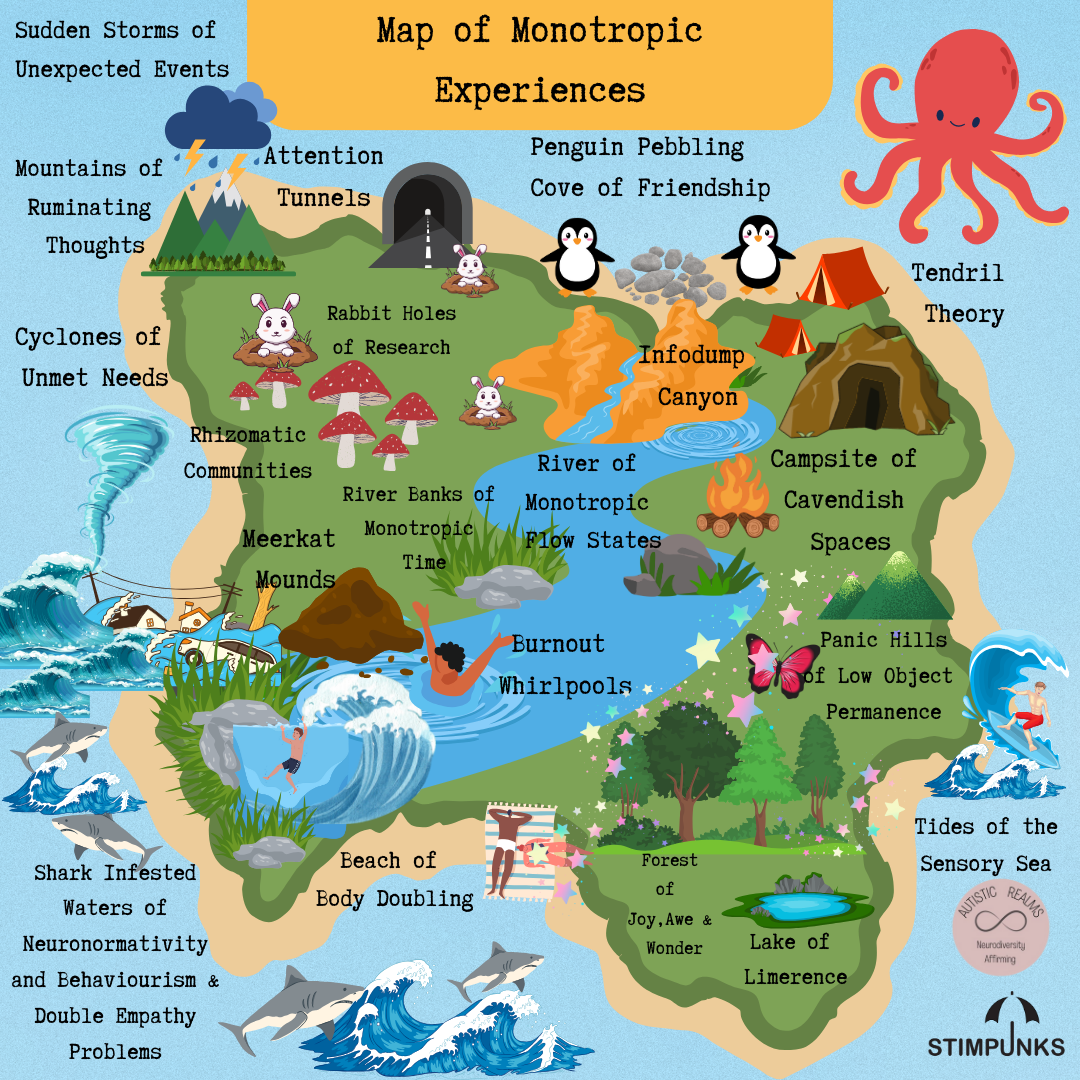
  • Map of Monotropic Experiences

    Map of Monotropic Experiences

    Monotropism seeks to explain Autism in terms of attention distribution and interests.  OSF Preprints | Development and Validation of a Novel Self-Report Measure of Monotropism in Autistic and Non-Autistic People: The Monotropism Questionnaire This map highlights 20 common aspects of my personal monotropic experiences. How many do you experience? Where are you on the map…


  • Autistic Burnout – Supporting Young People At Home & School

    Autistic Burnout – Supporting Young People At Home & School

    Being autistic is not an illness or a disorder in itself, but being autistic can have an impact on a person’s mental and physical health. This is due to the often unmet needs of living in a world that is generally designed for the well-being of people who are not autistic. In addition, three-quarters of…


  • The Double Empathy Problem is DEEP

    The Double Empathy Problem is DEEP

    “The growing cracks in the thin veneer of our “civilised” economic and social operating model are impossible to ignore”, Jorn Bettin (2021). The double empathy problem (Milton, 2012) creates a gap of disconnect experienced between people due to misunderstood shared lived experiences. It is “a breakdown in reciprocity and mutual understanding that can happen between people…


  • Top 5 Neurodivergent-Informed Strategies

    Top 5 Neurodivergent-Informed Strategies

    Top 5 Neurodivergent-Informed Strategies By Helen Edgar, Autistic Realms, June 2024. 1. Be Kind Take time to listen and be with people in meaningful ways to help bridge the Double Empathy Problem (Milton, 2012). Be embodied and listen not only to people’s words but also to their bodies and sensory systems. Be responsive to people’s…


  • Autistic Community: Connections and Becoming

    Autistic Community: Connections and Becoming

    Everyone seeks connection in some way or another. Connections may look different for autistic people. In line with the motto from Anna Freud’s National Autism Trainer Programme (Acceptance, Belonging and Connection), creating a sense of acceptance and belonging is likely to be more meaningful for autistic people than putting pressure on them to try and…


  • Monotropism, Autism & OCD

    Monotropism, Autism & OCD

    Exploring similarities and differences between Autistic and OCD monotropic flow states. Can attention tunnels freeze, and thoughts get stuck?


  • Monotropism Questionnaire & Inner Autistic/ADHD Experiences

    Monotropism Questionnaire & Inner Autistic/ADHD Experiences

     Post first published 28th July 2023 Over the past few weeks, there has been a sudden surge of interest in the Monotropism Questionnaire (MQ), pre-print released in June 2023 in the research paper ‘Development and Validation of a Novel Self-Report Measure of Monotropism in Autistic and Non-Autistic People: The Monotropism Questionnaire.‘ by Garau, V., Murray,…


  • Penguin Pebbling: An Autistic Love Language

    Penguin Pebbling: An Autistic Love Language

    Penguin Pebbling is a neurodivergent way of showing you care, like sharing a meme or twig or pretty stone to say “I’m thinking of you,” inspired by penguins who gift pebbles to those they care about.


  • The Constellation of Intensities: Neuroqueering the Spiky Profile

    The Constellation of Intensities: Neuroqueering the Spiky Profile

    Why even the “spiky profile” still measures us against a grid — and what a constellation of intensities offers instead.


  • Stimpunks Solidarity and Otters

    Stimpunks Solidarity and Otters

    A reflection from Stimpunks Solidarity Sesh on otters, monotropism, and co-regulation, and what watching them together each week teaches us


  • Little Fluffy Clouds: An Invitation To Play

    Little Fluffy Clouds: An Invitation To Play

    Multisensory Play Ideas: Little Fluffy Clouds Sensory Session


This website stores cookies on your computer. These cookies are used to provide a more personalized experience and to track your whereabouts around our website in compliance with the European General Data Protection Regulation. If you decide to to opt-out of any future tracking, a cookie will be setup in your browser to remember this choice for one year.

Accept or Deny

WordPress Cookie Plugin by Real Cookie Banner