
Alt text for this image: "Close-up of an otter's face partially submerged in green-blue water, water droplets beaded along its long whiskers, dark eyes looking directly at the camera, wet brown fur and a pink nose visible above the waterline. CANVA image

Stimpunks Solidarity and Otters

Every Saturday at 10am Central (4pm UK), our Stimpunks Community gathers online to share life and stories in our Solidarity Session held in Discord. Some people have their cameras on; many don’t. Some of us speak, some use text, and many of us share memes throughout the session as people hop in and out and take bodymind breaks. In the background, we’re invited into a shared watch. For the past few months, we’ve been watching otters as our conversations ebb and flow.

Watching the otter cam together offers our community a source of co-regulation. Today, it gave me a focus when I was unable to listen or even join in verbally, but I still wanted to exist in parallel with the group online.

As I watched the otters and occasionally joined the text conversation, I started thinking about how much I’d love to be an otter, and how liberating that might be. I found myself watching their movement and behaviours and relating them to my own Autistic experience, wondering whether I’m not so far removed from the life of an otter already!

Many otters keep a preferred stone tucked in a pouch of skin, carrying and reusing it time and time again. It’s a bit like a comfort item or a stim tool, something reliable and joyful to return to. Special interests and sensory objects can work the same way for Autistic and monotropic people, as ways of stimming, which enable regulation through a flow state.

Many otters like to play alone. They may juggle a stone, somersault in open water, float on their backs and dive around. Every so often, they play with another otter for a short time, before each one drifts back into its own separate absorption and interest – a bit like going from their solitary Cavendish cave space to their social Cavendish watering hole space. I have observed many moments of shared delight as they play and live with their own freedom to just be themselves and exercise their bodily autonomy.

It feels similar to how our Solidarity Session runs, and it’s part of why it works for us as neurodivergent people. It allows a space in the week, away from the dominance of neuronormativity, where people can just exist and be themselves, with intermittent shared moments of collaboration, shared glimmers, infodumps, parallel play, body-doubling and coping support offered.

Maybe it isn’t only that otters are soothing to watch, though they definitely are for me! It might be that they offer an embodied version of something our community already knows and lives.

Every Saturday, the otters just get to be otters, and in a supportive, safe space like our Stimpunks Solidarity Session, we get to do the same. We can just be present; we don’t have to perform. We get to show up for each other, in whatever way we can that day, which is its own radical act. We co-regulate and join in on our own terms, in our own way, when we want, with no judgment, just being with a community that cares and ‘gets each other’.

Maybe we all need to have more time to be more like Otters!

You are welcome to join us!

Find out more here: Stimpunks Solidarity: The Radical Act of Showing Up For Each Other


Latest Posts

  • Autistic Burnout – Supporting Young People At Home & School

    Autistic Burnout – Supporting Young People At Home & School

    Autistic burnout in young people is real—and recovery starts with understanding. This post offers neuroaffirming ways to spot the signs, reduce demands, and truly support. 💛 #AutisticBurnout #Neuroaffirming #Monotropism #AutisticSupport


  • Monotropic Interests and Looping Thoughts

    Monotropic Interests and Looping Thoughts

    The theory of monotropism was developed by Murray, Lawson and Lesser in their article, Attention, monotropism and the diagnostic criteria for autism (2005). ​ Monotropism is increasingly considered to be the underlying principle behind autism and is becoming more widely recognised, especially within autistic and neurodivergent communities. Fergus Murray, in their article Me and Monotropism:…


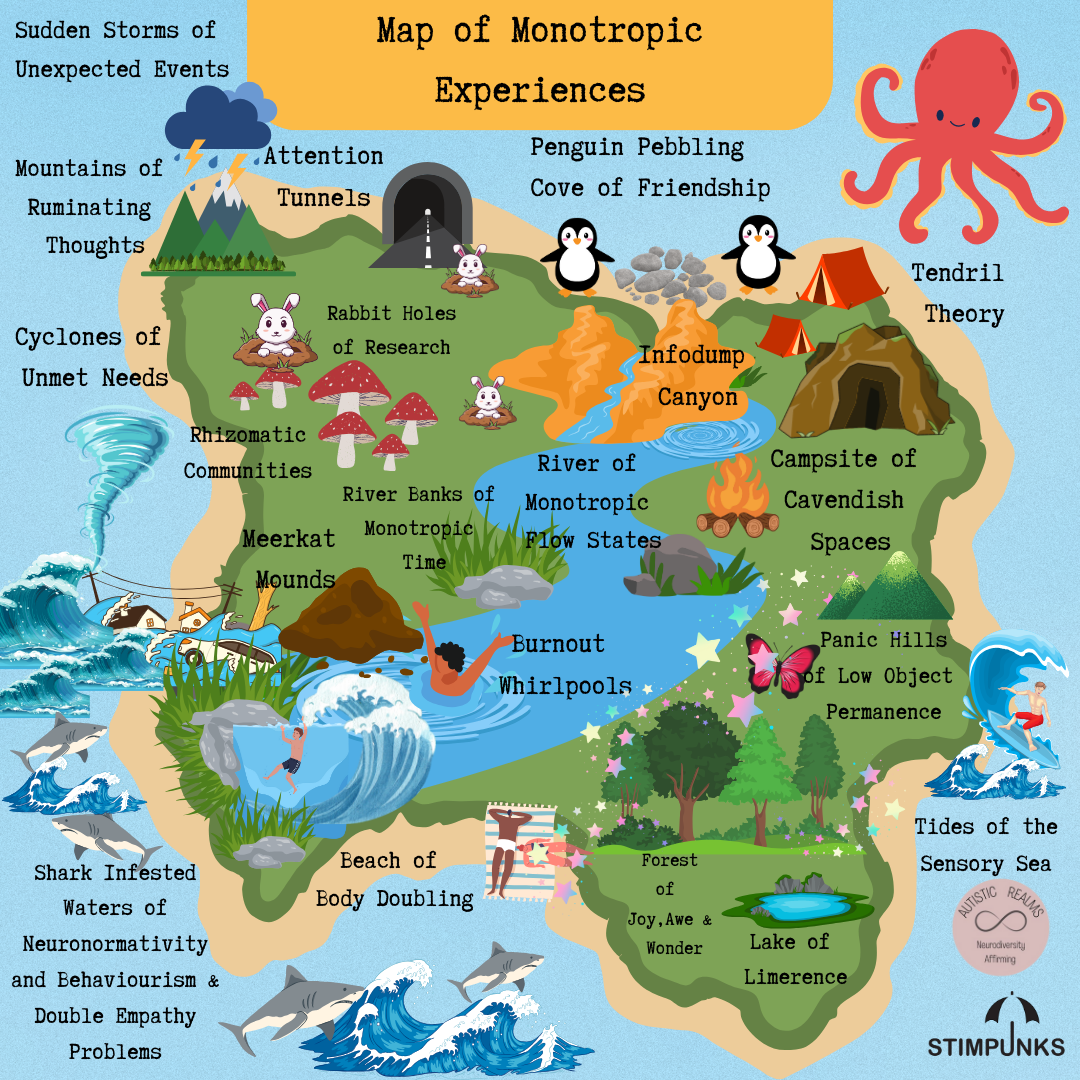
  • Map of Monotropic Experiences

    Map of Monotropic Experiences

    Monotropism seeks to explain Autism in terms of attention distribution and interests.  OSF Preprints | Development and Validation of a Novel Self-Report Measure of Monotropism in Autistic and Non-Autistic People: The Monotropism Questionnaire This map highlights 20 common aspects of my personal monotropic experiences. How many do you experience? Where are you on the map…


  • Autistic Burnout – Supporting Young People At Home & School

    Autistic Burnout – Supporting Young People At Home & School

    Being autistic is not an illness or a disorder in itself, but being autistic can have an impact on a person’s mental and physical health. This is due to the often unmet needs of living in a world that is generally designed for the well-being of people who are not autistic. In addition, three-quarters of…


  • The Double Empathy Problem is DEEP

    The Double Empathy Problem is DEEP

    “The growing cracks in the thin veneer of our “civilised” economic and social operating model are impossible to ignore”, Jorn Bettin (2021). The double empathy problem (Milton, 2012) creates a gap of disconnect experienced between people due to misunderstood shared lived experiences. It is “a breakdown in reciprocity and mutual understanding that can happen between people…


  • Top 5 Neurodivergent-Informed Strategies

    Top 5 Neurodivergent-Informed Strategies

    Top 5 Neurodivergent-Informed Strategies By Helen Edgar, Autistic Realms, June 2024. 1. Be Kind Take time to listen and be with people in meaningful ways to help bridge the Double Empathy Problem (Milton, 2012). Be embodied and listen not only to people’s words but also to their bodies and sensory systems. Be responsive to people’s…


  • Autistic Community: Connections and Becoming

    Autistic Community: Connections and Becoming

    Everyone seeks connection in some way or another. Connections may look different for autistic people. In line with the motto from Anna Freud’s National Autism Trainer Programme (Acceptance, Belonging and Connection), creating a sense of acceptance and belonging is likely to be more meaningful for autistic people than putting pressure on them to try and…


  • Monotropism, Autism & OCD

    Monotropism, Autism & OCD

    Exploring similarities and differences between Autistic and OCD monotropic flow states. Can attention tunnels freeze, and thoughts get stuck?


  • Monotropism Questionnaire & Inner Autistic/ADHD Experiences

    Monotropism Questionnaire & Inner Autistic/ADHD Experiences

     Post first published 28th July 2023 Over the past few weeks, there has been a sudden surge of interest in the Monotropism Questionnaire (MQ), pre-print released in June 2023 in the research paper ‘Development and Validation of a Novel Self-Report Measure of Monotropism in Autistic and Non-Autistic People: The Monotropism Questionnaire.‘ by Garau, V., Murray,…


  • Penguin Pebbling: An Autistic Love Language

    Penguin Pebbling: An Autistic Love Language

    Penguin Pebbling is a neurodivergent way of showing you care, like sharing a meme or twig or pretty stone to say “I’m thinking of you,” inspired by penguins who gift pebbles to those they care about.


  • Stimpunks Solidarity and Otters

    Stimpunks Solidarity and Otters

    A reflection from Stimpunks Solidarity Sesh on otters, monotropism, and co-regulation, and what watching them together each week teaches us


  • Little Fluffy Clouds: An Invitation To Play

    Little Fluffy Clouds: An Invitation To Play

    Multisensory Play Ideas: Little Fluffy Clouds Sensory Session


  • Neurodiversity Infinity Symbol: History, Time, and Collective Becoming

    Neurodiversity Infinity Symbol: History, Time, and Collective Becoming

    The neurodiversity infinity symbol has a story worth knowing. Rotate it and it becomes an hourglass holding time, community, and collective becoming.


This website stores cookies on your computer. These cookies are used to provide a more personalized experience and to track your whereabouts around our website in compliance with the European General Data Protection Regulation. If you decide to to opt-out of any future tracking, a cookie will be setup in your browser to remember this choice for one year.

Accept or Deny

WordPress Cookie Plugin by Real Cookie Banner