
Autistic Burnout resources for Autistic people of every age and for families & professionals to help develop understanding and support healing.
Free ebook: Autistic Burnout
This guide is also a free ebook. You can read it at your own pace, print it, or share it with the people who support you.
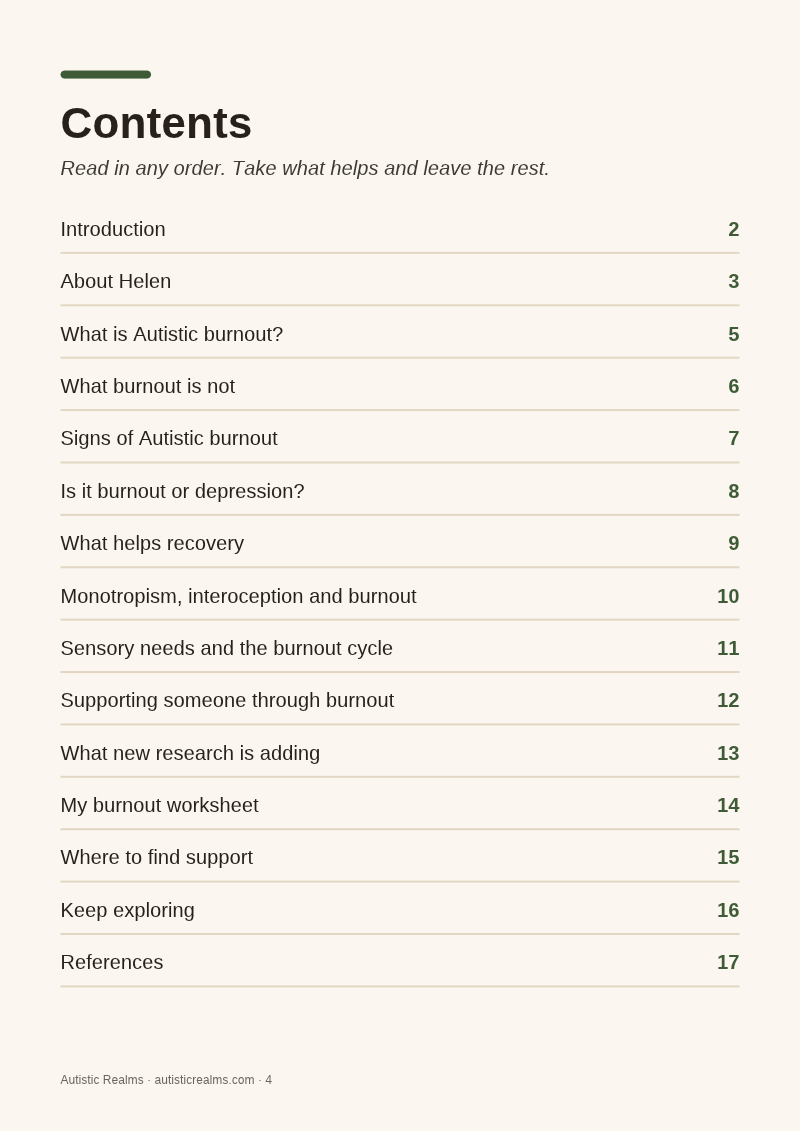
What is inside (18 pages):
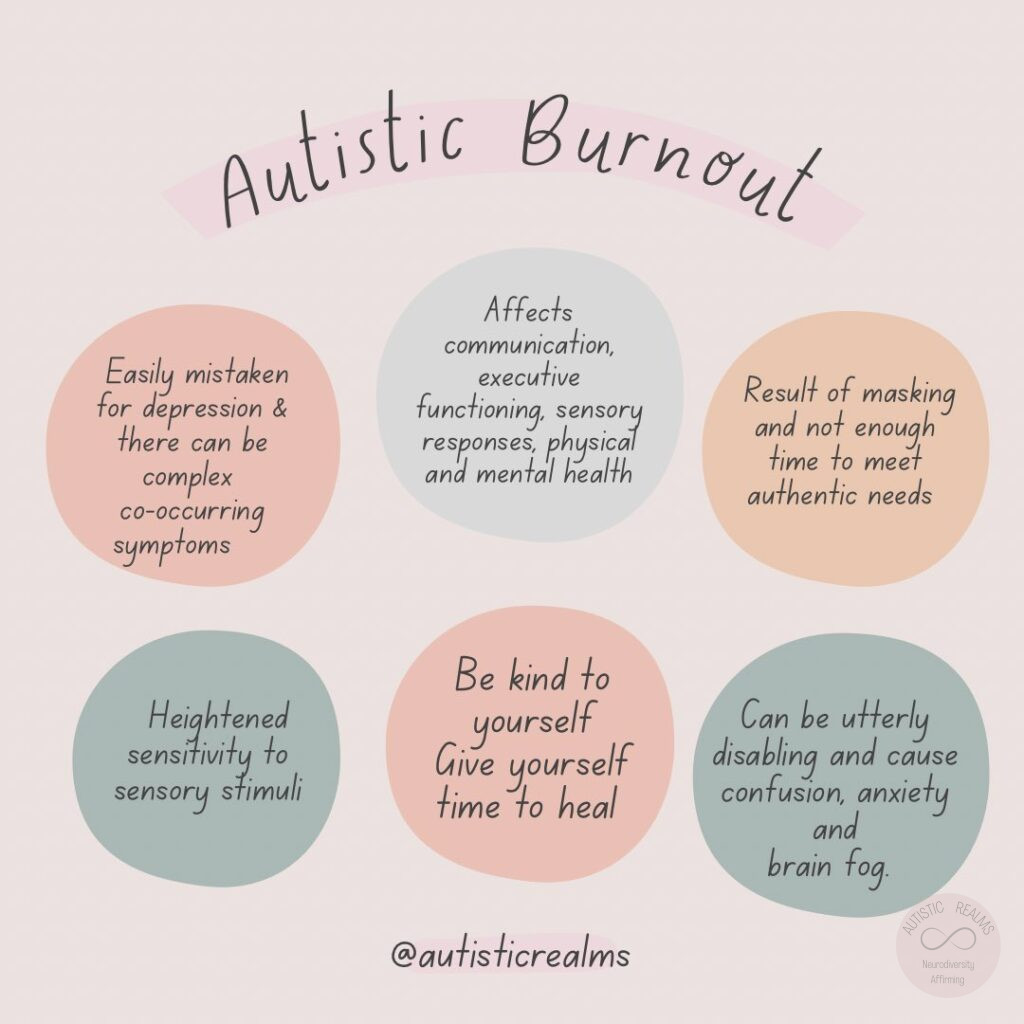
- What Autistic burnout is, and what it is not
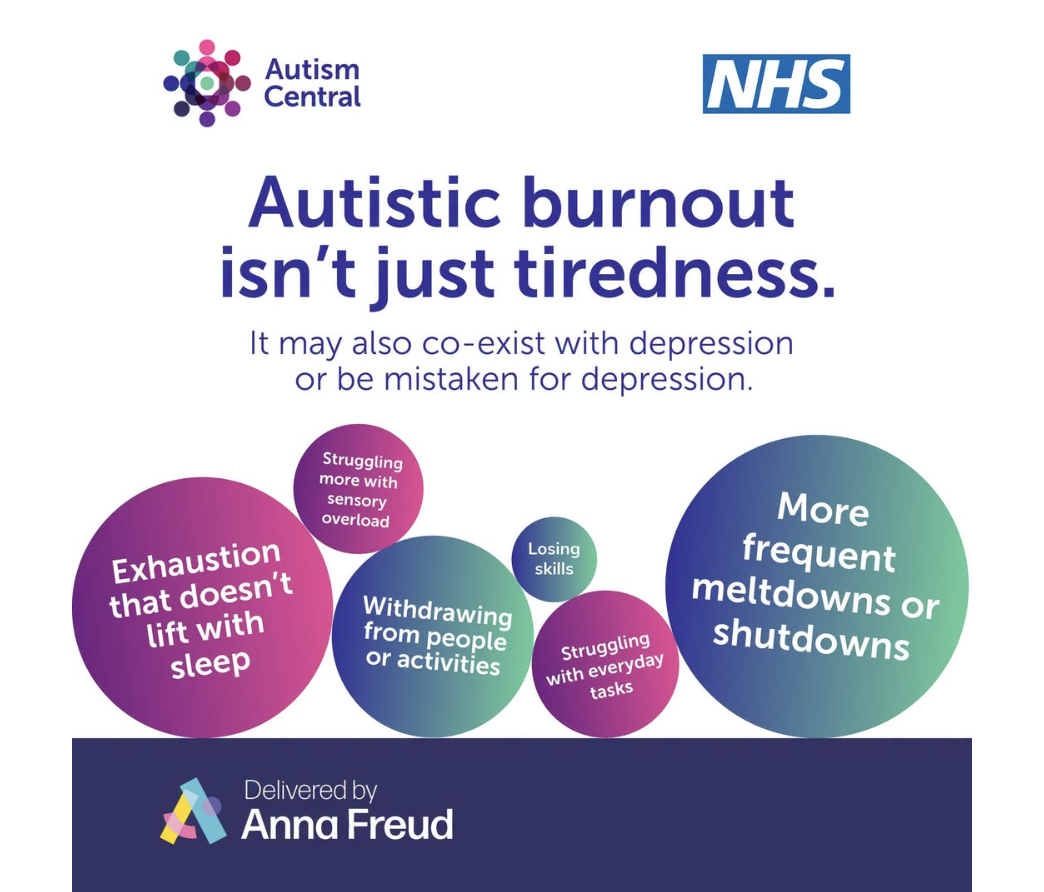
- Signs to notice, and how burnout differs from depression
- What helps recovery, and how to support someone
- Monotropism, interoception, the burnout cycle and AuDHD meerkat mode
- Quotes from research, and a printable burnout worksheet
- Where to find support, and full APA references
A peek inside
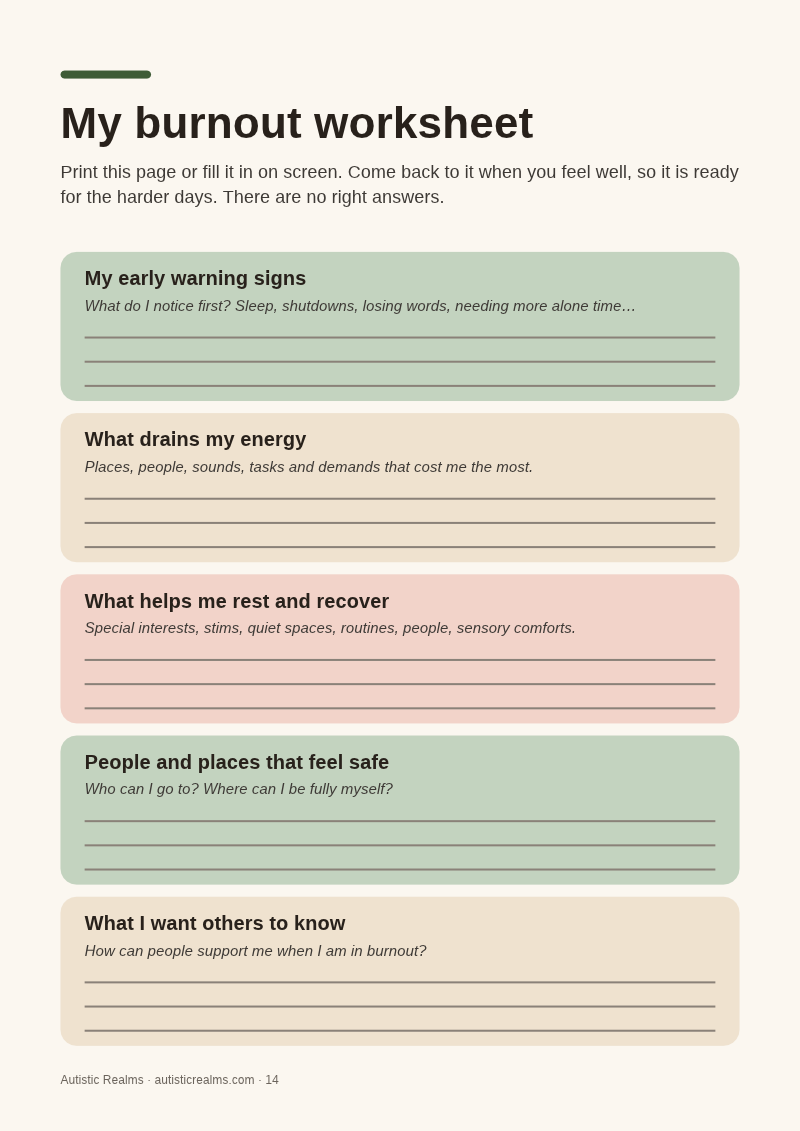
Get every resource on this topic: the Autistic Burnout Bundle has every Autistic burnout resource in one download for £15.99, or get both bundles for £25.
What is Autistic burnout?
Autistic burnout is a state of deep, long-lasting exhaustion that comes from living, for too long, with more demands than you have the resources to meet. Judy Endow (2015) described it simply as the demands of life exceeding a person’s resources. Raymaker and colleagues (2020), in the first study to define it with Autistic adults, describe three parts: chronic exhaustion, losing skills you used to have, and a reduced tolerance of sensory and social input. It usually builds over months or years, often through masking, and through homes, schools and workplaces that do not fit.
It is not laziness, a phase, bad behaviour or a parenting failure, and it is not the same as the occupational burnout that comes from an overloaded job. Autistic burnout can happen at any age, including in young children, and for many people it is a recurring or chronic experience rather than a one-off.
Signs of Autistic burnout
- Exhaustion that rest and sleep do not fix
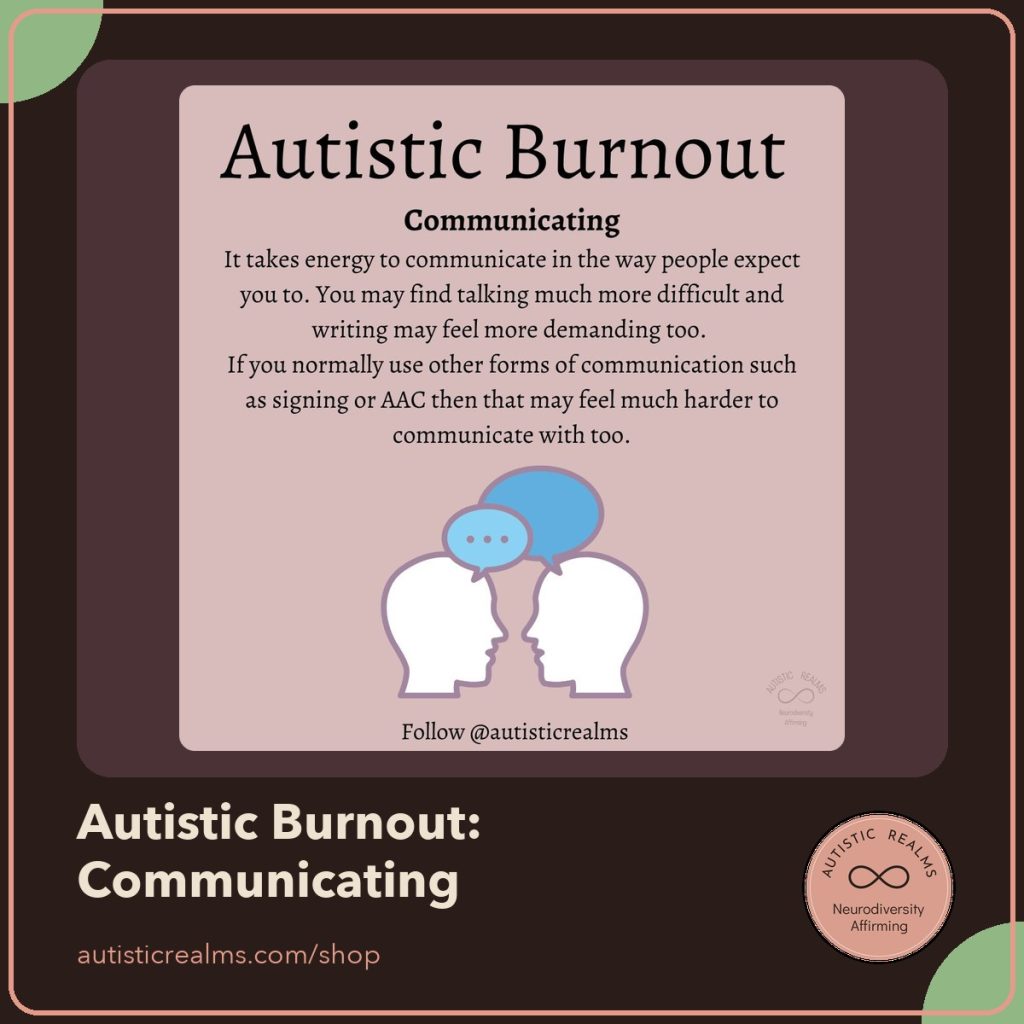
- Losing skills you used to have: speech and communication, organising and planning, self-care, reading, driving, cooking
- Being far more overwhelmed by sensory input, people and noise than before
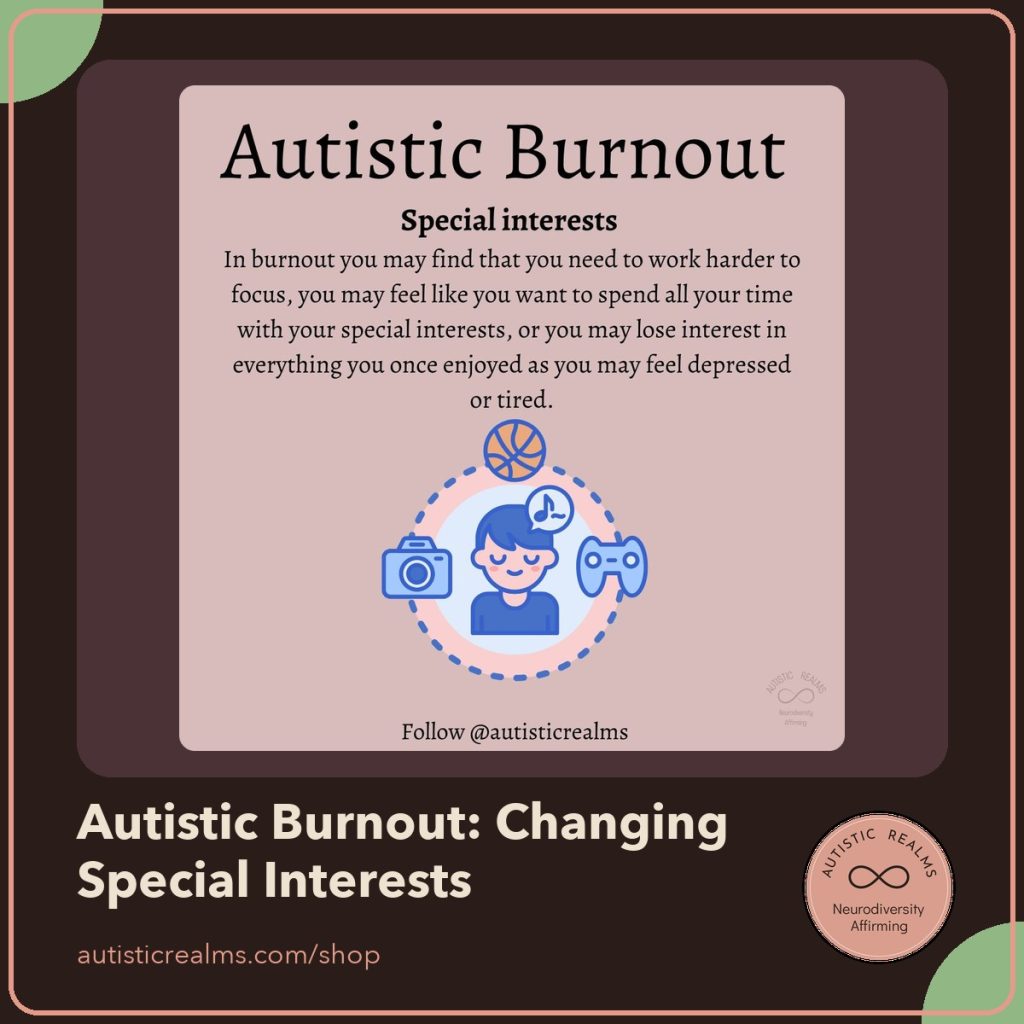
- Withdrawing from people, and from interests and activities you love, including deep interests
- More frequent meltdowns or shutdowns, and less ability to mask
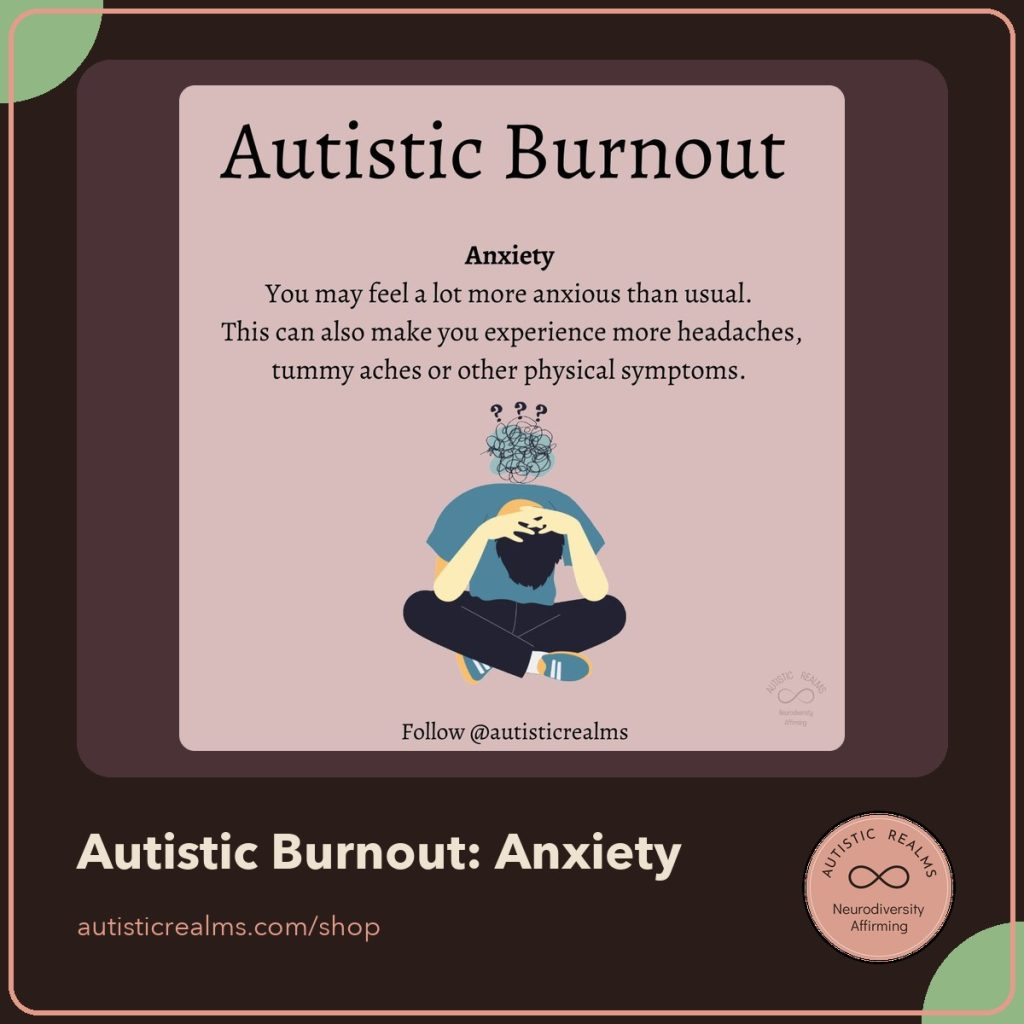
- Anxiety, low mood and, for some people, suicidal thoughts (see the crisis lines further down this page)
- In children and young people: difficulty attending school, what looks like “regression”, and far more distress at home than others see at school
Is it Autistic burnout or depression?
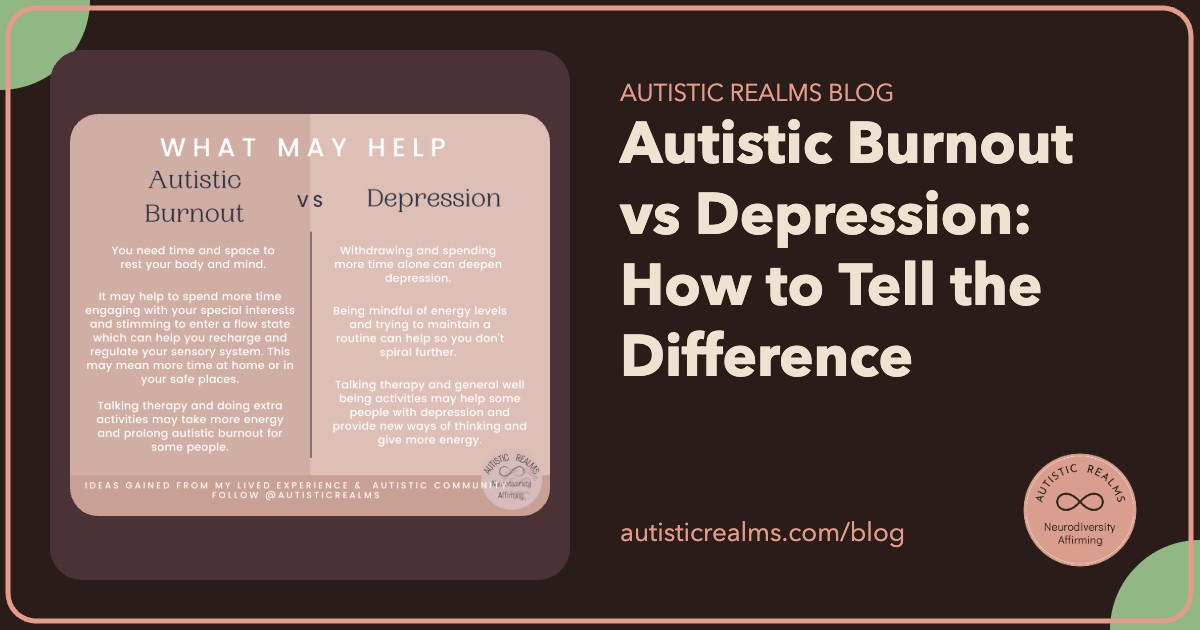
Autistic burnout is often mistaken for depression, and the two can happen together, but the support each needs is different. Burnout tends to lift with rest, lower demands and time in flow, and the loss of skills and sensory tolerance is central; depression does not usually respond to rest alone. My Burnout vs Depression resource sets the two side by side, and Autistic Burnout, Bodymind and Soul explores how it feels from the inside.
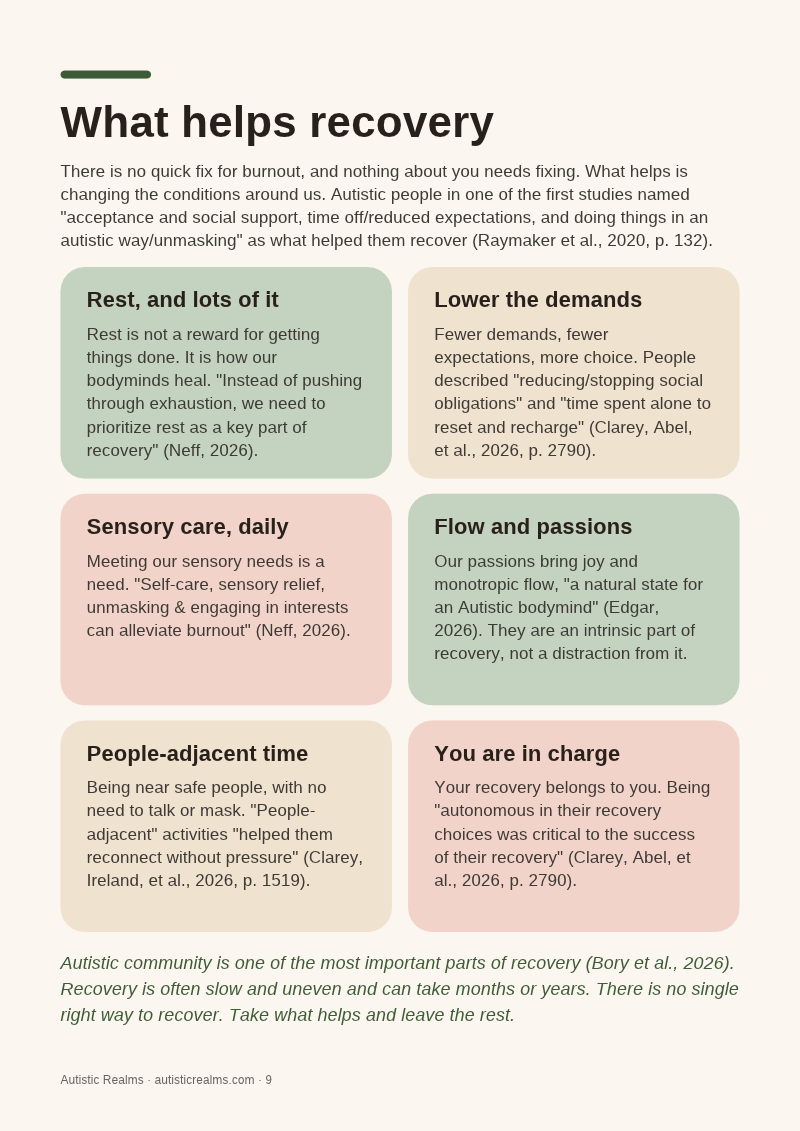
What helps recovery
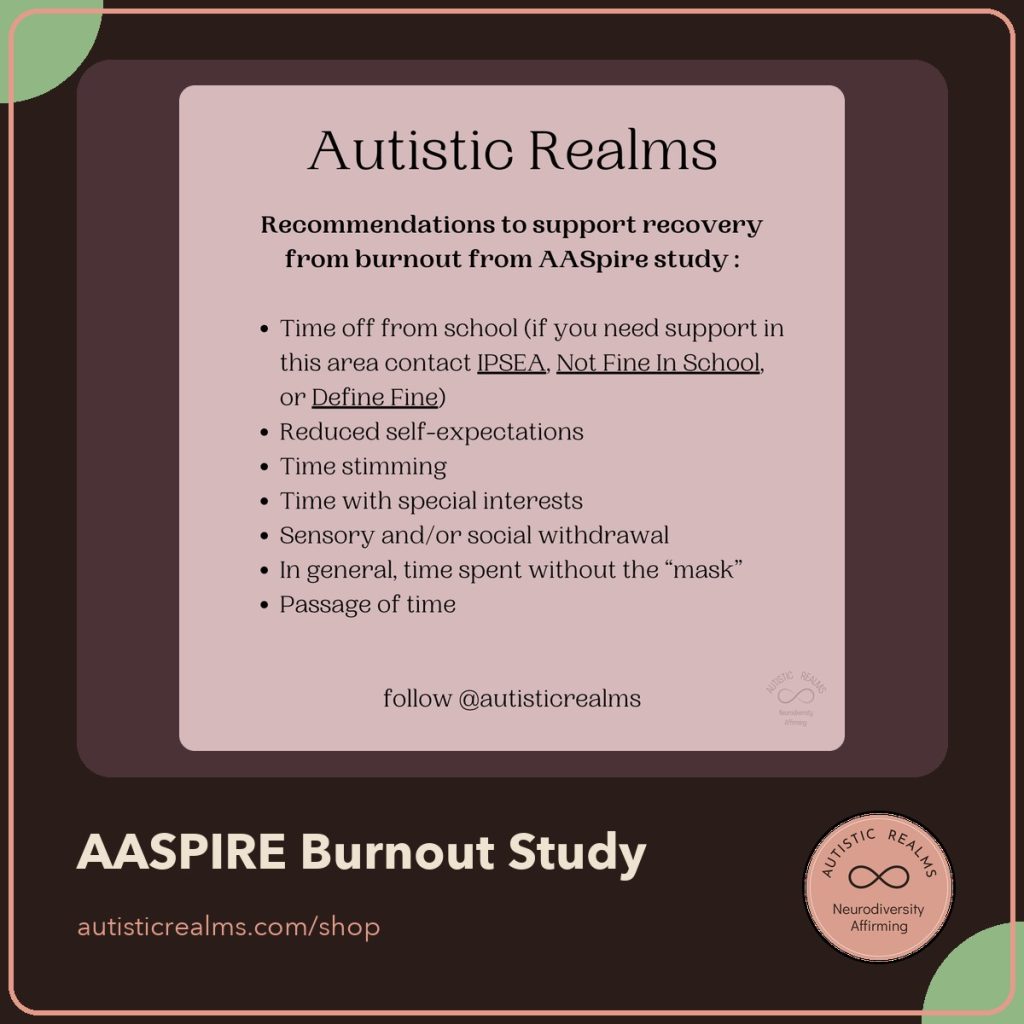
- Rest without guilt, and for far longer than feels reasonable
- A low-demand approach: fewer demands, fewer expectations, more choice
- Meeting sensory needs properly, every day, rather than as a treat
- Time in monotropic flow: deep interests are not a distraction from recovery, they are part of it
- Reducing masking and spending time with people you do not have to perform for
- Compassion and patience: recovery is slow, often uneven, and can take years
- Time near people you feel safe with, with no pressure to talk or perform, sometimes called “people-adjacent” time (Clarey, Ireland, et al., 2026)
- Being in charge of your own recovery: choice and autonomy matter (Clarey, Abel, et al., 2026)
What new research is adding (November 2026)
New research keeps adding weight to what Autistic people have said for years. Clarey, Ireland and colleagues (2026) found that shame, and “dual-masking” (hiding both being Autistic and being in burnout), can make burnout last longer, and that gentle “people-adjacent” time helped people reconnect. Masking and burnout-exhaustion are both linked with depression (Benatov et al., 2026), and masking is linked with anxiety and suicidality in Autistic women (Cuni & Cantero-García, 2026). Burnout is shaped by culture, gender and race as well as neurotype (Pagán et al., 2026). Many people do not “rise from the ashes” unchanged (de Leymarie, 2026), and Autistic community remains one of the most important parts of recovery (Bory et al., 2026).
Have a question this page does not answer? The Autistic experiences questions and answers page covers what Autistic people, families and professionals ask most, and the glossary explains the words, including burnout, school, PDA and masking.
Guides to Autistic burnout on this site
For parents and carers
- Autistic Burnout in Children: Signs and a Parent Guide
- Autistic Burnout: Supporting Young People at Home and School
- Autistic Skill Regression: Burnout or Shifting Attention?
- Autistic Burnout: A Family Guide (e-book, pay what you can)
For schools and professionals
- Supporting Pupils Through Autistic Burnout: A Teacher Guide
- Book review: Autistic Burnout, Children and Young People in Education by Viv Dawes
- Re-Storying Autism course: for families and professionals who want to prevent burnout rather than manage it
For Autistic adults
- Reclaiming Rest: Autistic Burnout, Monotropism and Resistance
- Going Deeper: Rest, Burnout and Monotropic Flow
- Autistic Burnout, Bodymind and Soul
- Tides of Burnout and Being Monotropic
- Autistic Burnout: Social Media Project, lived experiences shared by the community
- Embracing Monotropism and Preventing Burnout (e-book, pay what you can)
- All burnout visuals and resources in the shop
New to the words? What does neurodivergent mean? is a plain-language guide, and the Glossary explains the rest.
Everything below is signposting to other people’s work: articles, podcasts, books, research, free downloads, support services and crisis lines.
Understanding Autistic Burnout

I can’t seem to stop writing, but I keep dreaming of the end — a life where I don’t have to say anything to anyone, or ever think anything remotely original, where no one relies upon me to “use my platform” and I can just be unremarkable and wordless and yet cared for, like a pet. I imagine that if I keep writing and burning myself out, the day will come when I have no more words in me at all……..
This is what burnout has been like for me, and for many others who have been disabled by it. With each round, it’s made me slower and more fragile, my brain sludgier and less willing to exert effort. Eventually, after a long enough period of rest, some vestige of passion does come back and directs itself at something new. But I never return to being the person I was. And I get more tired, more quickly, each time.
— drdevonprice.substack.com – You Might Not Recover From Burnout
“Burnout scores remained relatively stable over time, suggesting that for many autistic individuals, burnout may not be a short-term state but a chronic and persistent experience that requires longer-term, individualized supports.”
Bougoure, M. et al. (2026). Measuring autistic burnout: A psychometric validation of the AASPIRE Autistic Burnout Measure in autistic adults.
Support Through Burnout
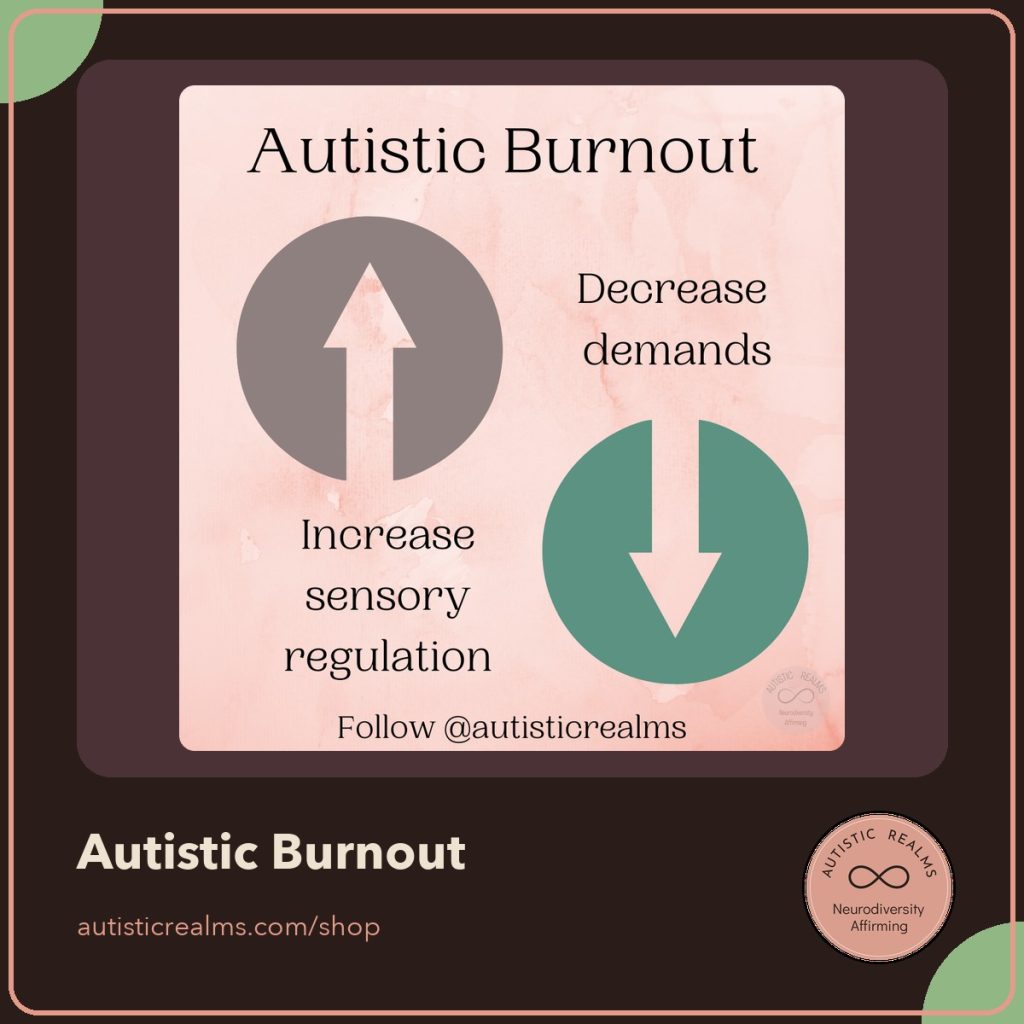
- Adopt a low-demand approach
- Encourage rest, and ways to re-energise that meet authentic Autistic needs
- Increase more time spent meeting sensory needs
- Offer time and compassion, without rushing recovery

Articles, Blogs & Websites
In alphabetical order.
- Alice Nicholls dralicenicholls.com
- Audre Lorde’s Radical Self-Care – Newman-Bremang, K. (2021). Reclaiming Audre Lorde’s radical self-care. Refinery29. Read the article
- Autism Central (NHS) – Helen’s articles for Anna Freud NHS Autism Central about Autistic burnout. Read the articles
- Autism Understood – Written by and for young Autistic people, by Spectrum Gaming. Helen contributed the Autistic burnout section. Shutdowns | Autistic burnout
- Autistic Advocate, The (Kieran Rose) – “An Autistic Burnout.” Read the article
- Autistic Burnout Network – Helen is a member of this network, which promotes understanding, recognition and acceptance of Autistic burnout. Led by neurodivergent professionals for Autistic people, offering events, resources and training. Visit the site & watch the recordings
- Autistic Girls Network Meltdowns, shutdowns and burnout
- Autistic Parents UK – Webinars, books and parent/carer support. Resources for Autistic parents
- Barriers to Education – “What Is Burnout?” An evidence-based guide for educators and families on recognising burnout in children and young people, particularly those who are neurodivergent. Helen contributed to this page. Read the article & check out the website
- Bridging the NeuroDivide (Tigger Pritchard) – Full resource index. Visit the site
- Canary SEND – “Beyond ‘School Refusal’: What Happens When a Child’s Nervous System Says Enough” — rethinking burnout, attendance and the limits of endurance. Read the article
- Dr Joanne Riordan – Educational Psychologist. drjoanne.co.uk
- Dulwich Centre – “How We Deal With Autistic Burnout,” by KJ Wiseheart. Read the article
- Embrace Autism – Autistic burnout information. Read more at Embrace Autism
- NeuroHub Connect David Gray-Hammond– “Alexithymia and Autistic Burnout: Too Tired to Feel It.” Read the article, join a community & explore loads more information about burnout
- Heather Cook (Autism Chrysalis) – Cook, H. (2025). How to recover from Autistic burnout. Read the article
- Jennifer Kemp – “Autistic Burnout: A Brief Guide to Recovery and Prevention.” Read the guide
- Jodie Clarke – Children’s Wellbeing Practitioner and Autism Specialist offering support, training and consultancy; also author of Young, Autistic and Burnt Out (see Books, below). jodieclarke.co.uk
- John Pendal – “Early Warning Signs of Burnout.” Read the blog
- Literally Ausome Autistic burnout
- MARF (Malaysian Autism Resource Foundation) – “Understanding Autism Burnout.” Read the article
- National Autistic Society Autistic burnout
- ND Stress – “The Many Paths Out of Autistic Burnout.” Read the article
- Neurodivergent Insights – “Autistic Burnout vs Depression.” Read the article
- Neurodiverse Connection – A neurodiversity-affirming guide to Autistic burnout, plus resources on meltdowns/shutdowns and trauma responses. Main site | Burnout guide | Understanding meltdowns and shutdowns | Trauma responses in Autistic people
- NeuroHub Connect – A neurodivergent-led consultancy and community platform offering training, courses and peer support for neurodivergent adults and professional training and resources. Visit the site
- Other Autism, The – The Other Autism. (2024, October 10). Autistic burnout, shutdown, and social hangover. Read the article
- PsychVault (Ethan Smith) – “Autistic Burnout: A Mismatch Problem” — a neurodiversity-affirming look at burnout as resulting from chronic environmental mismatch and unmet support needs, with practical strategies for reducing load. Read the article
- Reframing Autism – “Autistic Burnout Self-Care Strategies.” Read the article
- SEMA (Scottish Ethnic Minority Autistics) – Scotland’s only autistic minority ethnic-led organisation, offering training, consultancy and community support for racialised Autistic people and the professionals and organisations that support them. Visit the site
- Stimpunks Foundation – An overview of Autistic burnout: its causes, characteristics and recovery strategies, emphasising that burnout comes from mismatched environmental demands rather than being an inherent Autistic trait. Read the article
- Thinking Person’s Guide to Autism – “Supporting Your Young Person Through Autistic Burnout,” written by Helen Edgar of Autistic Realms. Read the article
- Viv Dawes, Autistic Advocate – Runs regular family workshops to support parents/carers experiencing burnout. Get support.

Videos & Podcasts
In alphabetical order.
- Aucademy – Jodie Smitten and Chloe Farahar discuss Autistic burnout (YouTube livestream). Watch
- Autistic Burnout Network Events 2025 & 2026– Viv Dawes and Helen Edgar, “Autistic Burnout and Family Life / School” — free training plus many other free presentations. Event page | Watch
- Kristy Forbes – Autism & ND Support — Autistic burnout podcast episode. Listen
- London Autism Podcast – Helen’s deep dive into Monotropism: how Autistic attention shapes experience, why burnout happens, and how reclaiming rest becomes a radical and restorative practice. Listen | About the podcast
- Pooky Knightsbridge – “Ideas for Avoiding Autistic Burnout” — Pooky Ponders: Big Questions with Brilliant People (2022). Listen
- Purple Ella – Autistic burnout (YouTube). Watch
- SENtalk with The Autistic Advocate (Kieran Rose) Watch
Recommended reading: Balance: How Neurodivergent Adults Can Nurture Well-Being Across Work, Life and Self-Care by Jessica Dark (Jessica Kingsley Publishers, out now: published November 2026). A gentle, neuro-affirming guide to energy, sensory needs, planning, stress and support.
Explore Jessica’s ND self-care, Palm & Palm meditation and mentoring at ND Perspective.
Books
In alphabetical order by author.
Clarke, J. (2024). Young, autistic and burnt out. Independently Published. https://www.amazon.co.uk/Young-Autistic-Burnt-Jodie-Clarke/dp/B0DPCVHW3V
Dark, J. (2026). Balance: How neurodivergent adults can nurture well-being across work, life and self-care. Jessica Kingsley Publishers. https://www.hachette.co.uk/titles/jessica-dark/balance-how-neurodivergent-adults-can-nurture-well-being-across-work-life-and-self-care/9781399838528/
Dawes, V. (2023). Supporting children and young people through Autistic burnout (a workbook for parents of Autistic children). https://www.amazon.co.uk/Supporting-Children-Through-Autistic-Workbook/dp/B0C6P6DZ38
Dawes, V. (2025). The young person’s guide to Autistic burnout. https://www.amazon.co.uk/Young-Persons-Guide-Autistic-Burnout/dp/1805017322
Edgar, H. (2023). Embracing Monotropism and supporting young people to help prevent Autistic burnout. https://www.amazon.co.uk/Embracing-Monotropism-Supporting-Prevent-Autistic/dp/B0CM1HN4SW
Engelbrecht, N., ND RP, et al. (2024). Embrace Autism’s the ultimate guide to Autistic burnout. https://www.amazon.co.uk/Ultimate-Autistic-Burnout-Embrace-Autisms/dp/B0DZD351TZ
Garvey, N. (2023). Looking after your autistic self: A personalized self-care approach to managing your sensory and emotional wellbeing. Jessica Kingsley. https://www.amazon.co.uk/Looking-After-Your-Autistic-Self/dp/1839975601
Neff, M. A. (2025). The Autistic burnout workbook: Your guide to your personal recovery plan. Simon and Schuster. https://www.amazon.co.uk/Autistic-Burnout-Workbook-Personal-Recovery/dp/1507223064
Pavlopoulou, G., Crane, L., Hurn, R., & Milton, D. (2024). Improving mental health therapies for autistic children and young people: Promoting self-agency, curiosity and collaboration. Routledge. https://www.amazon.co.uk/Improving-Mental-Therapies-Autistic-Children/dp/1032372524
Ray, S. (2025). Autistic burnout recovery workbook: A practical guide for late-diagnosed women to heal, set boundaries, and reclaim their energy. https://www.amazon.co.uk/Autistic-Burnout-Recovery-Workbook-Late-Diagnosed/dp/B0FFBNF16K
Academic Research
In alphabetical order by first author.
Ali, D., Bougoure, M., Cooper, B., Quinton, A. M. G., Tan, D., Brett, J., Mandy, W., Maybery, M., Magiati, I., & Happé, F. (2025). Burnout as experienced by autistic people: A systematic review. Clinical Psychology Review, 122, 102669. https://doi.org/10.1016/j.cpr.2025.102669
Ali, D., Mandy, W., & Happé, F. (2026). How does ‘autistic burnout’ feel? A qualitative study exploring experiences of earlier and later-diagnosed autistic adults. Autism, 30(4), 1014–1027. https://doi.org/10.1177/13623613261422117
Arnold, S. R., Higgins, J. M., Weise, J., Desai, A., Pellicano, E., & Trollor, J. N. (2023). Confirming the nature of autistic burnout. Autism, 27(7), 1906–1918. https://doi.org/10.1177/13623613221147410
Arnold, S., Higgins, J., Weise, J., Desai, A., Pellicano, E., & Trollor, J. (2021). Investigating autistic burnout #AutBurnout: Final report. Autism CRC. https://www.autismcrc.com.au/sites/default/files/reports/3-076RI_Autistic-Burnout_Executive-summary.pdf
Arnold, S., & Higgins, J. (2026, January 5). What is autistic burnout? And what can you do about it? The Conversation. https://doi.org/10.64628/aa.kqq5hexpc
Benatov, J., Sarel-Mahlev, E., & Bar Yehuda, S. (2026). Camouflage, burnout-exhaustion, and depression in autistic adults. Autism in Adulthood, 8(4), 801–808. https://doi.org/10.1089/aut.2024.0147
Bougoure, M., Zhuang, S., Brett, J. D., Maybery, M. T., English, M. C., Tan, D. W., & Magiati, I. (2026). Measuring autistic burnout: A psychometric validation of the AASPIRE Autistic Burnout Measure in autistic adults. Autism, 30(1), 20–36. https://doi.org/10.1177/13623613251355255
Bory, P., Fiorentino, M., Bérenguier, L., & Denis, A. (2026). Autistic burnout: Early insights from a systematic review on characteristics, precipitating factors, and protective mechanisms. L’Encéphale. https://doi.org/10.1016/j.encep.2026.08.011
Browne, K., Lawson, W., McGarry, S., Scott, M., Girdler, S., & Milbourn, B. (2024). “Consistent support is good for my mental health”: Exploring the lived experience of autistic mental health. Autism in Adulthood. https://doi.org/10.1089/aut.2024.0141
Buckle, K. L. (2022). Autistic inertia: What it is and what helps. https://autisticinertia.com/wp-content/uploads/2022/06/Inertia-what-it-is-and-what-helps.pdf
Carney, D. (2024, February 28). Study explores what it’s like to experience autistic burnout. BPS Research Digest. https://www.bps.org.uk/research-digest/study-explores-what-its-experience-autistic-burnout
Cassidy, S., Bradley, L., Shaw, R., & Baron-Cohen, S. (2018). Risk markers for suicidality in autistic adults. Molecular Autism, 9(1). https://doi.org/10.1186/s13229-018-0226-4
Clarey, M. M., Abel, S., Ireland, M. J., & Brownlow, C. (2026). Autistic burnout on Reddit: A Sisyphean struggle with daily tasks. Journal of Autism and Developmental Disorders, 56(7), 2790–2802. https://doi.org/10.1007/s10803-025-06765-4
Clarey, M. M., Ireland, M. J., Abel, S., & Brownlow, C. (2026). Beyond exhaustion: Shame, identity disruption, and functional collapse in autistic burnout. Autism, 30(6), 1519–1531. https://doi.org/10.1177/13623613261444797
Cuni, E., & Cantero-García, M. (2026). Autistic masking and mental health outcomes in autistic women: A systematic review (2015–2025). Journal of Autism and Developmental Disorders. Advance online publication. https://doi.org/10.1007/s10803-026-07557-0
de Leymarie, S. (2026). The Phoenix fallacy: Reframing the irreversible transformations following workplace burnout in autistic adults. Autism in Adulthood, 8(5), 815–817. https://doi.org/10.1089/aut.2024.0292
Feidner, M. J. (2024). Burning bridges and building new ones: A story of Autistic burnout in the workplace. Autism in Adulthood, 6(2), 117–118. doi: 10.1089/aut.2023.0087. https://pmc.ncbi.nlm.nih.gov/articles/PMC11304729/
Ferguson, A., Martin, D., & Pearson, A. (2026). “It has shown me how much I am capable of”: An exploration of Autistic burnout experiences in motherhood. Autism in Adulthood, 8(4), 634–645. https://doi.org/10.1089/aut.2024.0282
Grant, A. (2025, March 31). Autistic stimming explained – and why stopping it can lead to burnout. The Conversation. https://doi.org/10.64628/ab.sdp5kprnd
Higgins, J., & Arnold, S. (2023). Understanding autistic burnout from experts with lived experience. Nature Awards for Inclusive Health Research. https://doi.org/10.6084/m9.figshare.24659622.v2
Higgins, J., Weise, J., Trollor, J., Pellicano, E., & Arnold, S. (2021). Defining autistic burnout using grounded Delphi method: Autistic burnout through the eyes of experts by lived experience. Department of Developmental Disability Neuropsychiatry (3DN), UNSW Sydney. https://www.autismcrc.com.au/sites/default/files/posters/3-076RI_Higgins_Defining_Autistic_Burnout_using_Grounded_Delphi_Method.pdf
Jahandideh, P., Seyedmirzaei, H., Rasoulian, P., & Memari, A. (2026). Low battery alarm: A scoping review of autistic burnout. Journal of Autism and Developmental Disorders, 56(10), 3931–3951. https://doi.org/10.1007/s10803-025-06860-6
Langford, C. (2026). Falling off the merry-go-round: The hidden impact of autistic burnout and perimenopause. Autism in Adulthood. https://doi.org/10.1177/25739581261462881
Mantzalas, J., Richdale, A. L., Li, X., & Dissanayake, C. (2024). Measuring and validating autistic burnout. Autism Research, 17(7), 1417–1449. https://doi.org/10.1002/aur.3129
Nicolaidis, C., Yang, L.-Q., Uretsky, M. C., Raymaker, D., et al. (2026). Psychometric properties of the AASPIRE Autistic Burnout Measure – Revised [Preprint]. medRxiv. https://doi.org/10.64898/2026.08.19.26360826
Osborne, C., Barker, J., Cole, A., & Russell, R. (2026). Autistic people’s experience of camouflaging and autistic burnout in relation to one another: A systematic review. Research in Neurodiversity, 2, 100025. https://doi.org/10.1016/j.rin.2026.100025
Pagán, A. F., Bruce, M. J., Vanderburg, J. L., Sattem, G., Loveland, K. A., & Acierno, R. (2025). An analysis of how autistic burnout relates to posttraumatic stress in autistic adults. Research in Neurodiversity, 1, 100010. https://doi.org/10.1016/j.rin.2025.100010
Pagán, A. F., Loveland, K. A., & Acierno, R. (2026). Cultural influences on camouflaging and autistic burnout: Examining the experiences of Latino autistic young adults. Autism, 30(2), 346–361. https://doi.org/10.1177/13623613251380340
Raymaker, D. M., Maslak, J., Steckler, N. A., Moura, I., Teo, A. R., Hunter, M., Yang, L.-Q., Kapp, S., Scharer, M., & Nicolaidis, C. (2026). The AASPIRE Autistic Burnout Scale: Creation, pilot testing, and psychometric properties of a new measure of autistic burnout [Preprint]. PsyArXiv. https://doi.org/10.31234/osf.io/uqvtc_v1
Raymaker, D. M., Teo, A. R., Steckler, N. A., Lentz, B., Scharer, M., Santos, A. D., Kapp, S. K., Hunter, M., Joyce, A., & Nicolaidis, C. (2020). “Having all of your internal resources exhausted beyond measure and being left with no clean-up crew”: Defining autistic burnout. Autism in Adulthood, 2(2), 132–143. https://doi.org/10.1089/aut.2019.0079
Rebours, C., & Kruck, J. (2026). The cumulative cost of adaptation: Individual and structural factors associated with autistic burnout severity [Preprint]. PsyArXiv. https://doi.org/10.31234/osf.io/cqk6p_v1
Rosqvist, H. B., Hultman, L., & Hallqvist, J. (2023). Energy management. Alter, 17(3), 25–38. https://doi.org/10.4000/9ifu
Royal College of Psychiatrists. (2020). The psychiatric management of autism in adults (CR228). Part of the College’s commitment to improving mental health services for Autistic adults who do not have a generalised intellectual disability. https://www.rcpsych.ac.uk/improving-care/campaigning-for-better-mental-health-policy/college-reports/2020-college-reports/cr228
Schoondermark, F., Spek, A., & Kiep, M. (2024). Evaluating an autistic burnout measurement in women. Journal of Autism and Developmental Disorders. https://doi.org/10.1007/s10803-024-06438-8
Siggers, G., & Day, B. (2024). Beyond school avoidance: Recognising, identifying, and addressing Autistic burnout in children. BJPsych Open, 10(S1), S169. https://doi.org/10.1192/bjo.2024.433
Strzelecki, D. D. (2025). Autistic burnout: A preliminary research report. Journal of Modern Science, 61(1), 618–642. https://doi.org/10.13166/jms/202665
Summerill, J., & Summers, S. J. A. (2025). The consequences of social camouflaging in autistic adults: A systematic review. Research in Autism, 121–122, 202556. https://doi.org/10.1016/j.reia.2025.202556
Zhuang, S., Tan, D. W., Reddrop, S., Dean, L., Maybery, M., & Magiati, I. (2023). Psychosocial factors associated with camouflaging in autistic people and its relationship with mental health and well-being: A mixed methods systematic review. Clinical Psychology Review, 105, 102335. https://doi.org/10.1016/j.cpr.2023.102335
Anti-ABA, Anti-PBS &
Neuro-Affirming Practice
Applied Behaviour Analysis (ABA) and Positive Behaviour Support (PBS) are harmful strategies that contribute towards trauma and mental health difficulties, with growing research and evidence behind the damage they can cause. Helen has collated a free, downloadable PDF signposting document for anyone who’d like to find out more:
Why PBS Is Harmful for Autistic and Neurodivergent Young People
Helen also works with Stimpunks to raise awareness of the harm caused by behaviourist approaches, and why neuro-affirming practice matters.
Their anti-behaviourism resources bring together a wide range of academic and community-sourced writing and evidence, including WHY SHEETS that help people self-advocate for their needs in school and other settings.
These are endorsed by a growing list of signatories and explain concisely why practices like ABA and PBS can cause harm, alongside neuro-affirming alternatives.
- Alternatives to ABA Read
- Behaviourism: Why It Is Harmful Read
- Hoodie (Stimpunks Why Sheet) Read
- Neuroqueer Learning Spaces Read
- Positive Greetings at the Door (Stimpunks Why Sheet) Read
- Queer and Neurodivergent Liberation Are Entwined (Stimpunks Why Sheet) Read
If you’d like to support this work, you can add your signature as a parent, carer or professional to the Stimpunks Why Sheets. Signatures help give these documents even more weight:
Also worth a look: Neurodiverse Connection’s Against PBS & ABA campaign, which Helen has endorsed, and the blog Why PBS Is Harmful for Neurodivergent Young People.
Free Downloads
- Why CBT May Not Be the Best for All Autistic People Download the PDF
- Why Positive Behaviour Support (PBS) Is Harmful – Anti-ABA / anti-PBS signposting and further research. Download the PDF
Shop & Visual Resources
Visit Autistic Realms shop for e-books and other resources, including:
- Autistic Burnout: A Family Guide
- Embracing Monotropism and Supporting Young People to Prevent Autistic Burnout
Understanding and recognising Autistic burnout is vital for wellbeing. These visual resources support identifying signs of burnout, exploring recovery strategies, and developing personalised approaches to energy management, for use at home, in education, and in the workplace.
Support For Adults
If you or your loved one needs support, please seek professional support.
Autistic Parents UK – Webinars, books and parent/carer support. Resources for Autistic parents
Thriving Autistic – Autistic-led, neuro-affirming organisation offering community support, advocacy, and training.
https://thrivingautistic.org/
Discovery by Thriving Autistic – Resources to support Autistic people on their journey after identification or diagnosis.
https://discover.thrivingautistic.org/
Neurodivergent Practitioners Network – Thriving Autistics ’ neuro-affirming sister organisation offering a global directory connecting people with neurodivergent-led, neurodiversity-affirming therapists, coaches, and other practitioners. https://neurodivergentpractitioners.org/
NeuroHub Connect – A neurodivergent-led consultancy and community platform offering training, courses and peer support for neurodivergent adults and professional training and resources.
https://neurohubcommunity.org/
AMASE – Supporting Autistic adults’ mental health guide.
Read the guide
Support for Children, Young People and Families
Autism Central – NHS-backed peer education programme (delivered with Anna Freud) offering free online training and resources for Autistic people, families/carers and professionals.
Autism Understood – Signposting and information service for Autistic people and families in Greater Manchester/Cheshire, run by the same charity family as Spectrum Gaming.
Autistic Girls Network – Charity tackling under-recognition and late diagnosis in Autistic girls, women and those assigned female at birth, with a strong focus on masking and school experience.
AUsome Training – Autistic-led training for parents/carers and professionals, grounded in lived experience.
GROVE – Neurodivergent-led mentoring and education service, providing training, resources and mentoring for Autistic and neurodivergent children and young people, and the families and professionals who support them.
Not Fine in School – Parent-led community on school attendance difficulties, closely tied to burnout, shutdown and skill loss in children.
PDA Society – UK charity for the Pathological/Pervasive Demand Avoidance profile, where burnout is often misread as defiance rather than exhaustion.
Spectrum Gaming – Autistic-led charity building safe, joyful online gaming communities for Autistic children and young people.
Square Peg – Campaigns and resources on emotionally based school avoidance, run by and for families of children who can’t attend school due to anxiety or overwhelm.
Stimpunks Foundation – Neurodivergent-led nonprofit providing mutual aid, financial assistance, community and educational resources for Autistic and neurodivergent people and families.
Crisis Lines
Stimpunks Regulation and Coping – Global hotlines and helplines
UK (Shout): text SHOUT to 85258
Ireland (Spun Out): text HELLO to 50808
US/Canada (Crisis Text Line): text HOME or HOLA to 741741
Find A Helpline – A global directory of crisis helplines and support services across 175+ countries.
PAPYRUS – Prevention of Young Suicide | Autistic burnout resource
Free Training
Viv Dawes and Helen Edgar: Autistic Burnout Network Event 2025
More Resources
Please visit my shop for e-books and other resources, including:
Autistic Burnout: A Family Guide
Embracing Monotropism and Supporting Young People to Prevent Autistic Burnout


Read My Posts Related to Burnout
-

Autistic Burnout vs Depression: How to Tell the Difference
Written by Helen Edgar,
-
Autistic Burnout, Bodymind and Soul
Written by Helen Edgar,
-
Autistic Burnout: Social Media Project November 2023
Written by Helen Edgar,
-
Autistic Pride: Rest, Resistance & Monotropism
Written by Helen Edgar,
-
Book review – Autistic Burnout, Children /Young People in Education by Viv Dawes
Written by Helen Edgar,
-
Free Resources for Autistic Adults: The Thriving Autistic Discovery Programme
Written by Helen Edgar,
-
Going Deeper: Rest, Burnout, and Monotropic Flow
Written by Helen Edgar,
-
Hyperemesis, Shutdown, and the Storm After: My Pregnancies Through an Autistic Lens
Written by Helen Edgar,
-
Neurodivergent Co-Regulation
Written by Helen Edgar,
-
Quantum Neuro-Holographic Thoughts from a Liminal Space
Written by Helen Edgar,
-
Reclaiming Rest: Autistic Burnout, Monotropism, and Resistance
Written by Helen Edgar,
-
Spoon Theory and Autism: Energy, Burnout and Monotropism
Written by Helen Edgar,
-
Supporting Children through Autistic Burnout (Parent/Carer Guide)
Written by Helen Edgar,
-
Supporting neurodivergent students who are struggling to attend school
Written by Helen Edgar,
-
Supporting pupils through Autistic Burnout (Neuro-Affirming Teacher Guide)
Written by Helen Edgar,
-
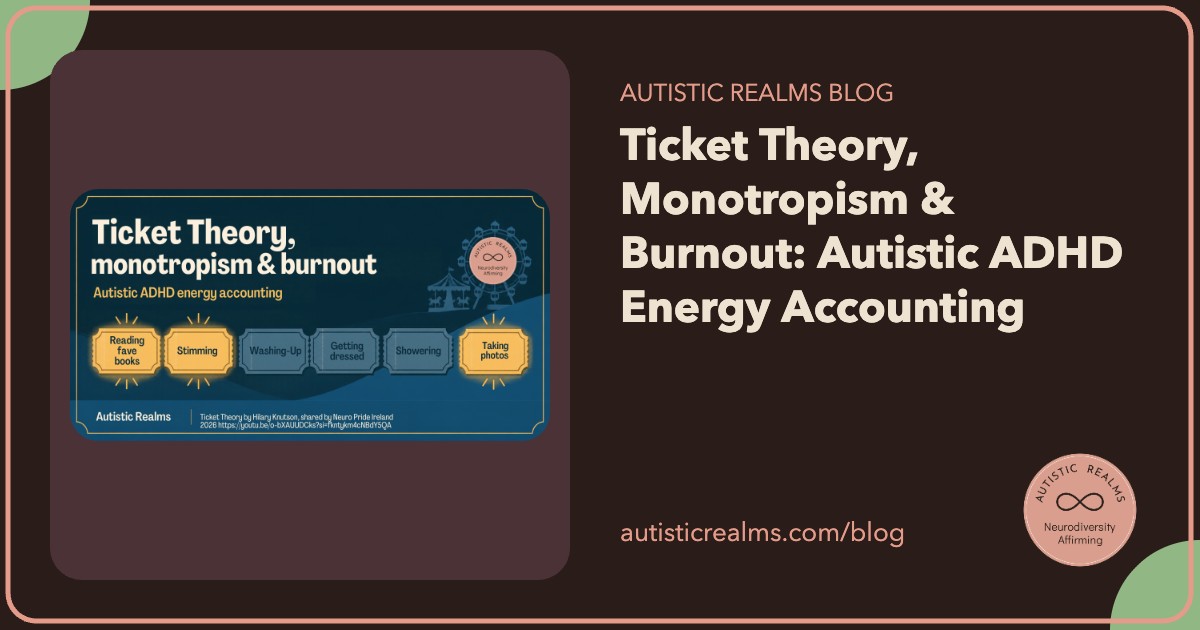
Ticket Theory, Monotropism & Burnout: Autistic ADHD Energy Accounting
Written by Helen Edgar,
-
Tides of burnout and being monotropic
Written by Helen Edgar,

Shop My Autistic Burnout Visuals
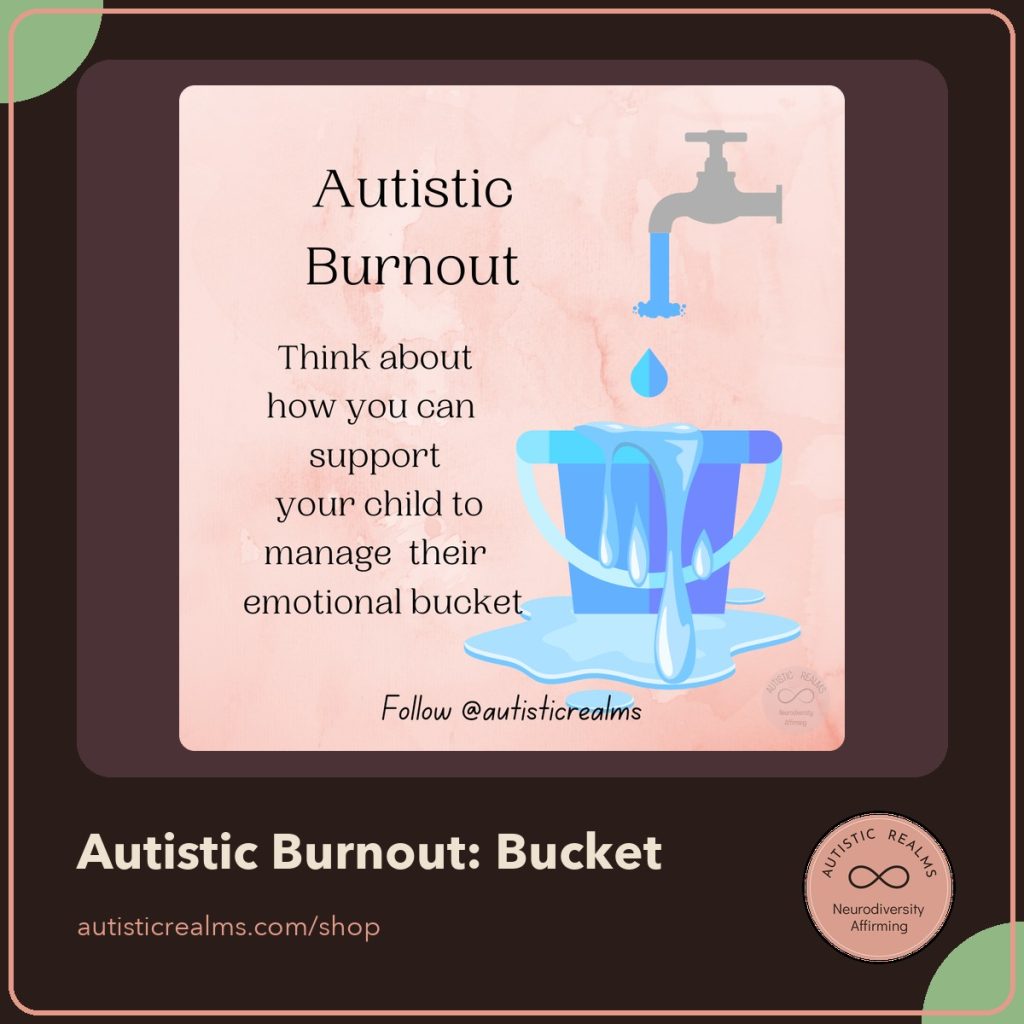
Understanding and recognising Autistic burnout is vital for wellbeing. These resources offer visual supports to help identify signs of burnout, explore recovery strategies, and develop personalised approaches to energy management. Designed for both individuals experiencing burnout and those supporting them in educational, home, and workplace environments.
-
Suggested: £1.99 (pay what you can)
-
Suggested: £1.99 (pay what you can)
-
£15.99
-
Suggested: £1.99 (pay what you can)
-
£4.99
-
Suggested: £1.99 (pay what you can)
-
Suggested: £1.99 (pay what you can)
-
Suggested: £1.99 (pay what you can)
-
Suggested: £1.99 (pay what you can)
Free resources from communities close to my heart
Everything here is free. These resources come from communities close to my heart: Stimpunks Foundation, which I co-direct with Ryan Boren; Thriving Autistic, the Autistic-led social enterprise in Ireland where I am Communications and Community Lead; Re-Storying Autism, the course and workbook David Gray-Hammond and I created together; and Spectrum Gaming, the charity and community for Autistic young people behind Autism Understood and Barriers to Education, where I have volunteered on several projects, including Barriers to Education and their burnout resources.
The Autism Understood and Barriers to Education pages are written especially for Autistic young people, so they are lovely to share with children and teenagers, or to explore together.
Stimpunks Foundation
- Autistic Burnout: The Cost of Masking and Passing: a deep, community-written guide to burnout, masking and recovery.
- Burnout and Sensory Safety: how sensory safety can protect us from overload and burnout.
- Spoon Theory: a simple, shared way to talk about limited energy.
- Regulation and Coping: a gentle field guide to regulation and coping.
- Get Help: practical coping resources and next steps for when things feel hard.
Thriving Autistic
- Module 2: Masking and Burnout: the costs of masking, recognising burnout, and gentle paths towards safer unmasking and recovery.
- Discovery by Thriving Autistic: a free, self-paced programme for recently identified Autistic adults, created by Autistic professionals and drawn from the live Discovery Programme.
Re-Storying Autism
- Re-Storying Autism free guides: short, free guides on topics such as Autistic burnout, sensory overload, co-regulation and low-demand approaches.
- Free preview lesson: try a lesson from the Autistic-led course and workbook for families, parents, carers and Autistic people, at your own pace.
Autism Understood (for young people)
- Autistic Burnout: what burnout is and how it can feel, explained for young people.
- Autistic Burnout: What Helps: gentle ideas for rest and recovery.
- Autistic Burnout: Another Perspective: another Autistic voice on living through burnout.
- Managing Your Brain’s Energy: noticing and protecting your energy.
Barriers to Education (for young people)
- What Is Burnout?: burnout in children and young people, its signs and the research behind it.
- Why Burnout Happens: the stress cycle that can lead to burnout.
- Burnout Recovery: what recovery can look like and how to support it.
What would you add?
Do you know of a resource, organisation, book or piece of research that should be here, or have you spotted a link that has stopped working? I would love to hear from you, as this guide grows with our community.