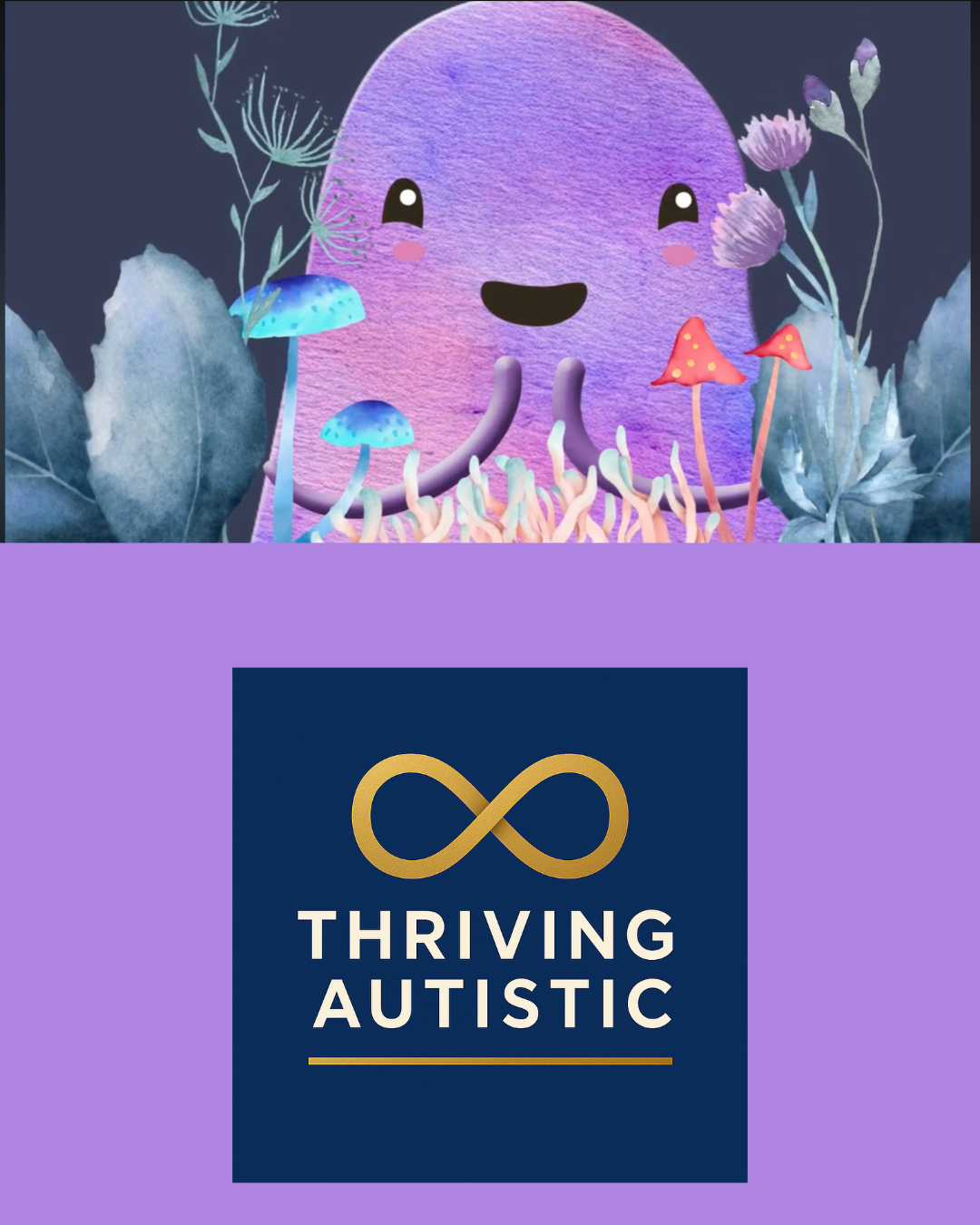
A friendly purple watercolour character from the Thriving Autistic animations, with a rounded body, a wide smile and rosy cheeks, its hands gently clasped. It stands among soft blue leaves, wildflowers and colourful mushrooms against a dark background. Below, on a lilac panel, is the Thriving Autistic logo: a gold infinity symbol above the words "Thriving Autistic" on a navy square.

Free Resources for Autistic Adults: The Thriving Autistic Discovery Programme

Coming to know yourself as Autistic person can bring relief, joy, grief, recognition and a lot of questions all at once. Many of us find that the months after identification are a time of looking back over our lives with new eyes, and it helps to have gentle, affirming places to turn to while we do that. The Thriving Autistic Discovery Programme is one of those places, and its resources are now free for anyone to explore.

What it is

The Discovery Programme is a six-module journey of self-discovery for recently identified Autistic adults, created, designed and facilitated by Autistic professionals at Thriving Autistic, an Irish neurodivergent-led social enterprise. The free online collection gathers self-paced videos, guides and practical tools drawn from the live programme, so you can move through them in whatever order and at whatever pace suits you. There is no right way to explore it, and you can come back to a module as often as you need.

Who it is for

The resources are for Autistic adults who have recently come to understand themselves as Autistic, whether that came through a formal identification or through self-identification. Both routes are welcomed as valid. They can also be useful for anyone further along in their journey who wants to revisit a topic, and for family members, friends and professionals who want to understand Autistic experience from Autistic people themselves.

What it covers

Each of the six modules has video guides, downloadable resources and practical tools designed by and for the Autistic community.

  1. Imposter Phenomenon and Intersectionality: making sense of your identification and the feelings that come with it.
  2. Masking and Burnout: understanding the cost of masking, recognising Autistic burnout, and finding paths toward safe unmasking and recovery.
  3. Our Sensory Selves: exploring your sensory world, building practical strategies, and creating environments that support your wellbeing.
  4. Monotropism and Attention Styles: understanding how Autistic attention works, the power of flow, and working with your natural attention patterns.
  5. Relationships, Empathy and Communication: reframing empathy, navigating relationships, and finding ways to connect that honour who you are.
  6. Internalised Ableism and Self-Advocacy: identifying internalised ableism, building self-advocacy skills, and stepping into your Autistic identity with confidence.

Free, and funded by Rethink Ireland

All of the online resources are free. The programme is supported by Rethink Ireland through its Disability Participation and Awareness Fund, which funds places on the live, facilitated programme for people based in Ireland. The live programme runs periodically, subject to funding, and Thriving Autistic offers sliding-scale subsidised rates for people outside Ireland so that it stays as accessible as possible.

My part in it

I co-authored the Discovery Programme with Thriving Autistic and I have also helped facilitate it since 2024. I was also project lead on the two Discovery animations, which you can watch further down this page. Sitting with groups of newly identified Autistic adults as they find words for experiences they have carried for years has been some of the most meaningful work I do. Many of the themes I write about here on Autistic Realms, such as masking, burnout, monotropism and internalised ableism, run through the programme too, and you can read more about them in my post on masking, internalised ableism and imposter syndrome.

The Discovery animations

Alongside the programme, Thriving Autistic made two short animations to share some of its heart with a wider audience, and I was project lead on both. Discovering You’re Autistic follows the journey from confusion to clarity, and from feeling out of place to finding belonging. Lightbulb Moments: Being Autistic gathers the realisations Autistic adults described to us, and celebrates that moment of recognition when you understand that you are not alone. You can watch both below, or find them on the Thriving Autistic animation page.

Discovering You’re Autistic

Lightbulb Moments: Being Autistic

Awards and festival selections, 2026

  • National Diversity Awards 2026: Finalist, Celebrating Unity in Society
  • iDEAL International Film Festival 2026: Award Winner, and Nominee in the festival’s 5th year
  • AIMAFF 2026: Finalist
  • Neurocinema Neurodivergent Film Festival 2026: Official Selection
  • SkipTown Playhouse International Film Festival 2026: Official Selection

The team

These animations were a real collaboration, and I am so grateful to everyone who brought them to life.

  • Project lead: Helen Edgar
  • Writers: Helen Edgar, Laura Buckland Mason, Sonny Hallett, Fergus Murray and Jessica K Doyle
  • Animator: Iara Abigalil
  • Composer and musician: Somebody Someone (Aubrey Hays)
  • Vocal treatment and mixing: Paulo Beto
  • Producer: Tara O’Donnell-Killen
  • Funded by: Rethink Ireland and the Department of Children, Disability and Equality

Find out more and explore

However you arrive and whatever stage you are at, I hope you find something there that helps you feel a little more at home in yourself.


Latest Posts

  • Autistic Burnout – Supporting Young People At Home & School

    Autistic Burnout – Supporting Young People At Home & School

    Autistic burnout in young people is real—and recovery starts with understanding. This post offers neuroaffirming ways to spot the signs, reduce demands, and truly support. 💛 #AutisticBurnout #Neuroaffirming #Monotropism #AutisticSupport


  • Monotropic Interests and Looping Thoughts

    Monotropic Interests and Looping Thoughts

    The theory of monotropism was developed by Murray, Lawson and Lesser in their article, Attention, monotropism and the diagnostic criteria for autism (2005). ​ Monotropism is increasingly considered to be the underlying principle behind autism and is becoming more widely recognised, especially within autistic and neurodivergent communities. Fergus Murray, in their article Me and Monotropism:…


  • Map of Monotropic Experiences

    Map of Monotropic Experiences

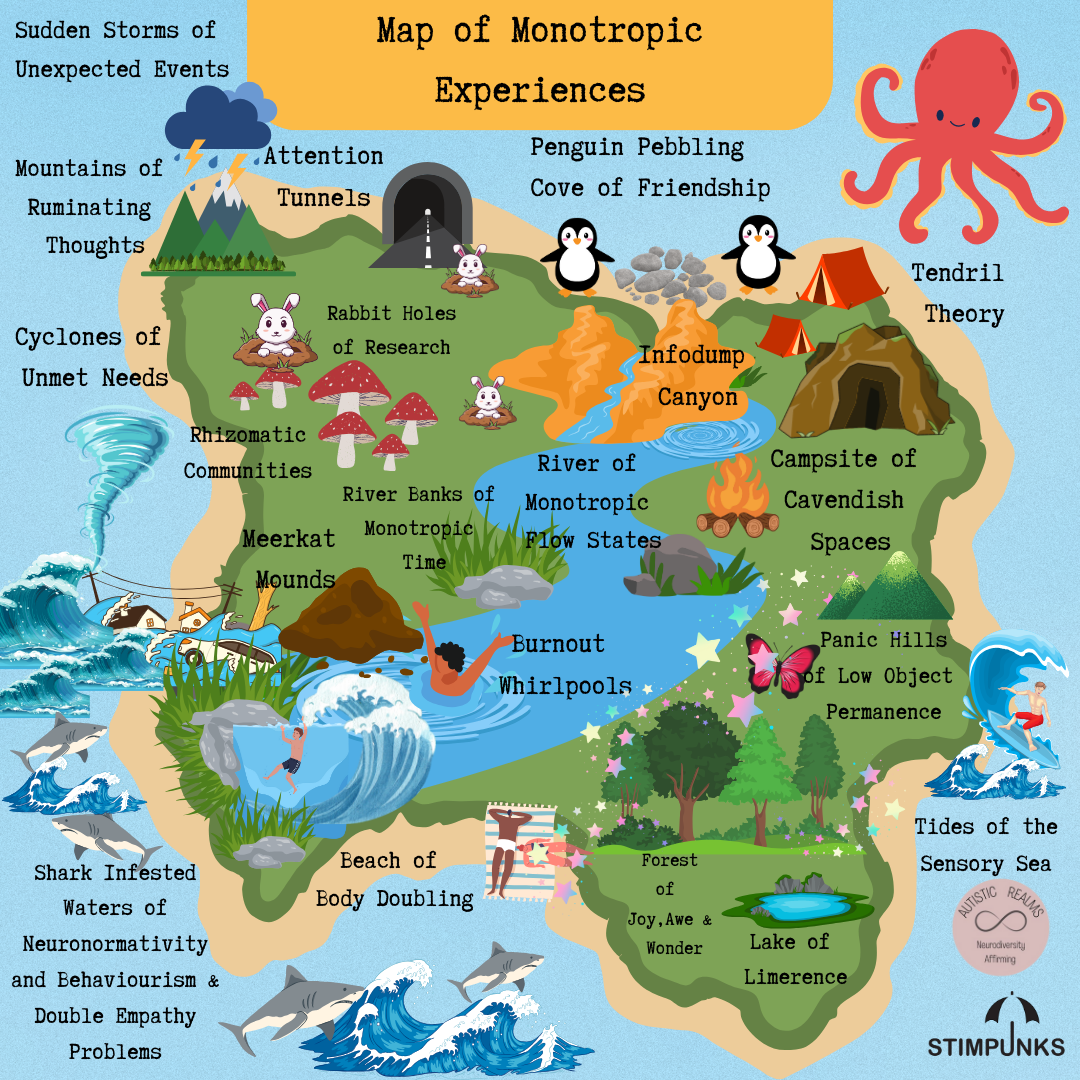
    The Map of Monotropic Experiences now has a home of its own. Visit monotropicmap.org to explore each of the twenty areas, mark your own map and find the free training. You can also find the free training and downloads further down this page. Monotropism seeks to explain Autism in terms of attention distribution and interests. …


  • Autistic Burnout – Supporting Young People At Home & School

    Autistic Burnout – Supporting Young People At Home & School

    Being autistic is not an illness or a disorder in itself, but being autistic can have an impact on a person’s mental and physical health. This is due to the often unmet needs of living in a world that is generally designed for the well-being of people who are not autistic. In addition, three-quarters of…


  • The Double Empathy Problem is DEEP

    The Double Empathy Problem is DEEP

    “The growing cracks in the thin veneer of our “civilised” economic and social operating model are impossible to ignore”, Jorn Bettin (2021). The double empathy problem (Milton, 2012) creates a gap of disconnect experienced between people due to misunderstood shared lived experiences. It is “a breakdown in reciprocity and mutual understanding that can happen between people…


  • Top 5 Neurodivergent-Informed Strategies

    Top 5 Neurodivergent-Informed Strategies

    Top 5 Neurodivergent-Informed Strategies By Helen Edgar, Autistic Realms, June 2024. 1. Be Kind Take time to listen and be with people in meaningful ways to help bridge the Double Empathy Problem (Milton, 2012). Be embodied and listen not only to people’s words but also to their bodies and sensory systems. Be responsive to people’s…


  • Autistic Community: Connections and Becoming

    Autistic Community: Connections and Becoming

    Everyone seeks connection in some way or another. Connections may look different for autistic people. In line with the motto from Anna Freud’s National Autism Trainer Programme (Acceptance, Belonging and Connection), creating a sense of acceptance and belonging is likely to be more meaningful for autistic people than putting pressure on them to try and…


  • Monotropism, Autism & OCD

    Monotropism, Autism & OCD

    Exploring similarities and differences between Autistic and OCD monotropic flow states. Can attention tunnels freeze, and thoughts get stuck?


  • Monotropism Questionnaire & Inner Autistic/ADHD Experiences

    Monotropism Questionnaire & Inner Autistic/ADHD Experiences

     Post first published 28th July 2023 Over the past few weeks, there has been a sudden surge of interest in the Monotropism Questionnaire (MQ), pre-print released in June 2023 in the research paper ‘Development and Validation of a Novel Self-Report Measure of Monotropism in Autistic and Non-Autistic People: The Monotropism Questionnaire.‘ by Garau, V., Murray,…


  • Penguin Pebbling: An Autistic Love Language

    Penguin Pebbling: An Autistic Love Language

    Penguin Pebbling is a neurodivergent way of showing you care, like sharing a meme or twig or pretty stone to say “I’m thinking of you,” inspired by penguins who gift pebbles to those they care about.


  • Masking, Internalised Ableism and Imposter Syndrome: What We Do to Survive, and What We Are Taught to Believe

    Masking, Internalised Ableism and Imposter Syndrome: What We Do to Survive, and What We Are Taught to Believe

    Masking is what we do to survive. Internalised ableism is what we are taught to believe. Imposter syndrome asks whether we belong. Helen Edgar gently untangles all three.


  • Free Resources for Autistic Adults: The Thriving Autistic Discovery Programme

    Free Resources for Autistic Adults: The Thriving Autistic Discovery Programme

    Free, self-paced videos, guides and tools for recently identified Autistic adults, from the Thriving Autistic Discovery Programme. What it is, who it is for, what it covers, and how to explore it.


  • Bagpuss: Lost Things. Holding Space for Emergence & Joy

    Bagpuss: Lost Things. Holding Space for Emergence & Joy

    Exploring Bagpuss through a neurodivergent lens: monotropism, slow attention, and the quiet beauty of restoring meaning to lost and overlooked things.


This website stores cookies on your computer. These cookies are used to provide a more personalized experience and to track your whereabouts around our website in compliance with the European General Data Protection Regulation. If you decide to opt out of any future tracking, a cookie will be setup in your browser to remember this choice for one year.

Accept or Deny

WordPress Cookie Plugin by Real Cookie Banner