June 2025
Bagpuss was my absolute favourite childhood programme. I must have watched it hundreds of times, possibly thousands of times! Curled up, absorbed, comforted by its gentle rhythm and predictable storytelling, yet there was always something that was a bit different that ignited my curioiusity in each episode. Looking back, it was the most perfect programme for as yet unidentified Autistic me. It was quiet and cosy and repetitive in the best kind of way. Just a small world that unfolded at its own pace, with characters who felt both strange and familiar, and stories that often began with something discarded or lost. It all felt very magical, and I wanted to live there amongst them all, forever.
For anyone unfamiliar, Bagpuss was a 1970/80s children’s television series in the UK centered around a shop where Emily, a young girl, brings broken or lost objects she’s found. She places them in front of Bagpuss, her saggy cloth cat, and speaks a familiar phrase:
“Bagpuss, dear Bagpuss,
Old fat furry cat-puss,
Wake up, and look at this thing that I bring,
Wake up, be bright, be golden and light,
Bagpuss,
Oh hear what I sing“
And then, everything changes.
Bagpuss opens his eyes, stretches, and the whole shop comes alive. His toy friends, Gabriel, Madeleine, Professor Yaffle, and the mice come alive and gather to examine the object Emily has brought to them, and they reimagine its story. Nothing ever gets “fixed” in a practical sense, but everything feels lovingly restored and has meaning.
Looking back now, it all makes a lot of sense. It may not have been made with neurodivergence in mind, but watching Bagpuss feels, in many ways, like a part of my own re-storying and I still relate to it 40+ years later.
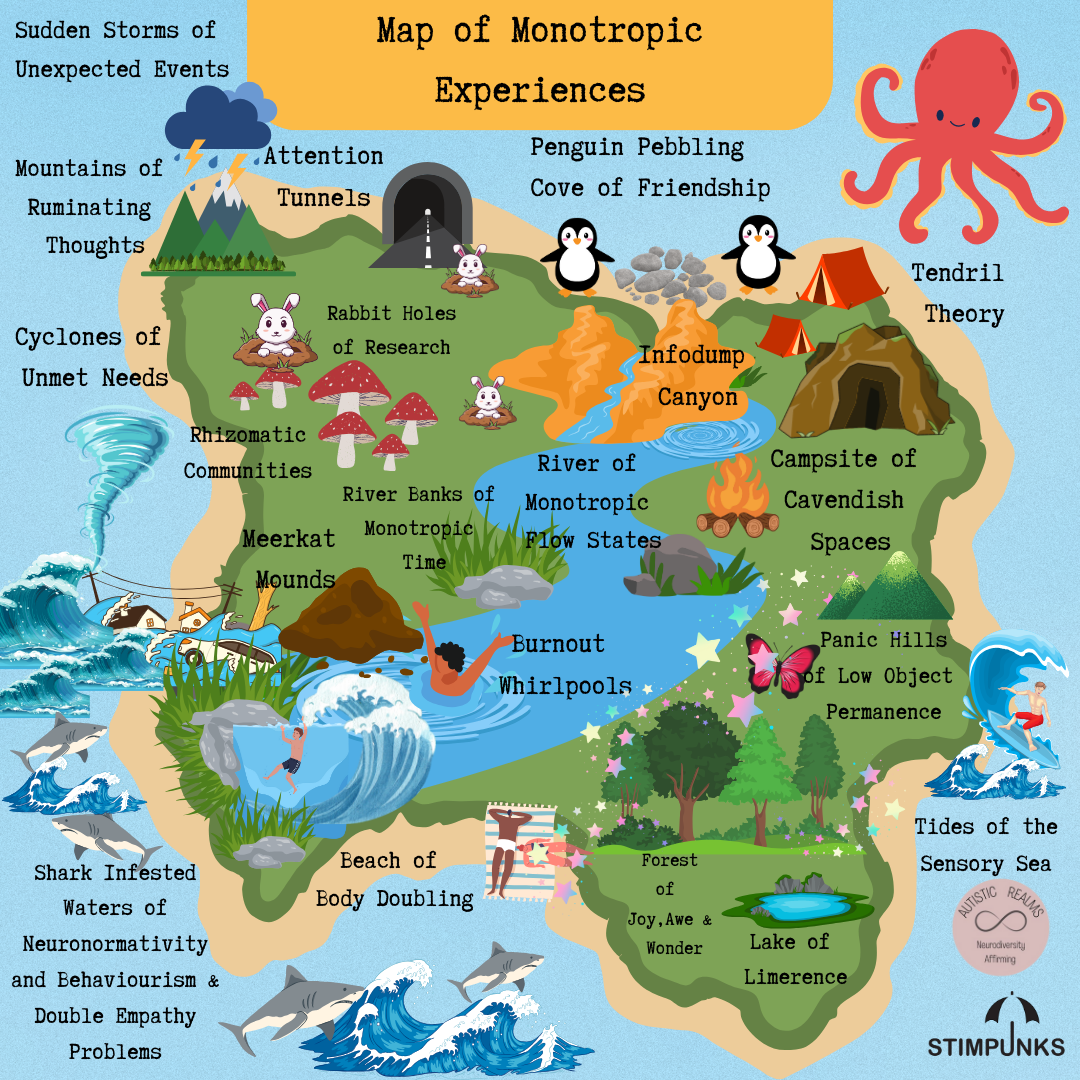
Once Bagpuss wakes up, something shifts. The whole world of the little shop comes alive with him. His friends gather in their different ways, each with their own logic, their own style of thinking, responding, and ways of being. They don’t jump to fix things, they wonder, they are inspired and curious. They turn the objects over gently, looking at it from different angles, playing with stories, holding space for possibility. It felt to me like an internal unfolding, sparked into motion by something small but meaningful, some pull on my attentional thread that led to a shared monotropic flow that we shared together.
There was no urgency in the Bagpuss programmes, no expectation to make the found objects useful again.
What the outside world calls lost or broken isn’t dismissed; it’s worthy of care, just as it is, in the way it was found.
The process isn’t about repair in the usual sense; it’s about restoration of meaning and finding different and other ways of being and perceiving that are equally valuable. Perhaps it is the kind of meaning that matters most to us as neurodivergent people, emotional meaning, sensory meaning, the kind that can’t always be explained, but can be felt. The kind that can bring joy even though you may not be able to explain exactly why. The kind of meaning that may lie within our imaginations sometimes, but is equally important, valid and real.
Perhaps Emily and Bagpuss aren’t really separate?
They have a kind of shared rhythm between structure and story, between the world outside and their inner experiences, leaving the viewer in the middle of their imaginings. Bagpuss didn’t need to rush; he didn’t need to be “productive.” he just needed to be curious, stay with the flow of Emily and the story, and hold space for what might emerge.
Bagpuss didn’t need to explain himself. He followed his interests, followed what made sense to him, and invited others to do the same. Maybe that’s what so many neurodivergent ways of being ask for too; not correction, but curiosity, not urgency, but spaciousness for emergence to surface.
There’s something deeply affirming about a world that makes room for slow attention, for gentle noticing, for restoring meaning on our own terms and discovering sense-making in the little and unnoticed parts of life that so often get dismissed or are even stigmatised.
The world would feel kinder if more of us had space to follow what matters, to move with our own rhythm, and to notice that what appears small, broken, or strange on the outside may be deeply alive in its own way and hold great value for us. There is so much richness that lives beneath the surface, and when we stop rushing to fix or define, we might begin to recognise the kinds of meaning that don’t demand explanation, and the worth of what others overlook.
Like Bagpuss and his friends, we need space for thoughts, possibilities, and joy to emerge. Space to notice what calls to us, to follow the pull of curiosity, to tend to what matters in our own time. Our ways of being are woven with imagination, sensory meaning, and possibility.
Even the things that seem forgotten or overlooked often carry so much potential.
When we have the time to sink in, to let go of expectations, and to follow our interests and flow, joy can surface in the most unexpected places and in the most unexpected ways.
Watch Bagpuss
https://www.bbc.co.uk/programmes/m000wqbd
More from Autistic Realms
If this post was useful, these courses, books and resources might help too. Everything in the shop is pay what you can, and many resources are free.
- Building a Positive Autistic Identity: a gentle, self-paced course written for Autistic people.
- Re-Storying Autism course: a video course and workbook with David Gray-Hammond.
- Re-Storying Autism (book): our book, co-written with David Gray-Hammond.
- Neuro-Affirming Glossary (Updated 2026): key words for families and professionals.
- Autism and Neurodiversity Starter Pack: free, written with David Gray-Hammond.
- The Autistic Realms shop: over 380 resources, pay what you can and many free.