Tag: Burnout
-

Spoon Theory and Autism: Energy, Burnout and Monotropism
What spoon theory means for Autistic people: how everyday tasks use up limited energy, why spoons run out faster, and how monotropism and burnout fit in.
-
Autistic Burnout vs Depression: How to Tell the Difference
Autistic burnout and depression can look the same from the outside but need different support. The differences, where they overlap, and what helps each.
-
Awe, Wonder and Monotropic Attention in Neuroqueer Learning Spaces
If Helen De Cruz designed a learning space, what would it look like? Helen Edgar follows wonder and awe through monotropism, glimmers, flow and Cavendish Space.
-
Masking, Internalised Ableism and Imposter Syndrome: What We Do to Survive, and What We Are Taught to Believe
Masking is what we do to survive. Internalised ableism is what we are taught to believe. Imposter syndrome asks whether we belong. Helen Edgar gently untangles all three.
-
Free Resources for Autistic Adults: The Thriving Autistic Discovery Programme
Free, self-paced videos, guides and tools for recently identified Autistic adults, from the Thriving Autistic Discovery Programme. What it is, who it is for, what it covers, and how to explore it.
-
Plain Language:
A plain-language guide to monotropism, wonder and awe — what happens when Autistic and ADHD attention is given space to notice, and stay
-
No Space Is Neutral: Safe Spaces, Imagined Neutrality, and the Work of Belonging
: No space is neutral. Exploring minority stress, the Double Empathy Problem, and what it really takes to build safer, neuroqueer spaces together.
-
Weird Pride in a Hostile World
Weird Pride is a practice of becoming. A refusal to shrink. A quiet, feral devotion to staying alive as ourselves in a world that keeps trying to make us something else.
-
Re-Storying Autism
Re-Storying Autism A Framework For Families, Parents, And Carers: Reimagining Support For Autistic People. #1 Amazon Bestseller
-
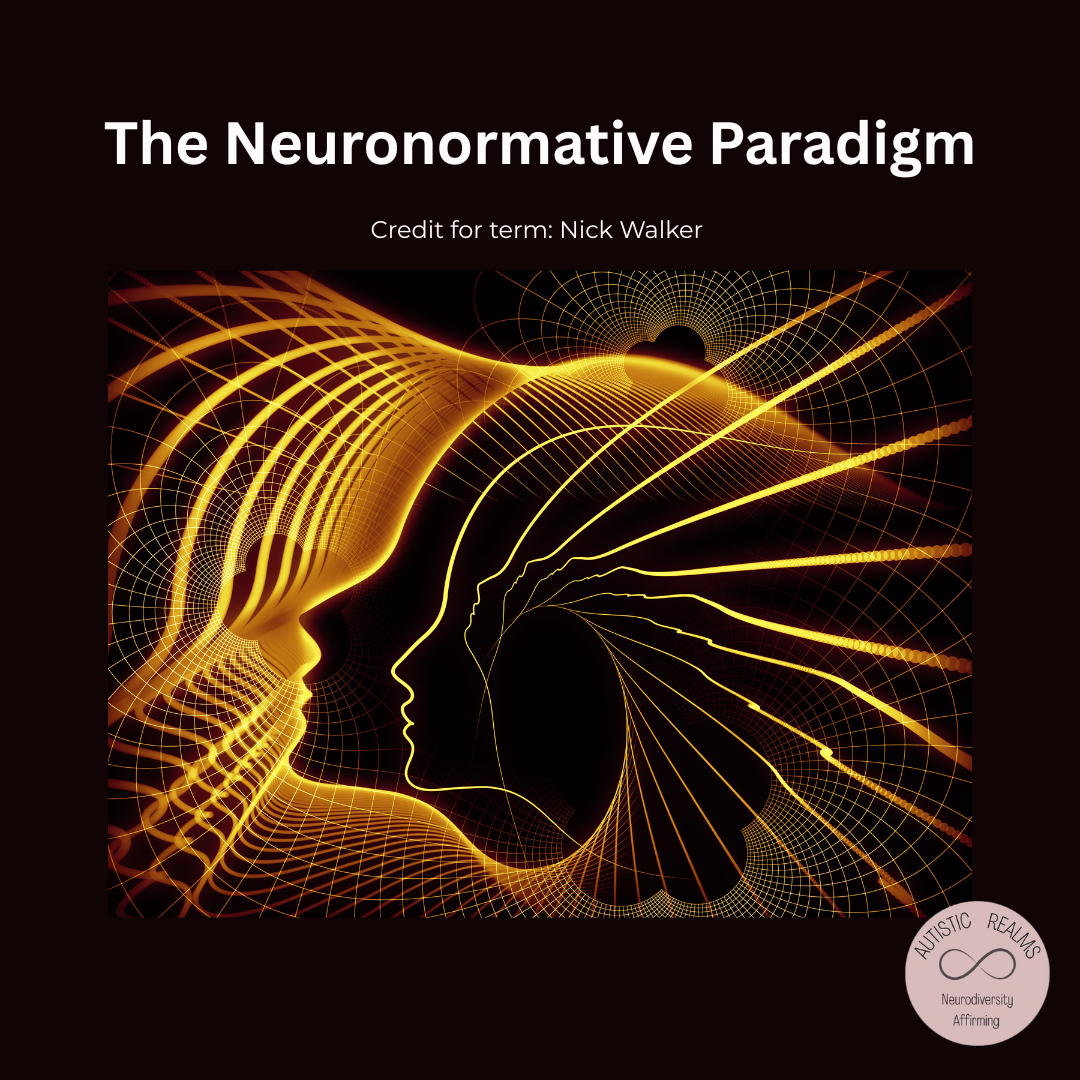
The Neuronormative Paradigm: Naming The Systems That Harm
The Neuronormative Paradigm, conceptualised by Nick Walker, names the systems that define and enforce what society considers normal. This exploration piece contrasts the neuronormative paradigm with the neurodiversity paradigm, which recognises all ways of being as vital to human diversity.
-
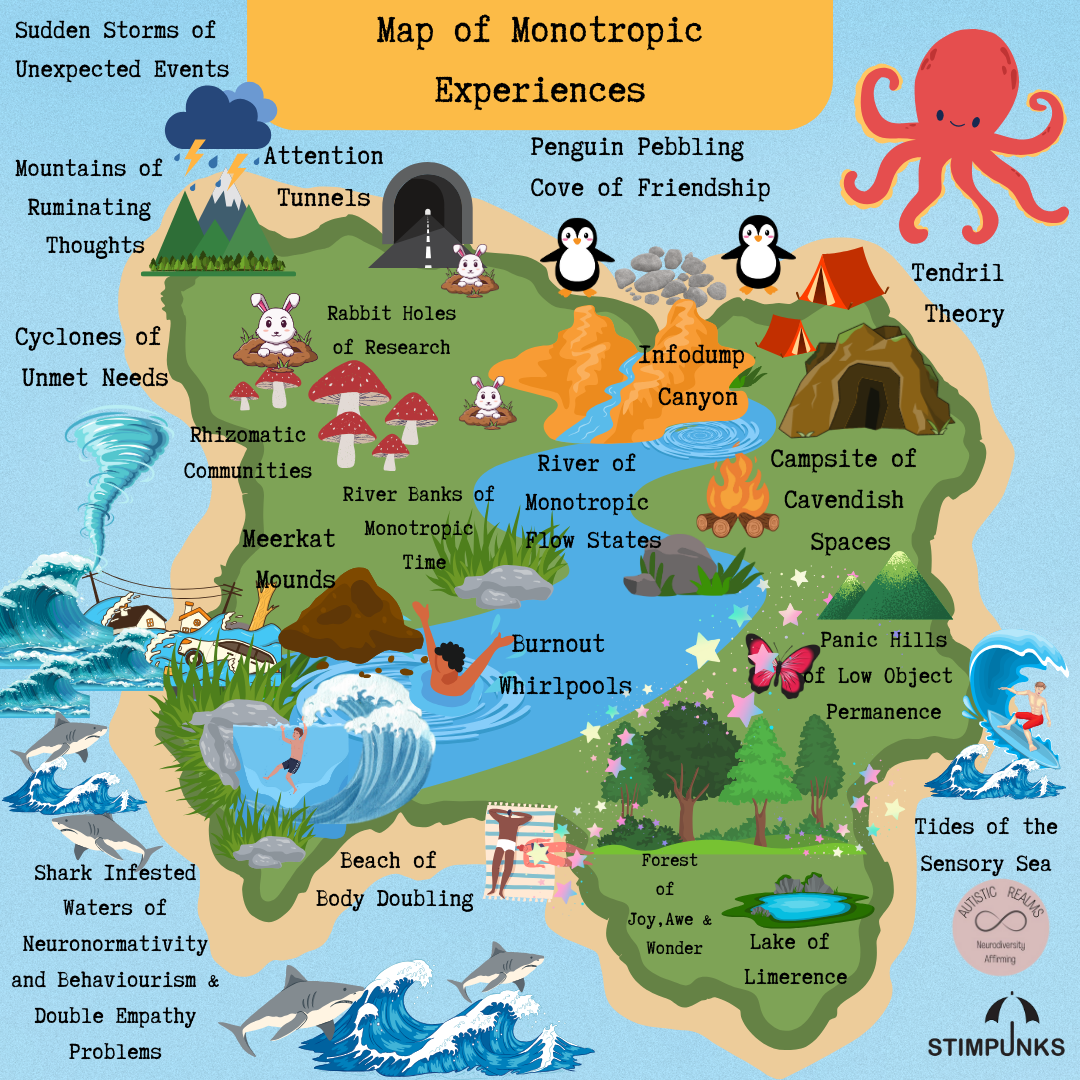
Χάρτης Μονοτροπικών Εμπειριών
ThalloMinds has kindly translated The Map of Monotropic Experiences (Χάρτης Μονοτροπικών Εμπειριών) that I created in collaboration with Stimpunks! Huge thanks for all the hard work!
-
Monotropism vs Polytropism: ADHD, AuDHD & Autistic Attention
Explore how monotropism shapes Autistic, ADHD, and AuDHD attention. Dispelling myths, uncovering research and exploring why neuroaffirming support matters for our wellbeing.
-
Autistic Mental Health: Beyond the Pathology Paradigm
Autistic mental health is often framed through a narrow, deficit-based lens — one that focuses on pathology, risk, and what’s “wrong.” But this view leaves out the richness of autistic lives, the diversity of our needs, and the resilience in our communities. Moving beyond the pathology paradigm means centring lived experience, recognising the systemic barriers…
-
Why PBS is Harmful for Autistic and Neurodivergent Young People
Exploring why and how Positive Behaviour Support (PBS) can harm Autistic people. #Neurodiversity #AutismAcceptance #PBS #DisabilityJustice
-
From Autistic Realms to More Realms: Exploring Other Ways of Being
Journey from Autistic Realms into More Realms—where neuro-affirming support meets creative, sensory, and neuroqueer explorations of other ways of being.
-
Neuro-Affirming Neurodivergent & Disabled Wheel of Life: Reclaiming Flow on Our Own Terms
Neuro-Affirming Neurodivergent & Disabled Wheel of Life: Reclaiming Flow on Our Own Terms Workbook available for instant download.
-
Glimmers: Autistic Joy and Monotropism
Glimmers are small, powerful moments of Autistic joy that emerge when we’re deeply immersed in what matters to us. Learn how monotropism & flow create space for joy in an overwhelming world. #AutisticJoy #Glimmers #monotropism
-
Going Deeper: Rest, Burnout, and Monotropic Flow
Autistic burnout recovery often means going deeper into flow, not switching off. Find out about reclaiming rest through monotropic focus, spiral time, and meaningful immersion.
-
Autistic Pride: Rest, Resistance & Monotropism
Written for Autistic Pride Day 2025: what Autistic Pride means to me, from monotropism and the cost of masking to reclaiming rest and finding belonging in community.
-
Unmasking: Reclaiming Our Monotropic Attentional Resources?
Exploring masking and unmasking: reclaiming our monotropic attentional resources, reconnecting with ourselves and community
-
Autistic Pride: Restorying & Unknowing Autism
Restorying is how we reclaim our Autistic voices, honour our ways of knowing, and build futures rooted in connection, not correction.
-
The Power of Monotropic Flow: Reclaiming Ourselves Through Creative Practice
“Art opens up space for healing and a way of reclaiming your own narrative”. Letting go of how we should rest or should work opens up a pathway towards restorative flow.
-
Neurodiversity Affirming Reading Recommendations
Looking for neurodiversity-affirming reads? I’ve have a growing collection of books listed by autistic authors, advocates, and researchers. Perfect for parents, professionals, and curious minds alike. Explore stories that affirm, not fix. Neurodivergent voices centred. From education to identity, burnout to belonging.
-
Reclaiming Rest: Autistic Burnout, Monotropism, and Resistance
Rest can become a radical act in a world that often equates our worth with productivity, especially for Autistic or otherwise neurodivergent people navigating the tides of burnout, where even our ways of resting may look different.
-
Neuroqueering Time: Bergson, Deleuze, and Monotropism (an exploration)
Time as a double temporality problem, exploring interest gravity for monotropic people and flow as a temporal home…..
-
Autistic Young People: Skills Regression, Burnout or a shift in Monotropic Attentional Resources?
Autistic individuals may not lose skills but instead redirect their monotropic attention toward new interests or areas of development.
-
Monotropic Time & Neuroqueering Temporalities
Monotropic Time & Neuroqueering Temporalities Dwelling in Resonance: Monotropism, Monotropic Time, Spirals & Neuroqueer Temporalities
-
Monotropic Time
Each person’s experience of time is likely to be influenced by culture, age, disability and neurodivergence. For Autistic/ADHD/AuDHD people, time is anything but linear or neutral and is not a universally accepted given.
-
Testimonials for Autistic Realms
Testimonials gathered from National Diversity Awards nomination feedback 2024 and 2025. Feel free to vote for me and others here: Helen is breaking new ground in the dismantling of neuronormativity while working tirelessly to grow and deliver her practice as an Autistic Advocate. I have known of Helen’s work for over 20 years and she…
-
Neuro-Affirming Research in Practice: Supporting Autistic Students, Embracing Monotropism In The Classroom And Beyond
Written by Tanya Adkin and Helen Edgar, based on the presentation we delivered to the National Autistic Society Professionals’ Conference in March, 2025. Shared with permission from NAS. We will explore the importance of the theory of monotropism and the significance of flow states and suggest some practical strategies educators can implement to create more…
-
Could it be PANS/PANDAS… Be Curious!
This collection of text and images was created collaboratively by neurodivergent educators, working together to shine a light on this often-overlooked area of care and support. Helen Edgar, Joanne Riordan, Laura Hellfeld, Viv Dawes, Julie Webb and Ben Palmer . Have you noticed a change in your child’s ability to cope with life or a decline in their well-being? It is…
-
Challenges for Autistic & Neurodivergent Families Navigating the SEND System: We Need to Understand the Double Empathy Problem & Embrace Monotropism
(Blog based on a presentation I delivered to London Met University 14th March 2025, updated April 24th 2025 following the research published by…. Introduction The Special Educational Needs and Disabilities (SEND) system is designed to support children with additional needs, yet for many neurodivergent families, it presents more barriers than solutions. Families navigating this system…
-
Tides of burnout and being monotropic
“Once the storm is over, you won’t remember how you made it through. But one thing is certain. When you come out of the storm, you won’t be the same person who walked in.” [And that may even be a good thing]. (Kafka on the Shore, Haruki Murakami, 2002) Haruki Murakami is one of my…
-
The Map of Monotropic Experiences: A Summary
The Map of Monotropic Experiences now has a home of its own. You can explore each of the twenty areas in more depth at monotropicmap.org. The free training and downloads are on the main Map of Monotropic Experiences page. The Map of Monotropic Experiences, created by Helen Edgar of Autistic Realms in collaboration with the…
-
Neuronormative Domination, Monotropism & The Map of Monotropic Experiences
The Map of Monotropic Experiences now has a home of its own. Read more about neuronormative domination, the water the whole map sits in, at monotropicmap.org, and explore each of the twenty areas of the map there too. In collaboration with Stimpunks, I created a Map of Monotropic Experiences. This is a revised edition of…
-
Radical Resilience
Image of pink flower growing between gaps in pavement. Text:Wild flowers offer hope. Be radically resilient. Find possibilities in-between hard spaces. Be authentic and flourish in adversity. Transform the landscape. Be a wild flower.
-
Autistic Burnout – Supporting Young People At Home & School
Autistic burnout in young people is real—and recovery starts with understanding. This post offers neuroaffirming ways to spot the signs, reduce demands, and truly support. 💛 #AutisticBurnout #Neuroaffirming #Monotropism #AutisticSupport
-
Monotropic Interests and Looping Thoughts
The theory of monotropism was developed by Murray, Lawson and Lesser in their article, Attention, monotropism and the diagnostic criteria for autism (2005). Monotropism is increasingly considered to be the underlying principle behind autism and is becoming more widely recognised, especially within autistic and neurodivergent communities. Fergus Murray, in their article Me and Monotropism:…
-
Map of Monotropic Experiences
The Map of Monotropic Experiences now has a home of its own. Visit monotropicmap.org to explore each of the twenty areas, mark your own map and find the free training. You can also find the free training and downloads further down this page. Monotropism seeks to explain Autism in terms of attention distribution and interests. …
-
Monotropism and Collective Flow
In Milan Kundera’s novel, ‘The Unbearable Lightness of Being’ (1981), he described the heaviness of life, the restrictive oppression and boundaries that can tie us all down, yet there is freedom in the possibilities the mind can bring and in the choices we can make. We can subvert the restrictions of neuronormative society; we can,…
-
An Autistic Experience of Social Media
I am writing this one month into my journey of setting up Autistic Realms; I aim to support and develop understanding and awareness about neurodivergence, education and mental health. As a late-identified autistic person and also a parent and teacher, I have always found real-life communication and interaction quite ‘difficult’ and complex to navigate. I…
-
Autistic Burnout, Bodymind and Soul
Kieran Rose (2018) describes autistic burnout as a ‘crash where you keep on crashing’. This resonates deeply. I have experienced cycles of burnout throughout my life due to systemic unmet needs living as an autistic person in a world primarily designed for non-autistic people. The double empathy problem (Milton, 2012) is real, and as explained…
-
Neuroqueering in the Liminal Spaces
Neuroqueering in Liminal Spaces “By silencing our bodyminds, they (neurotypical society) have halted the growth of a chaotic self. We are no longer able to move fluidly through our experience, instead frozen like ice on an arctic tundra” (Gray-Hammond, 2023) David Gray-Hammond (Emergent Divergence) and I are responding to each other’s blogs to help expand the…
-
Monotropism, Holotropism & Floatation Experiences
I am autistic and monotropic, and I am interested in exploring Helen Mirra’s theory of holotropism (2023) and how this may impact flow states and regulation. Holotropism synthesises the theory of monotropism (Murray, 2005) with deep ecology and holistic anatomy. Holotropism is a: “multi-dimensional, spacious, edgeless terrain under the monotropism map…To be holotropic is to have…
-
An unlearing and relearning journey.
Hello! I have never done an introduction post for Autistic Realms, so after 18 months and some one kindly nominating me for the Positive Role Model Award as part of the National Diversity Awards and receiving so much lovely feedback, I thought I would share a bit about myself! I am Helen Edgar, late identified…
-
Celebrations: Neurodivergent-friendly ideas to help make celebrations a success for the whole family
(A guest blog, originally written forand published by ThePDASpace, May 2023) Family life can be busy and chaotic, and you may feel like you are constantly juggling to try and keep some balance to get through the day and avoid a crisis. Changes to everyday routines, such as celebration days and events, can be difficult…
-
Embracing Autistic Children’s Monotropic Flow States
Article originally written and published for Neurodiverse Connection (Sept 2023) Autistic and ADHD people are more likely to be monotropic than the rest of the population (Garau, V. et al., June 2023). This means they focus more energy and resources on fewer interests/tasks/ sensory input at any one time compared to non-autistic polytropic people. Developing a…
-
Autistic Burnout: Social Media Project November 2023
Autistic burnout is a term often used within the autistic community to describe an intense exhaustion that many autistic people experience where input and demands from life exceed the capacity a person has to manage. As part of my ongoing work within the neurodivergent community, I hope to help develop a deeper understanding and awareness…
-
Monotropism, Autism & OCD
Exploring similarities and differences between Autistic and OCD monotropic flow states. Can attention tunnels freeze, and thoughts get stuck?
-
Monotropism Questionnaire: Take It and Understand Your Results
Post first published 28th July 2023 Over the past few weeks, there has been a sudden surge of interest in the Monotropism Questionnaire (MQ), pre-print released in June 2023 in the research paper ‘Development and Validation of a Novel Self-Report Measure of Monotropism in Autistic and Non-Autistic People: The Monotropism Questionnaire.‘ by Garau, V., Murray,…
-
Monotropism and Experiences of being Monotropic
The theory of Monotropism was developed by Dr Dinah Murray, Wenn Lawson and Mike Lesser (2005) in their article, Attention, monotropism and the diagnostic criteria for autism. Monotropism is increasingly considered to be the underlying principle behind autism and is becoming more widely recognised, especially within autistic and neurodivergent communities. Fergus Murray,(2018), describes montropism as:…
-
Book review – Autistic Burnout, Children /Young People in Education by Viv Dawes
I am excited to announce that Viv Dawes (autistic advocate, writer, and trainer, www.autisticadvocate.co.uk) has just published her new book, Autistic Burnout, Children /Young People in Education, a book aimed at parents of autistic (or other neurodivergent) children. I have revised my preface here as a short review so everyone gets a chance to find…
-
Low Demand Parenting (for the whole family)
There are a growing number of courses and books discussing the benefits of low-demand parenting strategies. This approach has been adopted by many professionals, such as Dr. Naomi Fisher, who support families. It is becoming increasingly popular amongst parents, especially in neurodivergent communities or in communities where children are struggling with mental health. Many of the low-demand…
-
Autism & OCD – What Could Help
Updated October 2026. Autism and OCD overlap in ways that are easy to mistake for one another, and getting that wrong leads to the wrong support. This post sets out the differences and what could help; for the attention side of the story, Monotropism, autism and OCD explains why thoughts can loop, and the monotropism…
-
Monotropism = Happy Flow State
Updated October 2026. This was my first attempt to explain monotropic flow to parents, and I still believe its central point: deep interests are not a problem to be managed but the place where Autistic, ADHD and PDA young people regulate and recover. I have written a fuller plain-language monotropism guide since, and glimmers and…
-
Autism is fluid
Updated October 2026. “Being Autistic” is one of the searches that brings most people here, so a word on where this post sits now. It is a short statement of the neurodiversity paradigm: autism is a way of being, not a disorder to fix, and Autistic needs are fluid. If you want the vocabulary behind…
-
Neurodivergent Friendly Classrooms
Updated October 2026. I wrote this for Twinkl in 2023, and the attendance crisis it describes has only deepened. The classroom ideas still apply. Since then I have written about why behaviour-based approaches such as PBS do harm, and about the monotropism that underlies so much of what teachers see; both are worth reading alongside…
-
Supporting neurodivergent students who are struggling to attend school
Updated October 2026. School attendance remains the question I am asked about most by families and schools, and the reasons have not changed: unmet needs, sensory overload, masking and burnout. This post sets out what schools can do. For the burnout side read the Autistic burnout hub and the teacher guide; for parents, Parent ideas…
-
Supporting pupils through Autistic Burnout (Neuro-Affirming Teacher Guide)
Supporting pupils through Autistic Burnout (Neuro-Affirming Teacher Guide)
-
Supporting autistic students experiencing OCD in a school setting
Updated October 2026. More pupils are living with OCD alongside being Autistic than most schools realise, and the support that works is rarely the standard behaviour plan. This guide is still my starting point for teachers; read it with Autism and OCD: what could help and, where burnout is part of the picture, the Autistic…
-
Autism, OCD, Alexithymia & Interoception
Updated October 2026. Alexithymia and interoception are two of the least understood pieces of the autism and OCD picture, and I still get messages about this post every week. Since writing it I have explored the same territory through monotropism, which helps explain why anxious thoughts loop, and gathered the support side in Autism and…
-
Education Crisis – Neurodiversity Affirming Teacher Training Needed
Language Identity First Language: In line with preferences from the Autistic community I will be using Identity First Language (ie. Autistic person, NOT person with Autism) Neurodiversity – This relates to the biological fact that human brains and minds differ from each other. Neurodiversity aligns with the idea that all children are unique and…
-
Supporting Children through Autistic Burnout (Parent/Carer Guide)
Updated October 2026. This guide was one of the first things I wrote for Autistic Realms, and it is still the page most parents arrive at. Since then I have gathered everything on burnout into one place, the Autistic burnout hub, and written about how burnout differs from depression and about spoon theory and energy.…
-
Parent ideas for autistic children struggling with school attendance
Updated October 2026. If your child cannot face school, there is always a reason, and the ideas here are about finding it rather than forcing attendance. Since I wrote this I have added a parent guide to Autistic burnout, which is behind a great deal of school distress, and a short explainer on spoon theory…
-
Ideas for Autistic Children who are Struggling at School
Updated October 2026. This was among the first posts on Autistic Realms and it is still the one I send to parents who sense something is wrong before anyone else does. The signs below hold. For what to do next, Parent ideas for Autistic children struggling with school attendance follows on, and the Autistic burnout…