
Original blog posted on Neurohub Community (25th Feb 2026)
Co-authored by
Weird Pride Day is 4th March. Our theme for 2026 is Weird Pride in a Hostile World, because “Weird Pride is always an act of resistance, as well as a celebration, and right now that’s more important than ever”.
We are living through an age that loves tidy stories. Stories with clear protagonists and antagonists, with progress arcs. Stories where identity is supposed to arrive fully formed, laminated, and ready for public display.
Weird pride, however, leaks, it flickers. It appears in half-sentences, in unfinished thoughts, in bodies that move strangely, in lives that refuse linearity. Weird pride is not the polished rainbow branding of resilience, it is the slow, stubborn refusal to disappear from the map altogether and to fall between the cracks.
For many neurodivergent people, pride is not a feeling that descends upon us after self-acceptance. It is neither a reward for “doing the work”, nor a badge we earn once we have successfully assembled an identity.
Weird pride emerges in the in-between
It shows up when someone says, quietly, “I think I might be different”, and does not immediately apologise. It shows up when a person stops trying to explain themselves to those committed to misunderstanding them.
It shows up when survival becomes a creative act. Perhaps, more accurately, it is the act of saying “I think I can be different”.
In a hostile world, one structured around productivity, compliance, normality, and legibility, existing as weird is already a form of resistance. There is no glamorous resistance or organised revolt. We are not the cinematic dissidents of Hollywood dystopia. Weird pride is a messy resistance, often coming from tired people, and an inconsistent resistance, but still a resistance to normativity.
Liminal Lives
Many marginalised people live in liminal spaces, Liminality being the condition of being in- between. Neither inside nor outside, in between systems, identities and spaces of belonging. Not quite recognisable but stubbornly refusing erasure.
Neurodivergent people often occupy a permanent threshold, too functional to be believed, too impaired to be accommodated, too articulate to be taken seriously or not articulate enough. Too distressed to be ignored, too much, too little, too weird!
Liminality is not just psychological,it is structural. Institutions are built around binary sorting systems:
- Healthy / ill
- Normal / disordered
- Capable / incapable
- Independent / dependent
But lived experience is relational, fluctuating, and context-dependent, it does not fit neatly into binaries. People living on the margins of society, trying to survive between everything often fall through the gaps when there is not enough support and community to strengthen those edges.
Liminal spaces are uncomfortable, but they are also fertile.
They are places where new language, and subsequently new realities get invented.
Liminal spaces allow new identities to get prototyped, new ways of being to become imaginable; and it is in liminal soil where Weird pride grows best.
Neurodivergence As Becoming
One of the most radical moves in contemporary neuroqueer thinking (Walker, 2021) is the shift away from neurodivergence as a fixed thing you are and toward neurodivergence as something you do and can become. Not just in the sense of performance. Certainly not only in the sense of choice. It is neurodivergence in the sense of becoming.
Becoming means:
- You are not a finished product.
- You are not a static object.
- You are a process.
- Your nervous system is shaped by experience.
- Your subjectivity is shaped by relationship.
- Your sense of Self is shaped by what you are in proximity to.
We are not for a second asserting here that anyone can become Autistic, or similar. What we are saying is that all bodyminds are formed in context, and that “normality” itself is a cultural construction, not a biological destiny.
If neuronormativity is a system that defines certain cognitive styles as correct, then diverging from that system, resisting it, refusing it, reworking it, is itself a form of neurodivergence. The fundamental premise underlying neuroqueer practice is refusal rather than any kind of biological essentialism. Therefore, being neurodivergent becomes less a diagnostic container, and weirdness less a value judgement; both become an act of sociopolitical resistance in our very mundane dystopia of a society.
A place you stand.
A way you move.
A stance toward the world.
Neuroqueering As Practice
Neuroqueer is not primarily an identity label, it is a verb.
To neuroqueer is to:
Subvert the demand to perform normativity. both neuronormativity, and by natural association, heteronormativity.
Refuse compulsory coherence.
Interrupt the scripts you were handed about how a person should think, feel, move, speak, love, work, and exist.
Neuroqueering is an ongoing, improvisational-yet-intentional practice.
Small acts count.
Minor gestures accumulate (Manning, 2016)
Neuroqueering is not about becoming a better version of yourself, rather, it is about becoming a liberated version of yourself. It is embracing the truth of you and to keep changing, and we claim it through the shapeshifting nature of neuroqueer practice.
Folding, Masking, And Unfolding
Many neurodivergent and/or Weird people learn early that parts of us are undesirable to a normative world.
- Too intense.
- Too slow.
- Too fast.
- Too much.
- Not enough.
So we fold, we fold inwards, we fold our voices smaller, we fold our desires and actions into shapes that look acceptable. Masking becomes a survival technology necessitated by a hostile ecosystem; one in which the core structures of that ecosystem have created a biased chance for survival for those who present as not weird and able to perform normativity. It is a survival technology that harms and protects us in equal measure.
Folding too tightly for too long creates pain, psychological distress, acquired neurodivergence, and can lead to burnout. Unfolding is rarely sudden, it is usually gradual, like unbending a limb that has been contorted close to the body for many years.
A sentence gets longer.
Stimming becomes louder.
A boundary appears.
A need gets named and advocated for.
Unfolding feels risky because it is. With each unfolded edge we ask; Is this version of me allowed to exist? This is further impacted by those people multiply marginalised by gender, race, age, sexuality and their own trauma and cultural histories.
Weird pride lives in the unfolding, not in the arrival. It happens in the attempts, in the ‘let’s try this’, ‘what would happen if’. It happens in the ‘may be’ and the ‘what if…’, not the should or ‘just’. Weirdness is an embracing of becoming; that liminal place between normalised and fully liberated. It is the becoming that is oppressed because it prevents us from reaching liberation.
The Ecosystemic Nature of Distress
Mainstream neuronormative culture loves individual explanations.
- What’s wrong with you?
- What disorder do you have?
- What’s broken inside your brain?
But distress does not arise in a vacuum.
Distress is relational, and the machinations of human cognition do not solely occur in the discrete locale of one’s brain. It emerges at the intersection of:
- Bodies
- Environments
- Histories
- Relationships
- Material conditions
- Power structures
A person can be deeply well in one context and profoundly unwell in another. The problem is not the person, the problem is the ecosystem. A hostile ecosystem produces and reproduces distress.
Neuroqueering, then, is not just about changing ourselves. It is ecological conservation for the neurodivergent and weird bodyminds for whom the ecosystem at large is dangerous. It is about changing the conditions we live inside. Neuroqueering must encompass the extended neurocognition of the ecosystemic bodymind by:
- Building spaces where weirdness is not punished.
- Creating relationships that do not require constant translation.
- Designing environments that do not assume one kind of bodymind.
Weird pride is a collective infrastructure, and neuroqueering is the development of tools to design and build that infrastructure.
The Autistic Rhizome
A rhizome is a root system that spreads horizontally.
- No central trunk.
- No single origin point.
- Multiple entryways.
- Multiple exits.
Autistic culture is rhizomatic, it has no single story, no universal experience. There is no correct way to be Autistic. Instead People find each other sideways. Through books, memes, half-remembered forum posts, late-night messages and through recognition:
Fragments. Connections. Shared metaphors. Borrowed language. Reworked ideas.
The validation of
“Oh. You too?” “I get that as well!”
Community is not a place you arrive, it is something you co-create. It is the collective infrastructure that grows rhizomatically in all directions from the liminal spaces and people who are living at the margins. It is the soil where “becoming” becomes “something”.
Weird pride grows along rhizomatic lines; messy, decentralised, alive.
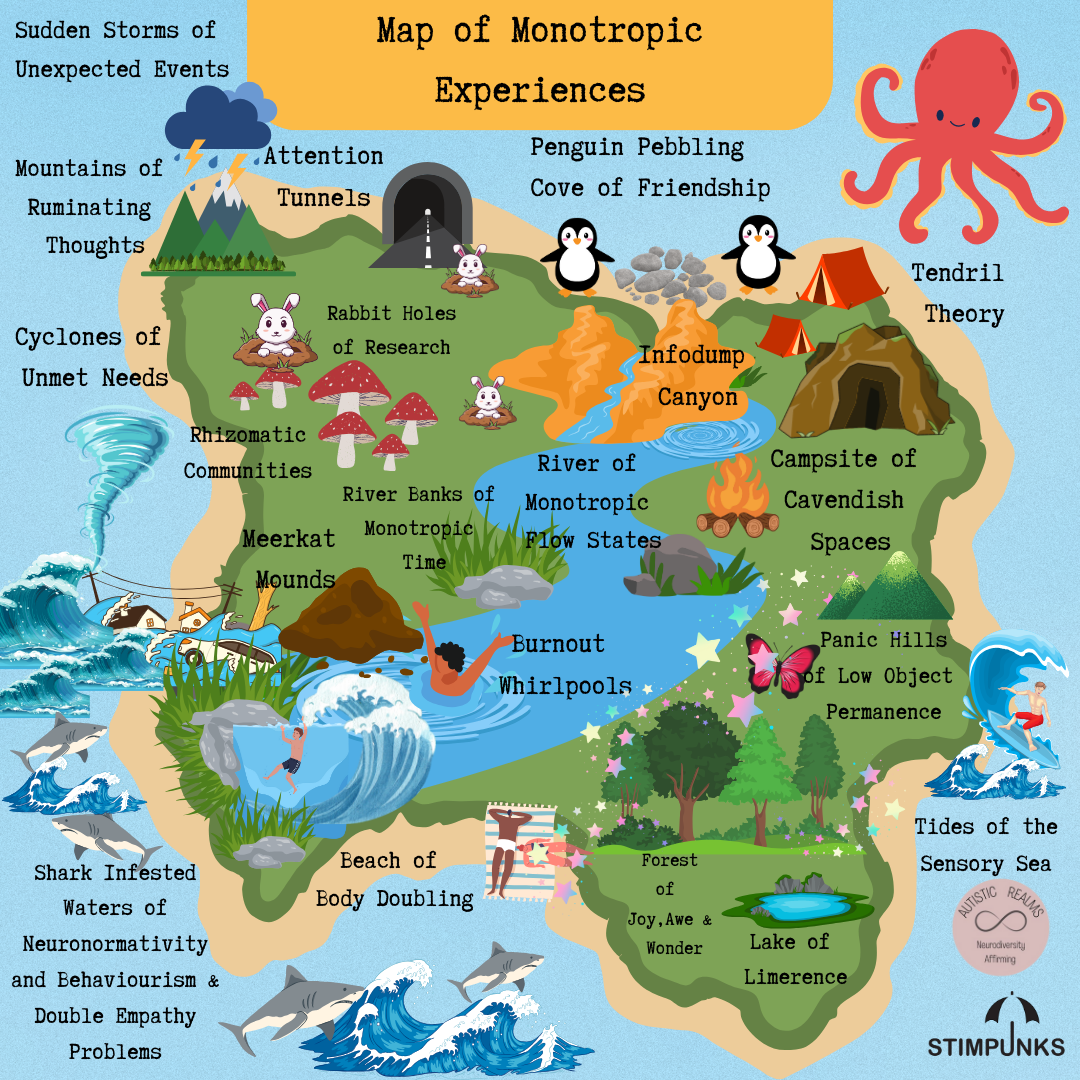
Read More: https://autisticrealms.com/mossy-minds-monotropism/
Mutual Aid, Interdependence, and Collective Care
Neuronormativity worships independence.
Be self-sufficient.
Don’t need too much.
Handle your own problems.
But humans have never been independent, we have always survived through interdependence.
Neurodivergent communities, in their weirdness feel this and know it as meaningful. We swap coping strategies, share scripts, lend spoons. Sit quietly together, infodump and penguin pebble.
Mutual aid is not charity. It is not hierarchy. It is the recognition that we are already entangled.
Weird pride is not “I did this alone”. Weird pride is “we kept each other alive, we are thriving depsite everything”.
Weird Pride as a Practice
Weird pride is not a static emotional state. It is not constant confidence, neither is it permanent self-love. Weird pride is a practice.
A repeated choice and conscious act to:
- Treat your experience as real.
- Stop apologising for existing.
Some days Weird pride looks like joy, others it looks like rage. Some days it looks like lying on the floor and not dying. All of it counts.
Weird pride does not require perfection. It does not require coherence. It does not require certainty. It only requires that you keep showing up, in whatever form you can manage, as someone who refuses to be erased.
Toward Post-Normal Futures
A post-normal future is not a utopia, or a world without suffering. It is a world that stops pretending there is one correct way to be human. A world where variation is expected, assumed. A world where difference is not automatically problematised.
Weird pride is rehearsal for that future. Every time we neuroqueer ourselves, we loosen the grip of normality. Every time we choose truth over performance, we widen the field of possibility. Every time we build weird, tender, awkward, loving community, we prove that other ways of living are viable. Not perfect but a valid possibility and viable.
Viability is revolutionary.
Weird pride does not need to be loud. It is the moment of ignition when a spark becomes a flame.
Weird Pride is a practice of becoming. A refusal to shrink. A quiet, feral devotion to staying alive as ourselves in a world that keeps trying to make us something else. And that, honestly, is already miraculous.
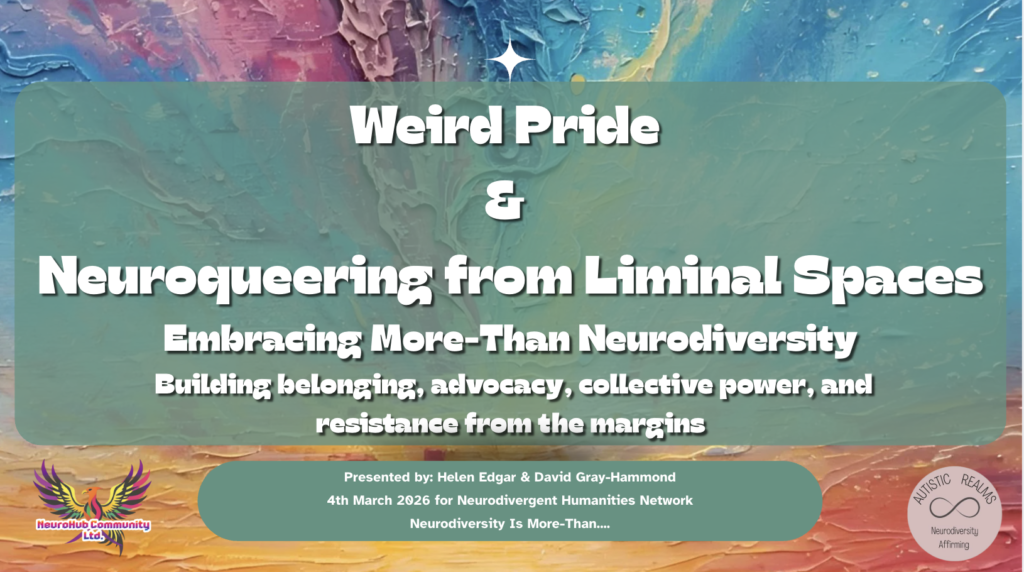
This blog has formed the basis for our presentation for Durham University, Institute for Medical Humanities: Neurodiversity is More Than…event.
4th March 2026
A symposium organised by Abs S. Ashley and Ombre Tarragnat bringing together academics, independent researchers and lived-experience activists from across the globe to chart new possibilities with and beyond the neurodiversity concept.
This event brings together academics, independent researchers and lived-experience activists from across the globe to chart new possibilities with and beyond the neurodiversity concept.
What forms of inclusion and exclusion does neurodiversity perform as a concept, as a field, and as a movement? How may lines of queer, trans, crip, decolonial, posthumanist, or Mad thinking shake up and overspill the conventional boundaries of neurodiversity? How may the perspective of the more-than contribute to a radical expansion of neurodiversity beyond autism, the human, and the Global North? How can the disciplinary perspectives of literature, anthropology, sociology, or philosophy be brought together with activist practice to shape the critical neurodiversity studies that is so urgently needed today?
This online event is open to all members of the Neurodivergent Humanities Network, as well as members of the public.
Speakers will include
Helen Edgar and David Gray-Hammond
This event is hosted by the Neurodivergent Humanities Network, in collaboration with the Discovery Research Platform for Medical Humanities, University of Bristol, and the Centre de Recherches sur les Arts et le Langage.
Free tickets: https://www.eventbrite.co.uk/e/neurodiversity-is-more-than-tickets-1975828909456?aff=oddtdtcreator
Find out more and explore what David and I are doing and join us in our NeuroHub Community Space to further these discussions.