
If you have spent any time navigating schools, social care, or therapy as an Autistic person or supporting a loved one, you have likely encountered attachment theory. You may have been blamed for your children’s difficulties and said they were due to attachment disorders and perhaps your parenting issues, or you may have been told you have attachment issues yourself. It shows up in reports, assessments, and professional language; it sounds authoritative, and it often feels unchallengeable.
Before any of us knew we were Autistic in my family, I was personally blamed for my children’s difficulties. My own struggles as a parent, their anxiety, their subsequent difficulties in school, all of it was framed as rooted in attachment disorders, with me being blamed as the main cause. No one asked whether we might be an Autistic family in a world that wasn’t built for us. No one considered that what looked like disordered attachment might be something else entirely. The blame and shame created by all of this are still inside me now as I write; it has caused a lot of trauma. It has taken me years to fully understand and unlearn my own training about attachment theory and really think about the harm that having some of these labels put on us can cause when the problem may not be us; it may be the result of living in a patholgising neuronormative society.
As a teacher with twenty years of experience in early years and special education, I am very familiar with attachment theory as framed by John Bowlby and subsequently Mary Ainsworth and others. It formed a significant part of my child development training, and for many years, I accepted it, as most of us do when we have nothing else to fall back on. It felt like it made sense, it felt caring, and it offered a language and reason for the relationship difficulties some children had with their caregivers and vice versa. Their work proved valuable for a considerable time and helped explain many traits of avoidance, anxiety and relational security that I saw in many of the children I worked with, but it also made me doubt my own parenting capacity and feel I was to blame for our family’s difficulties.
However, the more I have learned about my own Autistic identity and my children’s and the more I have learned from the communities I am in, the more cracks I have seen in this theory. I now believe Bowlby’s attachment theory has serious problems, and I found Kieran Rose’s blog last year really informative on this subject. This piece draws on his thinking, alongside the work of the Stimpunks Foundation and the community insights I have gained over the past few years.
Bowlby’s Attachment Theory
Bowlby developed his ideas on attachment theory in 1969, which were later expanded by Mary Ainsworth in 1978. The world they were working in then was shaped by sexism, racism, ableism, and colonialism. In line with much thinking of the time, they both had very fixed ideas about what families should look like, and this is reflected in the writing of the time, which many training courses still refer to.
The “normal family” Bowlby’s theory assumed was white, Western, middle-class, with a mother at home and a father out at work earning. There was no space for neurodivergent families (the term didn’t even exist back then). There was also no thought given to extended caregiving networks, same-sex parents, or any of the many ways people actually live and love each other.
As Cobbaert et al (2026) have researched and explained, “Dominant narratives of dependence, attachment theory and emotional expression obscure trauma, sensory differences and structural violence, while legitimising coercive and exclusionary practices. […] Attachment theory itself arises from Eurocentric assumptions about caregiving, emotionality and selfhood. By positioning attachment theory as a culturally neutral developmental framework, such work risks reinforcing colonial epistemologies under the language of cultural safety.“
Attachment theory has travelled through time, and this work is still seen as foundational for many child development, early years teaching and psychology courses. It has moved from academia into schools and into the clinical reports that still exist in so many settings today, often with blame put onto neurodivergent, marginalised and other minority groups of people.
Children are not empty vessels
At its core, Bowlby’s attachment theory assumes children arrive relationally blank; it assumes that who they become in a relationship is built almost entirely by how well their caregiver attunes to them, or not. The child is essentially a blank slate waiting to be written on, formed and moulded into a person who can fit in “correctly” to become a productive member of society.
Rose (2025) points out an uncomfortable parallel between the founder of behaviourism Ivar Lovaas, who described Autistic children as essentially being like raw materials waiting to be built into people. Rose is not equating attachment theory with ABA, but the underlying assumption is quite similar: that children have no intrinsic relational self and that the adult’s job is to construct one, or else the parent is at fault if it doesn’t happen in the way society expects.
Autistic children arrive with their own ways of being, connecting, processing, and relating. They are not empty vessels; they are not broken, and they deserve to be met for who they are.
The mother-blame machine
Parents of Autistic children are more likely to be Autistic themselves (Sandin et al, 2017), often without knowing it, we are already navigating systems that were never designed with us in mind. Bowlby put the mother at the centre of everything. If a child’s attachment looked wrong, it was the mother who had failed and was often blamed, which is still often the case today, especially for Autistic parents (Lockington & Gullon-Scott, 2025). For Autistic families, this becomes like a machine for producing and adding more guilt and shame onto us.
Rose (2025) connects this to Bruno Bettelheim’s (1967) refrigerator mother narrative, which is the idea that Autistic children were Autistic because their mothers didn’t love them enough. This is now widely discredited, but the thinking behind it still feels to be sadly running through our social care systems and education today.
Bowlby’s framework, particularly as applied, suggested that if secure attachment wasn’t established in early infancy, outcomes were largely fixed. Later research challenged this significantly (Rutter, 1972), demonstrating that connection and relational growth are possible across the lifespan, shaped by ongoing experience and context rather than them being locked in by any single window.
This really matters for Autistic people, especially as so many of us are identified later in life. Many of us may find the deepest experiences of belonging not in infancy but in adulthood, through community and finally having language to help us understand who we are. A theory that closes the door at two years old does not describe human connection as it actually unfolds for many of us, or account for the spiky profiles that Autistic people so often have.
It also matters for how we think about Autistic parents. Attachment theory, as it has been applied in clinical and social care contexts, has too often been used as a deficit lens, measuring neurodivergent parents against a neuronormative template of attunement, eye contact, and emotional expression. But connection does not have a single shape, and an Autistic parent or carer who shows love through parallel play, or sensory co-regulation, or a different communication style is not failing to attach to their child; they may be attaching in ways that are simply not understood by others. When neurodivergent ways of parenting are pathologised rather than understood, families are harmed. We need neurodivergent ways of parenting to be understood so that our children are able to thrive and future generations are not affected by this.
Ways Forward
Monotropism
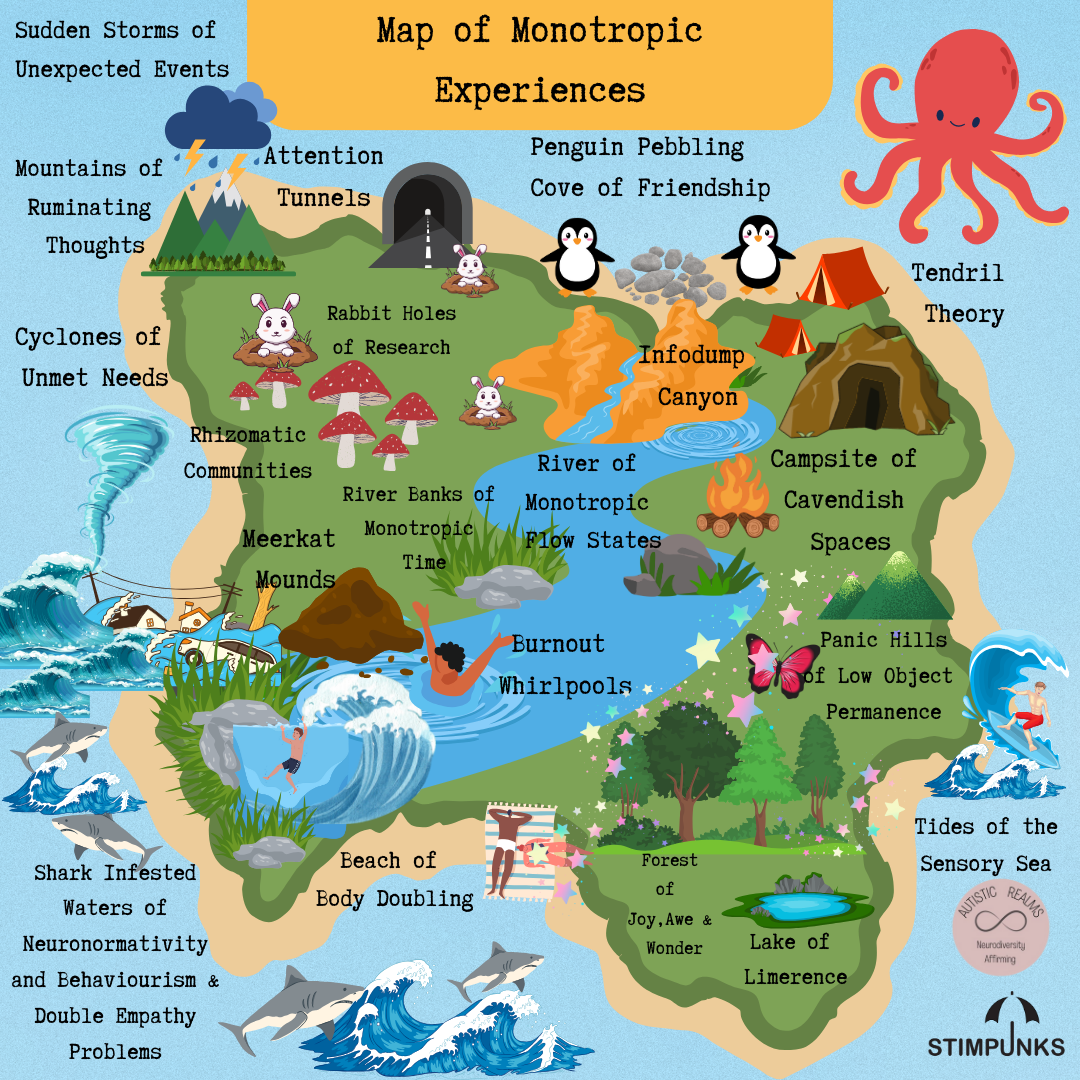
One of the biggest gaps I feel is that most current attachment theories have not brought in the importance of the theory of monotropism into consideration for Autistic and ADHD families (Murray, Lesser & Lawson, 2005; Garau et al, 2023). This is how many monotropic people tend to draw attention into fewer channels at any given time, meaning fewer cognitive and sensory resources are available for other processes. I think the theory of monotropism could help shape how we understand attachment, connection and experience safety in all of our relationships.
Masking
The other issue with attachment theory is that it doesn’t account for the impact of Autistic masking. Masking is a trauma response and “is effortful and depleting”, (Pearson & Rose, 2023), and an Autistic person who is masking during an assessment by a therapist might appear to be connecting in expected ways, or might appear disconnected when they are just overwhelmed. Either way, what the assessor observes may have very little to do with what is actually happening relationally, or how that child actually feels or would respond when they feel safer. For many Autistic people, masking develops in response to environments where authentic expression has not felt safe. In an assessment, what a therapist or teacher reads as relational difficulty may in fact be a survival response to the conditions of being assessed in itself for both the child and the parent/carer/
The Double Empathy Problem
Another concept that feels significantly absent here is Milton’s Double Empathy Problem (2012). This framework challenges the assumption that communication difficulties between Autistic and non-Autistic people originate within the Autistic person. Milton argued that when people with different lived experiences encounter one another, misunderstanding tends to flow in both directions, and each person may find the other harder to read, harder to predict, and harder to feel understood by. The difficulty is mutual; it is not a deficit located inside the Autistic person; it is a mismatch between two different ways of experiencing and moving through the world.
When professionals use neuronormative attachment frameworks like Bowlby’s to assess Autistic connections with children and caregivers who may also be Autistic or otherwise neurodivergent, they are really only measuring how closely our connections resemble what they see as neuronormative forms of connection. Anything outside that window is likely to be seen as ‘wrong’ or ‘disordered’ rather than a neurological difference, and that is when harmful labels may be applied to people or harmful interventions that try to ‘normalise’ neurodivergent ways of parenting, children’s relationships, and ways of connecting with others.
So what might Autistic and neurodivergent attachment actually look like?
Dr. Monsheng Letsoalo (2025) has recently proposed a framework called Neurodivergent Attachment Theory — NAT — published in Global Scientific Journal (currently a pre-print). I think it is worth sharing as a starting point for conversation and I was excited to discover this recently!
Rather than measuring Autistic connection and attachment styles against neuronormative ideals on how relationships should look and often finding them lacking, wrong or disordered, NAT starts from within neurodivergent experience itself. I have found the framework can help us to think about how sensory differences shape us and how we may seek connection in different ways as Autistic or otherwise neurodivergent people. NAT may help professionals consider how masking affects what they may observe or assume about Autistic people.
As Letsoalo says, existing attachment frameworks frequently misinterpret Autistic behaviours. They write how, “for example, an autistic child who avoids eye contact or physical touch may be classified as “insecure-avoidant,” despite forming deep emotional bonds through alternative means such as shared interests, parallel play, or consistent routines (Sng, 2023). Similarly, individuals with ADHD may be labeled “disorganised” due to apparent inconsistencies in attention or emotional expression, when in reality, these behaviours may reflect executive functioning challenges rather than attachment insecurity (Hinshaw et al., 2022)“.
Letsoalo (2025) proposes five neurodivergent attachment styles, which I think could be really valuable to reframe attachment theory. They say that “These styles are not deficits but adaptations, ways of seeking safety, regulation, and
meaning in a world often unaccommodating to neurodivergent needs. NAT reframes attachment not as a fixed label, but as a dynamic interplay between neurology, environment, and interpersonal context.“
The table below summarises the main key points, and access to the full text is available here.
Neurodivergent Attachment Styles
Letsoalo (2025)
- Sensory-Secure Attachment – Characterized by connection through
sensory attunement, co-regulated routines, and consistent, non-intrusive
engagement.- Masking-Avoidant Attachment – Driven by chronic masking, this style seeks
closeness but fears being seen. Emotional availability is limited by the
exhaustion of performing neurotypicality.- Hyperfocus-Attached – Marked by intense fixation on a person, idea, or
relationship as a regulatory anchor. This style can create strong bonds but
risks enmeshment and identity diffusion.- Looping-Disorganized Attachment – Marked by internal looping
(rumination, sensory overload, or intrusive thoughts) that disrupts relational
stability. This style oscillates between craving and rejecting connection.- Cognitive-Connector Attachment – Based on shared intellectual interests or
communication through scripting, pattern-recognition, and ideation.
Emotionally rich, though often misunderstood due to abstract or “flat” affect.
Things to consider when thinking about Autistic relationships and ways of connecting
When we are considering Autistic children who may look like they are not bonding in the ‘right’ way with their caregivers, we need to think about what is ‘right’ for them? Are they safe? Are their sensory needs being met? Do they have spaces where they can genuinely be themselves? Have the people around them really tried to understand how they connect on their terms, or have they been waiting for the Autistic person to do all the adapting and conforming?
As Rose (2025) points out, when Autistic people struggle relationally, it is often not insecure attachment. It is often the case that we face very high rates of interpersonal harm from an early age. It is often environments that punish difference and demand compliance. None of that shows up through the lens of Bowlby’s attachment theory and it often causes Autistic children and their families a lot of harm with the labels and interventions that are then placed upon them.
Relationships matter. Safety and connection are everything — and when we truly understand and honour authentic Autistic identity, we begin to see how differently those things can look, and how real they are.
Attachment theory, as Bowlby developed it and as it continues to be applied, was not built with Autistic lives in mind. It pathologises difference, it places blame on parents, and particularly on mothers, and it overlooks the frameworks that genuinely help us understand Autistic connection: monotropism, masking, sensory differences, the Double Empathy Problem, and the everyday realities of Autistic family life.
If you are a professional reading this, I am inviting you to stay curious, look for the connection that may not always appear the way you expect and to learn from Autistic people and research by Autistic people.
If you are an Autistic person, or the parent of an Autistic child, and this theory has been used to define or blame you, I feel the harm it may have caused. The connection you have, the love you give and receive, the ways you bond, attach, and belong may be different, but they are valid, even when the frameworks around you have not had the language to recognise them.
As Letsoalo (2025) writes: “Ultimately, embracing neurodivergent attachment styles is an essential step toward fostering inclusive psychological theory and practice. Doing so promises not only to improve therapeutic outcomes but also to enhance societal understanding and acceptance of neurodivergent individuals’ diverse ways of loving and being loved“.
As Ahana has responded in reply to my blog, “maybe any attachment theory is pathologising, and we should throw away the master’s tools“.
I coudn’t agree more!
References
Ainsworth, M. D. S., Blehar, M. C., Waters, E., & Wall, S. (1978). Patterns of
attachment: A psychological study of the strange situation. Lawrence Erlbaum
https://www.scirp.org/reference/referencespapers?referenceid=2892775
Ainsworth, M. D. S., & Bell, S. M. (1970). Attachment, Exploration, and separation: illustrated by the behavior of One-Year-Olds in a strange situation. Child Development, 41(1), 49. https://doi.org/10.2307/1127388
Beck, L. A., & Simonoff, E. (2019). Attachment styles in autism spectrum disorder: A systematic review. Journal of Autism and Developmental Disorders, 49(10),
4154–4166. https://doi.org/10.1007/s10803-019-04136-0
Cobbaert, L., E.Maloney, K.Harding, and S.James. 2026. “Dismantling the Diagnostic Construct of Borderline Personality Disorder: A Critical Discourse Analysis.” International Journal of Mental Health Nursing35, no. 2: e70241. https://onlinelibrary.wiley.com/doi/10.1111/inm.70241
Garau, V., Woods, R., Chown, N., Hallett, S., Murray, F., Wood, R., Murray, A. & Fletcher-Watson, S. (2023). The Monotropism Questionnaire, Open Science Framework.
https://www.researchgate.net/publication/371579106_Development_and_Validation_of_a_Novel_Self-Report_Measure_of_Monotropism_in_Autistic_and_Non-Autistic_People_The_Monotropism_Questionnaire
Kapp, S. K., Gillespie-Lynch, K., Sherman, L. E., & Hutman, T. (2013). Deficit,
difference, or both? Autism and neurodiversity. Developmental Psychology, 49(1), 59–71. https://doi.org/10.1037/a0028353
Letsoalo, M. (2025). Neurodivergent attachment theory. Global Scientific Journal, 13(5), 2082–2104.
https://www.globalscientificjournal.com/researchpaper/Neurodivergent_Attachment_Theory.pdf
Lockington DC, Gullon-Scott F. (2025). The Lived Experiences of Autistic Mothers: A Systematic Review and Thematic Synthesis of Qualitative Evidence. Autism Dev Lang Impair.
https://pmc.ncbi.nlm.nih.gov/articles/PMC12246537/
Milton, D. E. M. (2012). On the ontological status of autism: The ‘double empathy problem’. Disability & Society, 27(6), 883–887.
https://www.tandfonline.com/doi/abs/10.1080/09687599.2012.710008
Murray, D., Lesser, M., & Lawson, W. (2005). Attention, monotropism and the diagnostic criteria for autism. Autism, 9(2), 139–156.
https://pubmed.ncbi.nlm.nih.gov/15857859/
Pearson, A., Rose, K., & Rees, J. (2023). ‘I felt like I deserved it because I was autistic’: Understanding the impact of interpersonal victimisation in the lives of autistic people. Autism, 27(2), 500-511.
https://journals.sagepub.com/doi/abs/10.1177/13623613221104546
Rose, K. (2025). Autism and attachment theory. The Autistic Advocate. https://theautisticadvocate.com/autism-and-attachment-theory/
Rose, K., & Pearson, A. (2023). Autistic masking: Understanding identity management and the role of stigma. Jessica Kingsley Publishers.
https://pavpub.com/health-and-social-care/health-autism/autistic-masking-understanding-identity-management
Rutter, M. (1972). Maternal deprivation reassessed. Penguin.
https://gwern.net/doc/psychiatry/1972-rutter-maternaldeprivationreassessed.pdf
Sandin S, Lichtenstein P, Kuja-Halkola R, Hultman C, Larsson H, Reichenberg A. (2017). The Heritability of Autism Spectrum Disorder. JAMA.
https://pubmed.ncbi.nlm.nih.gov/28973605/
Stimpunks Foundation. (2025). Attachment theory. https://stimpunks.org/glossary/attachment-theory/
Taylor, J. (2025). To understand the experiences of autistic counsellors: A United Kingdom phenomenological study. Counselling and Psychotherapy Research, 25(2), e12839. https://doi.org/10.1002/capr.12839
Tizard, B. (2009, October 5). Looking back: The making and breaking of attachment theory. The Psychologist. https://www.bps.org.uk/psychologist/looking-back-making-and-breaking-attachment-theory