OCD

OCD shop page cover image showing a plant tendril unfurling

OCD resources

Supportive resources for understanding OCD through a neurodiversity-affirming lens. These visuals help explain obsessive and compulsive experiences, reduce stigma, and provide practical strategies for individuals, families and professionals seeking compassionate approaches to supporting those with OCD.

  • Venn diagram: Autism vs OCD Monotropism Intersection Circle 1 Autism : Routines help regulate the sensory system Positive flow states support good mental health Circle 2 OCD: Compulsions & rituals dysregulate the sensory system. Negative flow states get stuck & can lead to loops of thought & mental health difficulties Monotropism intersects both circles: Monotropism A hyper focused attention channel

    Autism & OCD & Monotropism Venn Diagram

    A Venn diagram of where autism, OCD and monotropism overlap, and how flow states can help or get stuck.

    Suggested donation: £1.00 (optional, pay what you can)
  • Image of a person sitting with their head in their hand, with a tangled-thread brain in a shadow behind them. Text reads: Being Autistic and living with OCD can make life really hard. It is important that Autistic needs are understood when getting support.

    Autism OCD Support

    Being Autistic and living with OCD can be really hard; Autistic needs must be understood in support.

    Suggested donation: £1.00 (optional, pay what you can)
  • Image of two columns comparing routines. Text reads: Routines and Rituals. Autism: Autistic routines are helpful, support executive functioning, are predictable and secure. OCD: OCD rituals are not helpful, are fuelled by fear, take over your life and grow with attention.

    Autism Routines and OCD Rituals

    A poster comparing Autistic routines, which help, with OCD rituals, which are fuelled by fear and can take over.

    Suggested donation: £1.00 (optional, pay what you can)
  • Venn diagram of Autism and OCD overlap. Autism section: Monotropic flow states can be helpful and help monotropic people rest, regulate & recharge. Hyper/hypo sensory perception differences. Communication & social differences. Routines can be helpful & reduce uncertainty & anxiety. Intersection of Autism and OCD section reads: Monotropic thought process that may get 'stuck' & lead to repetitive, obsessive loops of thought & compulsions. Hypo/hyper sensory perception due to heightened anxiety Increased difficulty with communication, socialising, executive functioning due to less attention resources / energy can lead to escalation in mental health difficulties. OCD section reads: on Persistent unwanted thoughts, sensations, urges (obsessions) Persistent unwanted urge to carry out repetitive compulsions to reduce anxiety (internally or externally). Neurodiversity affirming therapy may help you manage OCD more effectively. Reassurance and fixating on routines can lead to increase in OCD. increase in OCD Understanding autism and OCD through a neurodiversity affirming lens can help people manage their life better and have better education and mental health outcomes Infographic to open conversations - not a medical or therapeutic model.

    Autism vs OCD Detailed Venn Diagram

    A detailed Venn diagram of how autism and OCD overlap and differ, with monotropism at the centre, to open conversations.

    £1.00
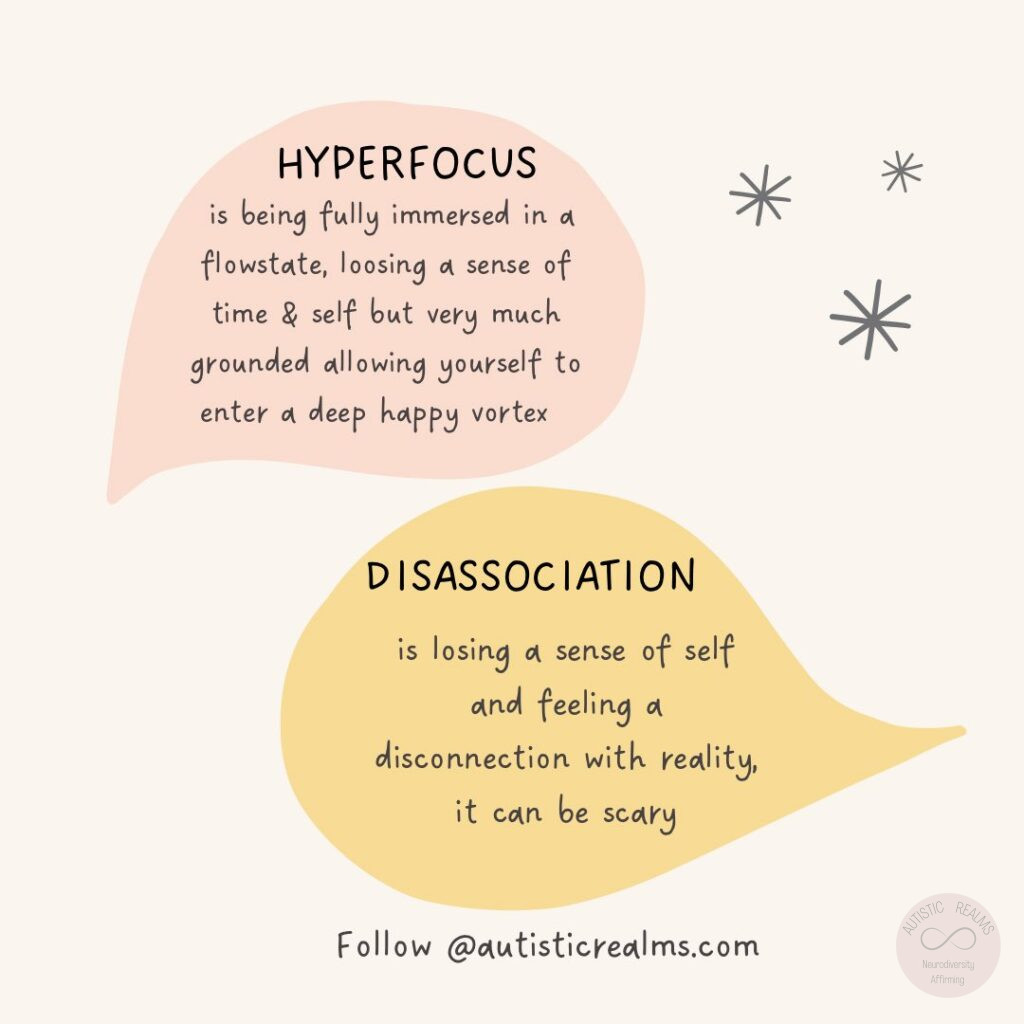
  • 2 speech bubbles: Text reads: HYPERFOCUS is being fully immersed in a flowstate, loosing a sense of time & self but very much grounded allowing yourself to enter a deep happy vortex DISASSOCIATION is losing a sense of self and feeling a disconnection with reality, it can be scary Follow@autisticrealms.com

    Hyperfocus vs Dissociation

    How hyperfocus (a grounded, happy flow state) differs from dissociation (disconnection from reality), though both can feel like losing time.

    Suggested donation: £1.00 (optional, pay what you can)
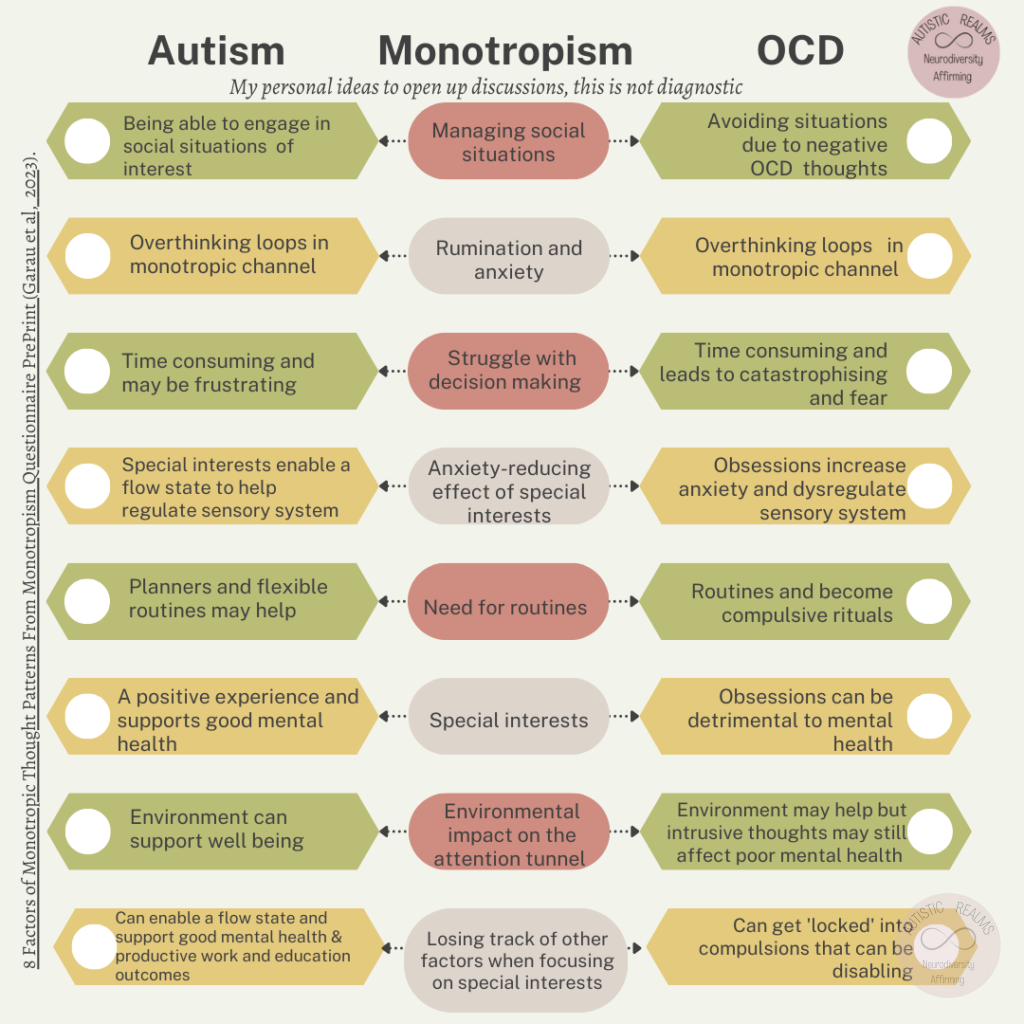
  • Chart of autism, monotropism and ocd intersection The following text will read left to right autism to monotropism to ocd concepts. 1. Being able to engage in social situations of interest. Managing social situations. Avoiding situations due to negative OCD thoughts 2. Overthinking loops in monotropic channel Rumination and anxiety. Overthinking loops in monotropic channel. 3. Time consuming and may be frustrating. Struggle with decision making. Time consuming and leads to catastrophising and fear. 4. Special interests enable a flow state to help regulate sensory system 4. Anxiety-reducing effect of special interests •Obsessions increase anxiety and dysregulate sensory system. 5. Planners and flexible routines may help. Need for routines. Routines and become compulsive rituals. 6. A positive experience and supports good mental health. Special interest. Obsessions can be detrimental to mental health. 7. Environment can support well being. Environmental impact on the attention tunnel. Environment may help but intrusive thoughts may still affect poor mental health. 8. Can enable a flow state and support good mental health & productive work and education outcomes. Losing track of other factors when focusing on special interests. Can get 'locked' into compulsions that can be disabling. My personal ideas to open up discussions, this is not diagnostic.

    Intersection OCD Autism and Monotropism

    A chart of where autism, monotropism and OCD intersect, my own ideas to open up discussion.

    £1.00
  • Image of a cycle diagram. Text reads: Monotropism & OCD. Stuck in a monotropic loop: obsessions, anxiety, compulsions, with doubt, seeking flow, safety and reassurance, temporary relief. Ideas to open conversations, not a medical or therapeutic model.

    Monotropism and OCD Loop

    A diagram of how monotropism and OCD can form a loop of obsessions, anxiety and compulsions, to open conversations.

    Suggested donation: £1.00 (optional, pay what you can)
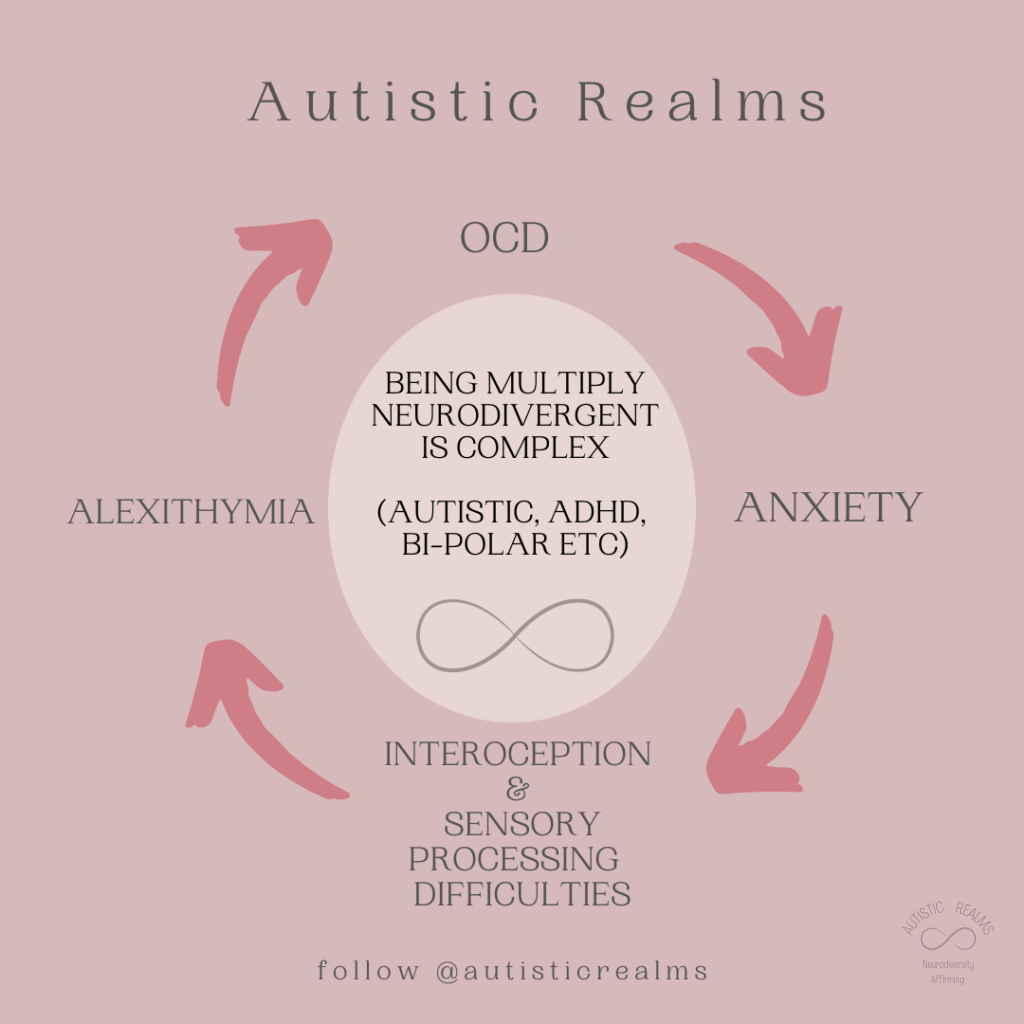
  • BEING MULTIPLY NEURODIVERGENT IS COMPLEX (AUTISTIC, ADHD, BI-POLAR ETC). Circle with text between each arrow going clockwise reading: 1. OCD 2. Anxiety 3. INTERCEPTION & SENSORY PROCESSING DIFFICULTIES 4. ALEXITHYMIA

    OCD Cycle – Multiply Neurodivergent

    Being multiply neurodivergent is complex: a cycle linking OCD, anxiety, interoception and sensory processing, and alexithymia.

    Suggested donation: £1.00 (optional, pay what you can)
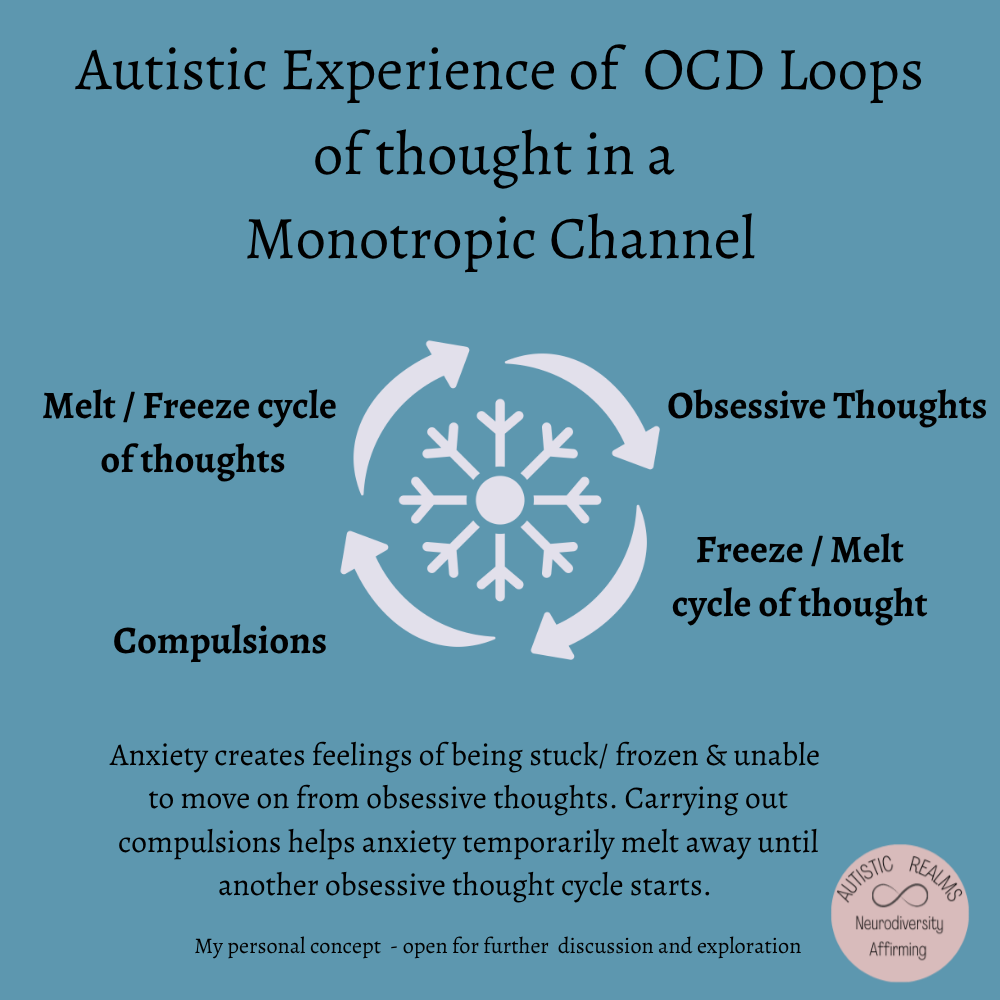
  • Image of a snowflake inside a circle of arrows on blue. Text reads: Autistic Experience of OCD Loops of thought in a Monotropic Channel. Obsessive thoughts, freeze and melt cycle, compulsions. Anxiety creates feelings of being stuck; compulsions let it melt away until the next cycle.

    OCD Loops and Freeze

    The melt and freeze cycle of OCD thought loops in a monotropic channel: my personal concept, open for discussion.

    Suggested donation: £1.00 (optional, pay what you can)
  • Image of a web of coloured circles around the word OCD. Text reads: Community Social Media Project August 2023. What single word would you use to describe OCD? Words include Scary, Frightening, Exhausting, Compelling, Hell, Torture, Cruel, Thief, Savage.

    OCD Mindmap of Words

    A word map from a community project asking people to describe OCD in a single word.

    Suggested donation: £1.00 (optional, pay what you can)
  • Image of a head in profile with a spiral and a padlock over the brain. Text reads: Autistic Realms. OCD. OCD can feel like you are locked inside your own head. Your thoughts may feel stuck. You may need support to move forwards.

    OCD Padlock in Mind

    OCD as a padlock in the mind, for when thoughts feel stuck and support can help you move forward.

    Suggested donation: £1.00 (optional, pay what you can)
  • Autistic and Living the Dream Autism & OCD Project Ocd poem. OCD Trapped in your own mind Scary, unyielding thoughts, Controlling everyday and stealing life, Leaving you feeling frightened, frustrated, exhausted and tortured. OCD so misunderstood, Restrictive, never ending and consuming Intrusive, agonizing thoughts, Living in a cruel nightmare. Hell. A poem created from words shared across the online community to describe OCD

    OCD Poem

    A poem about living with OCD, from the Autism and OCD community project with Autistic and Living the Dream.

    Suggested donation: £1.00 (optional, pay what you can)
  • Image of a smiling spoon and a frowning spoon. Text reads: Autistic Realms. Spoons are a way of representing energy (Miserandino, 2003). Autistic routines give spoons. OCD takes away spoons.

    Spoon Theory OCD

    A spoon theory graphic: Autistic routines can give spoons, while OCD can take them away.

    Suggested donation: £1.00 (optional, pay what you can)
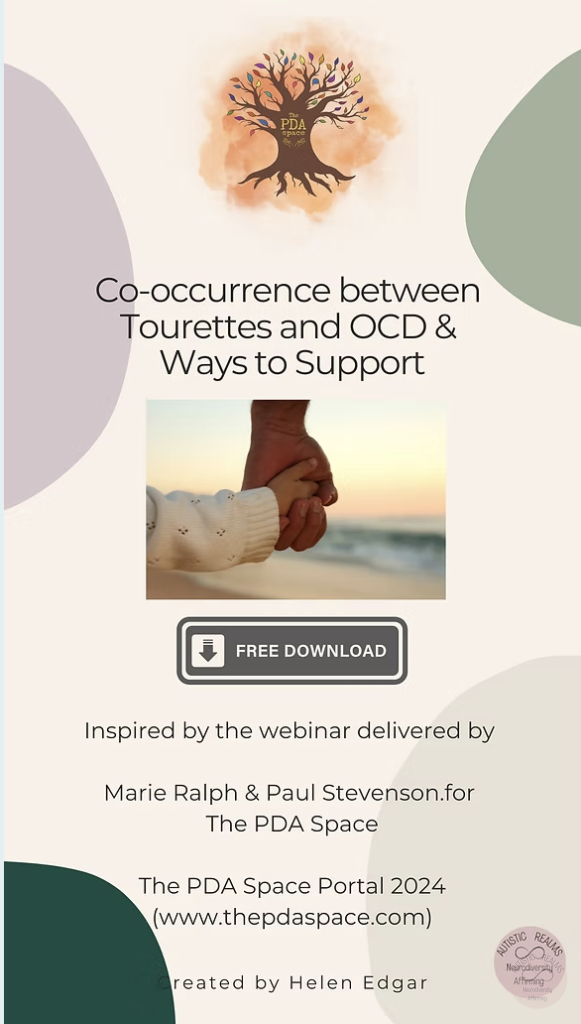
  • Embodiment Understanding OCD and Tourettes An e-book to support the webinar delivered by Marie Ralph & Paul Stevenson for The PDA Space May 2024

    Understanding OCD and Tourettes

    An e-book on the co-occurrence of Tourettes and OCD and ways to support, from a PDA Space webinar.

    Suggested donation: £0.00 (optional, pay what you can)

View My Best Sellers

Discover the resources that have resonated most with families, educators, and professionals. These popular items have helped many develop a deeper understanding of neurodivergent experiences.

WordPress Cookie Plugin by Real Cookie Banner