Tag: Neuroqueer
-

Awe, Wonder and Monotropic Attention in Neuroqueer Learning Spaces
If Helen De Cruz designed a learning space, what would it look like? Helen Edgar follows wonder and awe through monotropism, glimmers, flow and Cavendish Space.
-
Plain Language:
A plain-language guide to monotropism, wonder and awe — what happens when Autistic and ADHD attention is given space to notice, and stay
-
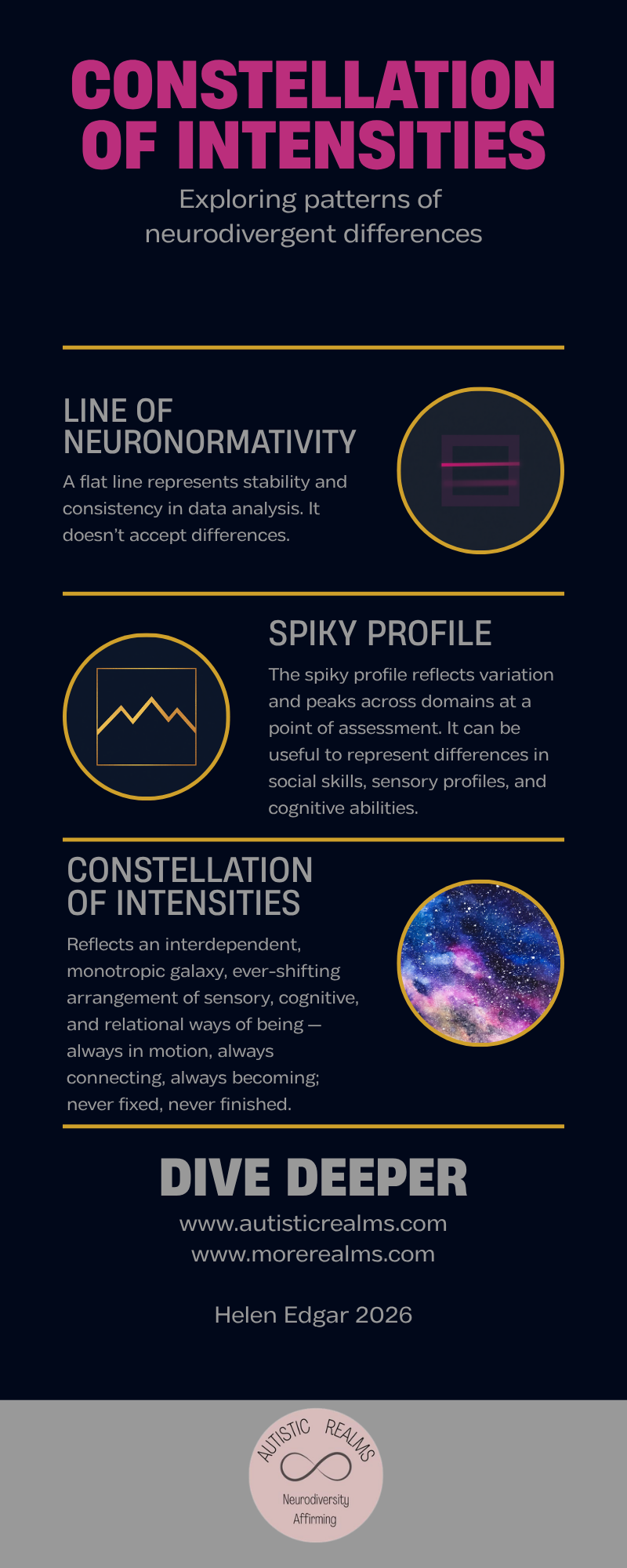
The Constellation of Intensities: Neuroqueering the Spiky Profile
Why even the “spiky profile” still measures us against a grid — and what a constellation of intensities offers instead.
-
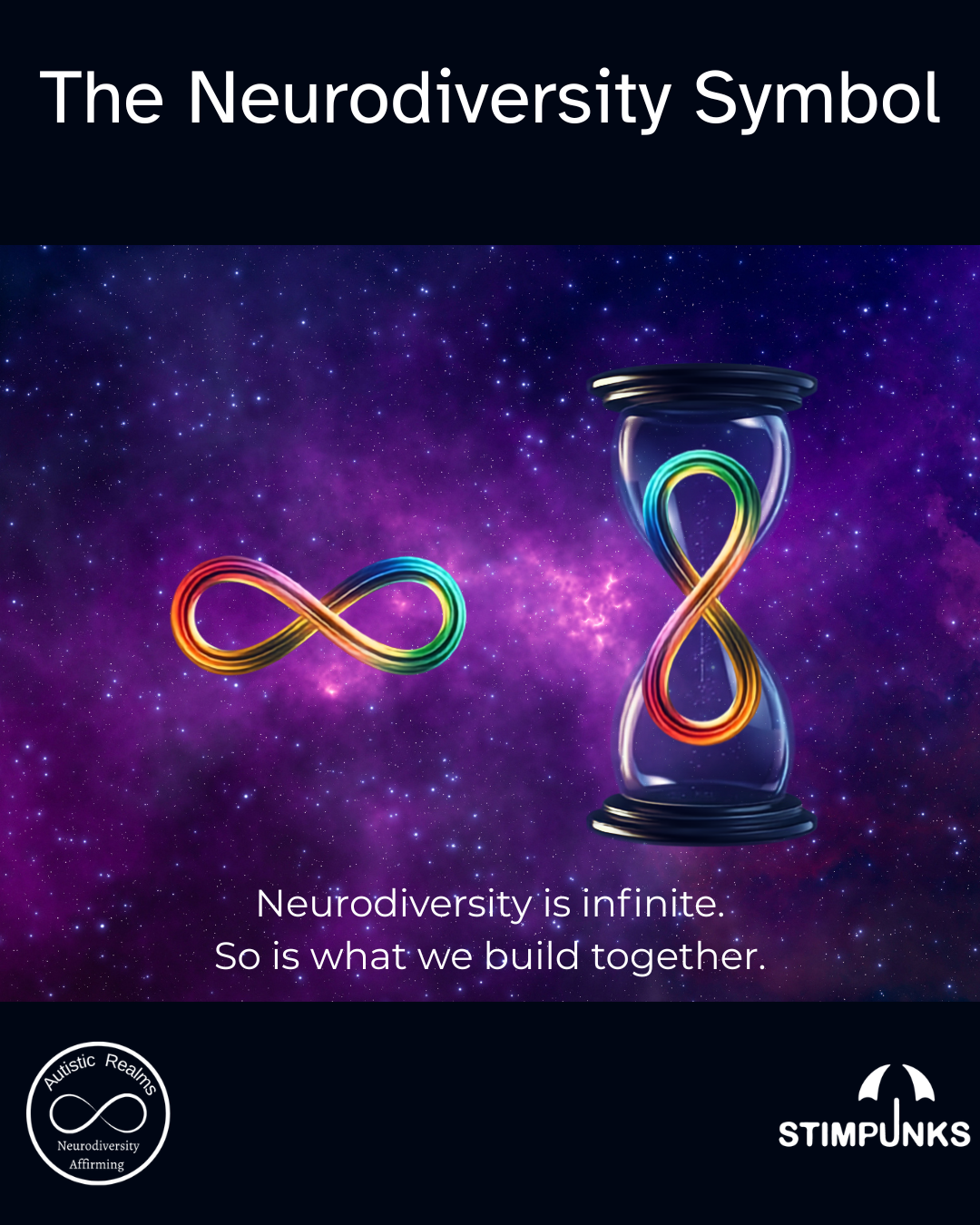
Neurodiversity Infinity Symbol: History, Time, and Collective Becoming
The neurodiversity infinity symbol has a story worth knowing. Rotate it and it becomes an hourglass holding time, community, and collective becoming.
-
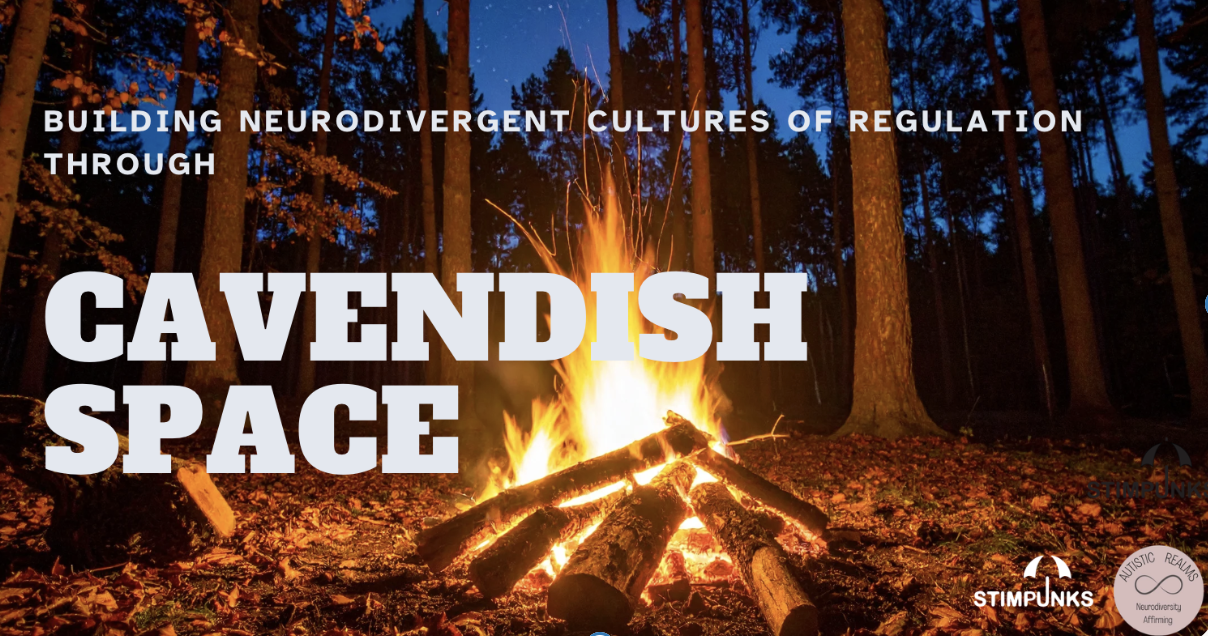
Building Neurodivergent-Affirming Cultures of Regulation: Reflections from a Cavendish Space Workshop
What does regulation really mean for neurodivergent people? Helen Edgar reflects on Cavendish Space, co-regulation, and building cultures where our nervous systems can thrive.
-
No Space Is Neutral: Safe Spaces, Imagined Neutrality, and the Work of Belonging
: No space is neutral. Exploring minority stress, the Double Empathy Problem, and what it really takes to build safer, neuroqueer spaces together.
-
What Would A Neuroqueer Pedagogy Be?
“What would a neuroqueer pedagogy be?” By Ombre Tarragnat (English translation with permission from Genre en Cours article Feb 2026)
-
Weird Pride in a Hostile World
Weird Pride is a practice of becoming. A refusal to shrink. A quiet, feral devotion to staying alive as ourselves in a world that keeps trying to make us something else.
-
The Autistic Rhizome: Community, Liminal Spaces & Belonging
Autistic belonging grows through community, from liminal spaces, not conformity.
-
Stimming as Embodied Sensory Language
Reframing stimming beyond “behaviour” as embodied sensory language, monotropic flow, and neuroqueer, interdependent connection with the world.
-
Join NeuroHub Community Space
Join me & David Gray-Hammond in our new community NeuroHub. Access to exclusive webinars, resources and space to connect with others! Hope to see some of you there!
-
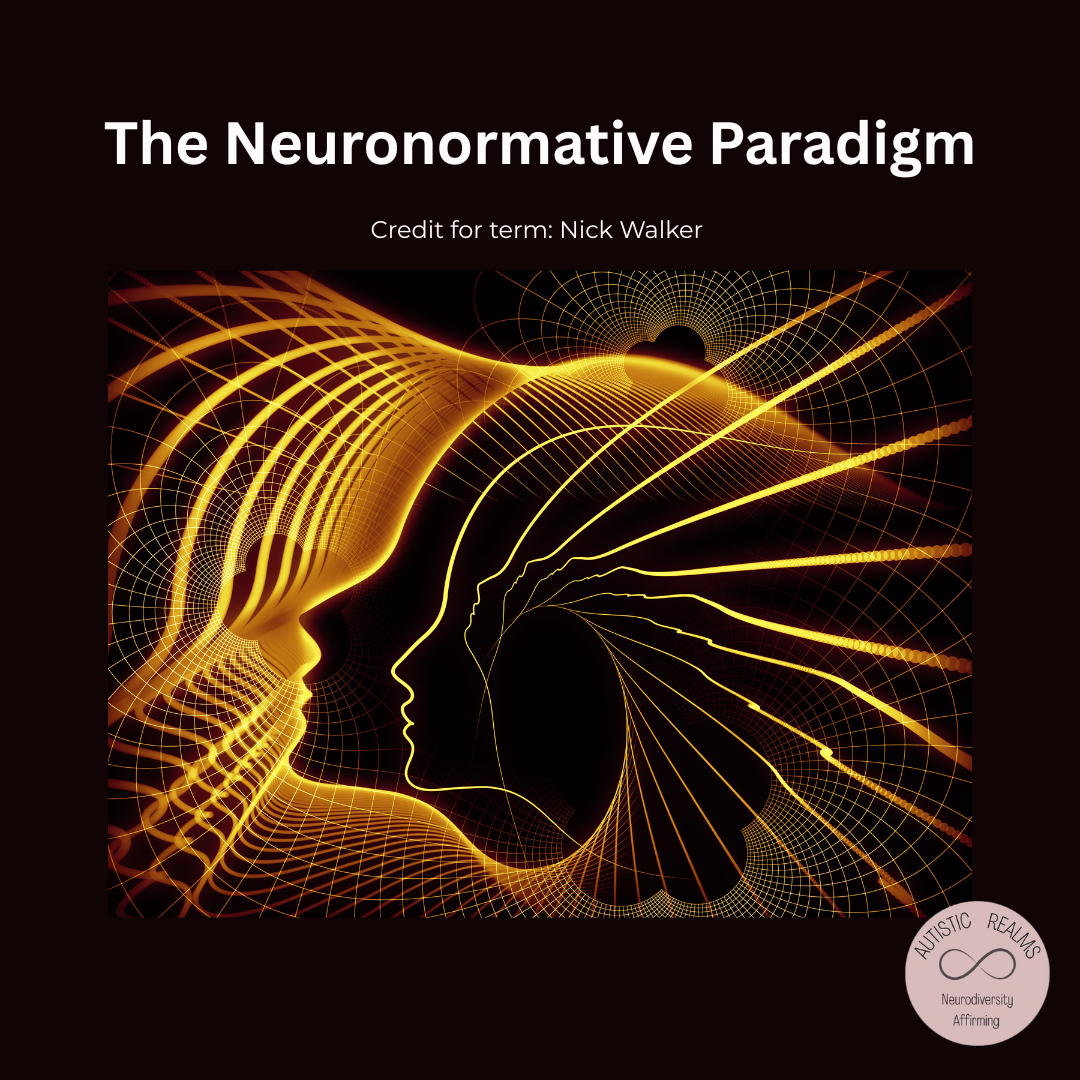
The Neuronormative Paradigm: Naming The Systems That Harm
The Neuronormative Paradigm, conceptualised by Nick Walker, names the systems that define and enforce what society considers normal. This exploration piece contrasts the neuronormative paradigm with the neurodiversity paradigm, which recognises all ways of being as vital to human diversity.
-
Beyond “Neurodiversity Lite”: Why Neurodiversity-Affirming Practice Matters
Explore the difference between true neurodiversity-affirming practice and “neurodiversity-lite,” and why justice, and lived experience matter.
-
From Autistic Realms to More Realms: Exploring Other Ways of Being
Journey from Autistic Realms into More Realms—where neuro-affirming support meets creative, sensory, and neuroqueer explorations of other ways of being.
-
Neuroqueer Learning Spaces: Free Training for Reimagining Education
Neuroqueer Learning Spaces: Free Training for Reimagining Education By Autistic Realms & Stimpunks Foundation
-
Ethodivergent Hearth Building: A Relational Neuroqueering Community Practice
Explore ethodivergent hearth building as a neuroqueer, relational practice of care, kinship, and more-than-human community with Autistic Realms & Stimpunks.
-
Awe, Wonder and Different Ways of Knowing: Cavendish Space and Helen De Cruz
Honouring the brilliant philosopher Helen De Cruz, whose work on wonder, thinking, and inclusion helped shape and inspire our Neuroqueer Learning Spaces and Cavendish Space. Her ideas continue to guide how we create space for divergent minds to thrive.
-
Mossy Minds & Monotropism
An exploration of moss and monotropic ways of being. An invitation to slow down, sink in, and reconnect through sensory depth and shared presence in liminal spaces.
-
Neurodiversity Affirming Reading Recommendations
Looking for neurodiversity-affirming reads? I’ve have a growing collection of books listed by autistic authors, advocates, and researchers. Perfect for parents, professionals, and curious minds alike. Explore stories that affirm, not fix. Neurodivergent voices centred. From education to identity, burnout to belonging.
-
Neuroqueering Monotropic Time: A short summary
Autistic/ADHD people are more likely to be monotropic and resonate with the theory of monotropism. Dinah Murray, Wenn Lawson, and Mike Lesser developed the theory of monotropism in the late 1990s. It is typically described as a neuro-affirming theory of Autism, but I think it is also a temporal mode. I am considering whether being…
-
Neuroqueering Time: Bergson, Deleuze, and Monotropism (an exploration)
Time as a double temporality problem, exploring interest gravity for monotropic people and flow as a temporal home…..
-
Monotropic Time – A Short Blog
Monotropic Time: A Different Rhythm If you are Autistic, ADHD, or AuDHD, time may not feel like a straight line, and you may feel you are constantly battling against the time on the clock. Your internal perception of time may feel more like a spiral, looping, stretching, expanding and contracting, sometimes speeding up and other…
-
Monotropic Time & Neuroqueering Temporalities
Monotropic Time & Neuroqueering Temporalities Dwelling in Resonance: Monotropism, Monotropic Time, Spirals & Neuroqueer Temporalities
-
Monotropic Time
Each person’s experience of time is likely to be influenced by culture, age, disability and neurodivergence. For Autistic/ADHD/AuDHD people, time is anything but linear or neutral and is not a universally accepted given.
-
What does ‘neuro-affirming’ mean for Autistic young people?
This blog was written by myself, Helen Edgar of @autisticrealms for GROVE. I am delighted to work with Grove Neurodivergent Mentoring and Education as their Training, Education & Resource Specialist. This blog was edited by Jess Garner, GROVE’sFounder/Director. The blog, ‘What does ‘neuro-affirming’ mean for Autistic young people?’ is available to read on GROVE’s website, along with many other resources and information…
-
Obstacles in the way of Neuro-Affirming Practice in Educational Settings & Ways Forward
Implementing neurodiversity-affirming practices in education, healthcare, and other systems is often hindered by pervasive narratives and biases. Recognizing and addressing these obstacles is crucial for fostering inclusive and supportive environments for neurodivergent and disabled individuals. Here are some common barriers that I have been working on with Stimpunks, who have a more in-depth page with…
-
Radical Resilience
Image of pink flower growing between gaps in pavement. Text:Wild flowers offer hope. Be radically resilient. Find possibilities in-between hard spaces. Be authentic and flourish in adversity. Transform the landscape. Be a wild flower.
-
Caverns, Pleats and Folds
Cartographers are people who create maps, and they transform physical geography into an accessible format so people can navigate in and through the spaces of the world. I recently watched a National Geographic documentary about caving ‘ Explorer: The Deepest Cave | Disney+ (disneyplus.com’). It led me to consider the underground maps inside the earth, the…
-
Neurodivergent Base-Camp
Explaining what it is like to be autistic to non-autistic people can be difficult. To quote Dawn Prince-Hughes (Cultural Autism Studies at Yale), being autistic is like “being human without the skin”. This can be difficult for non-autistic people to understand. Seeing and feeling the blank looks and Double Empathy Problem (Milton, 2012) at a…
-
Quantum Neuro-Holographic Thoughts from a Liminal Space
“Quantumness tends to prosper in very cold systems that are carefully isolated rather than part of a tepid soup awash with other activity.” (Lewton, T. 2024) This may be a weird take, but … I think we could use the idea of quantumness and reframe it around an interpretation of marginalised groups living on the edges of…
-
Neuro-Holographic Thoughts
I believe that the DEEP (Double Empathy Extreme Problem) is at the heart of all the systemic ableist issues we have in our education, social and healthcare systems. The lack of an embodied presence and connection between people being together as humans is causing harm. It is leaving marginalised people further on the edges and…
-
Neuroqueering in the Liminal Spaces
Neuroqueering in Liminal Spaces “By silencing our bodyminds, they (neurotypical society) have halted the growth of a chaotic self. We are no longer able to move fluidly through our experience, instead frozen like ice on an arctic tundra” (Gray-Hammond, 2023) David Gray-Hammond (Emergent Divergence) and I are responding to each other’s blogs to help expand the…
-
The Double Empathy Problem is DEEP
“The growing cracks in the thin veneer of our “civilised” economic and social operating model are impossible to ignore”, Jorn Bettin (2021). The double empathy problem (Milton, 2012) creates a gap of disconnect experienced between people due to misunderstood shared lived experiences. It is “a breakdown in reciprocity and mutual understanding that can happen between people…
-
Monotropism, Holotropism & Floatation Experiences
I am autistic and monotropic, and I am interested in exploring Helen Mirra’s theory of holotropism (2023) and how this may impact flow states and regulation. Holotropism synthesises the theory of monotropism (Murray, 2005) with deep ecology and holistic anatomy. Holotropism is a: “multi-dimensional, spacious, edgeless terrain under the monotropism map…To be holotropic is to have…
-
Neuroqueer Collaborative Work Flow Spaces
A behind-the-scenes look into the collaborative workflow between Helen Edgar (Autistic Realms) and Ryan Boren (Stimpunks) as we write about Neuroqueer Learning Spaces (NQLS) and continue our neuroqueering journeys, connecting with awe-inspiring people and discovering new ideas to explore along the way. Liminal Spaces Ryan Boren (Stimpunks) and I are neuroqueering ourselves and the spaces we…
-
Neuroqueer Learning Spaces — Webinar — a summary and reflection 6th May 2024
Neuroqueer Learning Spaces Webinar — A summary and reflection Neuroqueer Learning Spaces is a community project led by Ryan Boren (Stimpunks) and Helen Edgar (Autistic Realms). More information is available on Stimpunks’ website. To support this project and open up further discussions about neuroqueering education and learning spaces, David Gray-Hammond hosted a live webinar, “Explore Neuroqueer Learning…
-
Middle Entrance
I am starting my new blog in the middle. I am in the middle of what is known as ‘midlife’ as I am forty-five; I am also mid-career, having resigned from teaching and not yet working in any other defined role. I also live much of my life in and between the online (primarily neurodivergent)…
-
Autism is fluid
Updated October 2026. “Being Autistic” is one of the searches that brings most people here, so a word on where this post sits now. It is a short statement of the neurodiversity paradigm: autism is a way of being, not a disorder to fix, and Autistic needs are fluid. If you want the vocabulary behind…