
Stimming is the bodymind’s embodied sensory language — rhythmic movement, sound, or touch that supports regulation and expression. It enables flow and interdependent connection between Autistic people, other beings, and the sensory worlds we are all part of.
From “Behaviour” To An Embodied Sensory Language
I volunteer as co-creative director with Stimpunks. Our team have been revisiting the Stimpunks front page and we’ve been reflecting on what meaning our name really holds. The word Stimpunk — a weaving of stimming and punk — speaks to a collective refusal of neuronormative expectations of ways of being.
Stimming is often framed as a “behaviour”, a term rooted in frameworks that look at people from the outside. Stimming becomes a list of observable actions and often something to be managed or eradicated rather than something a person is expressing, feeling, thinking, or becoming.
For Autistic people, stimming is not just a behaviour or even a regulatory tool for partial improvement. Stimming is an entangled expression that emerges from inbetween our relationships and environment. From within our Autistic experiences stimming could be understood to be more about:
- embodied communication
- sensory language
- attentional rhythm
- affective movement
- relational attunement
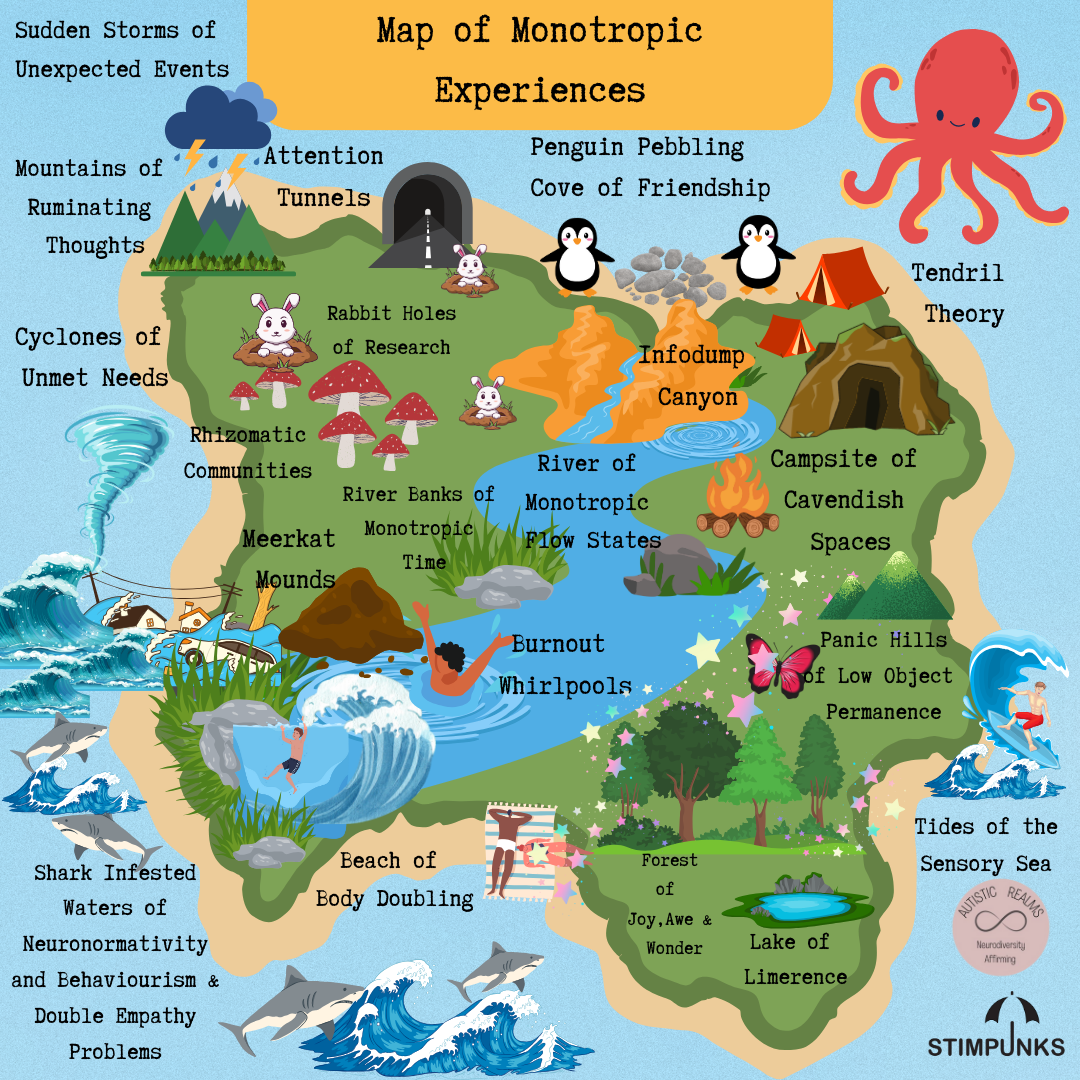
- monotropic flow made visible
Only thinking of stimming as a form of “behaviour” flattens our inner lived experience, the meaning, intention, and joy it can bring for many of us as Autistic people. It invites a deficit framing that asks, “What needs to be changed about this person? What’s appropriate? What’s excessive?” rather than encouraging curiosity about “What is being expressed? What is being co-created through relationships and environments?”
Recognising this difference can transform how Autistic people are understood and accepted. It opens space not only to challenge deficit framings, but also to move beyond a purely neuro-affirmative stance that sees stimming simply as a coping or regulation strategy. Stimming can instead be understood as an embodied, neuroqueer act that unsettles narrow ideas of what counts as valid communication, attention, regulation, and relational presence. In this way, stimming becomes a form of sensory resistance and world-making, queering dominant expectations about how our bodiyminds can move, feel, and relate.
Stimming As Sensory Language And Flow
Stimpunks’ glossary notes that stimming — traditionally defined as “the repetition of physical movements, sounds, or words, or the repetitive movement of objects” — engages multiple senses and serves multiple purposes, including self-regulation, sensory seeking, and expression.
Stimming supports regulation, and it also invites us into monotropic flow, where sensation, thought, emotion, environment, and relationships entangle and move together.
When an Autistic person rocks, hums, paces, taps, or spins, we are not only organising sensory input; we are speaking through sensation. We are engaging in forms of expression that emerge from the in-between of our relationships with others and with our environments. Our rhythms can hold attention, our repetition can stabilise perception, and our movements can anchor our bodies and thoughts in a world that is often intense, fast, and unpredictable.
Stimming Relational And Interdependent
Stimming is a relational practice that unfolds not only between people, but in the in-between of self, others, and environment. It is not something that happens solely inside an individual bodymind, but something that emerges through interdependent, constantly fluctuating sensory, emotional, and attentional engagement with the world around us.
“Interdependence acknowledges that our survival is bound up together, that we are interconnected and what you do impacts others. Interdependence is the only way out of most of the most pressing issues we face today.” (Leaving Evidence, 2022)
This frame shifts us beyond seeing stimming as something internal that needs containment, and beyond a purely neuro-affirming stance that focuses only on individual acceptance. It invites us to recognise stimming as part of a wider relational field, where regulation, expression, and connection are co-created through relationships and environments. Bodies do not regulate alone; they regulate in connection — with people, with spaces, with rhythms, with sensory conditions that either support or strain our capacity to stay in flow.
Suppressing or masking stimming disrupts this whole sensory ecology: the processes through which grounding, coherence, expression, and relational safety are sustained. The cost of that disruption can be high, often contributing to exhaustion, disconnection, and burnout.
We need spaces that are welcoming, connected, and built around supporting one another. This means creating environments where different ways of moving, communicating, and regulating are expected and accepted, not treated as a problem. We need to make room for different rhythms, movements, choices, and sensory comfort so people can belong as they are. In these kinds of spaces, stimming is not something to be controlled or hidden, but a natural and important way for people to stay grounded, express themselves, and connect with others and the world around them.
Stimming An Act Of Neuroqueering
When we understand stimming as embodied sensory language, we can begin to recognise it not as something to be reduced, corrected, or hidden, but as a valid way of expressing, knowing, and relating. Stimming is not a behaviour to be shaped; it is an embodied sensory language to be heard. It is the way the bodymind learns with and through the environments and relationships it inhabits.
In this way, stimming can be seen as an act of neuroqueering and relationally interdependent — a practice that invites connection with others, with space, with rhythm and flow. When we tune in to stimming as a language of embodied expression, we can create environments and relationships that embrace our different ways of being. We make room not just for tolerance, but for flourishing, where Autistic bodyminds and our sensory languages are welcomed, understood, and honoured in the world.
More Information & Resources:
Metz, S. (2024). Stimming as a Form of Autistic Aesthetic Experience,
Neuroqueering Landscape. Ought Journal.
Houghton, D. (2025, December 16). Neuroqueer: The Journey to Embodied Authenticity — Serenity Somatic practice. Serenity Somatic Practice. https://www.serenitysomaticpractice.org/embodiedmusings/neuroqueer-the-journey-to-embodied-authenticity
Sparrow, M. (2021, February 12). Stimming: What it is and why Autistic people do it. NeuroClastic.
https://neuroclastic.com/stimming-what-it-is-and-why-autistic-people-do-it/
Kapp, S. K., Steward, R., Crane, L., Elliott, D., Elphick, C., Pellicano, E., & Russell, G. (2019). ‘People should be allowed to do what they like’: Autistic adults’ views and experiences of stimming. Autism, 23(7), 1782–1792. https://doi.org/10.1177/1362361319829628https://journals.sagepub.com/doi/full/10.1177/1362361319829628
Therapist Neurodiversity Collective Inc.®. (2025, February 11). Autistic Stimming: Neurobiological Insight for Understanding & Support – Neurodiversity training. Neurodiversity Training.
https://neurodiversity-training.therapistndc.org/product/autistic-stimming/
@DisorderingDance, “Uncontained: Stimming and Neurodiversity’, presenting a paper, ‘Introducing Stimprovisation”. Critical Neurodiversity Studies Conference, Durham Uni, June 2025.
https://www.instagram.com/p/DLF58mhIb_r/?utm_source=ig_web_copy_link&igsh=NTc4MTIwNjQ2YQ==