A vibrant, multicoloured background made of swirling smoke in green, blue, purple, and pink. In the centre, large bold text reads “NeuroHub” in a rainbow gradient with a red outline. Beneath it, smaller pastel text says “Connect Divergently.” At the bottom are two logos: one circular logo with an infinity symbol and the words “Autistic Realms – Neurodiversity Affirming,” and another butterfly-shaped logo for a neurodivergent consultancy, accompanied by a badge noting “National Diversity Awards 2025 Finalist.

Join NeuroHub Community Space

A Collaborative Community for Exploring Neurodiversity

NeuroHub is David Gray-Hammond’s new membership community that I am delighted to be supporting.

It is built for people who want more than surface-level conversations about neurodiversity. It’s a space for the thinkers, the feelers, the explorers; anyone who wants to understand the shifting, living landscape of their own neurodivergence while being held in a community that values curiosity over conformity.


A vibrant, multicoloured background made of swirling smoke in green, blue, purple, and pink. In the centre, large bold text reads “NeuroHub” in a rainbow gradient with a red outline. Beneath it, smaller pastel text says “Connect Divergently.” At the bottom are two logos: one circular logo with an infinity symbol and the words “Autistic Realms – Neurodiversity Affirming,” and another butterfly-shaped logo for a neurodivergent consultancy, accompanied by a badge noting “National Diversity Awards 2025 Finalist.

Hosted at neurohub.blog, this is a sanctuary from the noise, a place where we can slow down together and trace meaning through the tangled roots of our experiences. NeuroHub gives us room to ask the questions that don’t fit neatly into diagnostic boxes, to unpick neuronormative assumptions, and to co-create new ways of understanding ourselves and one another.

There is already a wide range of topics being discussed, including parenting and caregiver roles, co-occurring physical and mental health difficulties, discussions on recent Autism research, exploring neuroqueer theory, and more……..


A Home for Deep Exploration


Inside NeuroHub, you’ll find a growing archive of talks, videos, recordings, and long-form content, material that is usually paywalled on other platforms.

Members get unlimited access, allowing us to build a shared body of knowledge that isn’t fenced off, all available for one subscription (with options to pay as you go for those who don’t want to commit but would like to join in things like our weekly peer support group meet-ups).

Subscriptions start at £10 per month and include lots of exclusive events and resources,

NeuroHub is, at its core, a community. A relational environment and a place to put our lived experiences into dialogue, to compare notes on being human in a world that often misunderstands us, and to craft new pathways for wellbeing, solidarity, and personal meaning.

We have a weekly peer support drop-in space, upcoming reading group and various training and lots of free resources and e-books!

Banner with flowing, smoke-like colours blending green, yellow, blue, and purple across the background. Large bold text in the centre reads “NeuroHub” in a rainbow gradient, with smaller text underneath reading “Peer Support Session.” A circular logo appears on the left and a butterfly-style logo on the right.


Collaborating Across Realms


A lovely message from David:

I am delighted to share that Helen Edgar from Autistic Realms will be joining NeuroHub as an affiliate collaborator.

Anyone familiar with Helen’s work knows her ability to weave worlds, pulling together imagination, insight, and an Autistic sensibility that sees the connective tissue between all things.

Her involvement brings new texture to NeuroHub; more perspectives, more creativity, and more room for the multiplicity of Autistic and otherwise neurodivergent experiences to be honoured and explored


Why NeuroHub?


Because the neurodiversity paradigm is evolving, and so are we.

Because too many conversations are shaped by people who have never lived the realities we write and speak about every day.

Because community is powerful, not in a hierarchical, top-down way, but in the rhizomatic sense: spreading sideways, exchanging nutrients, forming networks of support that don’t rely on one central authority.

Because understanding ourselves is easier when we do it together.


Join Us


NeuroHub is open now at neurohub.blog

Membership provides:

• Access to exclusive videos, talks, and recordings
• Weekly peer-support drop-in space
• An accessible community space to explore the meaning of neurodiversity and neuroqueer theory
• Collaborative content with trusted partners
• Upcoming reading groups and more!

A community space shaped by neurodivergent thinking, for neurodivergent people.

If you’re looking for a place to deepen your knowledge, connect with others, and take part in a living, evolving conversation about neurodiversity, NeuroHub may be that place.

There are already over 100 members!

Hope to see some of you there!

A screenshot of a purple-themed community platform called “NeuroHub.” At the top is a colorful banner with swirling green, purple, and blue smoke patterns, the DGH Neurodivergent Consultancy logo, and the text “NeuroHub.” Below the banner, the sidebar menu shows categories including Social, Neurodiversity Forum, and Mindfully Divergent. Under Social are channels labelled intros, announcements, questions, Instant Chat, General Posting, and Voice Chat. Under Neurodiversity Forum are Neurodiversity Live Chat and Neurodiversity Theory. The interface uses emoji icons beside each channel name.
A screenshot of the NeuroHub platform with a purple background. At the top is a banner featuring the DGH Neurodivergent Consultancy logo and colourful swirling smoke in green, purple, and blue, alongside the text “NeuroHub.” Below the banner, the sidebar menu lists options with icons: Feed, Webinars, Resources, Events, and Directory. The NeuroHub title appears in bold black text above the menu.

“Community is magic. 
Community is power.  
Community is resistance.”

Alice Wong
1974 – 2025
Circle with Neurohub logo on it and rainbow infinity symbol. Text reads: Affiliate Neurohub Connect Divergently

Latest Posts

  • Autistic Burnout – Supporting Young People At Home & School

    Autistic Burnout – Supporting Young People At Home & School

    Autistic burnout in young people is real—and recovery starts with understanding. This post offers neuroaffirming ways to spot the signs, reduce demands, and truly support. 💛 #AutisticBurnout #Neuroaffirming #Monotropism #AutisticSupport


  • Monotropic Interests and Looping Thoughts

    Monotropic Interests and Looping Thoughts

    The theory of monotropism was developed by Murray, Lawson and Lesser in their article, Attention, monotropism and the diagnostic criteria for autism (2005). ​ Monotropism is increasingly considered to be the underlying principle behind autism and is becoming more widely recognised, especially within autistic and neurodivergent communities. Fergus Murray, in their article Me and Monotropism:…


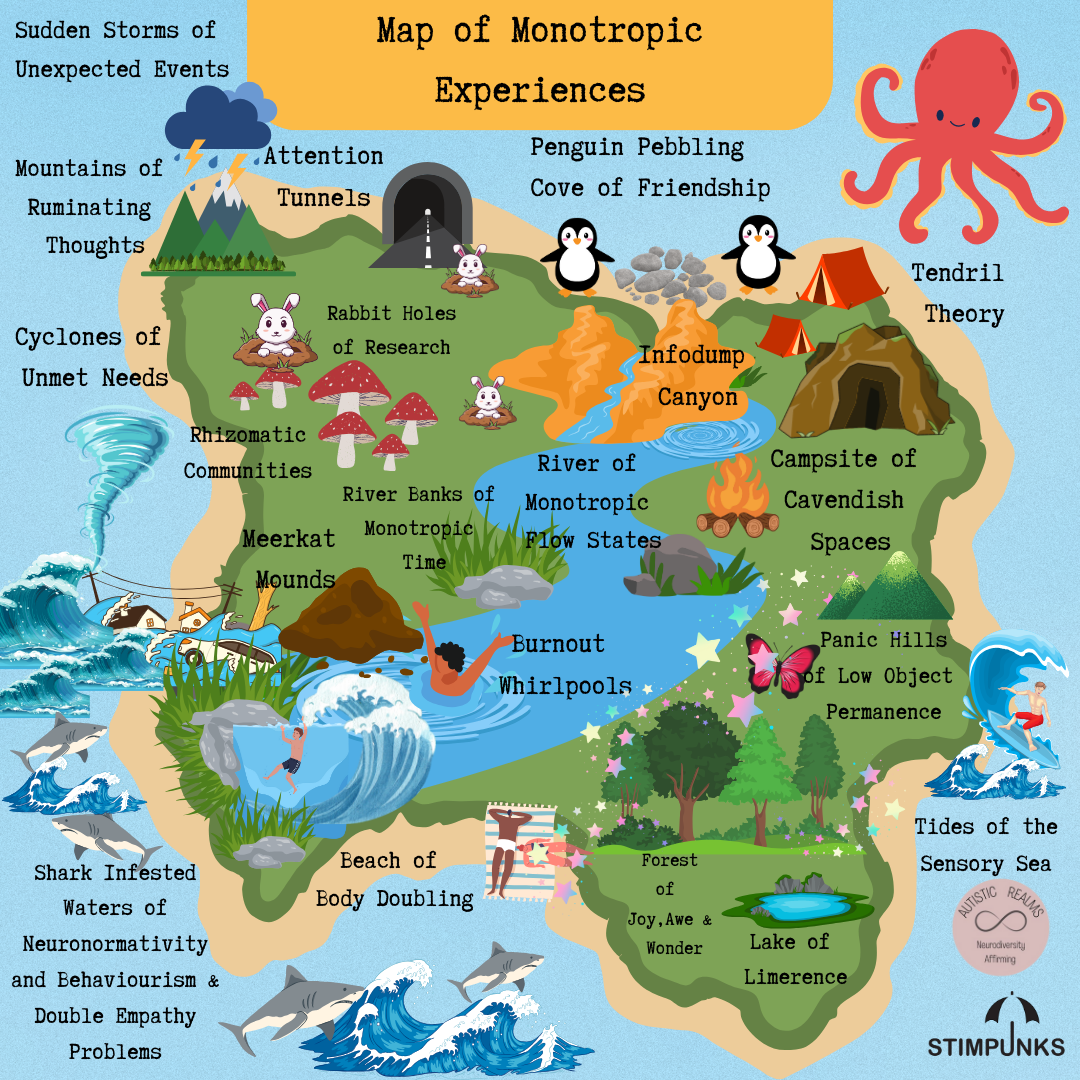
  • Map of Monotropic Experiences

    Map of Monotropic Experiences

    Monotropism seeks to explain Autism in terms of attention distribution and interests.  OSF Preprints | Development and Validation of a Novel Self-Report Measure of Monotropism in Autistic and Non-Autistic People: The Monotropism Questionnaire This map highlights 20 common aspects of my personal monotropic experiences. How many do you experience? Where are you on the map…


  • Autistic Burnout – Supporting Young People At Home & School

    Autistic Burnout – Supporting Young People At Home & School

    Being autistic is not an illness or a disorder in itself, but being autistic can have an impact on a person’s mental and physical health. This is due to the often unmet needs of living in a world that is generally designed for the well-being of people who are not autistic. In addition, three-quarters of…


  • The Double Empathy Problem is DEEP

    The Double Empathy Problem is DEEP

    “The growing cracks in the thin veneer of our “civilised” economic and social operating model are impossible to ignore”, Jorn Bettin (2021). The double empathy problem (Milton, 2012) creates a gap of disconnect experienced between people due to misunderstood shared lived experiences. It is “a breakdown in reciprocity and mutual understanding that can happen between people…


  • Top 5 Neurodivergent-Informed Strategies

    Top 5 Neurodivergent-Informed Strategies

    Top 5 Neurodivergent-Informed Strategies By Helen Edgar, Autistic Realms, June 2024. 1. Be Kind Take time to listen and be with people in meaningful ways to help bridge the Double Empathy Problem (Milton, 2012). Be embodied and listen not only to people’s words but also to their bodies and sensory systems. Be responsive to people’s…


  • Autistic Community: Connections and Becoming

    Autistic Community: Connections and Becoming

    Everyone seeks connection in some way or another. Connections may look different for autistic people. In line with the motto from Anna Freud’s National Autism Trainer Programme (Acceptance, Belonging and Connection), creating a sense of acceptance and belonging is likely to be more meaningful for autistic people than putting pressure on them to try and…


  • Monotropism, Autism & OCD

    Monotropism, Autism & OCD

    This blog has been inspired by Dr Jeremy Shuman’s (PsyD) presentation, ‘Neurodiversity-Affirming OCD Care‘ (August 2023), available here. Exploring similarities and differences between Autistic and OCD monotropic flow states. Can attention tunnels freeze, and thoughts get stuck? Autism research is shifting; many people are moving away from the medical deficit model and seeing the value…


  • Monotropism Questionnaire & Inner Autistic/ADHD Experiences

    Monotropism Questionnaire & Inner Autistic/ADHD Experiences

     Post first published 28th July 2023 Over the past few weeks, there has been a sudden surge of interest in the Monotropism Questionnaire (MQ), pre-print released in June 2023 in the research paper ‘Development and Validation of a Novel Self-Report Measure of Monotropism in Autistic and Non-Autistic People: The Monotropism Questionnaire.‘ by Garau, V., Murray,…


  • Penguin Pebbling: An Autistic Love Language

    Penguin Pebbling: An Autistic Love Language

    Penguin Pebbling is a neurodivergent way of showing you care, like sharing a meme or twig or pretty stone to say “I’m thinking of you,” inspired by penguins who gift pebbles to those they care about.


  • Embracing Our Autistic Selves Course

    Embracing Our Autistic Selves Course

    Autistic RealmsHelen Edgar Autistic Advocate, Author & ConsultantNeurodiversity-Affirming Supporting Autistic People To Grow & Thrive Welcome to Autistic Realms Newsletter! Happy New Year! I am delighted to be facilitating a new course ‘Embracing our Autistic Selves’ delivered by David Gray-Hammond starting Jan 7th 2026. Embracing Our Autistic Selves is a three-week online experience (via Zoom)…


  • End of Year Reflections & Invitation to NeuroHub

    End of Year Reflections & Invitation to NeuroHub

    Autistic RealmsHelen Edgar Autistic Advocate, Author & ConsultantNeurodiversity-Affirming Supporting Autistic People To Grow & Thrive Welcome to Autistic Realms Newsletter! Dear friends and community, As the year draws to a close, I wanted to say a heartfelt thank you for all your support. It has been such a gift to be part of a growing,…


  • Free 2025 Advent Calendar & Neuro-Affirming Autism Resources

    Free 2025 Advent Calendar & Neuro-Affirming Autism Resources

    Free 2025 Advent Calendar & Neuro-Affirming Autism Resources


WordPress Cookie Plugin by Real Cookie Banner