By Ombre Tarragnat, February 2026
Original article in French : https://genre-en-cours.education/b8e876ff-2365-498d-a024-e971e82af0fd/
Genre en Cours is an initiative led by the Philomel initiative of the Faculty of Arts at Sorbonne University and supported by CERES.
Translated by Helen Edgar and Ombre Tarragnat with permission from Genre en Cours (March 2026)
Neurodiversity, Neurodivergence, Neuroqueer
The concept of neurodiversity emerged in the 1990s within the Independent Living community, an international online space initially formed primarily by Autistic people. Inspired by the notion of biodiversity and by different forms of social diversity (sexual, ethnic, cultural, etc.), it refers to the diversity of neurocognitive functioning — and therefore, by extension, to diverse affective, behavioural, and existential styles.
In 2000, activist Kassiane Asasumasu coined the concept of neurodivergence to designate minoritised modes of neurocognitive functioning, such as autism, attention deficit hyperactivity disorder (ADHD), learning differences (dyslexia, dyscalculia, dyspraxia, dysorthographia), Down syndrome, epilepsy, personality differences (borderline, bipolar, etc.), and other psychiatric-labelled ways of functioning such as depression or post-traumatic stress.
The neurodiversity movement advocates for equal rights for neurodivergent people, as well as for their full participation in all areas of society. It opposes what it has termed the pathology paradigm, which views neurodivergences as individual disorders that should be treated through psychotherapy, or even “cured” or eradicated through biomedicine. This neuronormative paradigm is challenged by the neurodiversity paradigm, which maintains that neurodivergences are normal and potentially desirable variations. Conversely, so-called “neurotypical” people are not more “normal” than neurodivergent people, but are simply privileged by an arbitrary norm that can therefore be deconstructed. This shift in perspective is political: it shows that social and normative environments construct certain life trajectories as deviant, and that social spaces must be made more liveable for everyone.
More recently, the concept of “neuroqueer” — itself developed collectively — has made it possible to describe and support the lives of people who are both queer and neurodivergent.
More broadly, neuroqueer theory seeks to describe and resist the intersecting effects of neuronormativity and cis-heteronormativity. Neuroqueer rhetorician M. Remi Yergeau, for example, has examined the historical entanglement between queerphobia and autistiphobia in the behavioural sciences and neuroscience. The recent development of a neurotrans perspective has also highlighted the simultaneous emergence of gender conversion therapies and conversion therapies aimed at Autistic children, both based on applied behaviour analysis. Like gender conversion therapies, this behavioural reprogramming method does not “cure” the individual; it simply teaches them to camouflage their Autistic traits and to perform expected behaviours.
At a time of resurgent fascism in the West, anti-trans movements increasingly instrumentalise neurodivergent people (particularly Autistic people) to justify bans on gender-affirming care for minors. Similarly, in the French context, long-dominant psychoanalytic discourses continue to shape public attitudes by suggesting parental responsibility — especially maternal responsibility — for children’s autism. Neuroqueer and neurotrans perspectives play a decisive role in dismantling cis-heterosexist prejudices linked to neurodivergence.
Towards Transformative Somatic Practices
Autistic trans theorist Nick Walker draws on minoritised perspectives in psychology — such as humanistic, somatic, and transformative psychology — to inform neuroqueer theory.
These approaches contextualise neurodivergent behaviours within social environments and lived experience. They aim to challenge neuronormative principles that still shape the treatment of neurodivergent people today by individualising and pathologising their lives. Neuroqueer theory therefore seeks to transform dominant social structures.
Through their teaching practice in aikido, Walker has explored “transformative somatic practices” that allow neurodivergent people to express their embodiment without resorting to camouflaging their neurodivergent traits or other defensive mechanisms. Since accessibility demands from disability movements often benefit the wider population, these practices carry ambitions that go beyond narrow disability accommodations. In this context, while the neuroqueer approach seeks to deconstruct neuronormativity, it does not do so in an identity-exclusive way: the neuroqueer movement is not the prerogative of neuroqueer-identified individuals, and no diagnosis is required to claim it. On the contrary, anyone can engage in a process of neuroqueering.
Neuroqueer theory foregrounds different ways of being a “body-mind” (a concept disability studies borrowed from somatic psychology). This is not about abstractly celebrating diversity — a notion often co-opted by neoliberal capitalism — but about challenging the primacy of a single universal neurocognitive norm. In this sense, Walker invites us to explore the queer potential of “weirdness”: by embodying neurominoritised somatic practices, we help decentre the norm and reduce hierarchies of neurocognitive functioning.
Neuroqueering Learning Spaces
Autistic authors and activists Helen Edgar and Ryan Boren have applied the neuroqueer approach to pedagogy by examining learning environments. Drawing on the logic of queer thinking — the subversion of dominant norms and the proliferation of alternatives — rather than solely on its traditional object (sexual dissidence), they explain that:
“The contemporary classroom is a temple of neuronormativity. Every act in the struggle for the right to learn differently can be an act of neuroqueering […]. We suggest that learning spaces need to be fundamentally neuroqueer, enabling ‘freedom of embodiment’ and ‘cognitive freedom’. We need learning facilitators who are capable of ‘holding space’ so that children’s body-minds are allowed to live and learn authentically.” (Boren & Edgar, 2024)
On this basis, Boren and Edgar propose dismantling the uniformity of existing pedagogical spaces, which are accessible only to a minority of learners, whether neurotypical or neurodivergent. Beginning from the diversity of attention styles, memory processes, communication modes, as well as psychological and somatic needs, they invite us to re-centre the body in teaching practices. Reintroducing movement into the classroom helps normalise stimming (self-regulatory movements used to manage emotions, sensory input, or energy), tics, stretching, and other somatic practices that are integral to learning for many people.
Similarly, attention to sensory experience contributes to making learning spaces more accessible. In educational contexts, where access friction — the existence of incompatible needs — is common, sensory hypersensitivities can conflict with sensory-seeking behaviours (such as rocking on a chair, using fidget tools, tapping feet, chewing pens, or drumming on surfaces). Rather than relying solely on individual strategies (noise-cancelling headphones, sunglasses, etc.), a neuroqueer perspective encourages structural solutions, such as creating multiple spaces and uses within (and beyond) the classroom.
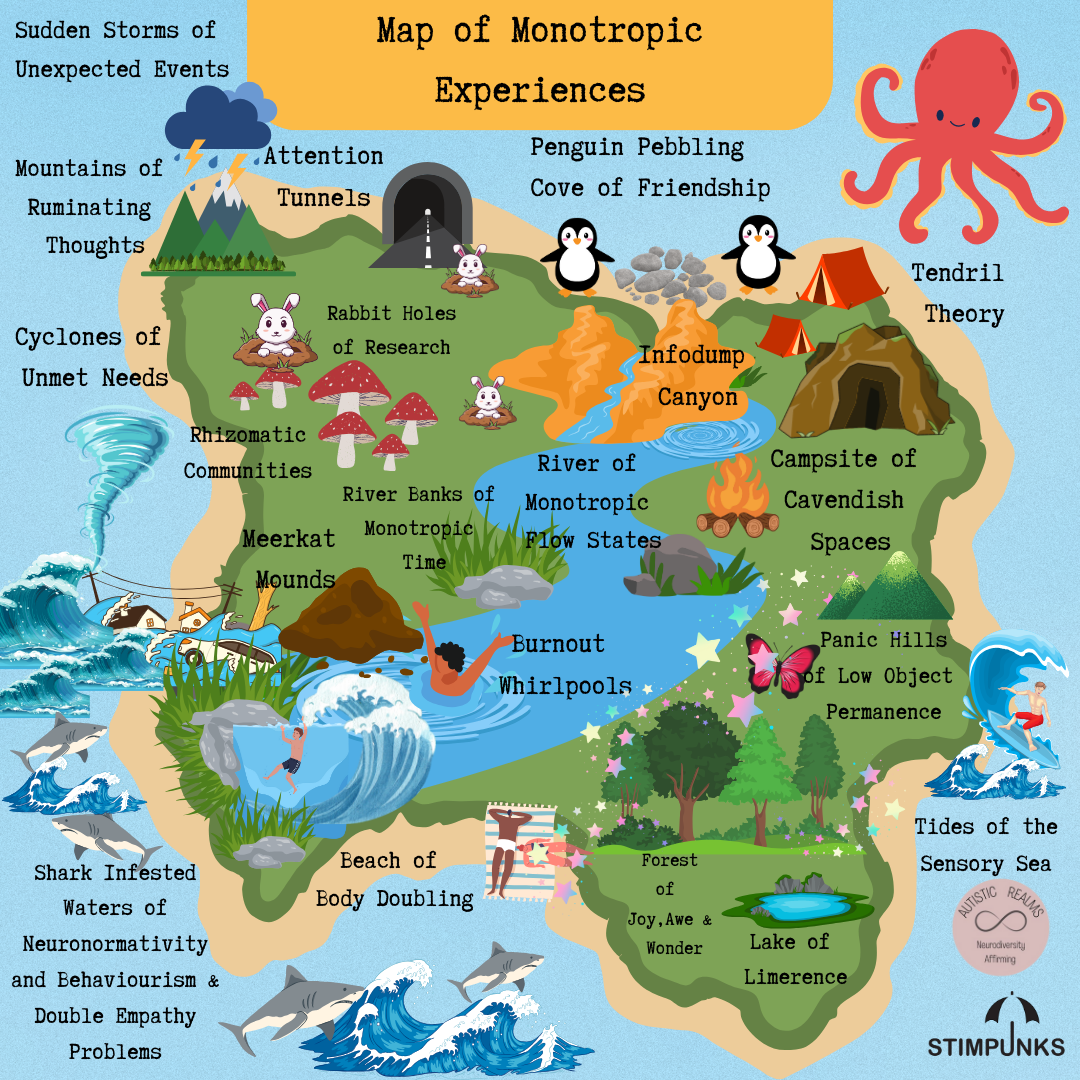
In this regard, Boren and Edgar develop the concept of “Cavendish spaces,” inspired by the British physicist and chemist Henry Cavendish, recently described as potentially Autistic. These are envisioned as “sensorially and psychologically safe spaces suited to zone-based work, flow states, intermittent collaboration, and the collaborative construction of niches” (Boren, 2022). Such environments might include quiet areas for solitary reflection alongside more dynamic collaborative spaces, as well as meeting points for knowledge exchange. Within these varied spaces, the roles of learning and teaching are redistributed.
For a neuroqueer approach to learning to be possible, teachers — reframed by Edgar and Boren as learning facilitators — must lead by example. One starting point could be to declare the learning environment a “free experimental zone aimed at shedding habits of normative performance and actively exploring, practising, claiming, and cultivating non-normative modes of embodiment” (Edgar, 2024).
References
Kassiane Asasumasu [Neurodivergent K of Radical Neurodivergence Speaking], “PSA from the actual coiner of ‘neurodivergent’, Lost in my Mind TARDIS, Tumblr, 2015.
Ryan Boren, “Cavendish Space”,Stimpunks, 26 July 2022.
https://stimpunks.org/glossary/cavendish-space/
Helen Edgar and Ryan Boren, “Neuroqueering Learning Spaces”, Stimpunks, n. d.
https://stimpunks.org/projects/neuroqueer-learning-spaces/
Helen Edgar (Autism Realms) & Ryan Boren, “An Open Framework For Neuroqueer Learning Spaces”, Stimpunks, 28 April 2024.
https://morerealms.com/neuroqueer-learning-spaces/
Jake Pyne, “Autistic Disruptions, Trans Temporalities: A Narrative ‘Trap Door’ in Time”, South Atlantic Quarterly, vol. 120, no. 2 (2021), pp. 343–361.
https://doi.org/10.1215/00382876-8916088
Silberman, Steve, NeuroTribes: The Legacy of Autism and the Future of Neurodiversity, New York: Avery, 2015.
Nick Walker, Transformative Somatic Practices and Autistic Potentials: An Autoethnographic Exploration, PhD thesis in Transformative Studies, California Institute of Integral Studies, 2019.
Nick Walker, Neuroqueer Heresies: Notes on the Neurodiversity Paradigm, Autistic Empowerment, and Postnormal Possibilities, Fort Worth, Autonomous Press, 2021.
M. Remi Yergeau, Authoring Autism: On Rhetoric and Neurological Queerness, Durham and London, Duke University Press, 2018.
Find out more about Ombre Tarragnat’s work here: