by Helen Edgar | Autistic Realms, May 2026
There is a story behind the spaces we all share, the therapy room, classroom, healthcare consultation rooms and workplaces. With the best intentions, people may tell themselves these rooms are neutral, free from politics and bias, held outside the messiness of power and privilege. We may invite people in, we may be the ones being invited in, we may be told we are all equal here, and this is a neutral space. However, there is no such thing as a neutral space; we need to recognise privilege, differences, intersectionality, and the quiet harm of these spaces that can add to minority stress. We need to move away from pathologising and trying to fix people’s minds, from seeing ourselves as broken, and instead think about how we can support and heal our souls together.
“Nothing is neutral.
Everything has a charge.”
Dr Jennifer Mullan
I don’t believe any space is neutral. The normative paradigm and neuronormative paradigm I wrote about affects every person and every setting and space we are in. Every setting carries the weight of those who built it, for whom it was built, and whose comfort was assumed in its design and what the purpose is for those trying to relate to each other in those spaces. The lighting, the acoustics, the way communication is expressed, the pictures on the walls, and even the way the seating is laid out. The theories underpinning what happens in these spaces often encode a normative worldview, which silences the voices and people that are so often missed out of these conversations – minority groups such as disabled people, queer people, and neurodivergent people.
What “Neutral” Actually Means
When practitioners claim neutrality — in therapy, in education, in support work — they usually mean something like: I treat everyone the same, I don’t bring my politics to this space, we are both equal here, and I want this to be a safe environment for both of us. I want to listen, and for you to feel comfortable being yourself. Neutrality is not the absence of a position; it is a position in itself. The lack of neutral spaces is something I feel needs to be voiced, recognised, and owned.
Like teaching, psychotherapy has its own difficult history to explore. Education and therapy settings have historically been used to enforce racist and sexist norms, to pathologise neurodivergent and LGBTQ+ people, and to uphold compliance with systems that cause harm (Davison, 2025). These spaces often reflect what the room was built for, and whose distress is considered legible, valid, and more worthy of care. As Miranda Fricker (2007) argued, epistemic injustice, the harm done when someone is wrongly discredited as a knower or interpreter, is embedded in the very structures through which we are heard, or not heard. A supposedly neutral therapy or educational space does not escape those structures; they add to the potential harm if we don’t acknowledge difference and privilege. I am aware that even writing this, I have privilege as a white, educated British woman, even though I am disabled and neurodivergent; there is still privilege in being able to voice these concerns in relative safety and my positionality.
Choosing not to name the impact of intersectionality, privilege, and power dynamics in the spaces we are in is a choice. However, it tends to serve those who are already centred by dominant culture, and to leave everyone else unseen — their pain individualised, their context erased, their difference treated as the problem to be managed by social skills training programmes in schools or behaviourist therapy frameworks – all of which are inherently harmful.
How Our Bodyminds Carry Weight
Before we even use language, spaces communicate safety or danger through texture and how our bodyminds, our senses, our nervous systems respond and how our past influences all of that. Our nervous systems are reading people and the room we are in constantly, the flicker of fluorescent lighting, the expectation of eye contact or perhaps the unfamiliar smell of a clinical space. The pace of speech, the weight of silence, the implicit demand to present yourself in ways legible to the person holding the power in that room. Even when people say there is no power dynamic, there is always one between teacher/student, therapist/client, employer and employee. This power dynamic is also shaped by life experiences and intersectionality. What lands in our bodies is not neutral; there are always silent signals that tell us whether we belong here, whether we are safe, whether our presence is welcome, and whether our identity is truly understood and accepted.
This is especially true for Autistic, neurodivergent, and otherwise disabled or marginalised people, including those with intellectual and learning differences. Sensory environments are never neutral; what feels like a calm, professional space to one person’s nervous system may be overwhelming, alienating, or actively dysregulating to another. When environments are designed without this in mind and when the assumption of a default, normative bodymind goes unquestioned, then access is denied before a word is even spoken, before therapy has started or learning has had the chance to emerge.
As Stephen at Self Led Life (2025) explores through a somatic and Gestalt lens, even a therapist’s carefully flattened tone or stillness may not register as neutral in the client’s body. It can land as distance, indifference, or even mild threat.
Co-regulation, the way a regulated nervous system can support another to settle, means the practitioner is always already part of the relational field. There is no stepping outside it. Presence is never neutral, because our nervous systems are already in conversation with each other.
Disability studies, mad studies and crip theory have been discussing this for many years, it is why we need disability-led discourse. The mind and body are not separate; we are not floating minds without bodies. Everything inside us is deeply entangled with the social and political world we inhabit and are part of. The stress of navigating spaces that were not built for us is not just about potential psychological harm; it is also physiological. The cumulative effects of being in spaces that don’t recognise this only add to the minority stress and poor mental health outcomes for people, even when people have the best of intentions to support and help others. We need to decolonise our therapy and education spaces to get to the root of all this.
Minority Stress, Internalised Stigma, and the Double Empathy Problem
For people who hold marginalised identities — Autistic people, disabled people, racialised people, LGBTQ+ people, people living in poverty — the ongoing work of navigating a world built for someone else accumulates in the body over time and impacts mental and physical health. It is often the reason why people can’t continue to access education or remain in work; it is why so many of us are chronically burnt-out. The therapy business is primarily thriving because of people’s unmet needs and systemic injustice.
The minority stress model (Meyer, 2003), shares the idea that chronic social stressors linked to stigma, discrimination, and the need for constant adaptation translate into measurable health disparities. It is not a weakness of the individual; it is the systemic harm and the resulting impact of physiological and structural exclusion that causes so many mental health issues and relationship breakdowns in the very spaces that are meant to support people.
Botha and Frost (2020) extended this model specifically to highlight Autistic experiences, identifying the particular stressors that shape Autistic mental health — stigma, discrimination, the pressure to conceal or suppress who you are, and the cumulative toll of navigating environments that treat neuronormative ways of being as the default and the standard. All of these stresses live in our bodies; they shape how safe it feels to walk into a room, to communicate, to regulate, to be seen, to feel understood, and to feel a sense of belonging.
Last week, van Asselt and colleagues (2026) published their new paper, which added another dimension to this picture and highlighted that internalised stigma and loneliness are significant predictors of stress and life satisfaction for Autistic people. This matters enormously in the context of supposedly neutral spaces, as when the messages a person has absorbed about their own differences, such as that they are too much, not enough, difficult, or disordered, are never named or challenged by the practitioner, those messages are quietly reinforced. Neutrality does not protect the client from stigma, which is why it is so important that we consider what truly neuro-affirming and humanity-affirming spaces could be like.
The Double Empathy Problem (Milton, 2012) highlights the difficulty of communicating with different lived experiences. Communication is mutual; it is not a deficit located in the Autistic, disabled person or the person with less power. The mismatch arises from differences, and it is everyone’s responsibility to find a way to meet and make communication work. Yet the assumption of deficit, the idea that Autistic people and people with mental health difficulties are the ones who need to learn to fit, is baked into most therapeutic and educational frameworks. However, I also think the double empathy problem goes deeper than communication I wrote about a few years ago – it is a Double Empathy Extreme Problem – Dynamic, Embodied, Ecological, and Political.
Teacher training courses and therapy courses that don’t acknowledge or really sit with the understanding of power, privilege, and the harm that normative frameworks create only add to minority stress and the ongoing harm of systemic ableism and oppression. Thinking about all this and recognising these issues has the potential to shape everything that follows and to transform our systems, workplaces, educational settings and therapy spaces.
Affective injustice, the injustice involving the emotions and affects of a person as an affective being, is one of the ways this plays out (Goffin, 2026). When a person’s emotional responses are dismissed, pathologised, or read through a normative lens, or even being held in silence as a form of trying to show empathy and create space, something important can always be quietly violated, not just feelings in the moment, but the feeling that someone’s inner life and way of experiencing the world really matters and is held.
Intersectionality sharpens all of this as Crenshaw (1989) highlights. An Autistic Black woman does not experience ableism and racism as separate forces; a queer disabled person navigating a therapeutic relationship holds all of that history in their body as they enter the room, even if they aren’t aware of it. A person with intellectual disabilities often faces assumptions about their capacity to know and communicate their own experience that compound every other layer of marginalisation, as I have written about in the harm of presuming competence. None of these realities suddenly disappears at the door of a supposedly neutral space.
Safe Spaces Need Building By Us
Safer spaces do not happen magically. They have to be actively, consciously and collaboratively constructed. It requires the person with power in that room to be honest about that power and privilege; we need to think of healing rather than treating people, as Dr Jennifer Mullan suggests. Therapists need to involve other healer helpers, and recognise the power and privilege they have when holding space, much like Kay Aldred’s concept of ‘space holders’ within the education space.
Anti-oppressive, decolonised practice asks all of these questions. It needs an awareness of the neurodiversity paradigm and a genuine commitment to what Neurodiverse Connection call a Culture of Care — an approach that centres the wellbeing, safety, and self-determination of marginalised and neurodivergent people not as an add-on, but as the foundation of how a service or organisation actually operates.
“Therapy is deeply political,
historical, and systemic by nature”.
“Colonisation has dehumanised us all”.
Therapy Is Not Neutral with Dr. Jennifer Mullan, facilitated by Iya Affo – YouTube
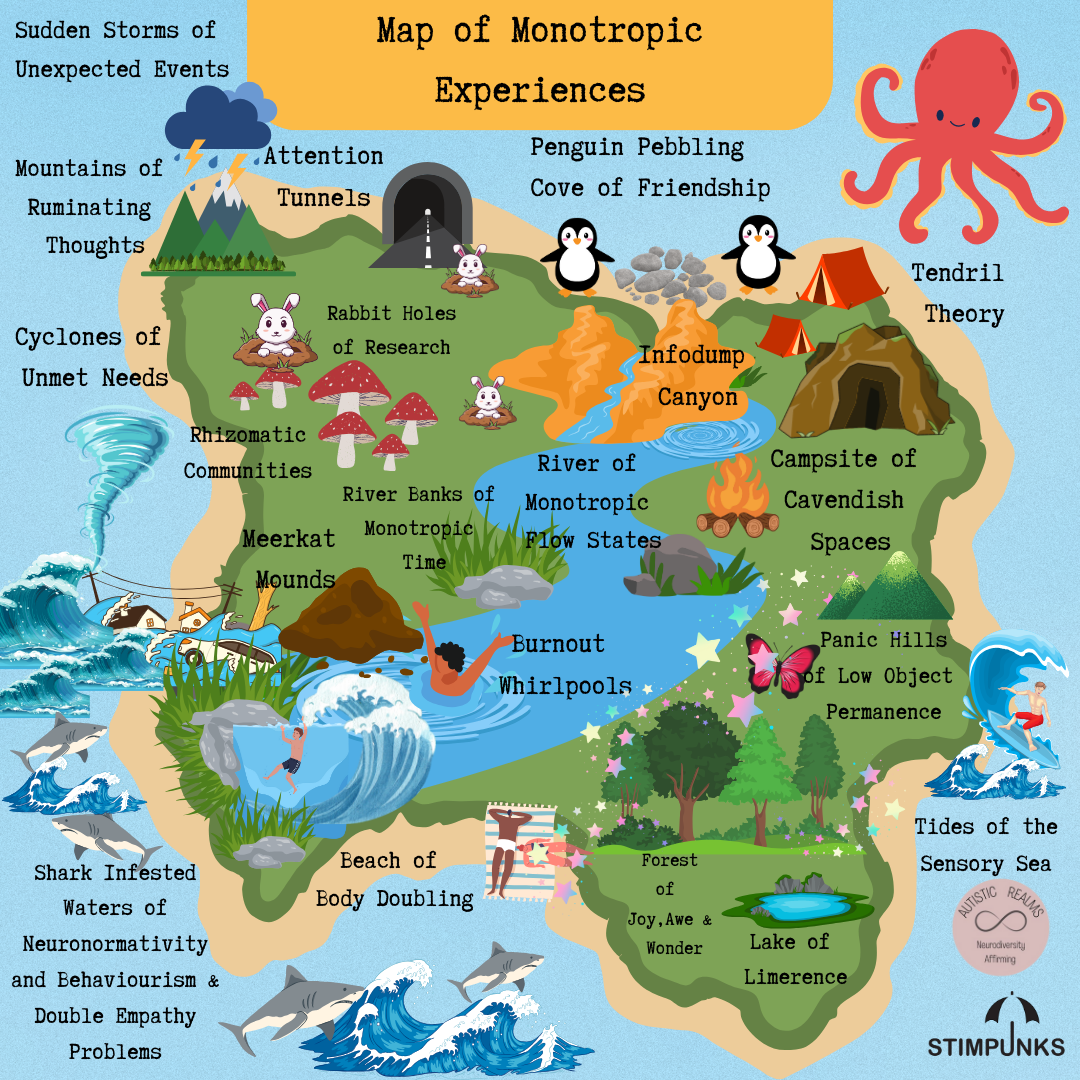
Creating a safe space means carefully considering the physical and sensory qualities of the environments we co-create with people. The project work I am doing with Stimpunks Foundation on the concept of Cavendish Space offers one vision of what this can look like in practice: psychologically and sensorily safe environments designed with caves for quiet reflection, campfires for small-group learning, and watering holes for peer exchange — spaces that support all bodyminds rather than demanding adaptation to an environment built against their needs.
We need to constantly ask and reflect on whose comfort this space is designed for, what assumptions may underlie it, and be willing to change it. This is not a one-time audit or an individual accommodation, it is not down to a single teacher, manager or therapist, it is an ongoing, collective process of systemic reform that that has to be built and rebuilt in genuine partnership with the communities who use the space, shaped by their knowledge, their feedback, and their right to have a say in the environments that affect them. Co-creation is a practice of returning, again and again, to the question of who belongs here — and doing the structural work to make the answer expansive.
I am not talking about erasing therapists, teachers, or any practitioner’s position, but rather about being more transparent about our positionality. We need to name what weight we carry, question, and understand the values we hold and think about where they came from. Most of this is an ongoing unlearning process and something I am still always working with myself, it is never perfect, with every connection I make I am always having to re-evaluate myself and learn and re-learn how I am, how I can be and how we can be together as humans in ways that honour our true needs and identities.
Sara Ahmed (2018) writes about how institutions can absorb the language of inclusion without really changing their shape and actually being inclusive. This is very similar to the neurodiversity-lite problem that I have written about extensively, which is deeply problematic and pervasive at the moment. Having an inclusive rainbow-coloured infinity symbol and a diversity statement can sometimes function as a wall, making it harder, rather than easier, to name what is actually happening. None of these makes a space safe. What makes a space safer is the ongoing, humble, relational work of being genuinely accountable to the people in it — and being willing to be changed by that encounter.
Neuroqueering the Space
If no space is neutral, that means every space is also shapeable and able to transform. The environments we create in therapy, at work, in education, and in our community can be consciously queered toward justice and the creation of safer spaces for everyone.
Neuroqueering (Walker, 2021) is not just a concept for Autistic or neurodivergent people, it is an invitation for everyone to interrogate the neuronormative assumptions threaded through our ways of being, the structures and systems we live within and the way we relate to others. It enables us to challenge the idea that there is a correct way to think, feel, communicate, and move through the world, and to build something more liberatory, plural, expansive, and genuinely meaningful in its place.
This is relational work; it is slow work, it requires people who are willing to sit with discomfort, to do their own learning, to take seriously the testimony of people whose experience has been systemically discredited. It requires institutions to structurally shift, to actually share power, to be changed by the encounters and relationships of the communities that they are part of. It asks us to understand that safety is not a static state; it is something that has to be tended, renegotiated, and returned to — together all the time.
What This Asks of Us
If you are a therapist, an educator, a support worker, a community organiser — if you hold any kind of professional power in relation to people who are navigating marginalisation. We all need to sit with this discomfort, not as villains or heroes, but as humans who are all part of systems that were never neutral to begin with. We can then work towards something better, even by having these conversations it opens up that space for change to evolve.
“Self-care is birthed by and through community care.”
—Talila A. Lewis
https://stimpunks.org/glossary/self-care/
It asks us to move from imagined neutrality to accountable presence, and to stop protecting ourselves behind the fiction of objectivity, and instead to start asking what this particular person, with this particular history, nervous system, and set of identities, actually needs from this space we are in together – this is a two-way conversation.
We need to work together towards neuroqueering our spaces. We need to keep asking questions, keep listening to the answers, keep iterating and keep moving, so that those who are most marginalised are centred, held, and have a genuine sense of belonging and safety to express themselves.
None of this can be fixed in a single therapy session, a lesson at school, or even a course of therapy and several modules on inclusion. It requires the very systems to change that created these problems in the first place, the structures, the institutions, the assumptions woven into how we build our spaces, train our practitioners, and decide whose knowledge counts; every room we enter carries all this history. Every space we build together is a chance to do things differently. No space is ever neutral.
References & Further Reading
Ahmed, S. (2018, June 28). Refusal, resignation and complaint. Feminist Killjoys. https://feministkilljoys.com/2018/06/28/refusal-resignation-and-complaint/
Aldred, K & D (2023). Embodied Education: Creating Safe Space for Learning, Facilitating and Sharing. Girl God Books
https://www.kaylouisealdred.com/embodied-education.html
Annamma, S. A., Connor, D., & Ferri, B. (2013). Dis/ability critical race studies (DisCrit): Theorizing at the intersections of race and dis/ability. Race Ethnicity and Education, 16(1), 1–31. https://doi.org/10.1080/13613324.2012.730511
Botha, M., & Frost, D. M. (2020). Extending the minority stress model to understand mental health problems experienced by the Autistic population. Society and Mental Health, 10(1), 20–34. https://doi.org/10.1177/2156869318804297
Kimberlé W. Crenshaw, Demarginalizing the Intersection of Race and Sex: A Black Feminist Critique of Antidiscrimination Doctrine, Feminist Theory and Antiracist Politics, 1989 U. Chi. Legal F. 139 (1989).
https://scholarship.law.columbia.edu/faculty_scholarship/3007/
Davison, A. (2025, November 15). Therapy can’t be neutral: My commitment to anti-oppressive practice. https://alidavison.co.uk/2025/11/15/therapy-cant-be-neutral-my-commitment-to-anti-oppressive-practice/
Fricker, M. (2007). Epistemic injustice: Power and the ethics of knowing. Oxford University Press.
https://academic.oup.com/book/32817
Goffin, K. (2026). Autistic injustice as affective injustice: the double empathy problem is not about empathy. Philosophical Psychology, 1–19. https://doi.org/10.1080/09515089.2026.2651512
Hallett, S. (2024, March 18). Counselling in a neurodiverse world. Medium. https://medium.com/@sonnyhallett/counselling-in-a-neurodiverse-world-2e72d63a77c9
Macurdy, B. (2025, July 14). The myth of the neutral therapist. Chosen Path Collective. https://chosenpathcollective.com/the-myth-of-the-neutral-therapist/
Meyer, I. H. (2003). Prejudice, social stress, and mental health in lesbian, gay, and bisexual populations: Conceptual issues and research evidence. Psychological Bulletin, 129(5), 674–697. https://psycnet.apa.org/doiLanding?doi=10.1037%2F0033-2909.129.5.674
Milton, D. E. M. (2012). On the ontological status of autism: The ‘double empathy problem.’ Disability & Society, 27(6), 883–887. https://doi.org/10.1080/09687599.2012.710008
Mullan, J. (2023). Decolonizing therapy: Oppression, Historical Trauma, and Politicizing Your Practice. W. W. Norton.
Price, M. (2011). Mad at school: Rhetorics of mental disability and academic life. University of Michigan Press.
https://www.jstor.org/stable/10.3998/mpub.1612837
Sarmiento Verano, L. (2021, August 20). Epistemic justice: Therapy as a liberatory practice. South of Therapy. https://southoftherapy.com/epistemic-justice-therapy-as-a-liberatory-practice/
Self Led Life. (2025, August 6). The myth of neutrality in the therapy room. https://selfled.life/the-myth-of-neutrality/
Stimpunks Foundation. (2026). Affective injustice. https://stimpunks.org/glossary/affective-injustice/
Stimpunks Foundation. (2024). Minority stress. https://stimpunks.org/glossary/minority-stress/
van Asselt, A., Roke, Y., Begeer, S., & Scheeren, A. M. (2026). Extending the minority stress model of autism: Internalised stigma and loneliness as predictors of stress and life satisfaction. Autism. https://doi.org/10.1177/13623613261446876
Walker, N. (2021). Neuroqueer heresies: Notes on the neurodiversity paradigm, autistic empowerment, and postnormal possibilities. Autonomous Press.
https://neuroqueer.com/