
Helen Edgar (Autistic Realms), June 2025
Written for Autistic Pride Day 18th June 2025 as part of NINE’s Neurodivergent Change Makers event.
This piece was included in the 2025 Autistic Pride Day ceremony held by NINE (Neurodivergent Infinity Network of Educators) with the Durham District School Board in Canada. You can find NINE’s talks and events on NINE’s YouTube channel, and their Autistic Pride Day ceremonies are streamed on the DDSB Live YouTube channel, including the inaugural ceremony (2023) and the second annual ceremony (2024).
Autistic Pride is a declaration of presence and value in a world that so often may make us feel invisible or unworthy. It is a resistance to norms that demands our compliance and masking, leading us to burnout. Autistic Pride is the power of advocating for our needs, rhythms, ways of communicating and the right to be our authentic selves.
Pride is about celebration, and it is also about finding ways of moving from surviving to thriving and understanding the importance of community spaces and solidarity. Autistic pride emerges from knowing that our Autistic ways of being are not broken or deficient but deeply human, richly textured, and valuable on their own terms as part of the wider fabric of society.
From Pathology to Paradigm: Neurodiversity and Monotropism
Autistic pride is rooted in the neurodiversity paradigm, which recognises neurological variation as a form of biodiversity rather than a deviation from normalcy (Walker, 2021). It challenges the dominant medical model that frames Autism as a disorder of social, sensory, and cognitive development, instead centring value in the very traits that are so often pathologised, while also recognising the difficulties and disabilities people may have.
Central to this reframing is the theory of monotropism, first proposed by Murray, Lesser, and Lawson (2005). Monotropism suggests that Autistic people (and likely ADHDers) have a greater tendency towards deeper yet more narrowly focused attention tunnels. Monotropic people may be immersed in fewer interests or tasks at a time, rather than spreading their attention across multiple inputs like most non-Autistic (polytropic) people.
I think the monotropic way of using attentional resources explains much about the Autistic experience: the ways we communicate, energy fluctuations and capacity, flow states, stuck states, sensory intensities and interoception differences, difficulties with sudden or unexpected transitions, the preference for predictability, and the exhaustion that follows prolonged multitasking when you divide your resources and split focus.
When Autistic people are forced into environments that demand constant task switching and fragmented attention to cognitive and sensory information processing, they may be more likely to become overwhelmed and experience meltdowns/ shutdowns. This can further impact their ability to communicate in ways people expect. Over time, without enough rest and recovery, they are more prone to experience periods of burnout.
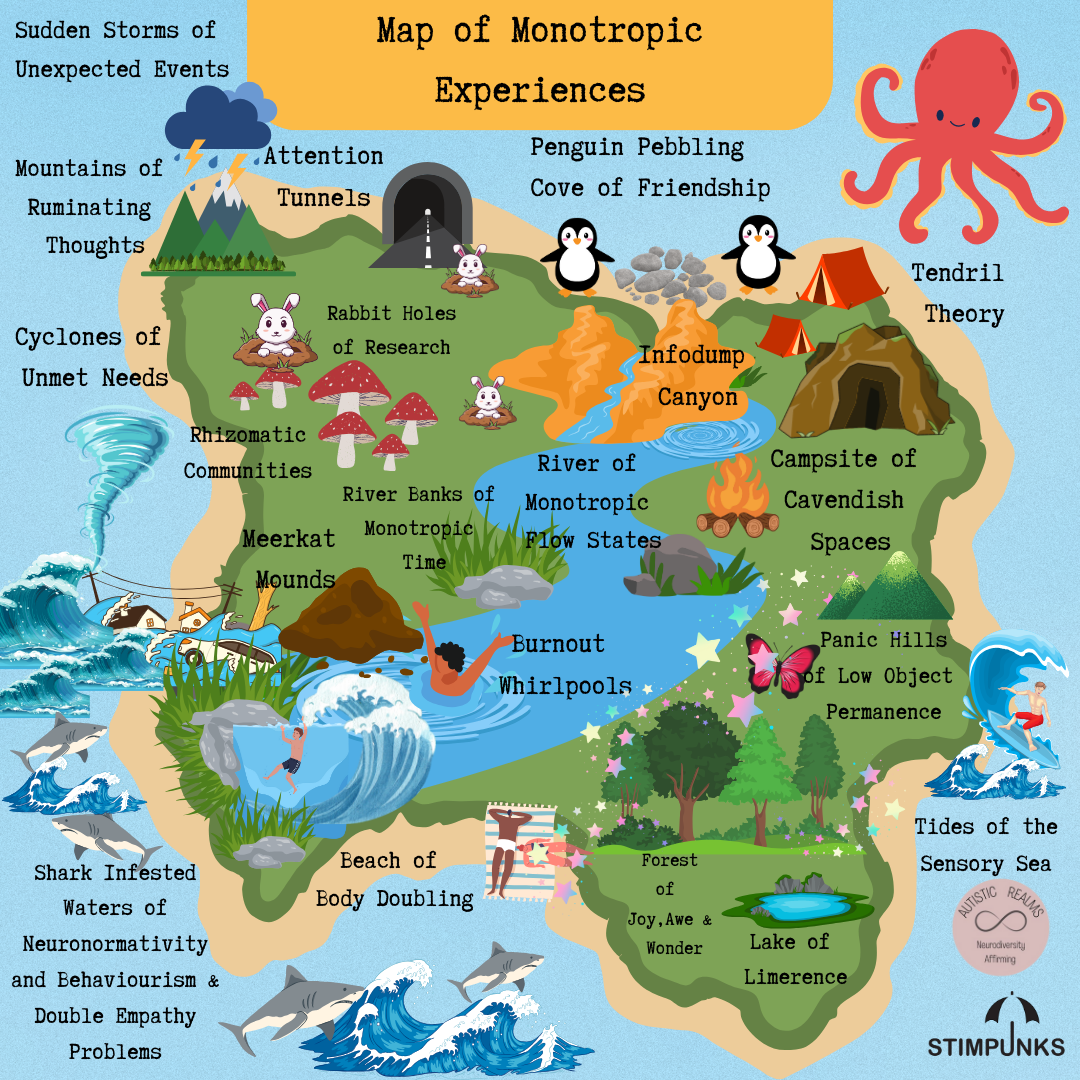
Burnout comes from a mismatch between monotropic needs and trying to live in a world that values and is set up for the neurotypical majority of polytropic people, rather than from being Autistic itself. Burnout is the result of unmet needs, masking and trying to communicate in expected ways. It can be hard to feel a sense of Autistic pride if you have felt misunderstood, silenced and are exhausted. The more we know and understand about our Autistic identity and needs, the more space we can create to reclaim our pride. Research led by and for Autistic people, reflecting the real inner experiences of how we experience and perceive the world, is crucial for this, and monotropism is a powerful example. The theory of monotropism was developed by Autistic people: research led by us, rather than research done about us. This gives Autistic people a voice, validates us as a community and is empowering. It can help create a sense of pride and open up more expansive spaces for people to share stories and communicate in ways that are meaningful for them (art/ poetry/ music/ video/ writing, and all forms of AAC). This is reflected in the Map of Monotropic Experiences project I am working on with Stimpunks, which we hope is helping to create a sense of community and Autistic Pride and honours all forms of communication.
For me, Autistic Pride means recognising my monotropic nature, my monotropic ways of processing and ways of experiencing the world as differences, not deficits. It is about creating space for focus, depth, immersion, and flow in my day, including how I communicate. Being in neuroaffirmative spaces online helps with this, allowing me to text and have videos on/off instead of feeling the need to always be talking verbally. It allows more flexibility to work asynchronously and communicate in ways that work with my flow and fluctuating energy levels. Autistic Pride is about understanding that our ways of processing the world are not flaws to be corrected, but are valid differences, and in the right environments, when we feel safe, we can thrive. We don’t need correction and coercion; we need acceptance and safety to develop a sense of pride.
The Cost of Masking
The demand to hide or suppress Autistic traits is still so embedded in many educational, work and health care settings and within our personal relationships, where we may not feel safe to be ourselves. Masking is a suppression of authentic ways of being, such as stimming or communicating in certain ways and hiding confusion or distress. Masking is often unconscious and learned over time in response to subtle or overt rejection by people rewarding compliance against neuronormative ideals. Pearson and Rose (2021) describe masking as shaped by stigma, and question how much of a choice it really is.
Masking has been linked to increased psychological distress and to suicidal thoughts and behaviours (Cassidy et al., 2020). The toll of performing neurotypicality and trying to go against the innate flow of monotropic ways of being can be profound. Over time, masking can result in losing authentic self-expression, fragmented identity, and a disconnection from your needs.
Autistic Pride can be an act of refusal to perform wellness or normality in order to seek worth and respect. Autistic Pride means making space for our divergence rather than hiding it, and challenging systems that try to suppress and invalidate our needs. It is about being able to advocate for your needs and seek support so you can do well, and about trying to find ways to reduce the likelihood and what feels like the almost inevitable impact of burnout due to living in a world that is not set up for us.
Burnout and the Need to Reclaim Rest
Autistic burnout, as described by Raymaker et al. (2020), is a state of physical, emotional, and cognitive exhaustion caused by cumulative life stress and a mismatch between the individual’s needs and their environment. Burnout is more than tiredness or depression. For me, it is a cry from my bodymind saying, I can’t keep pretending, I can’t keep pushing, I can’t keep talking, I need rest that is meaningful for me, deep rest, sensory rest, I need to rest my soul.
Rest for Autistic people will likely differ from how the neuromajority of people experience and understand rest. We live in a society that ties our worth to productivity, and Autistic people are often denied the kind of meaningful rest we require. Rest can sometimes be seen as laziness, immersion in our passions can be seen as a waste of time, or if your special interest is the focus of your paid work, you may be told you need more of a ‘work-life balance’. The need for recovery time off work or school is so often framed as failure leading to shame and further stigmatisation that we just cannot cope well enough. Parents of Autistic young people are often blamed for bad parenting or even fined if their children need recovery time away from school, adding to the blame culture that permeates so many of our lives in other ways, too. Autistic children are told to “try harder,” “pay attention,” and “be flexible.” At the same time, their needs for meaningful and sensory regulation and safe spaces are often ignored, and parent/carer voices are not believed (Mullally & Connolly, 2025).
Autistic Pride helps to reframe rest as necessary, rejuvenating, and liberatory. It challenges the idea that we must earn rest through overwork and by fitting into neuronormative expectations, and that we must rest in specific ways for it to be called ‘rest’. For monotropic people, rest may look different. It may not mean watching TV or going out in a busy restaurant or pub with friends. It might involve deep engagement in a special interest, stimming, immersion in music or nature, or simply being in a low-demand space with no interruptions, with your favourite sensory lights and weighted blanket playing your favourite music or anime cartoon on repeat. Reclaiming rest means affirming these different modes of Autistic and monotropic attunement, different ways of communicating and regulating, rather than suppressing or devaluing them. Autistic Pride means advocating for our unique ways of communicating and designing environments that work with our rhythms, sensory needs and flow states, not against them.
Autistic Pride and Community
Autistic Pride is created in communities by sharing knowledge, caring for each other, and building co-regulatory and interdependent cultures. Autistic people are increasingly asserting themselves not just as subjects of study but as creators of theory, research, and practice. This shifts the balance of power, challenging both scientific and social hierarchies. The development of Autistic led theories, such as Monotropism, is finally being taken more seriously in education, health and workplace settings, proving that Autistic people hold valuable knowledge about our own lives that is vital to shaping the services, supports, and systems we interact with.
Autistic Pride is collective; it holds space for all Autistic people, including those who are nonspeaking/ use AAC, intellectually disabled, multiply disabled, racialised, trans, and otherwise systemically excluded and marginalised. Pride without intersectionality is just performative; to have genuine Autistic Pride is to understand that we need to amplify the voices of those most marginalised in our communities and understand there is a privilege attached to being able to advocate for pride in the first place and that all forms of communication are valid.
Autistic Pride has nothing to do with exceptionalism or superpowers. It is about connecting to ourselves and others and creating a future rooted in dignity and rights. Botha, Dibb, and Frost (2022) found that many Autistic people describe community connection in deeply embodied and intuitive terms. One participant explained:
“There is an instant connection, I feel like we’re kind of the same . . . (my autistic friend) talks about things the way I think” (Andrew, 22; Botha et al., 2022).
Belongingness, feeling seen and accepted by others with shared experience, was described as a profound relief after years of social rejection. May (35) shared:
“I was very isolated and then I met autistic people.” (May, 35; Botha et al., 2022)
Autistic Pride, Connections and Belonging
Connection can extend into activism for those who are passionate about building community and helping to change the systems that have caused so much harm. There is not only a connectedness through neurotype, but also a political connectedness. Through projects and community-led organisations such as NINE, CASY and Stimpunks, we can work together to dismantle ableist narratives, resist cure-focused research, and promote neurodivergent ways of communicating and advocate for our rights. This is all a vital part of Autistic Pride.
Autistic community connectedness offers more than acceptance and understanding and can nurture a sense of belonging. Community is where we can find validation, joy in shared experiences, and strength in being truly seen. Neuroaffirming community spaces enable everyone to communicate in ways that work for them so everyone feels safe to express their thoughts and ideas without judgment. Autistic people are not broken or missing puzzle pieces; we can be proud of who we are, as Autistic people. Through community, we can discover more about ourselves, share our stories and develop a true sense of Autistic Pride.
References
Botha, M., Dibb, B., & Frost, D. M. (2022). “It’s being a part of a grand tradition, a grand counter-culture which involves communities”: A qualitative investigation of autistic community connectedness. Autism, 26(8), 2151–2164. https://doi.org/10.1177/13623613221080248
Cassidy, S. A., Gould, K., Townsend, E., Pelton, M., Robertson, A. E., & Rodgers, J. (2020). Is camouflaging autistic traits associated with suicidal thoughts and behaviours? Expanding the interpersonal psychological theory of suicide in an undergraduate student sample. Journal of Autism and Developmental Disorders, 50(10), 3638–3648. https://doi.org/10.1007/s10803-019-04323-3
Mullally, S. L., & Connolly, S. E. (2025). “I felt shamed and blamed”: An exploration of the parental experience of school distress. Frontiers in Psychiatry, 16. https://doi.org/10.3389/fpsyt.2025.1489316
Murray, D., Lesser, M., & Lawson, W. (2005). Attention, monotropism and the diagnostic criteria for autism. Autism, 9(2), 139–156. https://doi.org/10.1177/1362361305051398
Pearson, A., & Rose, K. (2021). A conceptual analysis of autistic masking: Understanding the narrative of stigma and the illusion of choice. Autism in Adulthood, 3(1), 52–60. https://doi.org/10.1089/aut.2020.0043
Raymaker, D. M., Teo, A. R., Steckler, N. A., Lentz, B., Scharer, M., Delos Santos, A., Kapp, S. K., Hunter, M., Joyce, A., & Nicolaidis, C. (2020). “Having all of your internal resources exhausted beyond measure and being left with no clean-up crew”: Defining autistic burnout. Autism in Adulthood, 2(2), 132–143. https://doi.org/10.1089/aut.2019.0079
Walker, N. (2021). Neuroqueer heresies: Notes on the neurodiversity paradigm, autistic empowerment, and postnormal possibilities. Autonomous Press.