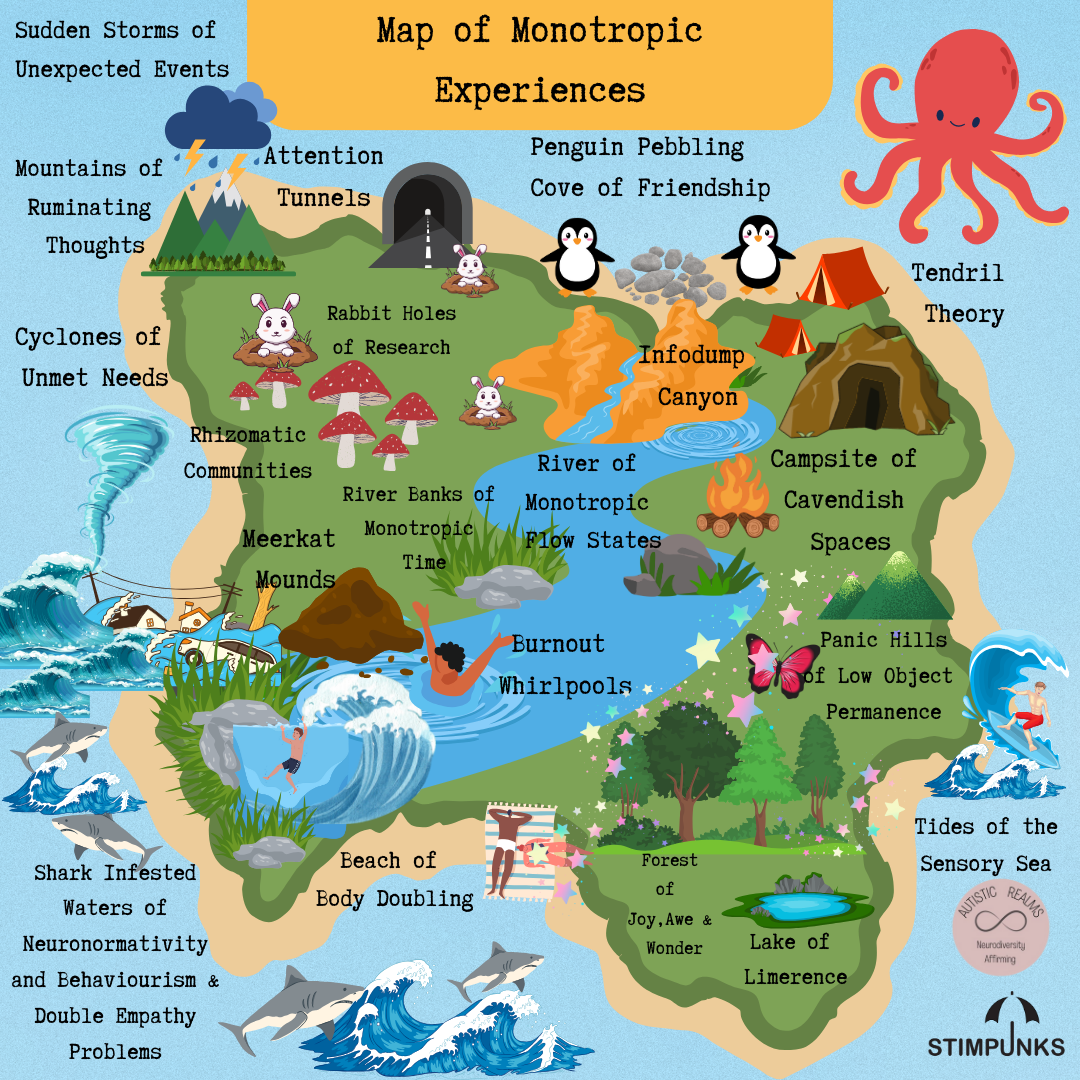

I was asked to choose a piece of music that was personal to me and reflected something about myself and Autistic Realms. I chose “Little Fluffy Clouds” by The Orb.

I used to play “Little Fluffy Clouds” by The Orb in class all the time during our multisensory early years creative sessions, so it has personal meaning for me. I chose this track because its playful, looping textures and sampled voice describing childhood skies feel exactly like how I notice the world even as an adult, looping, detailed, non-linear, full of wonder. It captures being monotropic and being in flow, and it invites imagination and authenticity.
The voice on the track recalls skies from childhood in specific detail, such as the exact colours of a sunset, the way clouds caught the light, nights thick with stars, and reflects on how that kind of noticing gets less as people get older; they lose their sense of awe and wonder. What gets framed as “too much detail” or “getting distracted by the sky” is often a different, richer way of encountering the world, not a deficit, but a different depth of relationship with it.
Neurodivergent children’s development doesn’t move in a straight line, it shifts and changes, ebbs and flows. When we centre children’s own rhythms, strengths and lived experience, rather than measuring them against a fixed idea of being “on track” and constantly judging against neuronormative expectations, we make room for the same awe, wonder, imagination and flow this track carries, and for the children who notice the sky like that too, in many diverse ways.
A bit of history
Since choosing this track, I’ve enjoyed learning more about how it came together. “Little Fluffy Clouds” wasn’t planned; it kind of evolved through a process of shared flow.
Alex Paterson and Martin “Youth” Glover made it in 1990, not long after their original band fell apart, and the whole thing started almost by accident when a fan sent them a cassette tape, unprompted, pairing Pat Metheny’s recording of Steve Reich’s Electric Counterpoint on one side with a spoken interview of singer Rickie Lee Jones on the other, and simply suggested they make something of it (Mullen, 2025).
That interview became the heart of the song. Jones recalls the skies of her Arizona childhood in detail as part of a promotional interview for her album Flying Cowboys. Layered over it is a line lifted from a 1990 BBC Radio 4 broadcast, and a drum break borrowed from Harry Nilsson’s “Jump Into the Fire,” slowed right down until it became something else entirely (Little Fluffy Clouds,).
They created this track by noticing, layering, circling back, and letting things find their own shape, which feels like exactly the right way for this piece to have come into the world.
It remains a track I associate with monotropic wonder, Autistic joy, and the kind of non-linear attention that feels true to how I experience the world.
Play Invitation: Little Fluffy Clouds — A Multisensory Journey
A multisensory creative session inspired by “Little Fluffy Clouds” by The Orb, designed to be adapted for children’s need. I used in class when I was supporting those with children with profound and multiple learning disabilities (PMLD).

The invitation
Play “Little Fluffy Clouds” by The Orb.
Can repeat or add other cloud and sky-themed tracks to create a playlist.
Children are invited to lie down, sit, or move freely under the parachute as they listen and respond to the music and resources, following their own rhythm and needs.
Resources to offer
- Cotton wool — to feel, pat, rub, throw, or roll over different body parts, depending on each child’s engagement, preference, and response to sensations
- Feathers — to feel, pat, rub, throw, or roll over different body parts, again following individual preference and response to sensations.
- White bedsheet as a parachute — can be used plain, or with a sky scene or coloured lights projected onto it, to bring the “clouds” of the track into the physical space.
- Bubbles — floating, catching light, drifting like clouds.
- Aromatherapy — fresh scents in a diffuser chosen according to each child’s own preferences.
- Fans — can be used for switch work, offering cause-and-effect exploration for children who are able to operate, or use for open sensory exploration of moving air on different body parts or with partners.
- Resonance board — for children with hearing impairments, so the beat and bass of the track can be felt as vibration.
How to support engagement
- Explore resources 1:1 or in small groups, following each child’s lead rather than directing the session (support as needed, stay with each resource as long as the child wants, model different ways of exploring or use in different ways with the child, repeat, loop back, move on as you engage and tune into each other to create a collaborative flow).
- Watch for individual signs of engagement, enjoyment, or overwhelm, and adjust the pace, resources, communication, or proximity accordingly.
- There’s no expectation to “complete” the session in any particular way or order. Some children may want to stay with one resource the whole time; that’s just as valid a response as moving through several or looping back to their preferred interest.
Why this works
Multisensory, child-led exploration like this offers many different ways to experience a shared moment, supporting each child’s sensory preferences, communication, and engagement, rather than measuring responses against a single expected outcome.
Repeating sessions enables continuity, develops predictive skills, and can help with regulation. You can gently expand resources or adjust some tracks in the playlist over time to add variation if needed.
References
Little Fluffy Clouds (n.d.). In Wikipedia. Retrieved July 10, 2026, from https://en.wikipedia.org/wiki/Little_Fluffy_Clouds
Mullen, M. (2025, December 5). “What were the skies like when you were young?”: How The Orb’s Little Fluffy Clouds showed the world that sampling could be an art form. MusicRadar. https://www.musicradar.com/artists/what-were-the-skies-like-when-you-were-young-how-the-orbs-little-fluffy-clouds-showed-the-world-that-sampling-could-be-an-art-form
Push Stuff. (1993). The Orb: Little Fluffy Clouds interview archive [Web page]. Retrieved July 10, 2026, from https://www.pushstuff.co.uk/mminfofreakos/orb091093.html
Simpson, D. (2016, June 7). How we made the Orb’s Little Fluffy Clouds. The Guardian. https://www.theguardian.com/music/2016/jun/07/how-we-made-the-orb-little-fluffy-clouds-interview
The Orb. (n.d.). The Orb (official site). Retrieved July 10, 2026, from https://theorb.com/
More from Autistic Realms
If this post was useful, these courses, books and resources might help too. Everything in the shop is pay what you can, and many resources are free.
- Building a Positive Autistic Identity: a gentle, self-paced course written for Autistic people.
- Re-Storying Autism course: a video course and workbook with David Gray-Hammond.
- Re-Storying Autism (book): our book, co-written with David Gray-Hammond.
- Neuro-Affirming Glossary (Updated 2026): key words for families and professionals.
- Autism and Neurodiversity Starter Pack: free, written with David Gray-Hammond.
- The Autistic Realms shop: over 380 resources, pay what you can and many free.