This blog was written for the NeuroHub Community Autistic Mental Health Conference 2026, an event I’m proud to help facilitate as part of a collective push for change in how Autistic mental health is understood and supported.
It’s not easy to define Autistic mental health. In a world where “mental illness” is often accepted as a pathology, something broken to be fixed, we rarely stop to ask why so many people are struggling, and especially why Autistic people are so disproportionately affected. It’s a complex interplay of identity, environment, and belonging. Let’s move beyond the pathology paradigm and centre Autistic voices and lived realities.
Mental health is often medicalised in ways that physical health is not. While we can point to a broken bone or measure blood pressure, mental distress is more elusive. Increasingly, researchers and advocates are recognising that what we call “mental illness” might not be something wrong with us, but a natural response to prolonged adversity. In this view, mental health conditions are a form of neurodivergence, ways of thinking and feeling that emerge from surviving trauma and hostile environments. Our brains adapt to harm to keep us alive. These adaptations such as hypervigilance, shutdown, dissociation, psychosis and overwhelm are then labelled as disorders.
This matters deeply for Autistic people. We are not separate from our environments. We live in a world that often misunderstands, invalidates, and isolates us. For many of us, trauma is not the exception, it’s the norm. I have yet to meet an Autistic person who hasn’t experienced some form of trauma, even if they are perhaps not yet recognising that within themselves, whether that be sensory trauma, communication invalidation, misattunement, masking, or systemic neglect.
The impact is stark. Research suggests that as many as 8 in 10 Autistic people have a mental health condition. Sadly, Autistic people have been found to have up to an eightfold increased risk of death by suicide compared to non-Autistic people (Brown et al., 2024). For Autistic children, the risk of thinking about or attempting suicide is 28 times higher than for their non-Autistic peers. These are not just numbers, they are lives cut short by systems that fail to meet our needs.
The latest Assuring Transformation NHS Digital data (April 2025) paints an equally troubling picture:
- 2,025 Autistic people and people with a learning disability are in mental health hospitals in England. Of these, 1,455 (72%) are Autistic.
- 240 under-18s are in inpatient units. Of these, 230 (96%) are Autistic.
- The number of Autistic people without a learning disability detained in mental health hospitals has increased by 141% since 2015.
- In 2015, Autistic people made up 38% of the total in hospital. Now it is 72% (National Autistic Society, 2025).
These statistics are not personal failings, they are systemic failures of education, healthcare, mental health services, and broader society to support Autistic people in ways that affirm our needs, identities, and ways of being.
Systemic injustice does not impact all Autistic people equally. Experiences of racism, ableism, sexism, queerphobia, transphobia, and classism often intersect, compounding barriers to care and amplifying harm. Autistic people who are multiply marginalised, such as Autistic people of colour, LGBTQ+ Autistic people, or Autistic people in poverty, are more likely to experience misdiagnosis, coercive treatment, and exclusion from community-based support. Any conversation about Autistic mental health must be grounded in intersectionality, recognising that liberation for one part of our community cannot be achieved without justice for all.
That’s why the NeuroHub Community’s Autistic Mental Health Conference founded and led by David Gray-Hammond is so important.
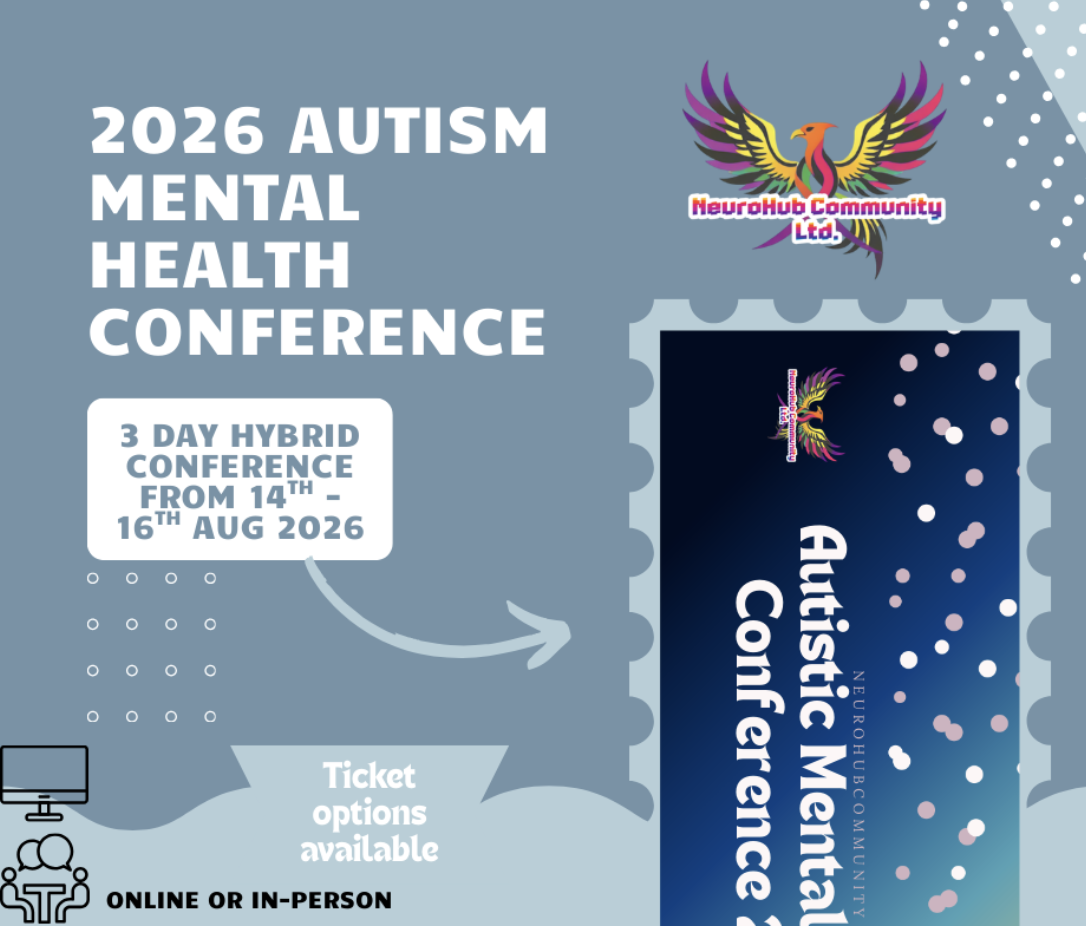
The NeuroHub Mental Health Conference 2026
This year’s conference theme is “Ecosystemic Causes of Mental Health Issues”, examining how environments, systems, and societal structures shape neurodivergent wellbeing. It’s an approach that sits close to the heart of everything we are advocating for: our distress is not a fault in us, it’s a response to the world around us.
Across three days, Friday 14th to Sunday 16th August 2026 (10am–6pm BST), the conference offers a rich programme of 40-minute talks, 15-minute lightning sessions, and pre-recorded contributions from experts and lived-experience speakers alike.
The conference is fully hybrid, with online access on all three days so people can join from anywhere in the world. Day two, Saturday 15th August, also offers an optional in-person experience in Coldean, Brighton & Hove, with stalls, food, and entertainment alongside the live sessions.
All talks are recorded and available to ticket holders afterwards, so nothing has to be missed.
This year’s conference is run in partnership with Autistic Inclusive Meets UK, and is rooted in the belief that neurodivergent people should lead the conversation about neurodivergent lives. It centres lived experience alongside research and education created by neurodivergent people themselves, moving beyond deficit-based, pathology-driven narratives towards a paradigm that recognises difference, celebrates creativity, and honours the depth and insight of those who experience the world in uniquely powerful ways.
The conference welcomes Autistic and neurodivergent people (diagnosed, self-identified, or still working it out), parents and families, professionals and practitioners, educators and support workers, and advocates and allies.
Full Conference Schedule
Friday 14th August
- 11:10am–11:50am — Natasha Leahy — The Trauma of Not Knowing: Late Autistic Identification as Systemic Harm
- 12:05pm–12:20pm — Sarah Meharg — Self advocating for reasonable adjustments
- 1:50pm–2:30pm — Lawrence Kampf — Grounding: Embodiment and Regeneration for the Neuro-complex – an experience
- 3:30pm–4:40pm — David Gray-Hammond & Tanya Adkin — The Ecosystemic Model Of Distress: An ecological approach to Autistic and monotropic wellbeing
- 5:00pm–5:40pm — Dr Nick Walker — Unorthodox Approaches to the Cultivation of Autistic Psychological Resilience
Saturday 15th August
- 10:20am–11:00am — Dr Nathan Keates — Power and Meaning: Autistic Mental Distress
- 11:10am–11:50am — Ed Shearer — Being Pushed from Pillar to Post
- 12:05pm–12:20pm — Nic James — The Sensory Scrum: Navigating the Microclimate of the Rugby Pitch as an Autistic Referee
- 1:10pm–1:50pm — Jessica Dark
- 2:00pm–2:40pm — Karen Parker — Health Needs are Not Behaviour: The “Performance Over Health” School Culture
- 3:00pm–3:40pm — Nikki Smith — Platforming autistic voices in research
- 3:50pm–4:30pm — Ava McAuley — Survival on the Surface: Understanding Masking, Misunderstandings and Mental Health in Autism
- 5:00pm–5:40pm — Erin Ekins — Under The Double Rainbow: Growing up Queerly Autistic and Proud
- 5:50pm–6:30pm — Harry Mansfield
Sunday 16th August
- 11:05am–11:45am — Meryem Cetinkaya — Autism, Suicidality, and Co-Created Care: Here to Help
- 2:45pm–3:25pm — Stacy Badon — Parallel Neurotypes: Navigating Co-Regulation in Neurodivergent Families
- 3:30pm–4:10pm — Amber Dawn — The Breadth of Breaking Bread; Supporting Neurodivergent Relationships with Food Intake and Sharing A Meal
On-Demand Library
As the schedule can only hold so many talks across three days, ticket holders also get exclusive access to a library of pre-recorded sessions, including:
- Bobbi Elman
- David Gray-Hammond
- Anshar Seraphim
- Sarah ‘Sass’ Burn
- Teodora Byrne — Cultivating digital space: The mental health lifeline of the online autistic community
- Jade Farrington — Autistic Resistance and Challenging Neuronormativity in the Therapy Room
- Laura Hellfield — Health Needs are Not Behaviour: The “Performance Over Health” School Culture
…plus many more besides.
🎟️ Find out more and book your ticket: NeuroHub Mental Health Conference 2026
Looking Back, Looking Forward
Last year’s conference drew a huge turnout both in person and online. It showed just how many of us need spaces where our mental health is spoken about with us, not at us.
After last year’s conference, I reflected with David Grey-Hammond on what the Autistic community means, and why events like this matter so much for our collective wellbeing. One line from that conversation has stayed with me, borrowed from Alice Wong:
“Community is magic. Community is power. Community is resistance”
(Wong, 2020).
That’s exactly what we are carrying forward into this year’s conference. We are expanding on the scale of last year’s event and the depth of connection and support it created. If our distress is shaped by the ecosystems we live in, then healing cannot happen in isolation; it has to happen in community, in spaces built by and for Autistic people, where we are not just surviving what the world hands us but actively working out how to thrive within it, together.
Autistic mental health is not just about treatment or diagnosis. It’s about understanding our lives, reclaiming our narratives, and creating a world where we can thrive, not just survive.
Join us, be part of this vital dialogue, and help pave the way toward more inclusive and equitable mental health support.
References & Further Reading
Botha, M., Dibb, B., & Frost, D. M. (2022). ‘It’s being a part of a grand tradition, a grand counter-culture which involves communities’: A qualitative investigation of autistic community connectedness. Autism, 26(8), 2151–2164. https://doi.org/10.1177/13623613221080248
Brown, C. M., Newell, V., Sahin, E., Cassidy, S., Forde, C., Wigham, S., & Richards, G. (2024). Updated systematic review of suicide in autism: 2018–2024. Current Developmental Disorders Reports, 11(3), 225–256. https://doi.org/10.1007/s40474-024-00308-9
Chapman, R. (2023). Empire of normality: Neurodiversity and capitalism. Pluto Press.
Frazer-Carroll, M. (2023). Mad world: The politics of mental health. Outspoken by Pluto.
Gray-Hammond, D., & Adkin, T. (2024, November 26). Creating autistic suffering: Autistic safety and neurodivergence competency. Emergent Divergence. https://emergentdivergence.com/2023/04/11/creating-autistic-suffering-autistic-safety-and-neurodivergence-competency/
Gray-Hammond, D. (2022). The new normal: Autistic musings on the threat of a broken society. Amazon.
Gray-Hammond, D. (2025). Unashamed autistic: Collected writings on the nature of autism and autistic pride. Amazon.
Milton, D. E. (2012). On the ontological status of autism: The ‘double empathy problem.’ Disability & Society, 27(6), 883–887. https://doi.org/10.1080/09687599.2012.710008
National Autistic Society. (2025, May 28). Number of autistic people in mental health hospitals at record high. https://www.autism.org.uk/what-we-do/news/number-of-autistic-people-in-mental-health-ho-29
Walker, N. (2021). Neuroqueer heresies: Notes on the neurodiversity paradigm, autistic empowerment, and postnormal possibilities. Autonomous Press.
Wong, A. (Ed.). (2020). Disability visibility: First-person stories from the twenty-first century. Vintage Books.

More from Autistic Realms
If this post was useful, these courses, books and resources might help too. Everything in the shop is pay what you can, and many resources are free.
- Building a Positive Autistic Identity: a gentle, self-paced course written for Autistic people.
- Re-Storying Autism course: a video course and workbook with David Gray-Hammond.
- Re-Storying Autism (book): our book, co-written with David Gray-Hammond.
- Neuro-Affirming Glossary (Updated 2026): key words for families and professionals.
- Autism and Neurodiversity Starter Pack: free, written with David Gray-Hammond.
- The Autistic Realms shop: over 380 resources, pay what you can and many free.