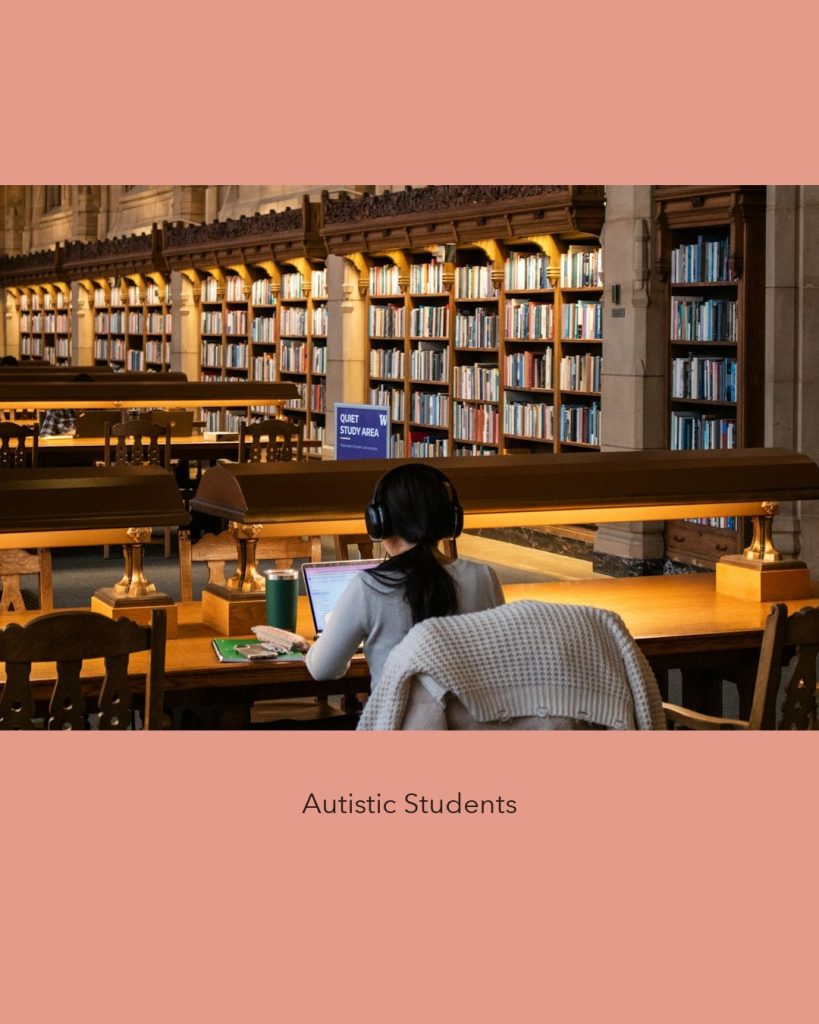
A gentle, research-informed guide for Autistic and otherwise neurodivergent students aged 18 and over at universities and colleges in the UK, and for the families, friends and staff who support us. Starting university or college is a big change for anyone. For many of us it means new sensory environments, new routines, new people and new systems, all at once, often while masking hard and running on empty. Research shows that Autistic students bring real strengths, and that understanding, good relationships and the right support make a big difference (Gurbuz et al., 2019; Scott & Sedgewick, 2021). So let’s start with the most important thing: your access needs are not a favour. You have rights.
A note on words
I use identity-first language (Autistic person, Autistic student) because many in our community prefer it, but please use the words that feel right for you (Botha et al., 2023). I write Autistic and non-Autistic with a capital A, as a word of identity and culture. Self-identification is valid, and so is not being sure yet. You do not need a diagnosis to belong here, and you do not need a formal diagnosis to be protected by the law (more on that below).
You can read more in my Neuro-Affirming Glossary.
For more organisations, practitioners and support, please visit my community signposting page.
What university can be like
University can be a place of real freedom. You may get to study what you love in depth, choose more of your own routine, and meet people who share your interests. It can also be a lot. Lectures move fast, timetables change, halls are noisy, and much of the “hidden curriculum” is never written down. Many Autistic students spend their first term working out systems alone, without knowing what they are allowed to ask for.
An access need is anything you need to take part fully. That could be slides before a lecture, a quiet place to take exams, written instructions, permission to leave the room, or using headphones in the library. Access needs aren’t about being “less able”. They are about removing barriers. You don’t have to call yourself disabled to ask for support. But if you are Autistic, the law will usually treat you as disabled, and that protection is there whenever you need it.
What research tells us about Autistic students
More Autistic people are going to university, and research is starting to listen to Autistic students themselves. Here is some of what it has found. Some of these papers use deficit-based or person-first language. I have included them because they help us understand where the research is, and where it still needs to go.
Getting ready for university
When 25 Autistic students getting ready to start university took part in focus groups, they talked about the social world, academic demands, the practical side of living at university, leaving the “scaffolding” of home, and becoming an adult. They shared hopes as well as worries (Lambe et al., 2019). Starting well matters, and so does planning for the practical things, not only the academic ones.
Strengths and challenges
In a UK survey of 26 Autistic and 158 non-Autistic students, Autistic students reported more challenges on the social side of university, including low autism awareness from others. They also reported more mental health difficulties and more thoughts of leaving. They described many academic strengths too (Gurbuz et al., 2019).
In interviews with 12 Autistic university students, relationships “tied everything together”. When relationships with staff and peers were supportive, things went well. When they were shaped by stigma, university became much harder. The researchers found that Autistic students can and do thrive at university, and that better autism knowledge among staff would make a real difference (Scott & Sedgewick, 2021).
Masking, burnout and mental health
Many of us mask, hiding or changing our natural ways of being to get by. Masking is often a response to stigma, rather than a free choice (Pearson & Rose, 2021), and many of us find it exhausting. Autistic burnout is long-term exhaustion, loss of skills and reduced tolerance for sensory input, after chronic stress without enough support (Raymaker et al., 2020).
A study of 70 Autistic and 315 non-Autistic UK students during the COVID-19 pandemic found that Autistic students had higher levels of burnout and mental health symptoms, and were more likely to have thought about dropping out (Cage & McManemy, 2022). The authors call for better academic and social support for Autistic students.
Leaving university, and what that teaches us
In interviews with 14 Autistic people who had left university, people described difficulties getting diagnosed, a lack of autism understanding, mental health struggles and feeling like an outsider. At university they described culture shock, becoming disengaged, a lack of proactive support, and a sense that leaving had become inevitable. Afterwards, many felt the experience had been traumatic and shameful, but also that people have to do what is right for them (Cage & Howes, 2020). If you have left a course, you have not failed. The researchers call on universities to offer clear support from the very start, without waiting to be asked, and to make the whole environment more accessible.
Assessment: exams, presentations and group work
Assessment comes up again and again when researchers listen to Autistic students. In the UK survey above, Autistic students described oral presentations as extremely stressful and unclear expectations as a real barrier, and said structure and smaller assignments helped. Some found group assessment hard and suggested an individual written option instead (Gurbuz et al., 2019). Exams and presentations were also a source of anxiety for the students Scott and Sedgewick (2021) interviewed.
A participatory study in England, designed by Autistic and non-Autistic students and staff together, found that extra time in exams, extensions and mentoring were the supports students used most and found most useful. But agreed support was often ignored or only partly put in place, students had to fight for it, and their support plans did not cover group work (Dexter et al., 2024). In a 2025 UK survey of more than 1,100 disabled students, 46% believed they had been given a lower mark because an assessment was not accessible to them (Disabled Students UK, 2026).
There is still very little research testing which academic adjustments work best, and much of what exists is low quality (Anderson et al., 2019). So researchers increasingly argue for designing assessment to be inclusive from the start, so that the assessment itself is fair and fewer students have to ask for changes one by one (Tai et al., 2023). The Office of the Independent Adjudicator says the same in its good practice framework, and points out that a time limit on its own is not usually a competence standard (OIA, n.d.). That matters, because it means the way you are assessed can usually be adjusted.
Is support reaching students?
A review of research on neurodivergent students in higher education found that support services and technology do exist, but there is a gap between what is offered and what students actually need, and fear of stigma makes that gap wider (Clouder et al., 2020). Writing from Arden University, Farrant and colleagues (2022) call on universities to move beyond awareness and celebrate neurodiversity among staff and students. They suggest practical steps such as relaxed, flexible teaching with breaks, sensory-aware rooms, clear assignment briefs and examples, treating extensions as a reasonable adjustment, alternative assessments and peer buddies. They also warn that relying on students to disclose leaves many people without support.
National surveys tell a similar story. In the 2026 National Student Survey (NSS), disabled students in England were less positive than other students on every theme, with the biggest gaps in how courses are organised and managed and whether students feel their voice is heard (Office for Students, 2026). For organisation and management, 75.5% of disabled students were positive, against 82.4% of students with no reported disability (Johnston & Wilkinson, 2026). In 2023, the NSS group that includes Autistic students (“social or communication impairment”, which also includes some people who are not Autistic) was less positive than students with no reported disability about how well courses were organised and how changes to teaching were communicated (Dickinson, 2023).
In Disabled Students UK’s 2025 survey of more than 1,100 disabled students, only 44% said all their agreed adjustments had been put in place, and 63% had gone without support because getting it took too much effort. More than four in ten of the students who took part were Autistic (Disabled Students UK, 2026). If you find yourself chasing support that was already agreed, you are not alone, and it is not your fault. That is one reason the Autistic Student Bundle includes emails you can copy and a way to keep a record.
There is good news too. A 2026 Freedom of Information study found that 82% of the UK universities that replied make adjustments straight away for students who may be Autistic but have no formal diagnosis, although only 2% have a written policy on it (Cross, 2026). So it is always worth asking, diagnosis or not.
After university: work and graduate outcomes
Work and careers matter to many of us, and national data show the system is not yet working well for Autistic graduates. The Graduate Outcomes survey asks UK graduates what they are doing 15 months after they finish. The AGCAS What Happens Next? report uses it to look at disabled graduates. Of Autistic first-degree graduates from 2021/22, 43% were in full-time work, compared with 60% of graduates with no known disability, and 12% were unemployed, compared with 5%. This was the biggest gap of any disability group. Autistic graduates were also the least likely to be on a permanent contract (40%, against 56%), and more likely to be in jobs that did not need their degree (Toogood, 2025). The Buckland Review of Autism Employment, using an earlier edition of the same report, found Autistic graduates were twice as likely to be unemployed as non-disabled graduates (Buckland, 2024).
Researchers point to barriers in recruitment and employer attitudes, and to some graduates choosing not to disclose (Vincent & Ralston, 2024). There are signs of change. Full-time work for Autistic postgraduate taught graduates rose from 40% in 2019/20 to 48% in 2021/22, and Autistic graduates were more likely than others to say they took a job to gain and broaden their experience (Toogood, 2025). Autistic graduates study across the full range of subjects and go on to work in every sector, and some choose part-time work for flexibility or to manage their energy (Vincent & Ralston, 2024). Researchers recommend mentoring, disability and careers services working together, and support to recognise your strengths and advocate for yourself (Vincent & Ralston, 2024). These figures only count graduates who told their university they are Autistic, so the real picture may be different.
If you are thinking about work, your university careers service can help while you study and often for a while after you graduate. Ask whether they offer one-to-one appointments, help with telling employers and asking for adjustments at interview, and supported placements or internships. Access to Work can help pay for support at work in England, Scotland and Wales, and Access to Work (NI) does the same in Northern Ireland.
What helps
Specialist mentoring can help. An evaluation of a specialist mentoring programme found that students received academic, social and emotional support, and that the quality of the relationship between mentee and mentor mattered most. Mentoring worked best as a tailored partnership (Lucas & James, 2018). In the UK, specialist mentoring can be funded through Disabled Students’ Allowance (see below).
Communication is a two-way street. The double empathy problem describes how misunderstandings between Autistic and non-Autistic people go both ways, rather than being a problem inside the Autistic person (Milton, 2012). In one study, Autistic people passed on information to each other as well as non-Autistic people did with each other. Mixed groups passed on less, and reported lower rapport (Crompton et al., 2020). This is one reason why time with other Autistic people can feel so restful.
Monotropism describes minds that tend to pull most of their attention into a few interests at a time, creating deep tunnels of focus (Murray et al., 2005). Planning around how your attention works, rather than against it, can make study days feel much more possible.
Across these studies, the same things come up again and again: support offered early and proactively, staff who understand autism, good relationships, tailored mentoring, accessible environments, and time with people who get you.
Your rights
In England, Scotland and Wales, the law is the Equality Act 2010. In Northern Ireland, it’s the Special Educational Needs and Disability (Northern Ireland) Order 2005, known as SENDO.
Under these laws, universities and colleges must:
- make reasonable adjustments so disabled students aren’t at a substantial disadvantage, in teaching, assessment, buildings, communication and the way rules are applied
- plan ahead. In all four countries the duty is anticipatory, which means universities should think about disabled students’ needs before anyone has to ask.
They also must not treat you badly because of something linked to your disability, like needing breaks or missing a seminar during burnout, unless they can justify it. The law on this is worded differently in Northern Ireland and can be harder to use there, so get advice early.
In England, Scotland and Wales the Equality Act says you cannot be charged for a reasonable adjustment. Northern Ireland’s law doesn’t say this in the same words. If you are asked to pay for an adjustment in Northern Ireland, contact the Equality Commission for Northern Ireland.
You don’t need a diagnosis to be protected
The legal test is about the effect on your day-to-day life, so you don’t need a formal diagnosis to be protected. In 2024 the Equality and Human Rights Commission published an advice note following the case of University of Bristol v Abrahart. It says the duty to make reasonable adjustments can apply even if a student has no formal diagnosis and hasn’t registered with the disability service, especially where the need is urgent or serious. That advice covers England, Scotland and Wales.
Wherever you study, telling your university in writing gives you the strongest protection.
What universities don’t have to change
Universities don’t have to change a genuine “competence standard”: the level of knowledge or skill your course requires. But how you are assessed, such as a live presentation or a timed exam, is rarely a competence standard in itself, so it can usually be adjusted.
Disabled Students’ Allowance (DSA)
DSA pays for study support you need because of a disability: specialist equipment and assistive software, a specialist mentor or study skills support, and some extra travel costs. It’s based on your needs, not your household income, and you don’t normally pay it back.
A few things to know:
- You need written evidence. For autism this usually means a letter or report confirming your diagnosis. If you’re still waiting for an assessment, ask your disability service what they can put in place now. Adjustments don’t depend on DSA.
- Don’t buy equipment before your needs assessment. You won’t get the money back.
- In England you pay the first £200 towards a new computer. DSA no longer pays for basic spelling and grammar software, and the Government has proposed further cuts to the software it pays for, so check GOV.UK for the latest.
- In Scotland you apply again each year, and SAAS may ask for some of your DSA back if you leave your course early.
- In Northern Ireland, if you are asked to pay for an adjustment, contact the Equality Commission for Northern Ireland.
- If you can’t get DSA (most international students and degree apprentices can’t), your university’s duty to make reasonable adjustments still applies to you.
Where to apply:
- England: GOV.UK – Disabled Students’ Allowance
- Scotland: SAAS – Disabled Students’ Allowance
- Wales: Student Finance Wales – DSA
- Northern Ireland: Student Finance NI – DSA
Adjustments that often help
Every Autistic person is different, so these are ideas, not a checklist:
- slides and reading at least 48 hours before sessions, plus recordings and captions
- clear, written instructions and marking criteria, with examples
- not being asked to speak without warning, and being able to contribute in writing
- warning before room changes and fire drills
- exam arrangements such as a smaller room, rest breaks or extra time
- flexible deadlines, or a simple way to get an extension
- an alternative to live presentations
- a quiet flat in halls
- a specialist mentor through DSA.
How to ask
- Contact your university’s disability or inclusion service. You can do this before you start, through UCAS or by email, or at any point during your course.
- Agree a support plan. It might be called a Student Support Plan, Learning Support Plan or Inclusion Plan. Check that it’s shared with your lecturers.
- Tell your module leaders what helps on their modules. A one-page profile saves you explaining everything over and over.
- Review it each term. Your needs can change, and that’s OK.
If phone calls are hard, say so and ask to arrange things by email. That’s an adjustment too.
When things go wrong
Sometimes agreed adjustments don’t reach the classroom. If that happens:
- keep a record: dates, what happened, who you told
- email the person involved, then your disability adviser
- get independent advice from your Students’ Union advice centre, the Disability Rights UK Disabled Students Helpline (England), Lead Scotland (Scotland), the Equality Advisory and Support Service (England, Scotland and Wales) or the Equality Commission for Northern Ireland
- make a formal complaint through your university’s process
- if you’re still unhappy, go to the ombudsman:
These bodies are free, and they can recommend that a university puts things right. They can’t rule that a university broke discrimination law. Only a court can do that, and the deadline is short: a claim must normally be started within six months of what happened, and using the university’s complaints process doesn’t stop the clock. So get advice early.
College and sixth form
Further education colleges and sixth form colleges have the same Equality Act duties as universities (SENDO in Northern Ireland), including thinking about lighting, noise and layout. What happens to a plan from school depends on your UK country:
- England: an EHC plan can carry on at college, up to the end of the academic year you turn 25, and colleges must use their “best endeavours” to get you the support you need. From 16 you make decisions about your plan yourself.
- Wales: a college must decide whether you have additional learning needs and, if you do, keep an Individual Development Plan up to 25. You can say no to having one.
- Scotland: the Additional Support for Learning Act covers school, not college. Before you leave school, the council must share information with your college if you agree.
- Northern Ireland: a statement covers school only. Your transition plan helps the college prepare, and colleges have duties under SENDO.
Your college decides on exam access arrangements (JCQ rules in England, Wales and Northern Ireland; Qualifications Scotland in Scotland, with no diagnosis needed). There may be money to help you stay in learning: the 16 to 19 Bursary Fund in England, and Education Maintenance Allowance in Wales, Scotland and Northern Ireland.
All of who you are
Being Autistic is one part of who you are. Your gender, sexuality, race, culture, faith, age, class and family life shape your experience too. Kimberlé Crenshaw (1989) called this intersectionality: barriers that add up and change each other. Transgender and gender-diverse people are three to six times more likely to be Autistic than cisgender people (Warrier et al., 2020), and Autistic people are more likely to describe themselves as bisexual, gay, lesbian or asexual (George & Stokes, 2018). Women, people of colour and older adults are more likely to be diagnosed late, or missed (Lockwood Estrin et al., 2021), and living with stigma has been linked to poorer mental health in Autistic people (Botha & Frost, 2020).
You can ask for your chosen name and pronouns to be used, for your gender identity or sexuality to stay private, for a prayer or quiet room, and for exam timing that respects your faith. Sexual orientation, gender reassignment, race and religion or belief are protected under the Equality Act, as well as disability. Switchboard (0800 0119 100) is there for LGBTQIA+ people across the UK.
Coming back to learning
Many adults find out they are Autistic in their thirties, forties or later. If that is you, you belong in education too. There are many routes in, including Access to HE Diplomas in England and Wales, SWAP in Scotland, Access courses in Northern Ireland, foundation years and part-time study. Disabled Students’ Allowance has no upper age limit, and part-time students can get it too. Ask about recorded lectures, timetables known early and classes grouped onto fewer days if you work, care or travel in.
Energy, burnout and wellbeing
University can be exhausting, and Autistic burnout is real (Raymaker et al., 2020). Masking all day, sensory overload, social demands and constant change all use energy, even when you are enjoying yourself. Build in rest before you need it, protect time for your interests, and notice the early signs: losing speech, skills slipping, everything feeling louder. Burnout is not laziness and it is not failure.
- Plan around your energy, not just your timetable. Leave gaps after busy days, and count travel, queues and social time as energy too.
- Work with your attention. If you are monotropic, deep focus on one thing can be restful, and switching can be tiring. Give yourself time to move between tasks.
- Know your sensory needs. Find your quiet places on campus, and keep your headphones, sunglasses or stim tools close.
- Make a plan on a good day, so it is ready for a hard one.
You can read more in my guides to Autistic Burnout: Signs, Recovery and Resources, Monotropism and Autistic Masking.
Finding your people
There is no right amount of socialising. Some of us want lots of people, some want one or two, and some want time alone most of the time. All of these are fine. Many Autistic people connect best through a shared passion, side by side, or online first. One person you trust can matter more than a big group. Finding your people is not about fixing how you socialise. It is about finding places where your way of being is understood.
- Students’ Union societies. Look for interest-based societies (gaming, anime, board games, books, science, art, music, walking) as well as any neurodivergent, disabled students’ or Autistic societies.
- Disabled students’ networks. Many Students’ Unions have a disabled students’ officer, network or forum. They can tell you about events with fewer sensory demands.
- Your disability or inclusion service. Some run social groups, peer mentoring or quiet study spaces.
- Freshers’ fair tips. Look at the list of societies online first and pick two or three to visit. Many fairs have a quiet hour or a quieter day, so ask your Students’ Union.
- Autistic-led groups. Groups run by and for Autistic people, in person and online. You will find many in my lists of Autistic-led organisations, charities and social media to follow and on my community signposting page.
- For families in England. Autism Central offers free NHS peer education for families and supporters of Autistic people. One to share with a parent, partner or carer.
Support and crisis lines
If you’re struggling, your university’s wellbeing service is a good place to start. You can also contact:
- Samaritans: 116 123, free, any time
- Shout: text SHOUT to 85258, free, any time
- England: call 111 and choose the mental health option
- Scotland: call NHS 24 on 111
- Wales: call 111 and press 2
- Northern Ireland: call Lifeline on 0808 808 8000, free, any time. There’s no 111 mental health line in Northern Ireland, so you can also contact your GP or the GP out-of-hours service, or go to an emergency department
- Student Minds – life as a neurodivergent student
In an emergency, call 999 or go to A&E. You will find more on my support and crisis lines page.
Tools to help: the Autistic Student Bundle
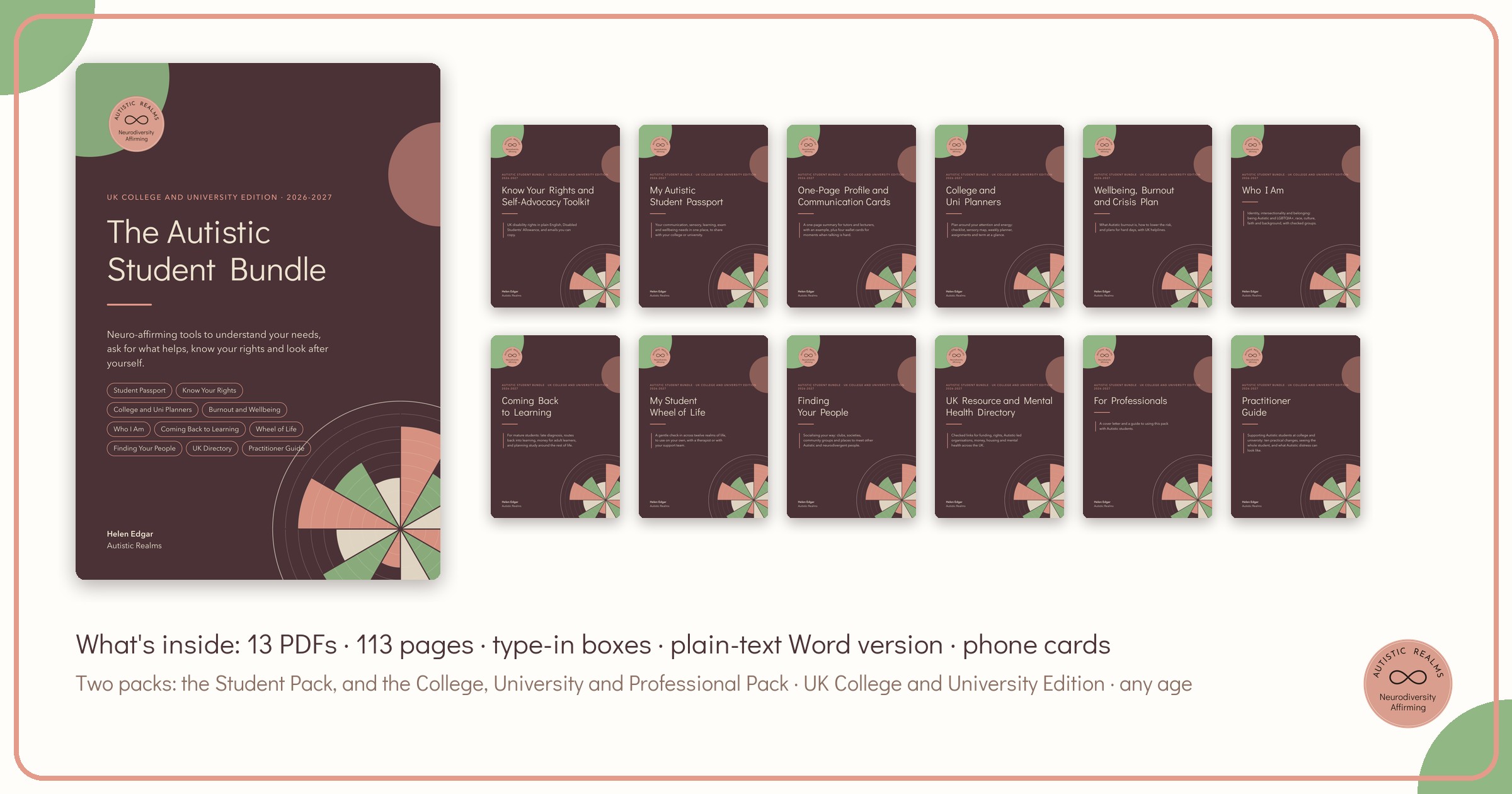
I made the Autistic Student Bundle (UK College and University Edition 2026-2027) because so many Autistic students, of every age, are left to work out college and university systems alone. It is a set of neuro-affirming tools to help you understand your needs, ask for what helps, know your rights and look after yourself. The PDFs have boxes you can type into, and there is a plain-text Word version too.
- Start Here: where to begin, and how to use the files on screen or on paper.
- Know Your Rights and Self-Advocacy Toolkit: UK disability rights in plain English, your rights at college in each UK country, money at college, DSA, telling people, what to do if adjustments aren’t happening, and emails you can copy.
- My Autistic Student Passport: your communication, sensory, learning, exam and wellbeing needs in one place, to share with your college or university.
- One-Page Profile and Communication Cards: a one-page summary for tutors and lecturers, with a filled-in example, plus wallet cards for moments when talking is hard.
- College and Uni Planners: monotropism and your attention, getting-ready checklists for college and university, a campus sensory map, a weekly energy planner, assignment breakdown and term at a glance.
- Wellbeing, Burnout and Crisis Plan: what Autistic burnout is and how to lower the risk, wellbeing traffic lights, a burnout plan and a crisis plan with UK helplines.
- NEW: Who I Am: identity, intersectionality and belonging, including being Autistic and LGBTQIA+, race, culture, faith and background, with checked groups.
- NEW: Coming Back to Learning: for mature students, with late diagnosis, routes back into learning, money for adult learners and a planner for study around work, caring and travel.
- My Student Wheel of Life: a gentle check-in across twelve realms of life, on your own, with a therapist or with your support team.
- Finding Your People: socialising your way, clubs and societies, community groups across the UK, and things you can say.
- UK Resource and Mental Health Directory: checked links for funding, rights, complaints, Autistic-led organisations, money, housing, college money and mental health across all four UK countries.
- For Professionals: a cover letter and short guide to give to the disability advisers, mentors, tutors and therapists who support you.
- Practitioner Guide: ten practical changes, seeing the whole student (including under-18s at college, identity and mature students), double empathy, and what Autistic distress can look like.
The Student Pack is for one student, £9.99. The College, University and Professional Pack has the same tools, ordered for staff: a practitioner licence for one adviser, mentor, tutor or therapist (£49.99 a year), and a site licence for a university or college (please contact me for a price).
The checked student links are free for everyone, and you can read more in my blog post Your access needs, your rights: a guide for Autistic students at UK universities.
For staff and professionals
If you work with Autistic students, as a disability adviser, mentor, tutor, lecturer, counsellor or therapist, thank you. Small changes make a big difference: clear written information, warning before changes, flexible ways to take part, and believing students when they tell you what they need. The University and Professional Pack has the same tools as the Student Pack, ordered for staff, with a cover letter, a guide to using the pack and the Practitioner Guide for college and university staff. You can use it with the students you support under a practitioner licence, or across a whole site under a site licence.
What the research suggests for assessment and careers
- Ask, don’t assume. Support works less well when staff guess what an Autistic student needs (Scott & Sedgewick, 2021).
- Make expectations clear. Give clear briefs, marking criteria and examples, and break large tasks into smaller steps (Gurbuz et al., 2019; Farrant et al., 2022).
- Offer a choice of format where the format is not the competence being tested, such as a written alternative to a live presentation (OIA, n.d.).
- Plan group work at module level. Individual support plans often don’t cover it (Dexter et al., 2024).
- Check agreed adjustments are happening before each assessment, so students don’t have to chase them (Dexter et al., 2024; Disabled Students UK, 2026).
- Join up disability and careers support. Offer mentoring, and make recruitment for placements and internships accessible (Vincent & Ralston, 2024).
I also offer training for universities and colleges.
References
References in APA style, listed alphabetically. Some of these papers use deficit-based or person-first language. I have included them because they help us understand where the research is, and where it still needs to go.
- Anderson, A. H., Stephenson, J., Carter, M., & Carlon, S. (2019). A systematic literature review of empirical research on postsecondary students with autism spectrum disorder. Journal of Autism and Developmental Disorders, 49(4), 1531–1558. https://doi.org/10.1007/s10803-018-3840-2
- Botha, M., & Frost, D. M. (2020). Extending the minority stress model to understand mental health problems experienced by the autistic population. Society and Mental Health, 10(1), 20–34. https://doi.org/10.1177/2156869318804297
- Botha, M., Hanlon, J., & Williams, G. L. (2023). Does language matter? Identity-first versus person-first language use in autism research: A response to Vivanti. Journal of Autism and Developmental Disorders, 53(2), 870–878. https://doi.org/10.1007/s10803-020-04858-w
- Buckland, R. (2024). The Buckland review of autism employment: Report and recommendations. Department for Work and Pensions. https://www.gov.uk/government/publications/the-buckland-review-of-autism-employment-report-and-recommendations
- Cage, E., & Howes, J. (2020). Dropping out and moving on: A qualitative study of autistic people’s experiences of university. Autism, 24(7), 1664–1675. https://doi.org/10.1177/1362361320918750
- Cage, E., & McManemy, E. (2022). Burnt out and dropping out: A comparison of the experiences of autistic and non-autistic students during the COVID-19 pandemic. Frontiers in Psychology, 12, 792945. https://doi.org/10.3389/fpsyg.2021.792945
- Clouder, L., Karakus, M., Cinotti, A., Ferreyra, M. V., Amador Fierros, G., & Rojo, P. (2020). Neurodiversity in higher education: A narrative synthesis. Higher Education, 80(4), 757–778. https://doi.org/10.1007/s10734-020-00513-6
- Crenshaw, K. (1989). Demarginalizing the intersection of race and sex: A Black feminist critique of antidiscrimination doctrine, feminist theory and antiracist politics. University of Chicago Legal Forum, 1989(1), 139–167.
- Crompton, C. J., Ropar, D., Evans-Williams, C. V. M., Flynn, E. G., & Fletcher-Watson, S. (2020). Autistic peer-to-peer information transfer is highly effective. Autism, 24(7), 1704–1712. https://doi.org/10.1177/1362361320919286
- Cross, K. (2026, November 4). Autism support without diagnosis is widely offered – but on what terms? Wonkhe. https://wonkhe.com/blogs/autism-support-without-diagnosis-is-widely-offered-but-on-what-terms
- Dexter, S., Grace, K., Quinnell, S.-L., Surrey, A., & Crane, L. (2024). Towards ‘a level playing field’: A participatory study of autistic university students’ experiences with academic support in England. International Journal of Disability, Development and Education, 72(1), 26–41. https://doi.org/10.1080/1034912X.2024.2317475
- Dickinson, J. (2023, November 9). What lies behind student satisfaction differences by characteristic? Wonkhe. https://wonkhe.com/blogs/what-lies-behind-student-satisfaction-differences-by-characteristic/
- Disabled Students UK. (2026). 2025 Access insights report. https://disabledstudents.co.uk/2025-access-insights-report-3/
- Farrant, F., Owen, E., Hunkins-Beckford, F. L., & Jacksa, M. (2022, May 9). Celebrating neurodiversity in higher education. The Psychologist. British Psychological Society. https://www.bps.org.uk/celebrating-neurodiversity-higher-education
- George, R., & Stokes, M. A. (2018). Sexual orientation in autism spectrum disorder. Autism Research, 11(1), 133–141. https://doi.org/10.1002/aur.1892
- Gurbuz, E., Hanley, M., & Riby, D. M. (2019). University students with autism: The social and academic experiences of university in the UK. Journal of Autism and Developmental Disorders, 49(2), 617–631. https://doi.org/10.1007/s10803-018-3741-4
- Johnston, D., & Wilkinson, M. (2026, August 14). Data isn’t enough to fix the disabled student experience gap. Wonkhe. https://wonkhe.com/blogs/data-isnt-enough-to-fix-the-disabled-student-experience-gap/
- Lambe, S., Russell, A., Butler, C., Fletcher, S., Ashwin, C., & Brosnan, M. (2019). Autism and the transition to university from the student perspective. Autism, 23(6), 1531–1541. https://doi.org/10.1177/1362361318803935
- Lockwood Estrin, G., Milner, V., Spain, D., Happé, F., & Colvert, E. (2021). Barriers to autism spectrum disorder diagnosis for young women and girls: A systematic review. Review Journal of Autism and Developmental Disorders, 8, 454–470. https://doi.org/10.1007/s40489-020-00225-8
- Lucas, R., & James, A. I. (2018). An evaluation of specialist mentoring for university students with autism spectrum disorders and mental health conditions. Journal of Autism and Developmental Disorders, 48(3), 694–707. https://doi.org/10.1007/s10803-017-3303-1
- Milton, D. E. M. (2012). On the ontological status of autism: The ‘double empathy problem’. Disability & Society, 27(6), 883–887. https://doi.org/10.1080/09687599.2012.710008
- Murray, D., Lesser, M., & Lawson, W. (2005). Attention, monotropism and the diagnostic criteria for autism. Autism, 9(2), 139–156. https://doi.org/10.1177/1362361305051398
- Office for Students. (2026, July 8). National Student Survey 2026 finds students’ views of their experiences of higher education are continuing to improve [Press release]. https://www.officeforstudents.org.uk/news-blog-and-events/press-and-media/national-student-survey-2026-finds-students-views-of-their-experiences-of-higher-education-are-continuing-to-improve/
- Office of the Independent Adjudicator for Higher Education. (n.d.). Good practice framework: Supporting disabled students. Removing obstacles to learning. https://www.oiahe.org.uk/resources-and-publications/good-practice-framework/supporting-disabled-students/removing-obstacles-to-learning/
- Pearson, A., & Rose, K. (2021). A conceptual analysis of autistic masking: Understanding the narrative of stigma and the illusion of choice. Autism in Adulthood, 3(1), 52–60. https://doi.org/10.1089/aut.2020.0043
- Raymaker, D. M., Teo, A. R., Steckler, N. A., Lentz, B., Scharer, M., Delos Santos, A., Kapp, S. K., Hunter, M., Joyce, A., & Nicolaidis, C. (2020). “Having all of your internal resources exhausted beyond measure and being left with no clean-up crew”: Defining autistic burnout. Autism in Adulthood, 2(2), 132–143. https://doi.org/10.1089/aut.2019.0079
- Scott, M., & Sedgewick, F. (2021). ‘I have more control over my life’: A qualitative exploration of challenges, opportunities, and support needs among autistic university students. Autism & Developmental Language Impairments, 6. https://doi.org/10.1177/23969415211010419
- Tai, J., Ajjawi, R., Bearman, M., Boud, D., Dawson, P., & Jorre de St Jorre, T. (2023). Assessment for inclusion: Rethinking contemporary strategies in assessment design. Higher Education Research & Development, 42(2), 483–497. https://doi.org/10.1080/07294360.2022.2057451
- Toogood, C. (2025). What happens next? 2025: A report on the outcomes of disabled graduates from the 2021/22 academic year. Association of Graduate Careers Advisory Services (AGCAS). https://www.agcas.org.uk/Knowledge-Centre/What-Happens-Next-report-2025
- Vincent, J., & Ralston, K. (2024). Uncovering employment outcomes for autistic university graduates in the United Kingdom: An analysis of population data. Autism, 28(3), 732–743. https://doi.org/10.1177/13623613231182756
- Warrier, V., Greenberg, D. M., Weir, E., Buckingham, C., Smith, P., Lai, M.-C., Allison, C., & Baron-Cohen, S. (2020). Elevated rates of autism, other neurodevelopmental and psychiatric diagnoses, and autistic traits in transgender and gender-diverse individuals. Nature Communications, 11, 3959. https://doi.org/10.1038/s41467-020-17794-1
Further reading on Wonkhe
Wonkhe writes about higher education policy. These pieces are useful if you want to go deeper:
- Abrahart, D. (2024, September 27). How to become competent over competence standards. What competence standards are, and why how you are assessed can still be adjusted.
- Blake, S. (2023, March 21). Neurodiverse students need more than just accommodations. Why practical fixes need to go alongside real inclusion and understanding.
- Dickinson, J. (2026, March 26). DfE proposes to strip most assistive software out of Disabled Students’ Allowance. The proposed DSA software changes in England.
What would you add?
Are you an Autistic student, or do you support one? If you know of Autistic-led groups, research or resources that should be here, especially from people whose voices are often missing, I would love to hear from you. This guide grows with our community.
This guide is for information and self-advocacy. It is not legal or medical advice. Law and service details were checked in November 2026. Rules and services change, so please check details before relying on them.
Last reviewed: November 2026