A gentle guide to masking for Autistic, ADHD and AuDHD people, families and professionals, with research, resources and ideas for unmasking at your own pace. Masking is something many of us learned in order to stay safe, and research now shows how much it can cost us (Hull et al., 2017; Pearson & Rose, 2021). You are not doing anything wrong by masking, and you do not have to stop all at once.
What is masking?
“The Mask is a living, breathing projection of self, a double consciousness, an acceptable closet, a stigma driven suppression of the authentic you, that both controls and envelopes you, that both keeps you safe and harms you, that grows and develops over a life-span forcing you to dissociate from it.”
Kieran Rose, The Autistic Advocate
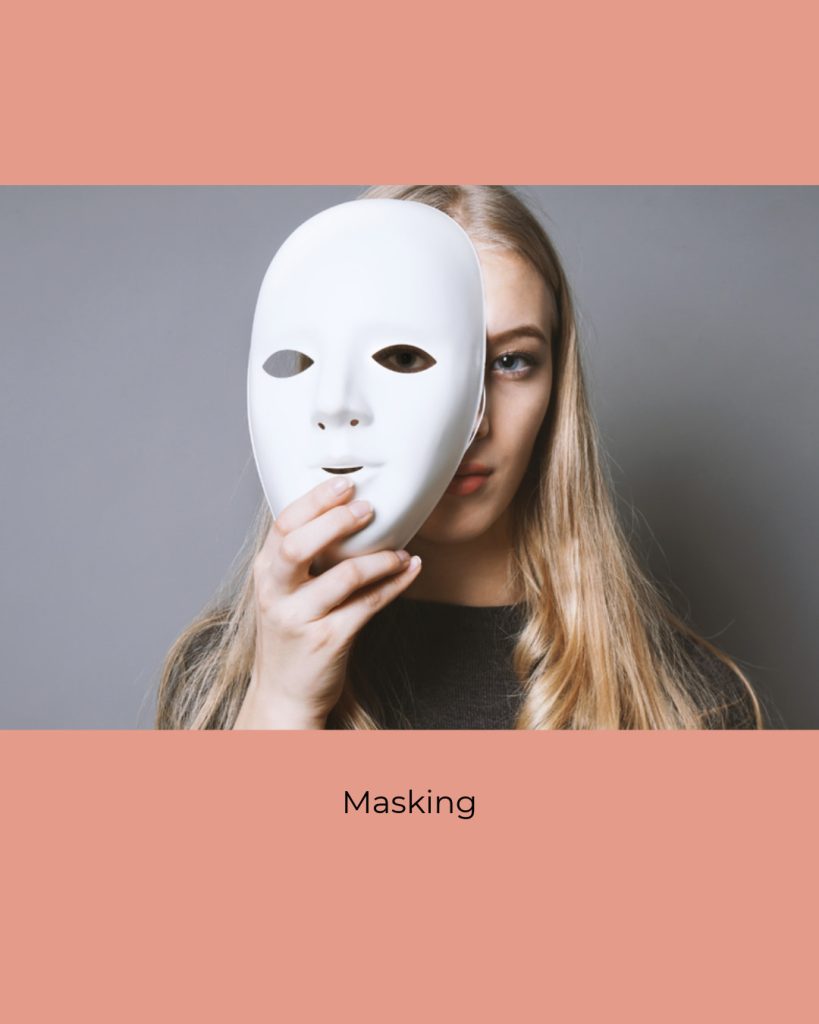
In plain language, masking (also called camouflaging) is when we hide, change or tone down our natural Autistic or ADHD ways of being so that we seem to fit in with neurotypical expectations. It can be conscious or happen without us noticing, and it often begins in childhood.
Researchers describe three broad parts to masking (Hull et al., 2017, 2019): masking itself, such as hiding stims, forcing eye contact or copying facial expressions; compensating, such as scripting conversations or studying social rules; and assimilating, such as performing being sociable even when it feels exhausting. A recent review describes many more everyday strategies and shows how much they depend on where we are and who we are with (Nel et al., 2025).
Masking is not dishonesty, and it is not a personality flaw. Pearson and Rose (2021) describe it as a response to stigma, shaped by an “illusion of choice”: we may seem to choose to mask, but often the real choice is between masking and being misunderstood, excluded or harmed. Through a double empathy lens, the pressure to mask comes from a mismatch between neurotypes, not from something broken in us (Milton, 2012). Non-autistic people form less favourable first impressions of Autistic people within seconds, based on how we come across rather than what we say (Sasson et al., 2017), and in real conversations Autistic people’s scores on standard social skills tests tell us very little about how the conversation goes (Morrison et al., 2020). Autism acceptance training can shift non-autistic people’s attitudes, though some hidden biases are harder to change (Jones et al., 2021).
Why we mask
- To stay safe. Many of us mask to avoid bullying, rejection, discrimination or violence. Higher camouflaging is linked with higher experiences of autism-related stigma (Perry et al., 2022). Autistic adults describe being hurt or taken advantage of by people they know, and say masking parts of themselves to stay safe in relationships leaves them exhausted (Pearson et al., 2022; Pearson et al., 2023).
- To get by in formal spaces. School, work and health appointments are places where many of us mask most (Cage & Troxell-Whitman, 2019). Autistic people describe masking at work to keep customers and colleagues comfortable, often at a cost to their health and careers (Sherwood et al., 2026). Autistic college students in one study rarely told others they were autistic, and decided person by person whether telling would help them be understood as themselves (Frost et al., 2019).
- To connect. Masking can be a way of trying to make friends and belong (Hull et al., 2017). The longing to connect is real and valid; the problem is a world that asks us to hide in order to be accepted.
- Because we were taught to. Many of us learned as children that our natural ways of moving, speaking and feeling were “wrong”. Over time, masking can become automatic, and we may lose touch with who we are underneath (Miller et al., 2021).
Masking and intersectionality
Masking does not happen in a vacuum. The pressure to mask is shaped by racism, sexism, homophobia, transphobia, classism and other systems of power. Autistic women and girls, and gender-diverse Autistic people, report higher levels of camouflaging, and this is one reason many are recognised late or not at all (McQuaid et al., 2022). Young people describe how masking shapes their developing sense of who they are (Drapalik et al., 2025). LGBTQIA+ Autistic people may be masking several parts of themselves at once (McQuaid et al., 2025). For Black and Global Majority Autistic people, masking can overlap with racialised code-switching, and being visibly Autistic can carry extra risk in schools, services and policing (Roberts, 2024). An Autistic multiracial Latina researcher describes a “dual masking phenomenon”: masking Autistic traits while also adapting to Whiteness to be accepted, including within White-led Autistic spaces (Benedetto, 2026). Unmasking safely is therefore not equally available to everyone, and that is a reason for systems to change, not for anyone to feel they are failing.
The cost of masking
Masking takes a lot of energy. Through a monotropism lens, it pulls our attention away from our interests and our bodies and spends it on constant self-monitoring, which leaves very little left for rest, flow and regulation.
- Exhaustion and burnout. Autistic adults describe masking and the demands of an unaccommodating world as central causes of Autistic burnout (Bulluss & Sesterka, 2020; Higgins et al., 2021; Mantzalas, Richdale, Adikari, et al., 2022; Mantzalas, Richdale, & Dissanayake, 2022; Raymaker et al., 2020). Autistic children and young people describe burnout, meltdown and shutdown too, and say they are often misunderstood by the adults around them (Phung et al., 2021).
- Mental health. Higher camouflaging is linked with more anxiety, depression and stress in adults and adolescents (Bernardin et al., 2021; Cook et al., 2021; Hodge & Meltzoff, 2026), with Autistic women especially affected (Cuni & Cantero-García, 2026). Masking is also connected with lower self-esteem and feeling less authentic (Evans et al., 2024).
- Suicidality. Camouflaging has been identified as a risk marker for suicidal thoughts and behaviours in Autistic adults (Cassidy et al., 2018). If you are struggling right now, please see the support and crisis lines page.
- Identity and being seen. Masking can delay recognition and diagnosis, and can leave people feeling they do not know who they really are (Bradley et al., 2021; Quinlan & Emery, 2026). Emerging work is also exploring how masking may interact with hormonal changes across the menstrual cycle (G. A. Grant & Gall, 2026). One study of Autistic women found that camouflaging was linked with distress, but that gender stereotypes and narrow assessment tools, more than masking itself, explained late recognition (Gonçalves Garcia et al., 2026).
- Physical health. Camouflaging has been linked with more symptoms of central sensitivity conditions such as fibromyalgia, migraine and irritable bowel syndrome, and Autistic people living with these conditions describe a heavier impact on their lives (S. Grant et al., 2026).
Research in this area is still developing. A twin study found the link between camouflaging and quality of life is complex (Remnélius et al., 2026), and some researchers frame masking as part of wider “impression management” that everyone does, with Autistic people paying a much higher price (Ai et al., 2022). What is consistent across studies is that acceptance helps: feeling accepted by others and by ourselves is linked with better mental health (Cage et al., 2018), while stigma is linked with poorer quality of life (Liu et al., 2026).
Masking, ADHD and AuDHD
Many ADHD and AuDHD people recognise masking too: holding still, hiding restlessness, over-preparing to hide forgetfulness, or working twice as hard to appear organised. A Dutch study found that ADHD adults also report camouflaging (van der Putten et al., 2024), and masking is described by neurodivergent people beyond autism (Miller et al., 2021). Other researchers argue that ADHD-specific ways of understanding and measuring this are still needed (Adamou, 2026). For AuDHD people, masking may mean managing two sets of expectations at once, which can be especially draining.
Unmasking gently
Unmasking is not a test to pass or a new demand. It is about slowly creating more spaces where you can be yourself, when it is safe enough to do so. Mandy (2019) asks whether it is “time to lose the mask”. Because masking is a response to stigma, the responsibility for making that possible sits with the people and systems around us, not only with Autistic people (Pearson & Rose, 2021). Neurodivergent-led research describes unmasking as a gradual, circular process: noticing the need to unmask, understanding your own masking, trying small changes, and managing what follows (Hedlund et al., 2026). Autistic students describe unmasking as both freeing and hard, with the hard parts rooted in other people’s stigma, and unmasking with accepting family was linked with less anxiety and depression (Durben, 2026).
- Notice, without judgement. When, where and with whom do you mask most? Being kind to yourself about it matters: self-compassion is linked with less camouflaging and better mental health (Galvin et al., 2025).
- Start with safe people and places. Many of us unmask first at home, with Autistic friends, or in community spaces.
- Reclaim small things. Let yourself stim, wear what feels right, skip eye contact, script openly, or spend time in your interests. Each one gives back a little energy.
- Find community. Connecting with other neurodivergent people, and feeling accepted for who we are, can be protective (Cage et al., 2018; Perry et al., 2022).
- For families and professionals. Do not ask anyone to unmask; build environments where masking is not needed. Accept stimming, honour different ways of communicating and reduce demands. A child who “seems fine” at school but falls apart at home may be masking, not misbehaving. Clinicians are being encouraged to ask about masking and Autistic identity when understanding someone’s mental health (Lei et al., 2025), and a co-produced Children’s Masking Questionnaire and Good Practice Guide are freely available (Delara et al., 2026).
Masking on this site
- Masking, internalised ableism and imposter syndrome: what we do to survive, and what we are taught to believe
- Unmasking: reclaiming our monotropic attentional resources?
- Autistic burnout: signs, recovery and resources
- Monotropism: a plain-language guide and resources
- Understanding the double empathy problem: a guide for Autistic people and families
- Autistic menopause and perimenopause resources
- Re-Storying Autism course and Building a Positive Autistic Identity
- The neuro-affirming glossary explains words such as masking, camouflaging, neurotypical and double empathy.
Websites and resources
- Kieran Rose: The Autistic Advocate: writing, training and research on masking, including work with Dr Amy Pearson. His Autistic masking page gathers his writing, talks and research links in one place (Rose, n.d.).
- Autistic Girls Network: resources on masking, late recognition and school for Autistic girls and gender-diverse young people.
- Thriving Autistic: Autistic-led programmes and free resources for Autistic adults.
- Stimpunks: a neurodivergent-led foundation writing about stimming, masking and belonging.
- Monotropism.org: the home of monotropism theory, helpful for understanding the energy cost of masking.
- Embrace Autism: CAT-Q: a free online version of the Camouflaging Autistic Traits Questionnaire (Hull et al., 2019), for reflection rather than diagnosis.
- NeuroClastic: Autistic-led writing, including many first-person pieces on masking and unmasking.
Community-led work on masking
- Masking Research Collective: Mental Health and Masking project (Bristol, UK): a co-produced project bringing together Autistic young people, Autistic adults, parents, educators, clinicians and researchers. Together they created the Children’s Masking Questionnaire and a Good Practice Guide (Delara et al., 2026).
- Aucademy (UK): an Autistic-led education community interest company run entirely by Autistic academics, trainers and advocates, with free videos including several sessions on masking.
- NeuroHub Connect (UK): a neurodivergent-led community founded by David Gray-Hammond, with a free community space, blog and resources. It is also home to the Re-Storying Autism and Building a Positive Autistic Identity courses I co-run.
- Participatory Autism Research Collective (PARC) (UK): an Autistic-led network bringing Autistic scholars and activists together with researchers and practitioners, so that Autistic people shape the research done about us (Milton et al., 2019).
- For local peer support groups and Autistic-led spaces where unmasking can feel safer, see my community signposting page.
Blogs and articles
- Autism and masking (AutisticSLT): the hidden challenges of masking and its links with mental health.
- Understanding masking as trauma (AUsome Training).
- Mask on, mask off: How the common understanding of Autistic masking is creating another mask by David Gray-Hammond (2023).
- Autistic masking by Emily Katy (Authentically Emily).
- Lost connections: Interoception and masking by Kelly Mahler (2024): how masking can pull us away from our body’s signals.
- Shifting my unmasking from revealing to unearthing (Powered by Love, 2023).
- Stigma and masking as an Autistic parent by Zoe Williams (Autistic Parents UK, 2025).
- NeuroClastic: masking articles: a collection of Autistic-led writing on masking.
- Fawning and people-pleasing: Fawn: The trauma response that is easiest to miss (Neurodiverse Connection), 5 ways I’m unlearning my fawn response by Sam Dylan Finch (Let’s Queer Things Up, 2020) and the fawn response explained (Modern Intimacy). Many of us recognise fawning as part of our masking.
Videos
- Autistic masking in 3 minutes (Orion Kelly, That Autistic Guy, 2022).
- The 4 types of Autistic masking (I’m Autistic, Now What?, 2023).
- What is Autistic masking and why does it matter? with Jodie Smitten (Pooky Knightsmith Mental Health, 2020).
- Autistic masking: Kieran Rose and Amy Pearson educate Aucademy (Aucademy, 2023).
- Autistic masking REALLY: Kieran Rose educates Aucademy’s Chloe (Aucademy, 2021).
- Autistic masking and introducing Autistic shielding: Katie and Kieran educate Aucademy (Aucademy, 2022).
Podcasts
Podcasts by Autistic and neurodivergent hosts, many of which talk about masking, late discovery and unmasking: 1800 Seconds on Autism, Actually Autistic Educator, AuDHD Flourishing, Autistic Culture Podcast, Autistic Flappy Hour, Autistic Tidbits && Tangents, David’s Divergent Discussions, Divergent Conversations, The Hidden 20%, Late Discovered Club, Meet My Autistic Brain, Neurodivergent Moments, The Neurodivergent Woman, NeuroDiving, Neurotypicals Don’t Juggle Chain-Saws, Sluggish, Thoughty Auti.
Many of the blogs, videos and podcasts above were shared in Thriving Autistic’s Discovery Programme masking resource booklet, gathered from within the Autistic community.
Books
- Pearson, A., & Rose, K. (2023). Autistic masking: Understanding identity management and the role of stigma. Pavilion Publishing.
- Price, D. (2022). Unmasking autism: Discovering the new faces of neurodiversity. Harmony.
- Belcher, H. (2022). Taking off the mask: Practical exercises to help understand and minimise the effects of autistic camouflaging. Jessica Kingsley Publishers.
- Bargiela, S. (2019). Camouflage: The hidden lives of autistic women. Jessica Kingsley Publishers.
- Middleton, E. (2023). Unmasked: Everything they never told you about ADHD, autism and neurodivergence. Penguin Life.
For more books, see the neuro-affirming reading list.
Research and reading
References in APA style, listed alphabetically. This list is checked each month for new neuro-affirming research on masking.
- Adamou, M. (2026). Camouflaging in ADHD: The need for construct validation before clinical adoption. The British Journal of Psychiatry, 229(4), 366–369. https://doi.org/10.1192/bjp.2026.10577
- Ai, W., Cunningham, W. A., & Lai, M.-C. (2022). Reconsidering autistic ‘camouflaging’ as transactional impression management. Trends in Cognitive Sciences, 26(8), 631–645. https://doi.org/10.1016/j.tics.2022.05.002
- Bargiela, S. (2019). Camouflage: The hidden lives of autistic women. Jessica Kingsley Publishers.
- Belcher, H. (2022). Taking off the mask: Practical exercises to help understand and minimise the effects of autistic camouflaging. Jessica Kingsley Publishers.
- Benedetto, M. S. (2026). The “dual masking phenomenon”: A critical autoethnography of an autistic multiracial Latina amid the presence of White autistic researchers and self-advocates. Autism in Adulthood, 8(4), 710–719. https://doi.org/10.1089/aut.2024.0105
- Bernardin, C. J., Lewis, T., Bell, D., & Kanne, S. (2021). Associations between social camouflaging and internalizing symptoms in autistic and non-autistic adolescents. Autism, 25(6), 1580–1591. https://doi.org/10.1177/1362361321997284
- Bradley, L., Shaw, R., Baron-Cohen, S., & Cassidy, S. (2021). Autistic adults’ experiences of camouflaging and its perceived impact on mental health. Autism in Adulthood, 3(4), 320–329. https://doi.org/10.1089/aut.2020.0071
- Bulluss, E., & Sesterka, A. (2020, October 11). Doing more by doing less: Reducing autistic burnout. Psychology Today. https://researchnow.flinders.edu.au/en/publications/doing-more-by-doing-less-reducing-autistic-burnout
- Cage, E., Di Monaco, J., & Newell, V. (2018). Experiences of autism acceptance and mental health in autistic adults. Journal of Autism and Developmental Disorders, 48(2), 473–484. https://doi.org/10.1007/s10803-017-3342-7
- Cage, E., & Troxell-Whitman, Z. (2019). Understanding the reasons, contexts and costs of camouflaging for autistic adults. Journal of Autism and Developmental Disorders, 49(5), 1899–1911. https://doi.org/10.1007/s10803-018-03878-x
- Cassidy, S., Bradley, L., Shaw, R., & Baron-Cohen, S. (2018). Risk markers for suicidality in autistic adults. Molecular Autism, 9, 42. https://doi.org/10.1186/s13229-018-0226-4
- Cook, J., Hull, L., Crane, L., & Mandy, W. (2021). Camouflaging in autism: A systematic review. Clinical Psychology Review, 89, 102080. https://doi.org/10.1016/j.cpr.2021.102080
- Cuni, E., & Cantero-García, M. (2026). Autistic masking and mental health outcomes in autistic women: A systematic review (2015–2025). Journal of Autism and Developmental Disorders. Advance online publication. https://doi.org/10.1007/s10803-026-07557-0
- Delara, L., Ayadi O’Donnell, N., Baldoza, S., Belcher, H., Halsall, J., O’Brien, S., Sanctuary, L., & Hull, L. (2026). Development and pilot evaluation of the Children’s Masking Questionnaire. Frontiers in Psychiatry, 17, 1893936. https://doi.org/10.3389/fpsyt.2026.1893936
- Drapalik, K. N., Magin, D. J., Rinaldi, M. L., & Christodulu, K. V. (2025). Camouflaging and identity development among autistic female and gender-diverse youth: A qualitative exploration. Autism, 29(10), 2535–2549. https://doi.org/10.1177/13623613251345855
- Durben, D. L. (2026). Unmasking: A mixed-methods study of autistic college students’ efforts to stop masking/camouflaging. Journal of Autism and Developmental Disorders. Advance online publication. https://doi.org/10.1007/s10803-026-07409-x
- Evans, J. A., Krumrei-Mancuso, E. J., & Rouse, S. V. (2024). What you are hiding could be hurting you: Autistic masking in relation to mental health, interpersonal trauma, authenticity, and self-esteem. Autism in Adulthood, 6(2), 229–240. https://doi.org/10.1089/aut.2022.0115
- Frost, K. M., Bailey, K. M., & Ingersoll, B. R. (2019). “I just want them to see me as…me”: Identity, community, and disclosure practices among college students on the autism spectrum. Autism in Adulthood, 1(4), 268–275. https://doi.org/10.1089/aut.2018.0057
- Galvin, J., Aguolu, P., Amos, A., Bayne, F., Hamza, F., & Alcock, L. (2025). Self-compassion, camouflaging, and mental health in autistic adults. Autism in Adulthood, 7(3), 324–332. https://doi.org/10.1089/aut.2023.0110
- Gonçalves Garcia, S., da Silveira Simões-Pires, C., Acosta Brum, J., & Centurion Cabral, J. (2026). Taking off the mask: Investigating autism diagnosis and camouflaging in adult women. Autism in Adulthood, 8(4), 677–686. https://doi.org/10.1089/aut.2024.0150
- Grant, G. A., & Gall, A. (2026). Rethinking clinical visibility in autistic females: Autistic camouflaging and menstrual cycle variability. International Journal of Environmental Research and Public Health, 23(8), 1006. https://doi.org/10.3390/ijerph23081006
- Grant, S., Norton, S., & Hoekstra, R. A. (2026). A cross-neurotype analysis of camouflaging and illness perceptions in people with central sensitivity syndromes. Autism in Adulthood, 8(4), 646–663. https://doi.org/10.1089/aut.2024.0186
- Hedlund, Å., Unéus, D., Wik, J., Ingard, C., Isakson, K., Black, M. H., Hirvikoski, T., & Bertilsdotter Rosqvist, H. (2026). Reclaiming selfhood: Towards a conceptualisation of the autistic unmasking process. Frontiers in Psychiatry, 17, 1929738. https://doi.org/10.3389/fpsyt.2026.1929738
- Higgins, J. M., Arnold, S. R. C., Weise, J., Pellicano, E., & Trollor, J. N. (2021). Defining autistic burnout through experts by lived experience: Grounded Delphi method investigating #AutisticBurnout. Autism, 25(8), 2356–2369. https://doi.org/10.1177/13623613211019858
- Hodge, E. K., & Meltzoff, K. K. (2026). The relationship between autistic camouflaging and mental health: A scoping review. Frontiers in Psychiatry, 17, 1701615. https://doi.org/10.3389/fpsyt.2026.1701615
- Hull, L., Mandy, W., Lai, M.-C., Baron-Cohen, S., Allison, C., Smith, P., & Petrides, K. V. (2019). Development and validation of the Camouflaging Autistic Traits Questionnaire (CAT-Q). Journal of Autism and Developmental Disorders, 49(3), 819–833. https://doi.org/10.1007/s10803-018-3792-6
- Hull, L., Petrides, K. V., Allison, C., Smith, P., Baron-Cohen, S., Lai, M.-C., & Mandy, W. (2017). “Putting on my best normal”: Social camouflaging in adults with autism spectrum conditions. Journal of Autism and Developmental Disorders, 47(8), 2519–2534. https://doi.org/10.1007/s10803-017-3166-5
- Jones, D. R., DeBrabander, K. M., & Sasson, N. J. (2021). Effects of autism acceptance training on explicit and implicit biases toward autism. Autism, 25(5), 1246–1261. https://doi.org/10.1177/1362361320984896
- Lei, J., Cooper, K., & Hollocks, M. J. (2025). Psychological interventions for autistic adolescents with co-occurring anxiety and depression: Considerations linked to autism social identity and masking. Autism in Adulthood, 7(6), 663–670. https://doi.org/10.1089/aut.2024.0005
- Liu, B., Zhang, Z., Thomas, N., & Das, S. (2026). Quality of life outcomes associated with stigma in autistic adults and their families: A systematic review. Frontiers in Psychiatry, 17, 1911423. https://doi.org/10.3389/fpsyt.2026.1911423
- Mandy, W. (2019). Social camouflaging in autism: Is it time to lose the mask? Autism, 23(8), 1879–1881. https://doi.org/10.1177/1362361319878559
- Mantzalas, J., Richdale, A. L., Adikari, A., Lowe, J., & Dissanayake, C. (2022). What is autistic burnout? A thematic analysis of posts on two online platforms. Autism in Adulthood, 4(1), 52–65. https://doi.org/10.1089/aut.2021.0021
- Mantzalas, J., Richdale, A. L., & Dissanayake, C. (2022). A conceptual model of risk and protective factors for autistic burnout. Autism Research, 15(6), 976–987. https://doi.org/10.1002/aur.2722
- McQuaid, G. A., Lee, N. R., & Wallace, G. L. (2022). Camouflaging in autism spectrum disorder: Examining the roles of sex, gender identity, and diagnostic timing. Autism, 26(2), 552–559. https://doi.org/10.1177/13623613211042131
- McQuaid, G. A., Lee, N. R., & Wallace, G. L. (2025). Self-reported masking in sexual minority and heterosexual autistic adults. Autism, 29(8), 2137–2150. https://doi.org/10.1177/13623613251335738
- Middleton, E. (2023). Unmasked: Everything they never told you about ADHD, autism and neurodivergence. Penguin Life.
- Miller, D., Rees, J., & Pearson, A. (2021). “Masking is life”: Experiences of masking in autistic and nonautistic adults. Autism in Adulthood, 3(4), 330–338. https://doi.org/10.1089/aut.2020.0083
- Milton, D. E. M. (2012). On the ontological status of autism: The ‘double empathy problem’. Disability & Society, 27(6), 883–887. https://doi.org/10.1080/09687599.2012.710008
- Milton, D., Ridout, S., Kourti, M., Loomes, G., & Martin, N. (2019). A critical reflection on the development of the Participatory Autism Research Collective (PARC). Tizard Learning Disability Review, 24(2), 82–89. https://doi.org/10.1108/TLDR-09-2018-0029
- Morrison, K. E., DeBrabander, K. M., Jones, D. R., Ackerman, R. A., & Sasson, N. J. (2020). Social cognition, social skill, and social motivation minimally predict social interaction outcomes for autistic and non-autistic adults. Frontiers in Psychology, 11, 591100. https://doi.org/10.3389/fpsyg.2020.591100
- Nel, J., Spedding, M., & Malcolm-Smith, S. (2025). Consolidating a framework of autistic camouflaging strategies: An integrative systematic review. Autism, 29(10), 2379–2394. https://doi.org/10.1177/13623613251335472
- Pearson, A., Rees, J., & Forster, S. (2022). “This was just how this friendship worked”: Experiences of interpersonal victimization among autistic adults. Autism in Adulthood, 4(2), 141–150. https://doi.org/10.1089/aut.2021.0035
- Pearson, A., & Rose, K. (2021). A conceptual analysis of autistic masking: Understanding the narrative of stigma and the illusion of choice. Autism in Adulthood, 3(1), 52–60. https://doi.org/10.1089/aut.2020.0043
- Pearson, A., & Rose, K. (2023). Autistic masking: Understanding identity management and the role of stigma. Pavilion Publishing.
- Pearson, A., Rose, K., & Rees, J. (2023). ‘I felt like I deserved it because I was autistic’: Understanding the impact of interpersonal victimisation in the lives of autistic people. Autism, 27(2), 500–511. https://doi.org/10.1177/13623613221104546
- Perry, E., Mandy, W., Hull, L., & Cage, E. (2022). Understanding camouflaging as a response to autism-related stigma: A social identity theory approach. Journal of Autism and Developmental Disorders, 52(2), 800–810. https://doi.org/10.1007/s10803-021-04987-w
- Phung, J., Penner, M., Pirlot, C., & Welch, C. (2021). What I wish you knew: Insights on burnout, inertia, meltdown, and shutdown from autistic youth. Frontiers in Psychology, 12, 741421. https://doi.org/10.3389/fpsyg.2021.741421
- Price, D. (2022). Unmasking autism: Discovering the new faces of neurodiversity. Harmony.
- Quinlan, E., & Emery, H. (2026). ‘Joining the dots across time’: A temporal conceptual model of self-concept reconstruction following late recognition of autism. Autism. Advance online publication. https://doi.org/10.1177/13623613261486062
- Raymaker, D. M., Teo, A. R., Steckler, N. A., Lentz, B., Scharer, M., Delos Santos, A., Kapp, S. K., Hunter, M., Joyce, A., & Nicolaidis, C. (2020). “Having all of your internal resources exhausted beyond measure and being left with no clean-up crew”: Defining autistic burnout. Autism in Adulthood, 2(2), 132–143. https://doi.org/10.1089/aut.2019.0079
- Remnélius, K. L., Neufeld, J., Isaksson, J., & Bölte, S. (2026). Does camouflaging cause reduced quality of life? A co-twin control study. Journal of Autism and Developmental Disorders, 56(2), 709–721. https://doi.org/10.1007/s10803-024-06583-0
- Roberts, J. (2024). Ableism, code-switching, and camouflaging: A letter to the editor on Gerlach-Houck and DeThorne (2023). Language, Speech, and Hearing Services in Schools, 55(1), 217–223. https://doi.org/10.1044/2023_LSHSS-23-00037
- Rose, K. (n.d.). Autistic masking. The Autistic Advocate. Retrieved November 18, 2026, from https://theautisticadvocate.com/autistic-masking/
- Sasson, N. J., Faso, D. J., Nugent, J., Lovell, S., Kennedy, D. P., & Grossman, R. B. (2017). Neurotypical peers are less willing to interact with those with autism based on thin slice judgments. Scientific Reports, 7, 40700. https://doi.org/10.1038/srep40700
- Sherwood, K. L., Erickson, D., Burke-Miller, J., & Smith, M. J. (2026). “I try to act like a neurotypical so it makes customers more comfortable”: A mixed methods analysis of autistic camouflaging at work. Journal of Autism and Developmental Disorders. Advance online publication. https://doi.org/10.1007/s10803-026-07476-0
- van der Putten, W. J., Mol, A. J. J., Groenman, A. P., Radhoe, T. A., Torenvliet, C., Agelink van Rentergem, J. A., & Geurts, H. M. (2024). Is camouflaging unique for autism? A comparison of camouflaging between adults with autism and ADHD. Autism Research, 17(4), 812–823. https://doi.org/10.1002/aur.3099
Find more support
For Autistic-led organisations, community groups, courses and support in the UK and beyond, visit my community signposting page. If you need support now, the support and crisis lines page includes text, chat, BSL and LGBTQIA+ helplines.
Free resources from communities close to my heart
Everything here is free. These resources come from communities close to my heart: Stimpunks Foundation, which I co-direct with Ryan Boren; Thriving Autistic, the Autistic-led social enterprise in Ireland where I am Communications and Community Lead; Re-Storying Autism, the course and workbook David Gray-Hammond and I created together; and Spectrum Gaming, the charity and community for Autistic young people behind Autism Understood and Barriers to Education, where I have volunteered on several projects, including Barriers to Education and their burnout resources.
The Autism Understood and Barriers to Education pages are written especially for Autistic young people, so they are lovely to share with children and teenagers, or to explore together.
Stimpunks Foundation
- Masking: a glossary entry on masking and what it costs us.
- Autistic Burnout: The Cost of Masking and Passing: how long-term masking and passing can lead to burnout, and what helps.
- Internalized Ableism: how internalised ableism and masking feed each other.
- Identity: community writing on identity and belonging.
Thriving Autistic
- Module 2: Masking and Burnout: the costs of masking, recognising burnout, and gentle paths towards safer unmasking and recovery.
- Module 6: Internalised Ableism and Self-Advocacy: noticing internalised ableism and building self-advocacy, one small step at a time.
- Discovery by Thriving Autistic: a free, self-paced programme for recently identified Autistic adults, created by Autistic professionals and drawn from the live Discovery Programme.
Re-Storying Autism
- Re-Storying Autism free guides: short, free guides on topics such as Autistic burnout, stimming, sensory overload and low-demand approaches.
- Free preview lesson: try a lesson from the Autistic-led course and workbook for families, parents, carers and Autistic people, at your own pace.
Autism Understood (for young people)
- Masking: what masking is and why so many of us do it.
- Unmasking: finding safe ways to be more yourself.
- Autistic Culture: the shared ways of being, thinking and communicating that connect Autistic people.
Barriers to Education (for young people)
- What Is Burnout?: burnout in children and young people, its signs and the research behind it.
- Voices of Experience: young people and families sharing their experiences of school.
What would you add?
Do you know of other research, books, blogs, YouTube channels, podcasts or websites about masking that should be here? I would also love to hear what unmasking has looked like for you.
Last reviewed: November 2026