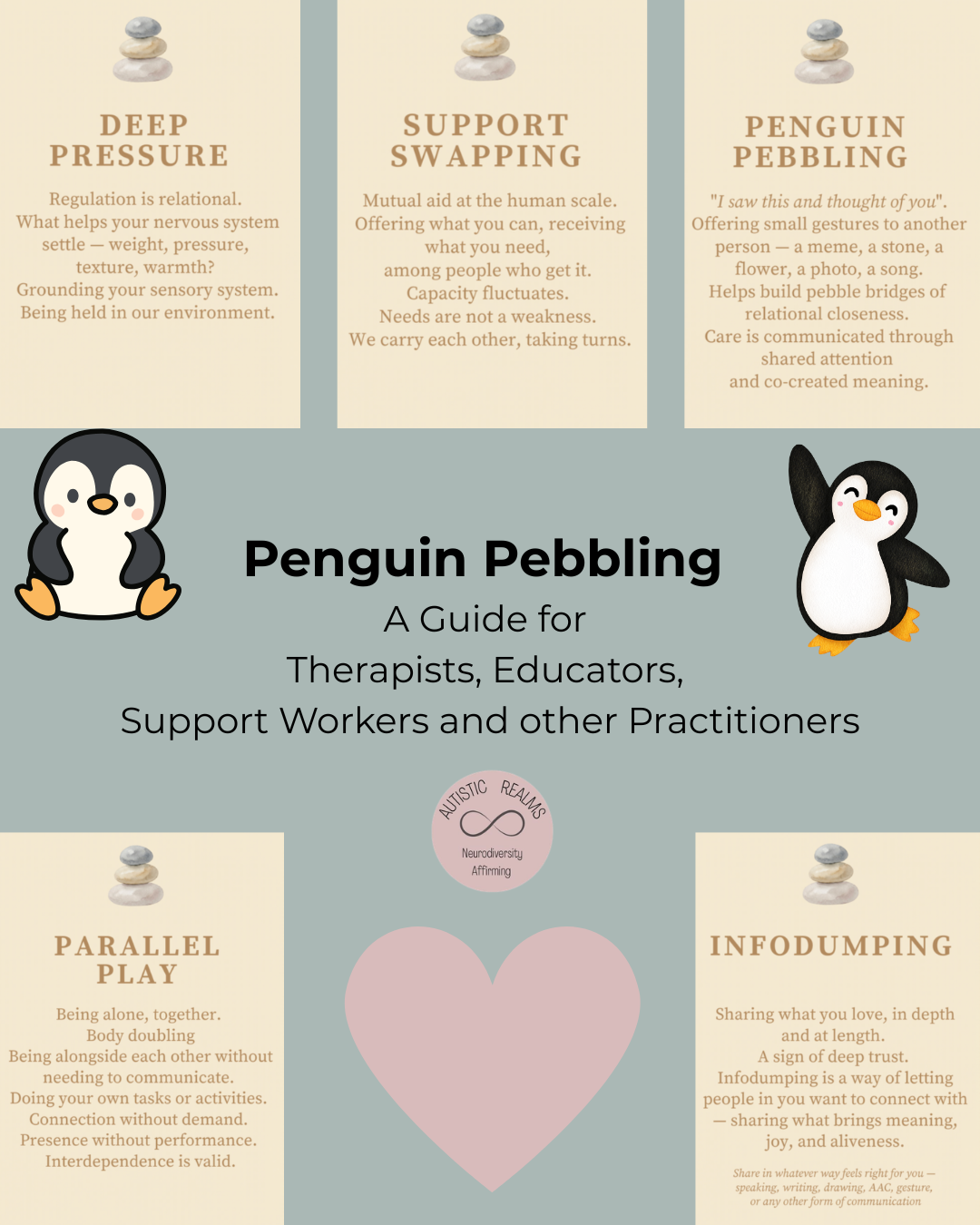
Penguin Pebbling now has a home of its own. Play the game with a group, and print the card decks with Plain Language and Easy Read guides, at penguinpebbling.app.
PENGUIN PEBBLING
A Game of Creating Belonging, Building Connection and Understanding Autistic Identity:
A Guide for Therapists, Educators, Support Workers and other Practitioners
Penguin Pebbling is a neuro-affirming card game built around the Five Autistic Love Locutions — infodumping, parallel play, support swapping, deep pressure, and penguin pebbling itself.
Play together in person or online, explore the prompts as a group, or use them for quiet, solo reflection and journalling. However you engage, it is an invitation to understand Autistic identity, celebrate the ways we connect, and build genuine belonging and meaningful connections together.
Created by Helen Edgar, Autistic Realms & Ryan Boren, Stimpunks (2026) Helen Edgar is also Co-Creative Director at Stimpunks Foundation
About This Game and This Guide
Penguin pebbling is something Autistic people have always done — sharing a twig picked up on a walk, sending a meme that is so completely someone, passing a stone because it reminded you of a person you care about. Not because you have to. Just because it says: I thought of you, I care.
This game was conceptualised by myself, Helen Edgar (Autistic AuDHD) and through collaboration with Ryan Boren (Autistic) from Stimpunks. It is grounded in Autistic community knowledge, and built around the ways neurodivergent people already show we care — in depth, alongside each other, through small gestures, through mutual aid, through bodyminds that need to feel held.
This guide is for practitioners who want to use the Penguin Pebbling game in a professional context to support Autistic people in their therapy or educational settings. It sets out the theoretical grounding, the research base, and the contexts in which the game may be most useful. We hope it gives you confidence to bring the game into your practice, and a sense of why it matters.
What is Penguin Pebbling?
Penguin Pebbling is a low-demand, neurodiversity-affirming card game built around the Five Neurodivergent Love Locutions — five relational modes natural to many Autistic and neurodivergent people: infodumping, parallel play, support swapping, penguin pebbling, and deep pressure (Schaber, cited in Stimpunks, 2022).
The game uses real pebbles, or other items of interest — marbles, buttons, shells or anything meaningful from a person’s own collection. It includes 30 prompt cards across the Five Autistic Love Locution themes. There are no winners and no wrong way to play. Players share in whatever way feels right — speaking, writing, drawing, AAC, signing, gesture, or simply being present.
It can be used with groups of two to six people, online or in person, or by individuals as a reflective journalling tool.
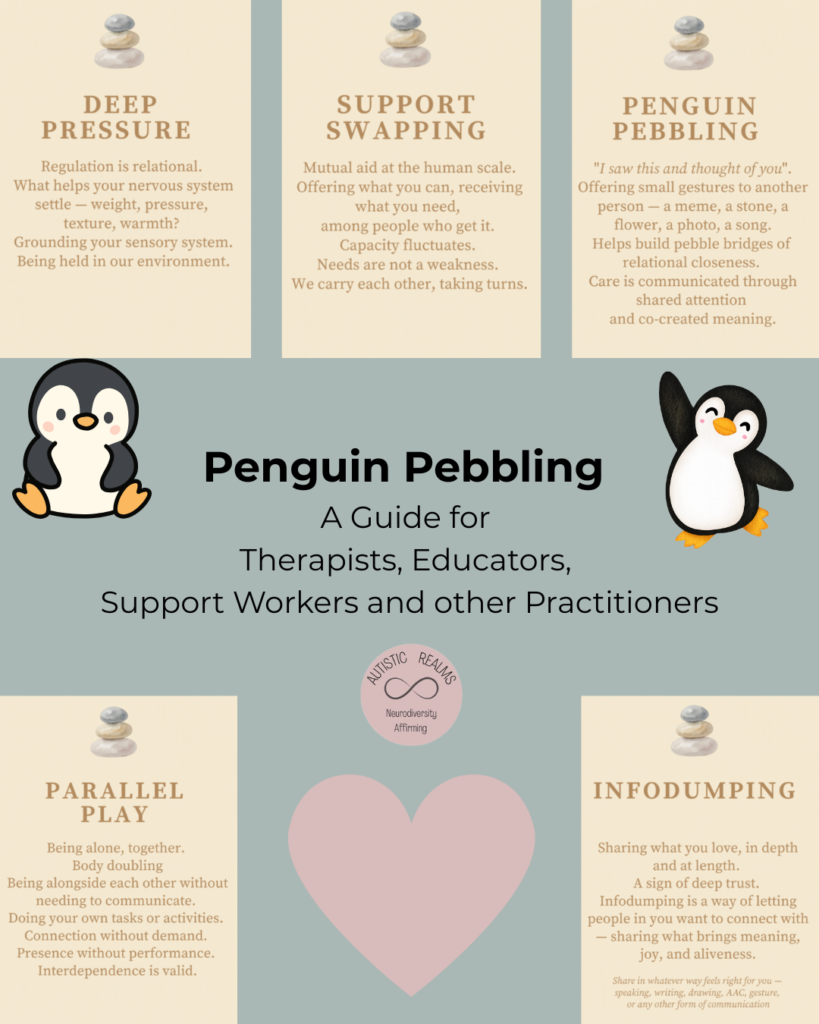
The Five Locutions
Infodumping Sharing what you love, in depth and at length. A sign of deep trust and an expression of monotropic attention. When someone infodumps, they are sharing their attention tunnel — letting you in to where they actually live (Edgar, 2024). Directly expresses Communication and Connection, and Meaning-Making in the SPACE-TIME framework (Edgar, 2025).
Parallel Play / Body Doubling Being alongside each other without needing to communicate. Connection without demand. Presence without performance. Interdependence is valid. Directly expresses Togetherness and Predictability in the SPACE-TIME framework (Edgar, 2025).
Support Swapping & Mutual aid at the human scale. Capacity fluctuates. Needs are not a weakness. We carry each other, taking turns. Directly expresses Acceptance and Agency in the SPACE-TIME framework (Edgar, 2025).
Penguin Pebbling I saw this and thought of you. Small gestures of care communicated through shared attention and co-created meaning. Pebble bridges of relational closeness (Edgar, 2023). Directly expresses Empathy and Meaning-Making in the SPACE-TIME framework (Edgar, 2025).
Deep Pressure Regulation is relational. What helps a nervous system settle — weight, pressure, texture, warmth — also helps connection. Grounding together. Directly expresses Sensory Attunement and Embodiment in the SPACE-TIME framework (Edgar, 2025).
Theoretical Grounding
Neurodiversity Affirming Practice
I have defined neurodiversity-affirming practice as recognising differences as unique attributes rather than deficits, taking a trauma-informed and strengths-based approach, and creating low-demand environments that allow individuals to express their authentic selves and advocate for their needs. The three pillars of Autistic Realms — Being, Belonging, and Becoming — run through the design of Penguin Pebbling.
The game creates the conversations needed for Autistic people to simply be, to belong without performance, and to become themselves through shared, authentic connection in ways they feel safe and meaningful.
The Double Empathy Problem
Milton’s (2012) Double Empathy Problem reframes Autistic communication as a mismatch between different neurological styles and lived experiences, not a deficit in the Autistic person. Milton highlights that misunderstandings between Autistic and non-Autistic people happen both ways. The word ‘double ‘ matters; it isn’t just a difficulty for Autistic people in understanding others. Non-Autistic people also struggle to understand Autistic perspectives, communication, and experiences, and it is up to everyone to work together to find a way that works for them. Brosnan and Camilleri (2025) have since explored neuro-affirmative support for Autistic people specifically through the Double Empathy Problem and monotropism frameworks, affirming the relational and contextual nature of Autistic communication.
The Penguin Pebbling Game is designed from within this understanding, it does not ask Autistic people to communicate in neuronormative ways. Instead, it creates space in which neurodivergent relational styles are accepted as the norm, and all ways of communicating are valid.
Monotropism
Murray, Lesser and Lawson (2005) describe monotropism as a tendency for Autistic attention to flow deeply into a small number of interests rather than broadly across many (as is the case for polytropic people). As I have previously written about, being monotropic may make it easier for Autistic people to enter a flow state when engaged with their passions— a deeply consuming, regulating experience where engagement and motivation are high. Heasman et al. (2024) have developed Autistic flow theory as a non-pathologising framework, recognising that Autistic people are more vulnerable to stress and mental health difficulties when environments do not meet monotropic needs and they can not engage in flow.
When someone infodumps or passes a pebble, they are sharing their attention tunnel, they are sharing their passions and flow and showing that they feel safe. The game honours this as an act of profound trust and relational depth — not a social difficulty to be managed.
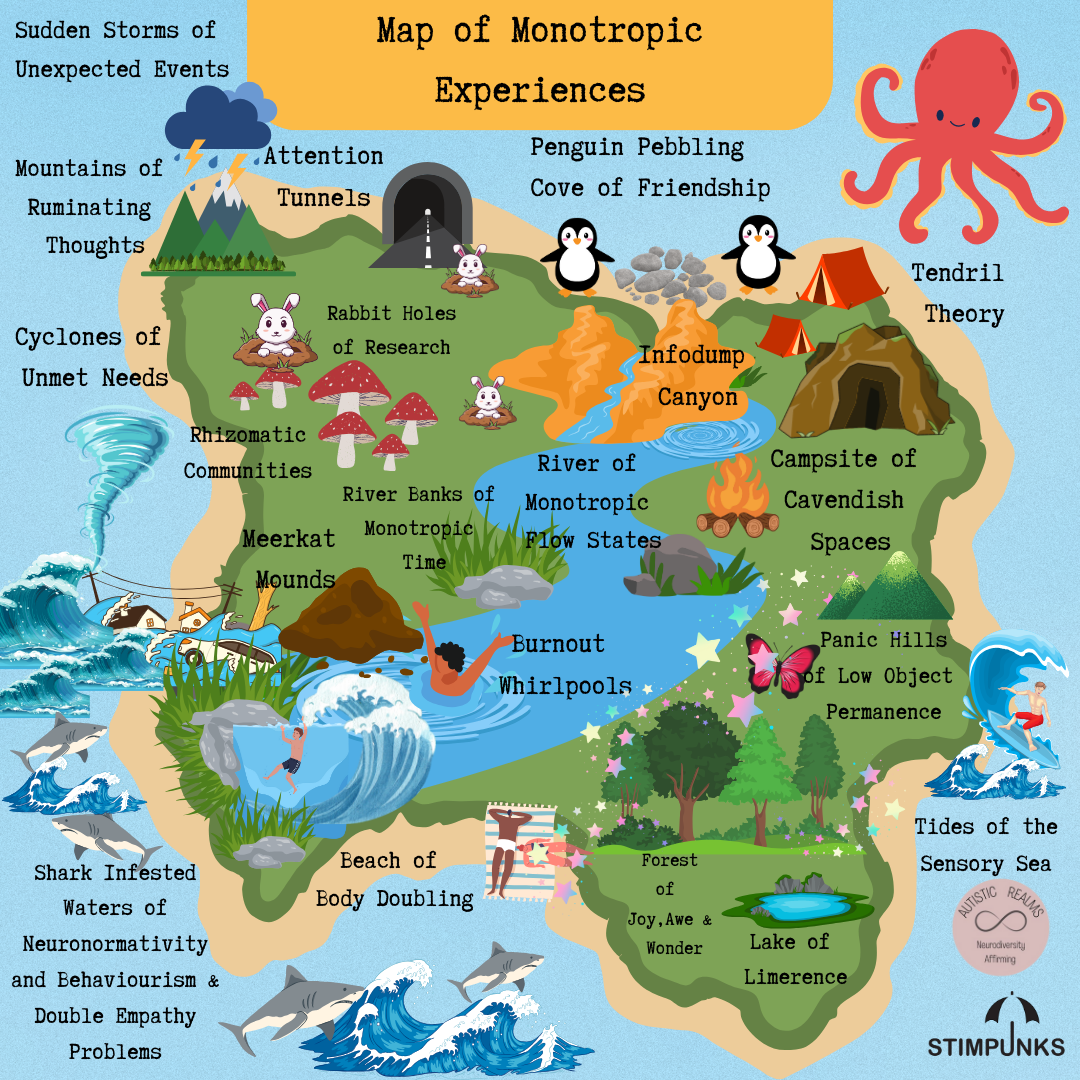
The Map of Monotropic Experiences I created with Stimpunks (2024), places the Penguin Pebbling Cove and Infodump Canyon as literal territories within the monotropic landscape — a recognition that these relational experiences are fundamental features of Autistic life experiences. Goldman et al. (2025) further frames focused interest engagement as self and community care, an affirming reframing at the heart of this game’s design.
Glimmer and Autistic Joy
I have written about glimmers — small sensory and relational moments that bring Autistic joy and regulation. The infodumping card “Do you have a glimmer to share?” draws directly on this framing. Wassell (2025) has explored experiences of Autistic joy, finding these moments central to wellbeing. The game creates a structured, low-demand space for glimmer-sharing, something rarely offered in conventional therapeutic or educational group settings, and it can open unexpected depth in a group or for individual reflection.
Polyvagal Theory and Nervous System Safety
Porges’ (1994)Polyvagal Theory describes how the autonomic nervous system shapes our capacity for social engagement. When the nervous system feels safe — ventral vagal — it supports connection, communication, and co-regulation. The game’s low-demand, no-pressure design, its use of real sensory objects that hold meaning for each person, and its deep pressure locution are all informed by this understanding. Creating relational safety is not a precondition for the game — it is what the game is designed to build. The interoception card specifically supports internal body-signal awareness — hunger, thirst, pain, fatigue — which is frequently challenging for Autistic people and central to nervous system self-knowledge and wellbeing.
The SPACE-TIME Framework
Last year I developed the SPACE-TIME Framework — a monotropism-informed neuroaffirming model for education, healthcare, and support settings — integrating the Autistic SPACE framework (Doherty et al., 2023; McGoldrick et al., 2025) with the eight dimensions of experience-sensitive care (Todres et al., 2009; McGreevy et al., 2024).
SPACE-TIME stands for: Sensory attunement, Predictability and Place, Acceptance and Agency, Communication and Connection, Empathy, Togetherness, Insiderness and Personal Journey, Meaning-Making and Sense of Place, Embodiment and Uniqueness.
Penguin Pebbling honours all dimensions. It creates sensory-safe, low-demand conditions (S, P); honours agency and authentic communication (A, C); builds empathy through shared relational languages (E); fosters togetherness without performance (T); centres personal and insider experience (I); creates conditions for meaning-making (M); and honours embodied, unique ways of being (E). The five locutions are direct expressions of the dimensions of care that SPACE-TIME articulates.
Autism-Informed Care
Neurodiverse Connection (2025), as a delivery partner for NHS England’s Culture of Care Programme, defines autism-informed care as centring Autistic experience rather than neuronormative norms, being neurodivergent-affirming, and identifying how challenges can be mitigated and needs met. The Culture of Care Programme’s twelve core standards — including relationships, needs-led care, choice, and lived experience — are all woven into the game’s design and ethos.
Autistic Love Locutions
Stimpunks Foundation (2022) documents five neurodivergent love locutions as forms of emotional connection that work with neurodivergent nervous systems rather than against them. I wrote about this in my blog about the Five Autistic Love Locutions and framed it around the theory of monotropism. The game makes these locutions explicit, named, and celebrated. Neurodivergent love, as Stimpunks describe it, is often an accessibility practice. Once you have the language for these locutions, you start seeing them everywhere — and recognising all the pebbles people have been passing you along can help support Autistic well-being.
Interdependence and Mutual Aid
The support swapping locution is grounded in disability justice frameworks of interdependence — the recognition that we are all reliant on each other, that capacity fluctuates, and that needs are not weakness.
The number 1 Amazon bestseller book and on-demand course I developed with David Gray-Hammond Re-Storying Autism:A Framework For Families, Parents, And Carers: Reimagining Support For Autistic People (2025) articulates this as moving beyond deficit ideology toward authenticity, respect, and supportive environments — exactly the relational culture the game is designed to build.
Ways to Implement The Penguin Pebbling Game in Your Practice
Therapeutic settings: As a 1:1 or group activity, to build relational safety, explore Autistic identity, and develop self-knowledge around sensory needs, communication styles, and ways of showing care. Particularly well suited to post-identification support for Autistic older children and adults, and to any therapeutic context where conventional social scripts create barriers. The experience-sensitive care dimensions of McGreevy et al. (2024) — particularly insiderness, agency, and togetherness — offer a strong clinical rationale for this use.
Educational settings: As a community-building activity for students, staff teams, or mixed groups. The parallel play and body doubling cards name and normalise experiences common to Autistic and ADHD people, giving people language for things they may have experienced but never had words for. The Autistic SPACE framework (Doherty et al., 2023; McGoldrick et al., 2025) and the SPACE-TIME framework (Edgar, 2025) all provide evidence-based rationale for the game’s approach in educational settings.
Occupational therapy: The deep pressure locution cards support sensory self-knowledge and toolkit development. The interoception card specifically supports awareness of internal body signals. The use of real pebbles or other sensory objects is itself a proprioceptive and regulatory tool throughout the game, directly supporting sensory attunement.
Support work: The game’s low-demand, non-compliance-based structure aligns with the NHS England Culture of Care Programme’s core standards around relationships, needs-led care, and lived experience (Neurodiverse Connection, 2024). It is consistent with trauma-informed and autism-informed affirming approaches to care.
Post-identification groups: Particularly well-suited to older Autistic children and Autistic adults who have received a late identification. The five locutions give language to relational experiences that many may recognise but have never had words for.
The game also supports the identity exploration journey described in Re-Storying Autism:A Framework For Families, Parents, And Carers: Reimagining Support For Autistic People (Edgar & Gray-Hammond, 2025), and directly supports insiderness and personal journey — key dimensions of the SPACE-TIME framework (Edgar, 2025).
Online and hybrid groups. The digital widget at autisticrealms.com allows the game to be played online, where a person may feel safer. Body doubling and parallel play are as possible online as in person.
Important Principles for Use
This game was developed from within Autistic community and lived experience. It belongs to that community. When using it in professional settings, please:
— Credit Helen Edgar, Autistic Realms & Ryan Boren, Stimpunks — Do not adapt it to become a deficit-focused or therapeutic assessment tool — Hold the low-demand, no-winner ethos in all facilitation — it matters — Consider purchasing the physical card set or making a donation to support continued community resource development
Autistic Realms and Stimpunks are community-led projects. Everything we create is grounded in lived experience and made freely available because we believe access matters. Your support helps us keep creating.
Penguin Pebbling Game: Printable Card Deck
Full game and resources: autisticrealms.com
Five Love Locutions: stimpunks.org
Stimpunks Glossary: stimpunks.org/glossary
Key References and Further Reading
Brosnan, M., & Camilleri, L. J. (2025). Neuro-affirmative support for autism, the Double Empathy Problem and monotropism. Frontiers in Psychiatry, 16. https://doi.org/10.3389/fpsyt.2025.1538875
Doherty, M., McCowan, S., & Shaw, S. C. (2023). Autistic SPACE: a novel framework for meeting the needs of autistic people in healthcare settings. British Journal of Hospital Medicine, 84(4), 1–9. https://doi.org/10.12968/hmed.2023.0006
Edgar, H. (2023). Penguin pebbling: An Autistic love language. Autistic Realms.
Edgar, H. (2024). Monotropism resources and signposting. Autistic Realms.
Edgar, H. (2024). Map of Monotropic Experiences. Autistic Realms & Stimpunks.
Edgar, H. (2025). Glimmers: Autistic joy and monotropism. Autistic Realms.
Edgar, H. (2025). SPACE-TIME: A monotropism informed framework for Autistic people. Autistic Realms.
Edgar, H., & Gray-Hammond, D. (2025). Re-Storying Autism. NeuroHub Community Ltd.
Goldman, M. et al. (2025). From pathology to adaptation: Reframing focused interest engagement as self and community care. Neurodiversity, 3. https://doi.org/10.1177/27546330251328415
Heasman, B., Williams, G., Charura, D., Hamilton, L. G., Milton, D., & Murray, F. (2024). Towards autistic flow theory: A non-pathologising conceptual approach. Journal for the Theory of Social Behaviour. https://doi.org/10.1111/jtsb.12427
McGoldrick, E., Munroe, A., Ferguson, R., Byrne, C., & Doherty, M. (2025). Autistic SPACE for Inclusive Education. Neurodiversity, 3. https://doi.org/10.1177/27546330251370655
McGreevy, E., Quinn, A., Law, R., Botha, M., Evans, M., Rose, K., Moyse, R., Boyens, T., Matejko, M., & Pavlopoulou, G. (2024). An experience sensitive approach to care with and for autistic children and young people in clinical services. Journal of Humanistic Psychology, 0(0). https://doi.org/10.1177/00221678241232442
Milton, D. (2012). On the ontological status of autism: The ‘double empathy problem’. Disability & Society, 27(6), 883–887. https://doi.org/10.1080/09687599.2012.710008
Murray, D., Lesser, M., & Lawson, W. (2005). Attention, monotropism and the diagnostic criteria for autism. Autism, 9(2), 139–156. https://doi.org/10.1177/1362361305051398
Neurodiverse Connection. (2024). Culture of Care Programme.
Pellicano, E., Fatima, U., Hall, G., Sedgewick, F., Remington, A., & Crane, L. (2022). A capabilities approach to understanding and supporting autistic adulthood. Nature Reviews Psychology, 1, 624–639. https://doi.org/10.1038/s44159-022-00099-z
Porges, S. W. (1994). The polyvagal theory: Phylogenetic substrates of a social nervous system. International Journal of Psychophysiology, 42(2), 123–146. https://doi.org/10.1016/S0167-8760(01)00162-3
Stimpunks Foundation. (2022). The five neurodivergent love locutions.
Todres, L., Galvin, K. T., & Holloway, I. (2009). The humanization of healthcare: A value framework for qualitative research. International Journal of Qualitative Studies on Health and Well-Being, 4(2), 68–77. https://doi.org/10.1080/17482620802646204
Wassell, E. (2025). Experiences of autistic joy. Disability & Society, 1–26. https://doi.org/10.1080/09687599.2025.2498417