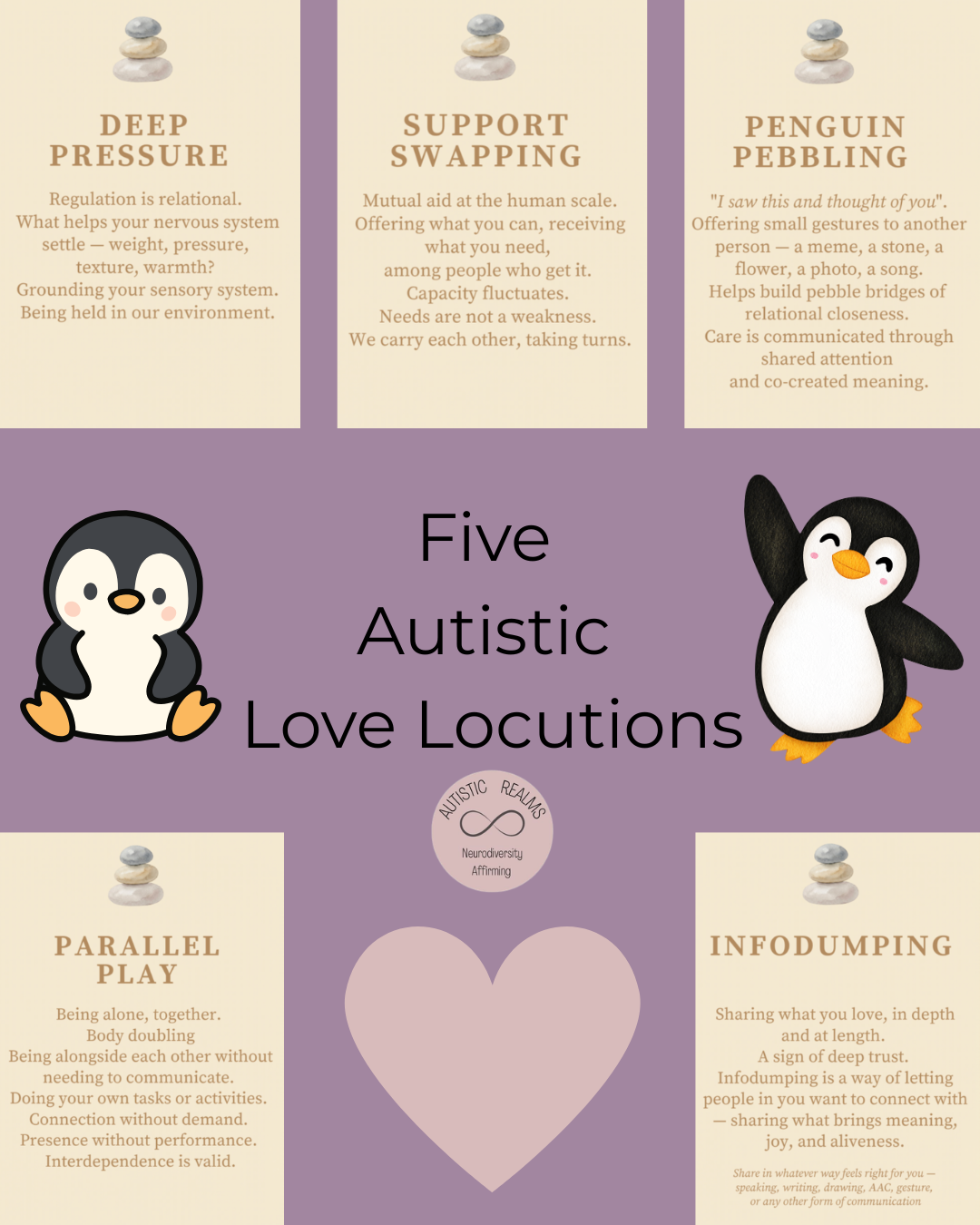
Want to explore the five love locutions together? The Penguin Pebbling game turns them into cards you can play, with printable decks and Easy Read guides, at penguinpebbling.app.
Helen Edgar, Autistic Realms (May, 2026)
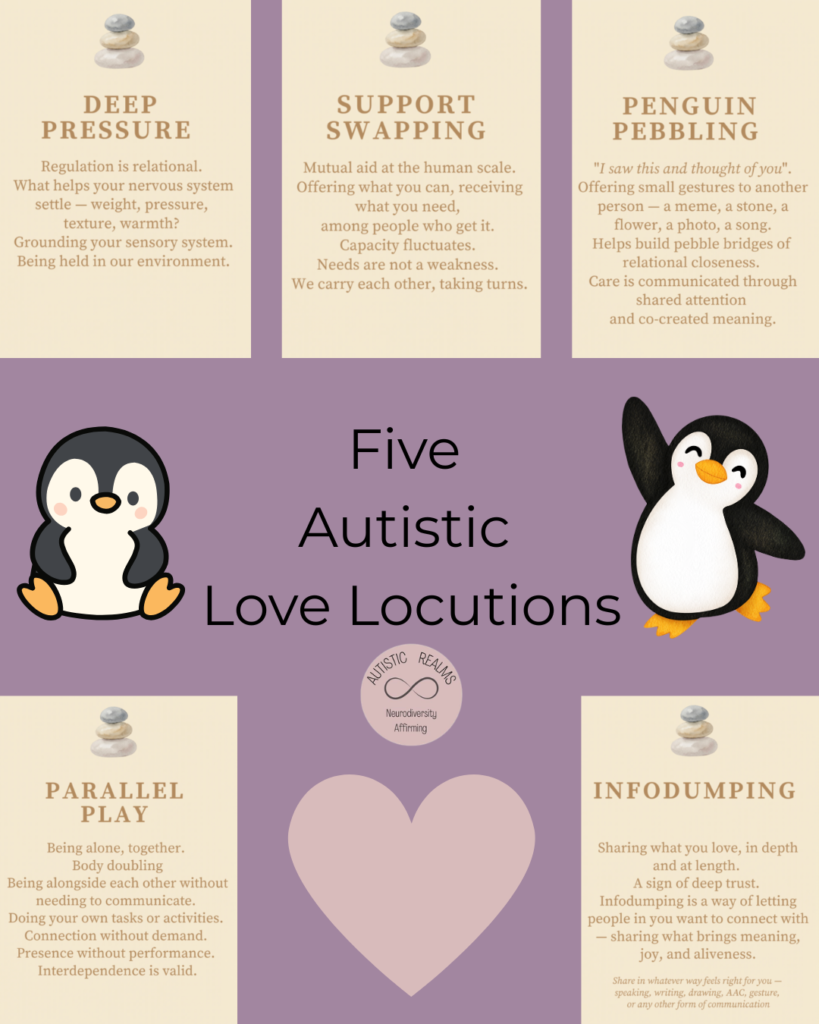
Autistic people have always had our own ways of showing love and care that may be different from the norm and expected ways.
It may not be the ways the world tends to expect — eye contact, small talk, the neat reciprocal exchanges. It’s often something different.
Showing that you care may look like offering your friend a twig you picked up on a walk when you thought of them. Sharing a meme of a funny joke between you on your phone. Sitting in the same room without saying anything for hours, both doing your own thing but wanting each other’s company. Asking someone to tell you something about what they are passionate about, because you know how much it means to them. Checking in if someone has eaten, because you noticed they probably haven’t, as they were so absorbed in their flow.
These are not lesser versions of connection or showing love.
They are Autistic languages of care.
The Five Neurodivergent Love Languages were first named by Amythest Schaber (2021)— an Autistic educator and creator whose work has shaped how so many of us understand our own relational lives. Their original framing was simple as they shared a tweet of the five neurodivergent love languages and an entire community responded (54k likes) by saying yes, that’s exactly it, I get it too!
Ryan Boren at Stimpunks Foundation then documented and expanded on the locutions in depth with one of their most popular pages of The Five Neurodivergent Love Locutions (239k views, 2022-2026). As Co-Creative Director at Stimpunks, we have been working on them together over the past few years, embedding them into Stimpunks Patterns and my own work at Autistic Realms.
Love Locutions
A locution is a particular form of expression or phrase characteristic of an individual or group. The Five Neurodivergent Love Locutions are characteristic of Autistic culture and resonate with many people. They emerged from Autistic community and Autistic ways of being. If you are multiply neurodivergent — Autistic, ADHD, PDA, or otherwise divergent in multiple ways — you may well recognise yourself here too.
Building on this work, I conceptualised the idea for Penguin Pebbling: A Game of Creating Belonging, Building Connection and Understanding Autistic Identity It is an online or in-person game that can be played independently or in a small group and was developed further in collaboration with Ryan Boren (Stimpunks).
Part of why these locutions matter so much is what Damian Milton called the Double Empathy Problem — the reality that communication difficulties between Autistic and non-Autistic people are mutual, understanding and meaning go both ways. The Five Autistic Love Locutions are the language many of us have always been speaking, expressing, and naming, and naming them helps others learn to hear it too.
This is my own take on the five locutions — through the lens of monotropism, my own lived experience as an Autistic ADHD person, and from what I have learned through the Autistic community I share.
Five Autistic Love Locutions
Infodumping
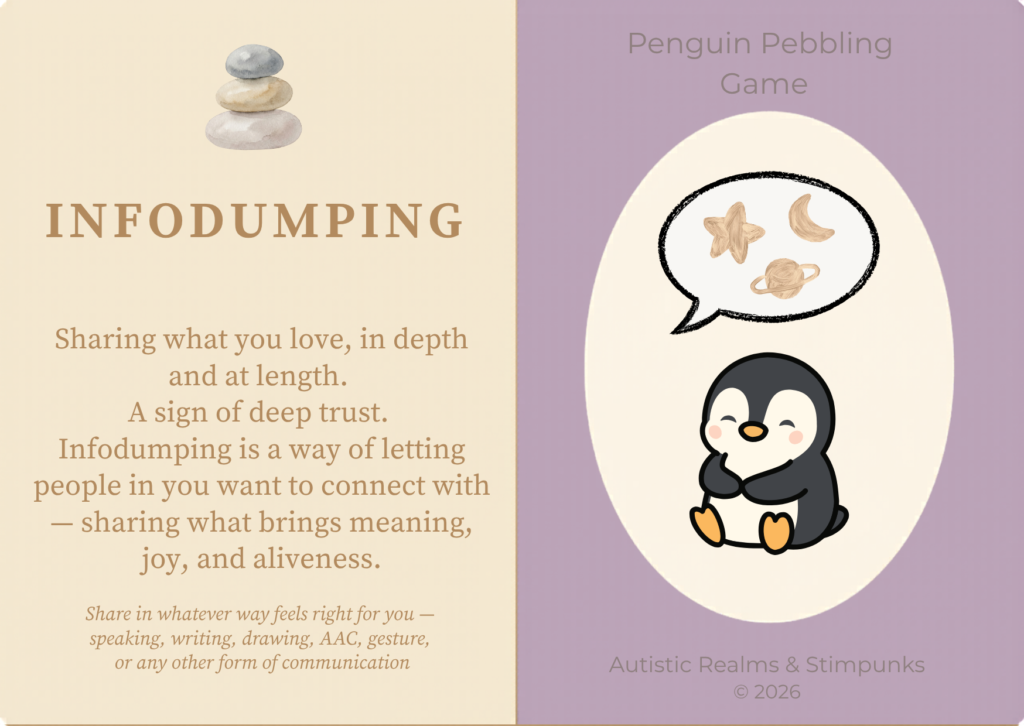
Sharing what you love, in depth and at length, with people you feel safe with.
When an Autistic person infodumps, they are sharing something that genuinely matters to them — an invitation into their world, not a failure of social awareness. Infodumping is a form of deep engagement, connection, and trust. Infodumping is a way of letting people in, a way of sharing your Monotropic passions and attention, showing that you trust and feel safe with those you are with.
I know this in myself, the moment when something I love comes up in conversation and I feel the pull to go deep, to share all of it, and also the small hesitation that asks: is this actually welcome here? That hesitation is the Double Empathy Problem, the moment of doubt, “Will I be accepted here? Am I safe to share here?“
As Stimpunks describe it, encouraging someone to infodump on their special interest is a recognised form of Autistic empathy — often nothing makes Autistic people happier than someone genuinely wanting to know about their passions and interests and show an interest in what is deeply meaningful for them.
The Infodumping cards in Penguin Pebbling create space for this — an invitation to share what you love, without apology.
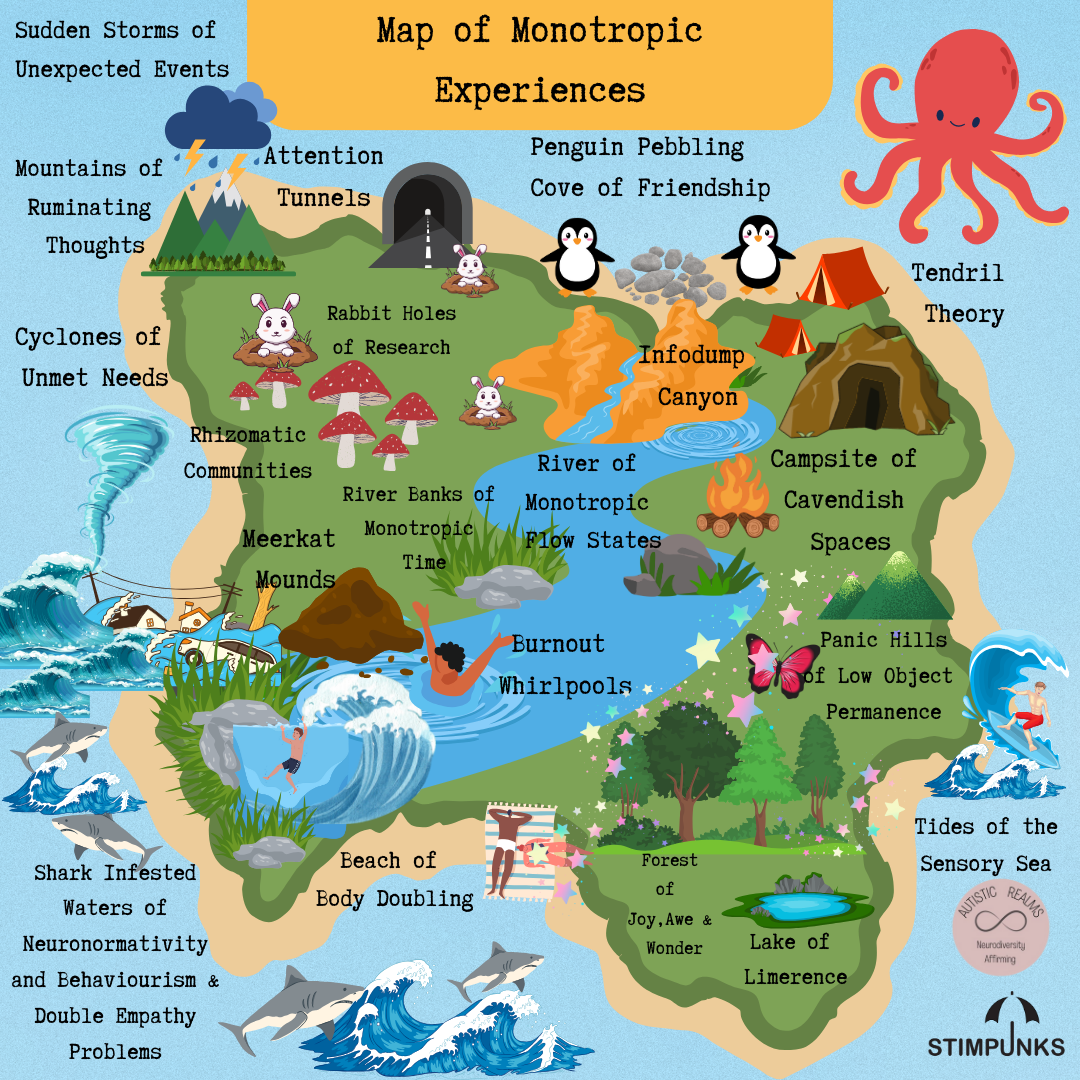
Read more: Monotropism and the attention tunnel · Map of Monotropic Experiences · Stimpunks: Infodumping
Parallel Play and Body Doubling
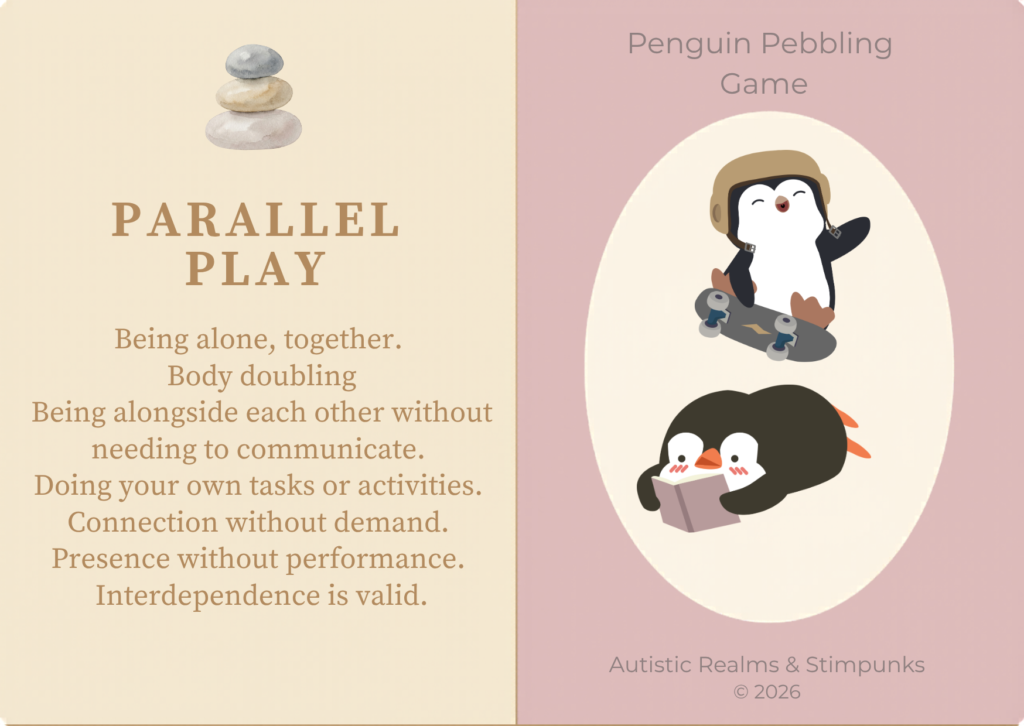
Being alone, together.
This is one of the most quietly radical of the Autistic love locutions. Two people sharing a space, but may be in different places. Perhaps, being on the same video call, each doing their own thing. No conversation required, no performance of togetherness, just the comfort of shared co-regulatory presence and a shared flow state.
For many Autistic people, this is not a lesser form of connection — it is the way people often feel safer to be themselves. Being alongside someone without the constant demand for interaction can be deeply regulating. It is how many of us recharge while still feeling close and connected to another.
I notice this in myself most clearly when I am working. Having someone nearby — even silently, even online with a camera on or off — changes something in my nervous system. It helps the task feel less daunting, and I feel less alone. I don’t need them to do anything; I often just need to know they are there.
Body doubling — being present with someone while they do a task — is a relational practice that many ADHD and Autistic people find transformative. Something about another person’s presence helps the nervous system settle and provides some accountability.
As I wrote in Shared Flow: Turning Attention Together, the most meaningful thing is often simply to share someone’s attention tunnel with them, rather than pulling trying to redirect them or pull them out.
Parallel play says: I want to be near you. I don’t need anything from you. Just stay.
The Parallel Play cards in Penguin Pebbling include a card where the whole group simply does their own thing for five to ten minutes — no communication needed. Just being together. It is often the card people respond to most. This can also be used as a self-reflective prompt for journaling.
Read more: Stimpunks: Parallel Play · Stimpunks: Body Doubling · Stimpunks: Flow
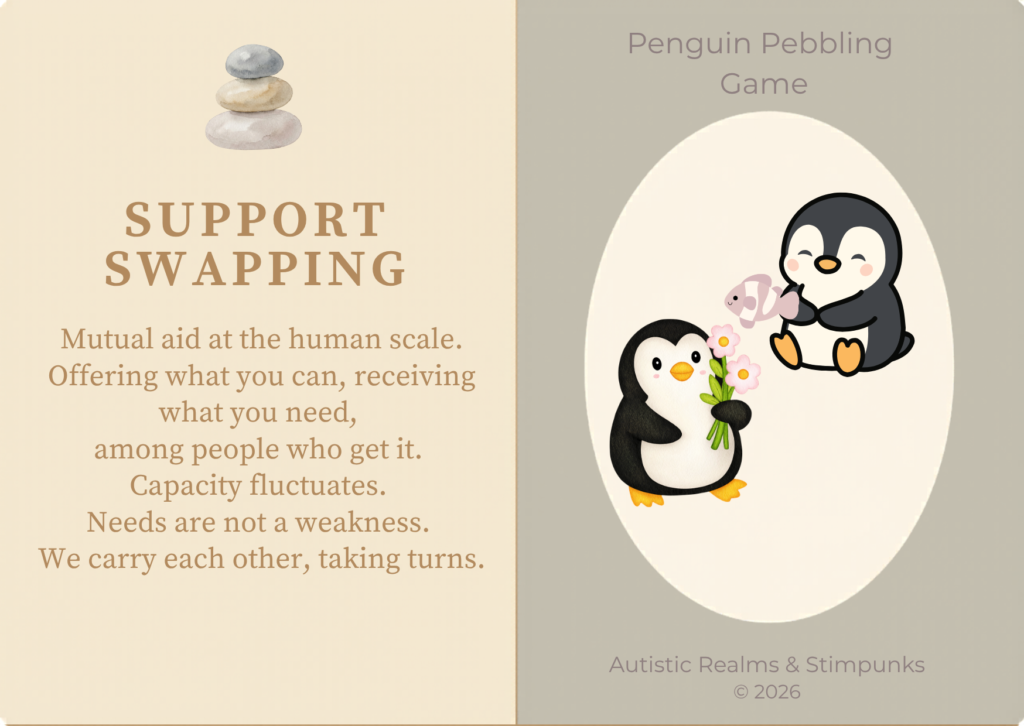
Support Swapping
Mutual aid at human scale.
Autistic people have always found each other and filled each other’s gaps – it is what Neurokin tend to do naturally when you relate to another person. You may notice this in how you are with your friends or those you work with: offering to carry more today for someone because their capacity or spoons are low, and then another time they swap with you when they notice you are running low or struggling. It is not about keeping score; it is about noticing what is needed and offering what we can, when we can.
II have experienced this in the Autistic community more than anywhere else in my life. Someone notices you are struggling and simply offers something — a short message, a resource, a quiet I saw this and thought of you. Or just the reassurance that low spoons and low capacity are real, and that you are allowed to rest and replenish. That kind of checking in, that gift of space and time, is a penguin pebble in its own right.
Support swapping is rooted in interdependence — the understanding that human capacity is not fixed or infinite, and that we are all, in different ways and at different times, reliant on each other. For Autistic, neurodivergent and disabled people, who often bear a heavier load from navigating a world not designed for them, this mutual reliance is not a flaw; it is a foundation we need to build on.
The Support Swapping cards in Penguin Pebbling are some of the most valuable in the deck. They ask: what do you find genuinely easy that others find hard? What do you wish someone would notice and offer? What is one small thing you need today?
Read more: Stimpunks: Support Swapping · Stimpunks: Mutual Aid · Stimpunks: Interdependence
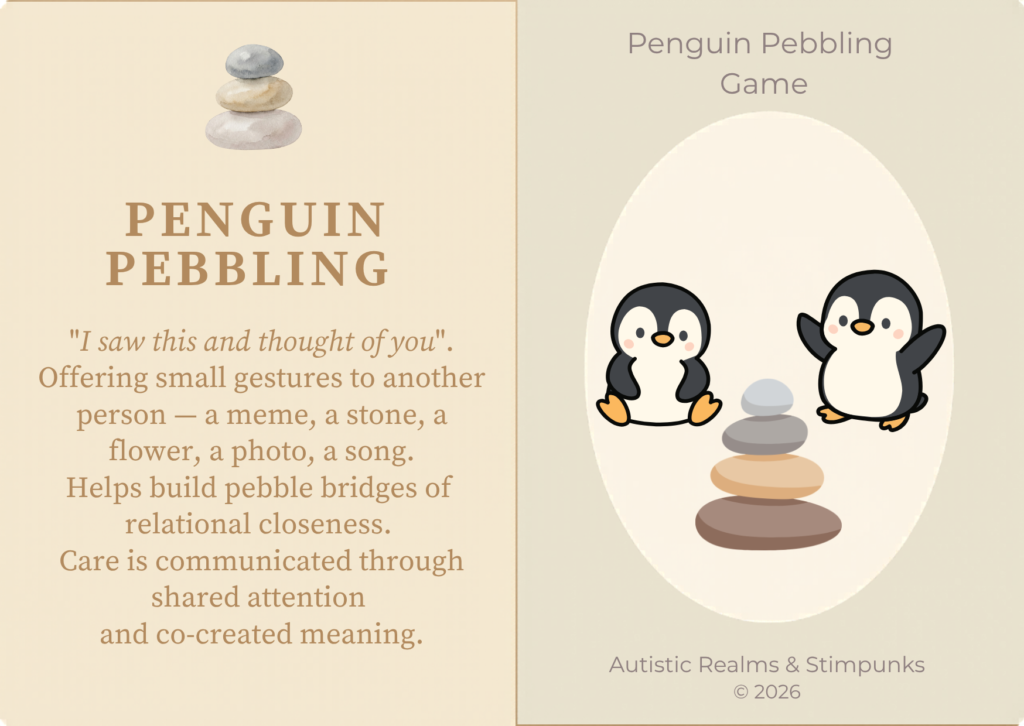
Penguin Pebbling
I saw this and thought of you.
Penguins pass pebbles to other penguins they care about.
Many neurodivergent people also pass ‘penguin pebbles‘ to each other as an act of love, to show they care. You may share a twig you picked up on your walk, a meme about something you know your friend loves — not because you have to, not because it is necessarily useful, just because it says: I thought of you. I wanted you to have this. I care.
I first wrote about penguin pebbling in Penguin Pebbling: An Autistic Love Language back in 2023, framing it through monotropism and the Double Empathy Problem. When an Autistic person’s attention tunnels into something, we often carry the people we love inside that focus too. A pebble is what emerges— a small, tangible proof that someone was in our thoughts and that we care.
The Map of Monotropic Experiences I made with Stimpunks marks Penguin Pebbling Cove as a real place within the landscape for many monotropic people (Autistic/ ADHD).
The way Autistic people show love is often communicated through shared attention, shared flow and co-created meaning. Pebbles are how we build those bridges — and once you start noticing the pebbles people pass you, you realise they have been doing it all along and really care for you!
The Penguin Pebbling cards in the game ask: have you ever found or thought of something and immediately thought of someone? Is there a way you show care that people don’t always recognise as care?
Read more: Penguin Pebbling: An Autistic Love Language · Stimpunks: Penguin Pebbling · Map of Monotropic Experiences
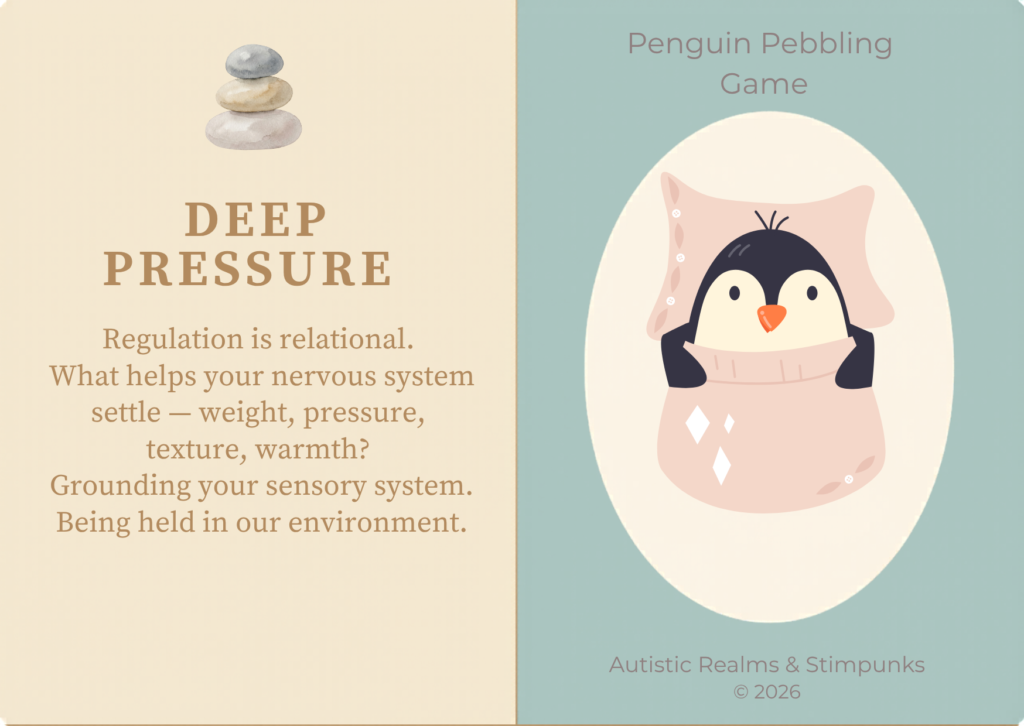
Deep Pressure
Regulation is relational.
For many Autistic people, what the body needs to feel safe is sensory. It may be the weight, pressure, warmth, or texture of a blanket, or a tight hug if wanted and consented to. The physical sensation of being held by the world, just feeling safe in your own space, in your own way, with your favourite food, scents, interests, and being able to stim and move as your body needs.
This locution recognises that nervous system regulation is not a solo act. We regulate in relationship with our environments, with sensory input, and with each other. When we create space to meet our sensory needs and those we support it can be one of the most valuable signs of care and love.
For me this often looks like being wrapped in my weighted blanket, in the dark with my fairy lights on when the world has felt too much and overwhelming. Knowing what you need and being in spaces where you can meet those needs is a form of self-advocacy and self-care, and creating neuro-affirming spaces with others that honour those needs can be an act of pebbling too!
The Deep Pressure cards in Penguin Pebbling are about knowing yourself. What helps your nervous system settle? What do you reach for when things are too much? Naming these things to yourself and to others is its own act of self-care and of forming connections with others; it helps co-create safe environments that work for everyone.
Read more: Stimpunks: Deep Pressure · Stimpunks: Interoception · Glimmers: Autistic Joy and Monotropism
Why These Locutions Matter
If you relate to these Five Autistic Love Locutions, you may start seeing them everywhere — and you may start recognising all the penguin pebbles people have been passing you all along, in ways you were perhaps not taught to receive or recognise.
You may begin to realise the person who sends you seventeen links about your interest is not trying to overwhelm you they may be saying “I care and value your friendship”. The friend who sits quietly beside you while you work is not ignoring you, they may be trying to say, ” I’m here with you”. The person who asks whether you’ve eaten yet may not be trying to control you; they may be checking in and saying “I see you deep in flow. I want to support you.” The stone someone picked up on a walk and gave you without explanation may be a penguin pebble that express “I thought of you today and I wanted you to know, I care, I love you.”
Play the Penguin Pebbling Game
Online Widget
Or
In Person Downloadable Cards To Print
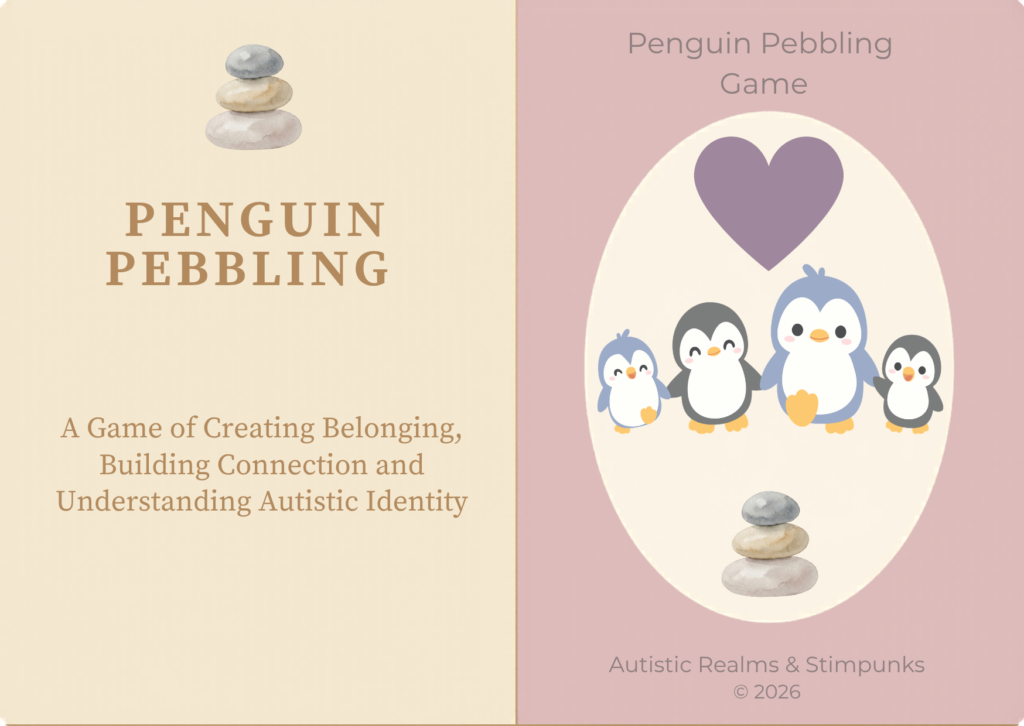
The Five Autistic Love Locutions are the heart of Penguin Pebbling: A Game of Creating Belonging, Building Connection and Understanding Autistic Identity — a free card game created by Helen Edgar, Autistic Realms & Ryan Boren, Stimpunks (2026).
Play online using the widget at autisticrealms.com, or download and print the cards. Bring real pebbles, or anything small from your collection.
🐧 Play the game: autisticrealms.com/penguin-pebbling
📖 Practitioners guide: Penguin Pebbling: Theory, Practice and the Five Neurodivergent Love Locutions
🐧 Penguin Pebbling Game: Printable Card Deck
🌐 Stimpunks: Five Love Locutions: stimpunks.org
🌐 Stimpunks Glossary: stimpunks.org/glossary
Helen Edgar is an Autistic writer, educator, and advocate at Autistic Realms and Co-Creative Director at Stimpunks Foundation. Her work is grounded in monotropism, neuroqueer theory, and Autistic lived experience.