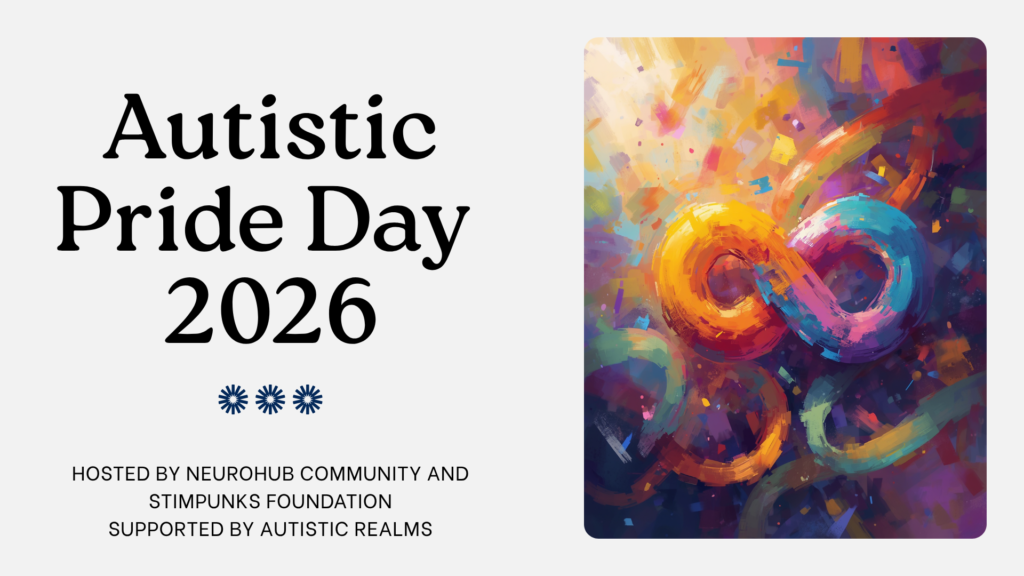
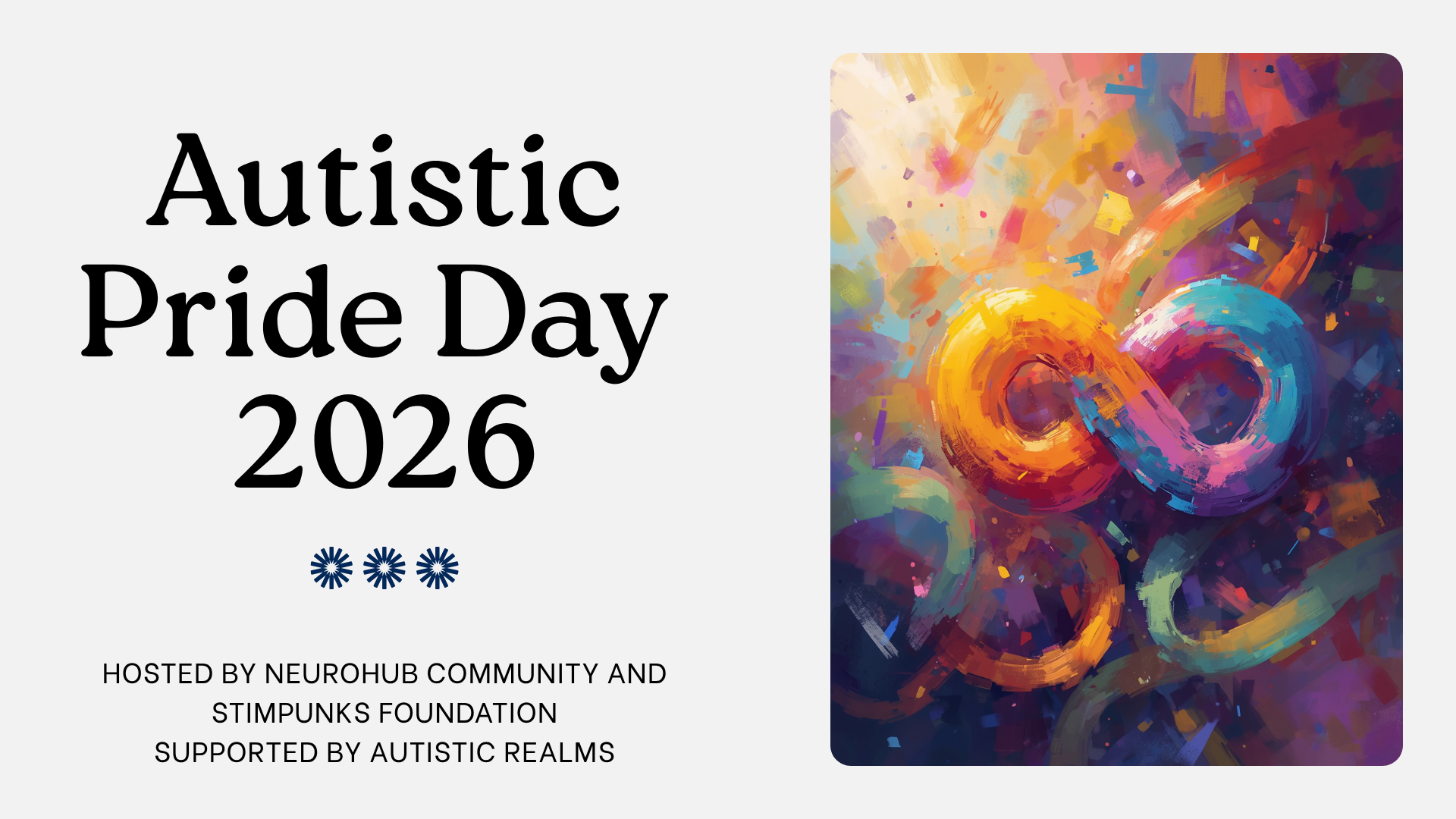
Light grey background. Bold black serif text reads "Autistic Pride Day 2026," followed by three small navy asterisk-style icons and the line "Hosted by NeuroHub Community and Stimpunks Foundation, supported by Autistic Realms." To the right, a colourful abstract painting of a glowing infinity symbol in swirling orange, teal, pink, and purple brushstrokes against a vibrant multicoloured background.

Stimming, Glimmers & Solidarity: Celebrating Autistic Pride Together

18th June 2026, Autistic Pride Day

Today is Autistic Pride Day!

I am collaborating with NeuroHub Community and Stimpunks Foundation because pride grows stronger when we are together.

You are invited to join our free Stim and Glim Party to celebrate Autistic Pride with your community.

18th June 2026
4pm BST
Online in Neurohub Community
Access here

Light grey background. Bold black serif text reads "Autistic Pride Day 2026," followed by three small navy asterisk-style icons and the line "Hosted by NeuroHub Community and Stimpunks Foundation, supported by Autistic Realms." To the right, a colourful abstract painting of a glowing infinity symbol in swirling orange, teal, pink, and purple brushstrokes against a vibrant multicoloured background.


What Is Autistic Pride Day?


Autistic Pride Day is a celebration first held in 2005, by Aspies For Freedom (AFF), an Autistic-led advocacy group founded the previous year by Amy and Gwen Nelson. AFF modelled the day on the Gay Pride movement, joining a wider tradition of advocacy-led pride days that use visibility and celebration, rather than charity-led awareness campaigns, to challenge stigma and assert dignity for marginalised communities.

At the time, autism was almost always spoken about through deficit-focused, cure-seeking narratives led by parents, professionals, and charities rather than Autistic people ourselves. Autistic Pride Day was created to change that: a day run by and for Autistic people, centring our own voices rather than giving space to organisations that speak on our behalf. Autistic self-advocacy organisations are a key force in the movement for Autistic acceptance and Autistic Pride. As Kabie Brook, co-founder of Autism Rights Group Highland, put it, “it originated from and is still led by autistic people ourselves”.

The rainbow infinity symbol serves as a powerful representation of diversity, highlighting the beauty in differences rather than focusing on deficits. It represents “diversity with infinite variations and infinite possibilities

Autistic Pride is about embracing your own identity and recognising that being Autistic is a valid and valuable way of being.

Autistic Pride isn’t about overcoming Autism, it’s about refusing the idea that we need to be overcome at all. We don’t need to be fixed, cured, or shaped to fit a world that wasn’t built with us in mind. We deserve to be valued and supported exactly as we are, in our own ways of moving, sensing, communicating, and connecting.

This year, our celebration centres on three connected things: stimming, bodymind affirmation, and glimmers.


Stimming
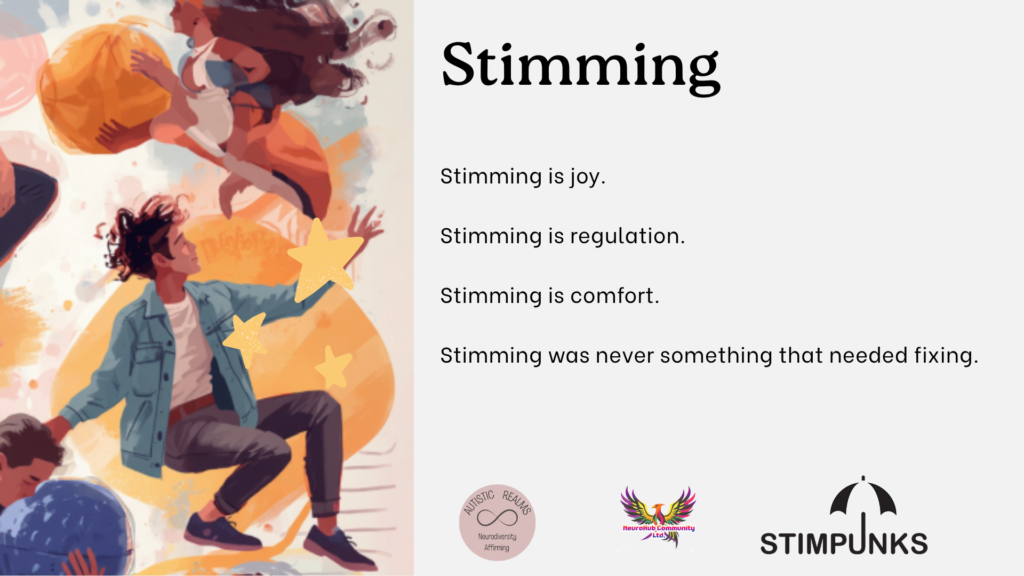
Left side shows a colourful illustrated scene of people joyfully jumping and stimming around large orange beanbag-like shapes, with yellow stars layered over the image. Right side has the black serif heading "Stimming," followed by the lines "Stimming is joy. Stimming is regulation. Stimming is comfort. Stimming was never something that needed fixing." Below are three logos: the Autistic Realms circular infinity logo reading "Neurodiversity Affirming," the NeuroHub Community Ltd logo featuring a colourful phoenix, and the Stimpunks Foundation umbrella logo.

Stimming has long been pathologised, treated as something to extinguish, mask, or train away through “quiet hands” approaches. But Autistic adults consistently describe stimming very differently: as an adaptive way of self-regulating, processing sensory input, and expressing emotion, one they actively object to having taken away from them (Kapp et al., 2019).


Glimmers
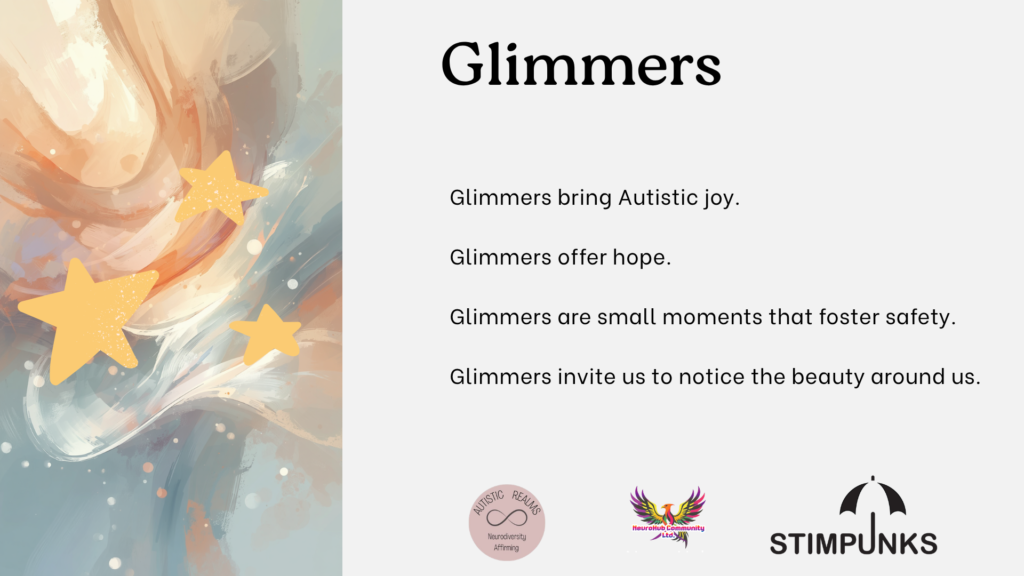
Left side shows a soft abstract painting in peach, cream, and dusty blue tones with three yellow stars layered over it. Right side has the black serif heading "Glimmers," followed by the lines "Glimmers bring Autistic joy. Glimmers offer hope. Glimmers are small moments that foster safety. Glimmers invite us to notice the beauty around us." Below are the same three logos: Autistic Realms, NeuroHub Community, and Stimpunks.

Glimmers are the small, often overlooked moments that spark Autistic joy: a favourite texture, a familiar tune, a deep dive into an interest, the comfort of a repeated pattern. The term was first used by Deb Dana to describe micro-moments of regulation that foster wellbeing, the opposite of a trigger.

For many Autistic people, glimmers and monotropic attention go hand in hand. Monotropism describes how attention can flow deeply into one interest or sensory experience at a time, rather than spreading thinly across many things at once (Murray et al., 2005), and this kind of deep immersion is closely related to what Csikszentmihalyi (1990) called flow.


Glimmers aren’t small in the sense of unimportant; as Wassell (2025) writes, they can bring great moments of Autistic joy. Naming and noticing glimmers is a way of honouring Autistic joy on its own terms, and sharing them with others who get it can turn an isolated moment of joy into something that strengthens a whole community.

Autistic Pride is an ongoing journey, woven into our daily lives.

Carry the glimmers of today with you and embrace Autistic Pride every day in your own way.


Join us!
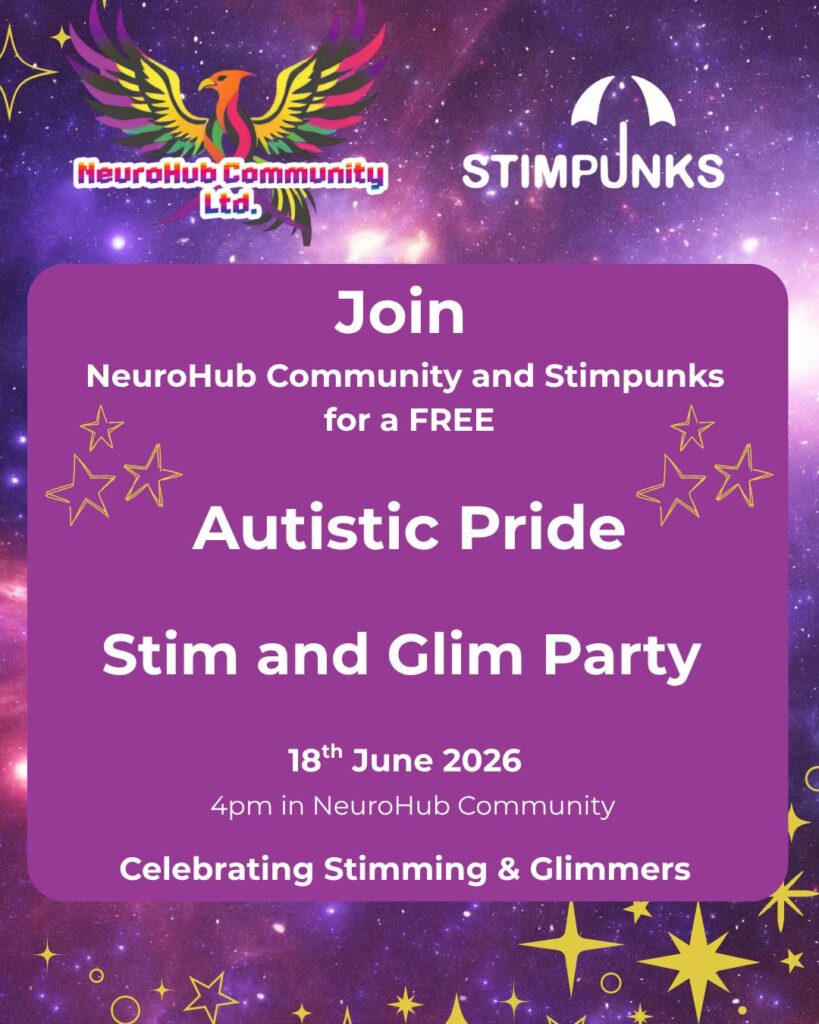
Promotional poster with a purple galaxy-themed background and yellow star illustrations. At the top are the logos for “NeuroHub Community Ltd.”, featuring a colorful phoenix, and “Stimpunks,” with a white umbrella-like symbol.  Centered on a large purple

Today I am hosting a free online Autistic Pride Stim & Glim Party with NeuroHub Community and Stimpunks Foundation.
4pm (BST),
We’re gathering to explore what Autistic Pride means for us. You are welcome to stim, share our glimmers, and connect with others in ways that feel right for you.

Community collaboration matters. Re-Storying Autism and our narratives happen best in connection with others. We need community, and we need the relationships we build with each other.

Whatever way you’re marking Autistic Pride today, whether that’s joining us online, stimming alone at home, engaging in your own interests, infodumping with a friend, or anything else – we are all here for each other.

Happy Autistic Pride Day!

References

Autistic Pride Day https://autisticprideday.org/

Autistic Empire. Autistic pride. https://www.autisticempire.com/autistic-pride/

Boren, R. (2022). Stimming. Stimpunks Foundation. https://stimpunks.org/glossary/stimming/

Csikszentmihalyi, M. (1990). Flow: The psychology of optimal experience. Harper & Row.

Edgar, H. (2025). Autistic pride: Restorying and unknowing autism. Autistic Realms. https://autisticrealms.com/autistic-pride-restorying-unknowing-autism/

Edgar, H. (2025). Glimmers: Autistic joy and monotropism. Autistic Realms. https://autisticrealms.com/glimmers-autistic-joy-and-monotropism/

Kapp, S. K., Steward, R., Crane, L., Elliott, D., Elphick, C., Pellicano, E., & Russell, G. (2019). ‘People should be allowed to do what they like’: Autistic adults’ views and experiences of stimming. Autism, 23(7), 1782-1792. https://doi.org/10.1177/1362361319829628

Murray, D., Lesser, M., & Lawson, W. (2005). Attention, monotropism and the diagnostic criteria for autism. Autism, 9(2), 139-156. https://doi.org/10.1177/1362361305051398

Wassell, E. (2025). Experiences of autistic joy. Journal of Autism and Developmental Disorders, 55(4), 1234-1249. https://doi.org/10.1080/09687599.2025.2498417

Wikipedia. Aspies for Freedom. https://en.wikipedia.org/wiki/Aspies_for_Freedom

Latest Posts

  • Autistic Burnout – Supporting Young People At Home & School

    Autistic Burnout – Supporting Young People At Home & School

    Autistic burnout in young people is real—and recovery starts with understanding. This post offers neuroaffirming ways to spot the signs, reduce demands, and truly support. 💛 #AutisticBurnout #Neuroaffirming #Monotropism #AutisticSupport


  • Monotropic Interests and Looping Thoughts

    Monotropic Interests and Looping Thoughts

    The theory of monotropism was developed by Murray, Lawson and Lesser in their article, Attention, monotropism and the diagnostic criteria for autism (2005). ​ Monotropism is increasingly considered to be the underlying principle behind autism and is becoming more widely recognised, especially within autistic and neurodivergent communities. Fergus Murray, in their article Me and Monotropism:…


  • Map of Monotropic Experiences

    Map of Monotropic Experiences

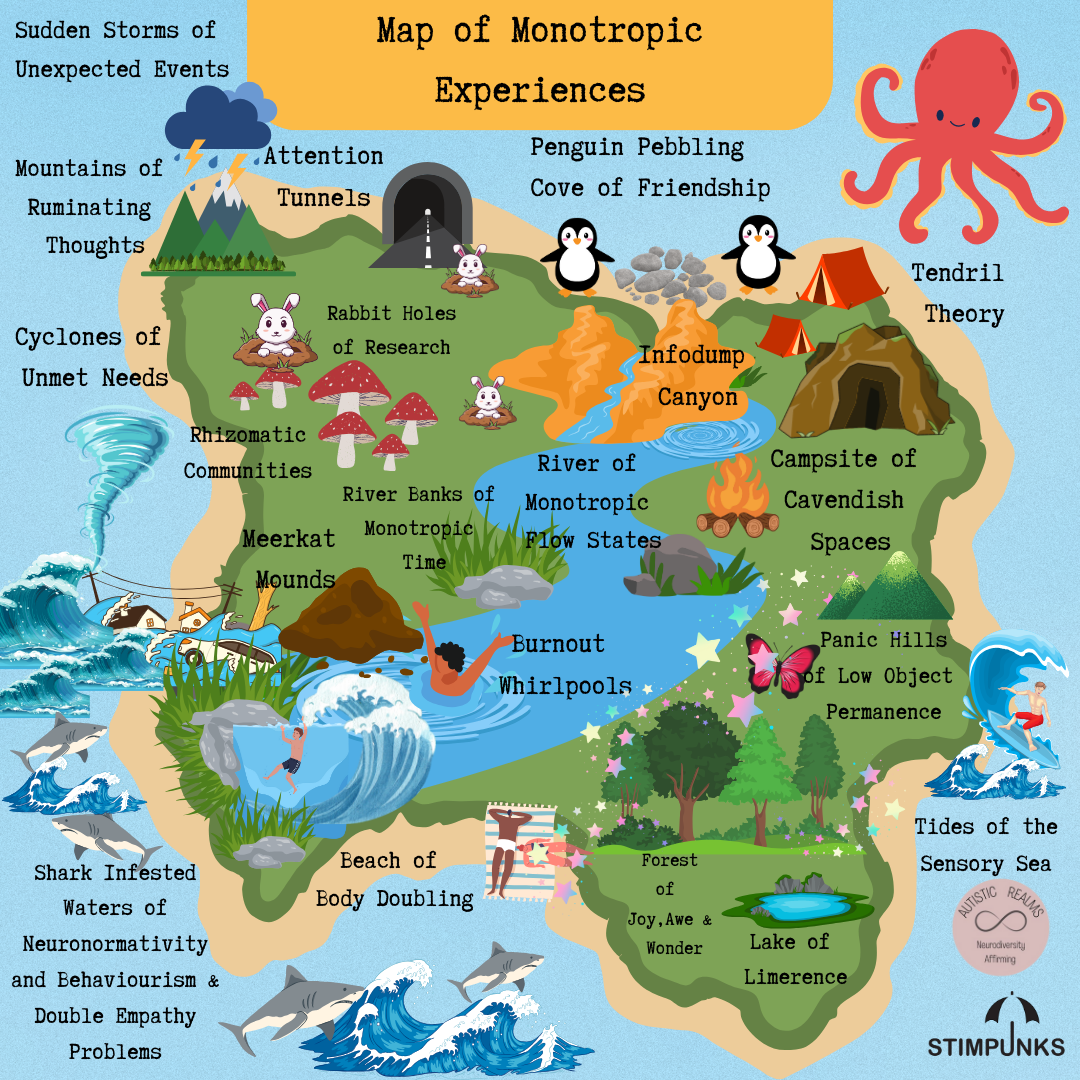
    Monotropism seeks to explain Autism in terms of attention distribution and interests.  OSF Preprints | Development and Validation of a Novel Self-Report Measure of Monotropism in Autistic and Non-Autistic People: The Monotropism Questionnaire This map highlights 20 common aspects of my personal monotropic experiences. How many do you experience? Where are you on the map…


  • Autistic Burnout – Supporting Young People At Home & School

    Autistic Burnout – Supporting Young People At Home & School

    Being autistic is not an illness or a disorder in itself, but being autistic can have an impact on a person’s mental and physical health. This is due to the often unmet needs of living in a world that is generally designed for the well-being of people who are not autistic. In addition, three-quarters of…


  • The Double Empathy Problem is DEEP

    The Double Empathy Problem is DEEP

    “The growing cracks in the thin veneer of our “civilised” economic and social operating model are impossible to ignore”, Jorn Bettin (2021). The double empathy problem (Milton, 2012) creates a gap of disconnect experienced between people due to misunderstood shared lived experiences. It is “a breakdown in reciprocity and mutual understanding that can happen between people…


  • Top 5 Neurodivergent-Informed Strategies

    Top 5 Neurodivergent-Informed Strategies

    Top 5 Neurodivergent-Informed Strategies By Helen Edgar, Autistic Realms, June 2024. 1. Be Kind Take time to listen and be with people in meaningful ways to help bridge the Double Empathy Problem (Milton, 2012). Be embodied and listen not only to people’s words but also to their bodies and sensory systems. Be responsive to people’s…


  • Autistic Community: Connections and Becoming

    Autistic Community: Connections and Becoming

    Everyone seeks connection in some way or another. Connections may look different for autistic people. In line with the motto from Anna Freud’s National Autism Trainer Programme (Acceptance, Belonging and Connection), creating a sense of acceptance and belonging is likely to be more meaningful for autistic people than putting pressure on them to try and…


  • Monotropism, Autism & OCD

    Monotropism, Autism & OCD

    Exploring similarities and differences between Autistic and OCD monotropic flow states. Can attention tunnels freeze, and thoughts get stuck?


  • Monotropism Questionnaire & Inner Autistic/ADHD Experiences

    Monotropism Questionnaire & Inner Autistic/ADHD Experiences

     Post first published 28th July 2023 Over the past few weeks, there has been a sudden surge of interest in the Monotropism Questionnaire (MQ), pre-print released in June 2023 in the research paper ‘Development and Validation of a Novel Self-Report Measure of Monotropism in Autistic and Non-Autistic People: The Monotropism Questionnaire.‘ by Garau, V., Murray,…


  • Penguin Pebbling: An Autistic Love Language

    Penguin Pebbling: An Autistic Love Language

    Penguin Pebbling is a neurodivergent way of showing you care, like sharing a meme or twig or pretty stone to say “I’m thinking of you,” inspired by penguins who gift pebbles to those they care about.


  • Stimming, Glimmers & Solidarity: Celebrating Autistic Pride Together

    Stimming, Glimmers & Solidarity: Celebrating Autistic Pride Together

    What is Autistic Pride Day? Explore its history, stimming, and glimmers with NeuroHub Community, Stimpunks & Autistic Realms.


  • Autistic Pride FREE Stim & Glim Party

    Autistic Pride FREE Stim & Glim Party

    Autistic RealmsHelen Edgar Autistic Advocate, Author & ConsultantNeurodiversity-Affirming Supporting Autistic People To Grow & Thrive Welcome to Autistic Realms Newsletter! 🌈 Autistic Pride: STIM & GLIM Party 🌈 Thursday 18th June, 4pm (BST) — Online & Free Join us for a joyful online celebration of Autistic Pride! This is a collaboration with two of my…


  • Between Being and Belonging

    Between Being and Belonging: An ecological game about neurodivergent thriving, exploring the webs that hold us within our ecosystems, and what can grow from the spaces between us This is in beta mode – a collaborative project between myself, Helen Edgar (Autistic Realms) with David Gray-Hammond at Neurohub Community. Please do not share wider at…


This website stores cookies on your computer. These cookies are used to provide a more personalized experience and to track your whereabouts around our website in compliance with the European General Data Protection Regulation. If you decide to to opt-out of any future tracking, a cookie will be setup in your browser to remember this choice for one year.

Accept or Deny

WordPress Cookie Plugin by Real Cookie Banner