Autistic Realms blog banner: Autistic and OCD: Dream Realms Project Update (2023)

Autistic and OCD: Autistic Dream Realms Project Update (May 2023)

This is an update from May 2023, part way through the Autistic Dream Realms project. You can read about the whole project in The Autistic Dream Realms Project.

Katie from Autistic and Living the Dream and I have been continuing our #AutisticDreamRealms project, sharing lived experiences of being Autistic and OCD.

It is becoming clear that there is still a great deal of stigma around OCD. There is a quietness around it, and it is rarely talked about. We have a thriving online Autistic community, but when it comes to finding support for Autistic OCD experiences, that community can be very hard to find.

Yet OCD commonly co-occurs with Autism. A meta-analysis found that around 17% of Autistic children and young people also met the criteria for OCD (van Steensel et al., 2011), compared with roughly 1 to 2% of the general population (Ruscio et al., 2010). A large Danish study also found that Autistic people were about twice as likely to be diagnosed with OCD later in life (Meier et al., 2015). The difference is stark. It means there are a great many Autistic OCD people struggling, and a great many parents who may be feeling very stuck as they try to support their Autistic children with OCD.

The support networks that have grown around Autism and other neurodivergences are amazing. We feel we need more conversations about OCD too, to raise awareness and help support networks grow, especially around the intersection of Autism and OCD.

From the social media platforms we have posted on, the Autistic OCD adult community seems a little more open to talking about OCD than parents caring for Autistic OCD young people. There may be many reasons for this, and it is worth reflecting on. We hope some of our posts can help open up conversations within the community about being Autistic and OCD, so more people can find support.

We are hopeful that there is a wealth of lived experience out there that can help others in similar situations, and we want to thank everyone who has contributed so far. We hope some of the stories shared validate and resonate with you, and that you might find some glimmers of hope and new ideas to help manage OCD. The experiences of Autistic adults living with OCD could be really valuable for parents trying to support their Autistic OCD children too.

I feel this project, in its own small way, is helping to bridge a divide: not only within the Autistic and OCD communities, but also between Autistic adults with lived experience of OCD and the parents and carers supporting their children, so that we can all help and learn from each other.

Read more

Written from my lived experience as an Autistic parent and teacher, and from knowledge gained through personal research and neurodivergent communities. I am not a medical professional or therapist.

References

Meier, S. M., Petersen, L., Schendel, D. E., Mattheisen, M., Mortensen, P. B., & Mors, O. (2015). Obsessive-compulsive disorder and autism spectrum disorders: Longitudinal and offspring risk. PLoS ONE, 10(11), e0141703. https://doi.org/10.1371/journal.pone.0141703

Ruscio, A. M., Stein, D. J., Chiu, W. T., & Kessler, R. C. (2010). The epidemiology of obsessive-compulsive disorder in the National Comorbidity Survey Replication. Molecular Psychiatry, 15(1), 53–63. https://doi.org/10.1038/mp.2008.94

van Steensel, F. J. A., Bögels, S. M., & Perrin, S. (2011). Anxiety disorders in children and adolescents with autistic spectrum disorders: A meta-analysis. Clinical Child and Family Psychology Review, 14(3), 302–317. https://doi.org/10.1007/s10567-011-0097-0
Latest Posts

  • Autistic Burnout – Supporting Young People At Home & School

    Autistic Burnout – Supporting Young People At Home & School

    Autistic burnout in young people is real—and recovery starts with understanding. This post offers neuroaffirming ways to spot the signs, reduce demands, and truly support. 💛 #AutisticBurnout #Neuroaffirming #Monotropism #AutisticSupport


  • Monotropic Interests and Looping Thoughts

    Monotropic Interests and Looping Thoughts

    The theory of monotropism was developed by Murray, Lawson and Lesser in their article, Attention, monotropism and the diagnostic criteria for autism (2005). ​ Monotropism is increasingly considered to be the underlying principle behind autism and is becoming more widely recognised, especially within autistic and neurodivergent communities. Fergus Murray, in their article Me and Monotropism:…


  • Map of Monotropic Experiences

    Map of Monotropic Experiences

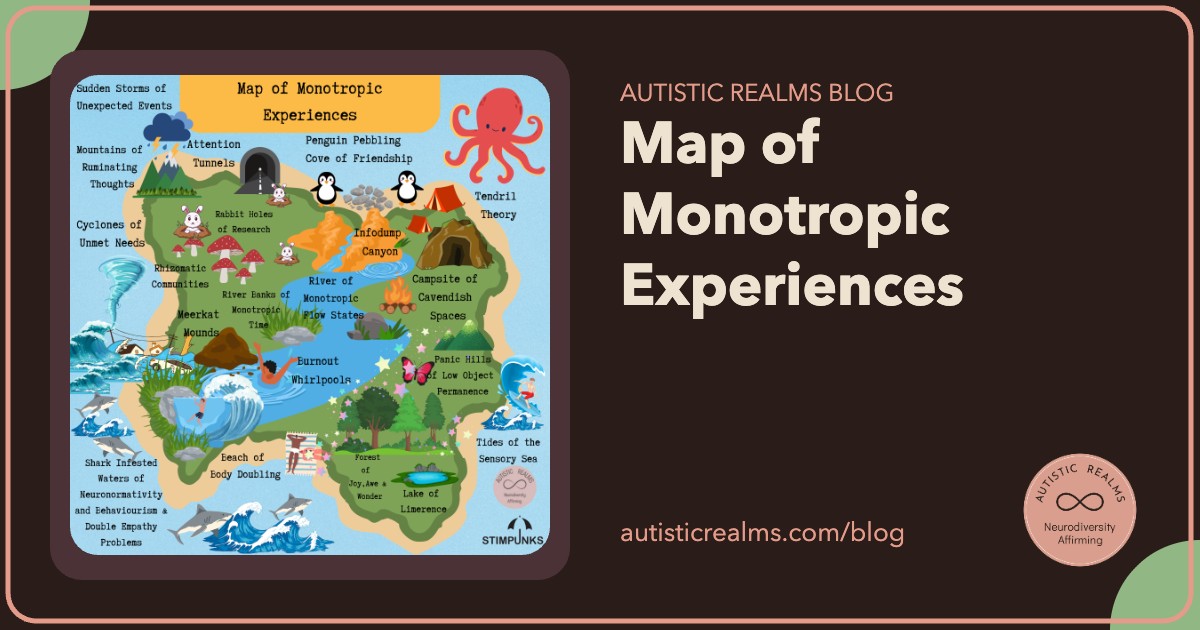
    The Map of Monotropic Experiences now has a home of its own. Visit monotropicmap.org to explore each of the twenty areas, mark your own map and find the free training. You can also find the free training and downloads further down this page. Monotropism seeks to explain Autism in terms of attention distribution and interests. …


  • The Double Empathy Problem is DEEP

    The Double Empathy Problem is DEEP

    “The growing cracks in the thin veneer of our “civilised” economic and social operating model are impossible to ignore”, Jorn Bettin (2021). The double empathy problem (Milton, 2012) creates a gap of disconnect experienced between people due to misunderstood shared lived experiences. It is “a breakdown in reciprocity and mutual understanding that can happen between people…


  • Top 5 Neurodivergent-Informed Strategies

    Top 5 Neurodivergent-Informed Strategies

    Top 5 Neurodivergent-Informed Strategies By Helen Edgar, Autistic Realms, June 2024. 1. Be Kind Take time to listen and be with people in meaningful ways to help bridge the Double Empathy Problem (Milton, 2012). Be embodied and listen not only to people’s words but also to their bodies and sensory systems. Be responsive to people’s…


  • Autistic Community: Connections and Becoming

    Autistic Community: Connections and Becoming

    Everyone seeks connection in some way or another. Connections may look different for autistic people. In line with the motto from Anna Freud’s National Autism Trainer Programme (Acceptance, Belonging and Connection), creating a sense of acceptance and belonging is likely to be more meaningful for autistic people than putting pressure on them to try and…


  • Monotropism, Autism & OCD

    Monotropism, Autism & OCD

    Exploring similarities and differences between Autistic and OCD monotropic flow states. Can attention tunnels freeze, and thoughts get stuck?


  • Monotropism Questionnaire: Take It and Understand Your Results

    Monotropism Questionnaire: Take It and Understand Your Results

     Post first published 28th July 2023 Over the past few weeks, there has been a sudden surge of interest in the Monotropism Questionnaire (MQ), pre-print released in June 2023 in the research paper ‘Development and Validation of a Novel Self-Report Measure of Monotropism in Autistic and Non-Autistic People: The Monotropism Questionnaire.‘ by Garau, V., Murray,…


  • Penguin Pebbling: An Autistic Love Language

    Penguin Pebbling: An Autistic Love Language

    Penguin Pebbling is a neurodivergent way of showing you care, like sharing a meme or twig or pretty stone to say “I’m thinking of you,” inspired by penguins who gift pebbles to those they care about.


  • Rewriting My Story: Understanding Myself Through Monotropism

    Rewriting My Story: Understanding Myself Through Monotropism

    How discovering I am Autistic and monotropic in my 40s has helped me restory burnout, masking, deep focus and a lifetime of books, with kindness and curiosity.


  • Whose “Normal”? Reimagining Connection and Belonging for Children with Profound and Multiple Learning Disabilities

    Whose “Normal”? Reimagining Connection and Belonging for Children with Profound and Multiple Learning Disabilities

    What would relational ecosystems look like if they began with children with profound and multiple learning disabilities? Helen Edgar reads five PBS and ABA blind spots through the lens of PMLD, sensory being and love.


  • Autistic Children’s Learning: Deligny, Desire Lines and Why Cavendish Space Matters

    Autistic Children’s Learning: Deligny, Desire Lines and Why Cavendish Space Matters

    Desire lines, Deligny’s wandering lines and Cavendish Space: Helen Edgar asks what Autistic children’s learning could look like if we trusted the paths they make.


WordPress Cookie Plugin by Real Cookie Banner