Image of open story book in forest with glittery glow around it. Text reads: Open Invite - Share your experiences of being monotropic. Share poems, art, blogs, essays or music that reflect your journey or specific elements of monotropism. We will publish across Stimpunks & Autistic Realms as part of our community project. SHARE YOUR STORY

Call for Submissions: Share your experiences of being monotropic.

Open Invite: Share your experiences of being monotropic.

Share poems, art, blogs, essays, videos, podcasts, music, etc., that reflect your experience of being monotropic. We will publish across Stimpunks & Autistic Realms as part of our community project. Some stories may be chosen for a community ebook that will be openly licensed; if you would rather your work wasn’t included in this please state on your submission.

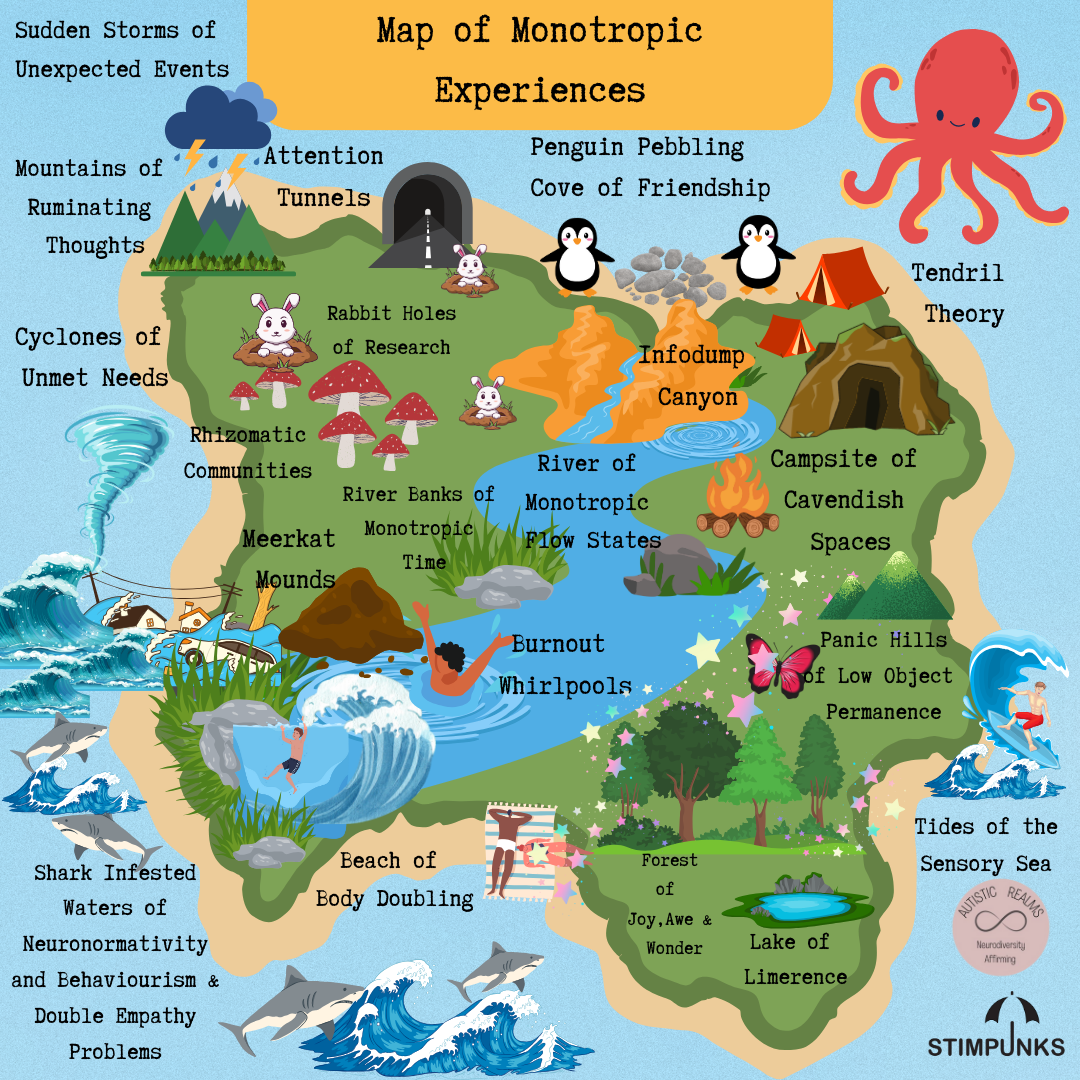
Map of Monotropic Experiences

You can use our “Map of Monotropic Experiences” for ideas. This map was created by myself, Helen Edgar (Autistic Realms) and offers insights into my own experiences as an AuDHD monotropic person.

We’d love you to share your experience of one or more of these areas.

Share how you travel between areas.

Share what your own Map of Monotropic Experiences may look like – you may like to add or take away different elements.

Would some areas take up more of the map than others?

Has your map changed over the years – what would your childhood map look like?

What do you want your map to look like in the future?

You don’t have to reference the map for your submission. We offer it as optional inspiration.

Map of Monotropic Experiences Map of an island with the areas: Attention Tunneling Penguin Pebbling Cove of Friendship Tendril Theory (@EisforErin) Mountains of Ruminating Thoughts Cyclones of Unmet Needs Rabbit Holes of Research Infodump Canyon Rhizomatic Communities River of Monotropic Flow States Campsite of Cavendish Spaces Meerkat Mounds (Gray-Hammond & Adkin) Riverbanks of Monotropic Time Shark Infested Waters of Neuronormativity, Behaviourism & Double Empathy Problems (Milton, 2012) Beach of Body Doubling Burnout Whirlpools Panic Hills of Low-Object Permanence Forest of Joy Awe and Wonder Lake of Limerence Tides of the Sensory Sea Sudden Storms of Unexpected Events

License: “Map of Monotropic Experiences” by Helen Edgar is
licensed under CC BY-SA 4.0


Reflection Questions

Here are some reflection questions to spur inspiration:

  • Where are you on the map?
  • Where do you want to be?
  • How can you get there?
  • What support will you need?
  • What is your biggest hurdle?
  • What new areas would add to the map?
  • Are some areas bigger for you? Perhaps you need to expand the mountains of ruminating thoughts or maybe you feel stuck in a giant burnout whirlpool.
  • Are you experiencing many areas all at once – how does that feel, and what helps you navigate?
  • What does the forest of joy, awe, and wonder feel like for you – what are your passions?

What Is Monotropism?

What is monotropism?

Monotropism is a neurodiversity affirming theory of autism (Murray et al 2005).

Autistic / ADHD / AuDHD people are more likely to be
monotropic (Garau et al., 2023).

Monotropic people have an interest-based nervous system. This means they focus more of their attention resources on fewer things at any one time compared to other people who may be polytropic.

Things outside an attention tunnel may get missed and
moving between attention tunnels can be difficult and take a lot of energy.

Monotropism can have a positive and negative impact on
sensory, social and communication needs depending on the environment, support provided and how a person manages their mind and body.

Community input from various social media platforms to help define monotropism
Collected by Autistic Realms, January 2024

Find out more:

www.monotropism.org


Latest Posts

  • Autistic Burnout – Supporting Young People At Home & School

    Autistic Burnout – Supporting Young People At Home & School

    Autistic burnout in young people is real—and recovery starts with understanding. This post offers neuroaffirming ways to spot the signs, reduce demands, and truly support. 💛 #AutisticBurnout #Neuroaffirming #Monotropism #AutisticSupport


  • Monotropic Interests and Looping Thoughts

    Monotropic Interests and Looping Thoughts

    The theory of monotropism was developed by Murray, Lawson and Lesser in their article, Attention, monotropism and the diagnostic criteria for autism (2005). ​ Monotropism is increasingly considered to be the underlying principle behind autism and is becoming more widely recognised, especially within autistic and neurodivergent communities. Fergus Murray, in their article Me and Monotropism:…


  • Map of Monotropic Experiences

    Map of Monotropic Experiences

    The Map of Monotropic Experiences now has a home of its own. Visit monotropicmap.org to explore each of the twenty areas, mark your own map and find the free training. You can also find the free training and downloads further down this page. Monotropism seeks to explain Autism in terms of attention distribution and interests. …


  • The Double Empathy Problem is DEEP

    The Double Empathy Problem is DEEP

    “The growing cracks in the thin veneer of our “civilised” economic and social operating model are impossible to ignore”, Jorn Bettin (2021). The double empathy problem (Milton, 2012) creates a gap of disconnect experienced between people due to misunderstood shared lived experiences. It is “a breakdown in reciprocity and mutual understanding that can happen between people…


  • Top 5 Neurodivergent-Informed Strategies

    Top 5 Neurodivergent-Informed Strategies

    Top 5 Neurodivergent-Informed Strategies By Helen Edgar, Autistic Realms, June 2024. 1. Be Kind Take time to listen and be with people in meaningful ways to help bridge the Double Empathy Problem (Milton, 2012). Be embodied and listen not only to people’s words but also to their bodies and sensory systems. Be responsive to people’s…


  • Autistic Community: Connections and Becoming

    Autistic Community: Connections and Becoming

    Everyone seeks connection in some way or another. Connections may look different for autistic people. In line with the motto from Anna Freud’s National Autism Trainer Programme (Acceptance, Belonging and Connection), creating a sense of acceptance and belonging is likely to be more meaningful for autistic people than putting pressure on them to try and…


  • Monotropism, Autism & OCD

    Monotropism, Autism & OCD

    Exploring similarities and differences between Autistic and OCD monotropic flow states. Can attention tunnels freeze, and thoughts get stuck?


  • Monotropism Questionnaire & Inner Autistic/ADHD Experiences

    Monotropism Questionnaire & Inner Autistic/ADHD Experiences

     Post first published 28th July 2023 Over the past few weeks, there has been a sudden surge of interest in the Monotropism Questionnaire (MQ), pre-print released in June 2023 in the research paper ‘Development and Validation of a Novel Self-Report Measure of Monotropism in Autistic and Non-Autistic People: The Monotropism Questionnaire.‘ by Garau, V., Murray,…


  • Penguin Pebbling: An Autistic Love Language

    Penguin Pebbling: An Autistic Love Language

    Penguin Pebbling is a neurodivergent way of showing you care, like sharing a meme or twig or pretty stone to say “I’m thinking of you,” inspired by penguins who gift pebbles to those they care about.


  • Awe, Wonder and Monotropic Attention in Neuroqueer Learning Spaces

    Awe, Wonder and Monotropic Attention in Neuroqueer Learning Spaces

    If Helen De Cruz designed a learning space, what would it look like? Helen Edgar follows wonder and awe through monotropism, glimmers, flow and Cavendish Space.


  • Masking, Internalised Ableism and Imposter Syndrome: What We Do to Survive, and What We Are Taught to Believe

    Masking, Internalised Ableism and Imposter Syndrome: What We Do to Survive, and What We Are Taught to Believe

    Masking is what we do to survive. Internalised ableism is what we are taught to believe. Imposter syndrome asks whether we belong. Helen Edgar gently untangles all three.


  • Free Resources for Autistic Adults: The Thriving Autistic Discovery Programme

    Free Resources for Autistic Adults: The Thriving Autistic Discovery Programme

    Free, self-paced videos, guides and tools for recently identified Autistic adults, from the Thriving Autistic Discovery Programme. What it is, who it is for, what it covers, and how to explore it.


WordPress Cookie Plugin by Real Cookie Banner