When your child is identified as Autistic, ADHD or PDA, or you begin to wonder about yourself, you walk into a new language overnight. Professionals have to keep up with it too, and get it right in reports and meetings. This glossary is the everyday vocabulary, written plainly from lived experience as an Autistic ADHD adult and parent and twenty years in SEND teaching, and it is neurodiversity-affirming all the way through: nothing here is a deficit. It began as a glossary for The PDA Space Summit in 2023 and has grown since.
Each card gives the meaning and, where there is one, the guide on this site that goes deeper. For the words of theory and philosophy that More Realms is written in, see its Glossary, and for the biggest shared vocabulary made by neurodivergent people, the Stimpunks glossary, which I helped to build.
Take the glossary with you
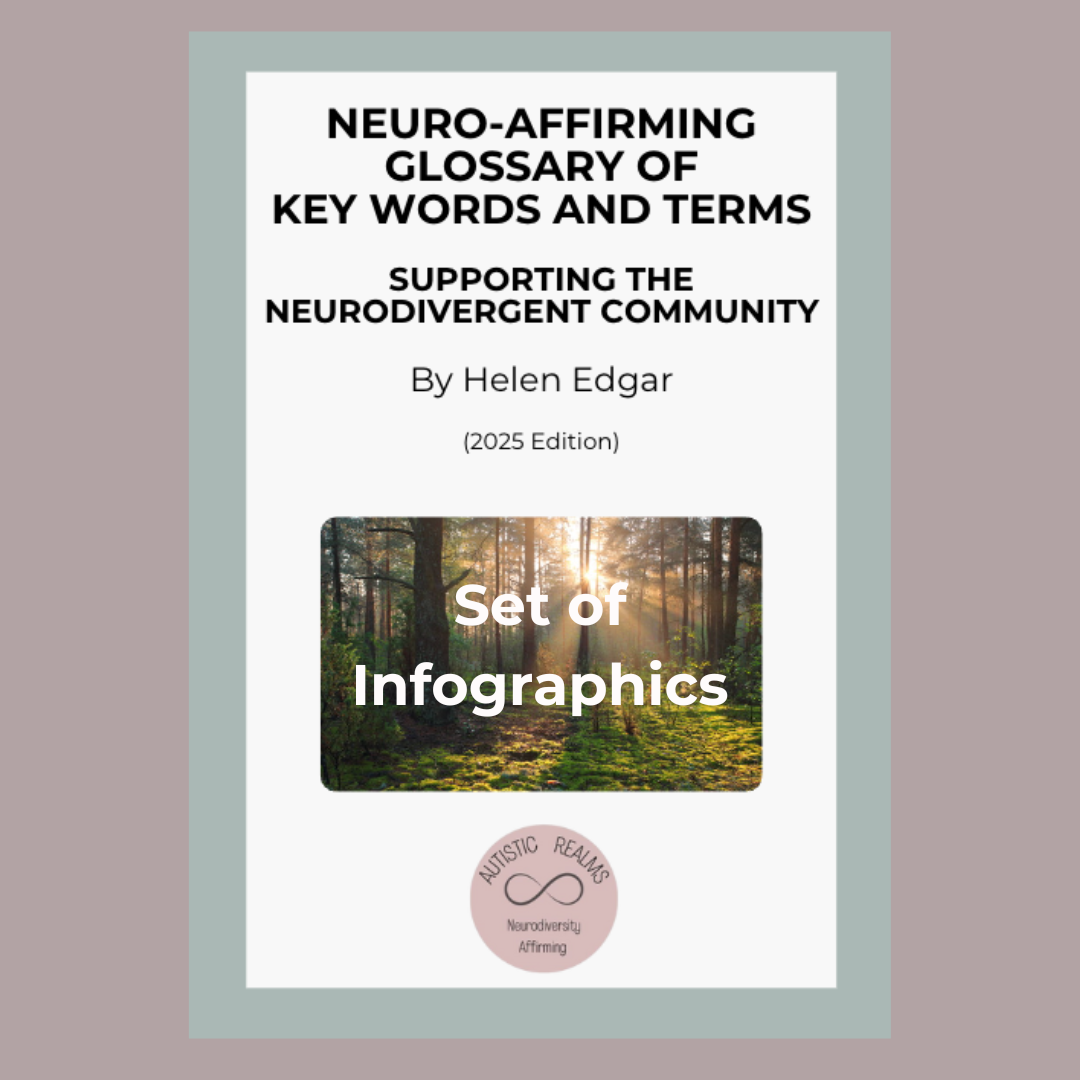
Neuro-Affirming Glossary Cards
Over 60 neuro-affirming words and terms as printable cards, one term per card, for discussion in education, health and care settings, staff rooms and family kitchens. Get it in the shop, pay what you can.

Neuro-Affirming Glossary (2025 edition)
The full e-book: every term with fuller explanations, signposting and references, updated for 2025. Get it in the shop, pay what you can.
The glossary, A to Z
A
ADHD (Attention Deficit Hyperactivity Disorder)
A difference in neurology affecting attention, thinking, processing and impulse. Many ADHD people are also monotropic, and many are Autistic too (AuDHD). Monotropism in ADHD, AuDHD and autism
Alexithymia
Difficulties identifying, understanding and expressing your emotions, or those of others. It is common in Autistic people and often sits alongside interoception differences. Autism, OCD, alexithymia and interoception
AuDHD
Being both Autistic and ADHD. The two pull in different directions at once, which changes how attention, energy, rest and interests work, and why advice written for one alone often misses. Read more
Autism, Autistic
A neurotype: a way of thinking, sensing, communicating and relating that is different from the majority. People are born Autistic; it is not an illness and does not need fixing. Autistic needs are fluid and change with the environment and the people around you. Autistic experiences: questions and answers
Autistic burnout
A period of intense sensory, social, emotional and physical overwhelm that results in exhaustion, difficulties with executive functioning, memory and attention, and a change in the capacity to communicate and regulate sensory input. It is brought on by long periods of unmet needs, and it can lead to anxiety, depression and other mental health difficulties. The Autistic burnout hub
C
Co-regulation
Finding calm together: a trusted person lending their own regulated state, attention and presence so that a child or adult can settle, rather than being told to “calm down”. The basis of shared flow. Neurodivergent co-regulation
D
Demand avoidance
See PDA. More broadly, the anxiety and threat response many Autistic people feel when something is required of them, including by themselves; the reason low-demand approaches work. Low-demand posts
Double empathy problem
Damian Milton’s theory that communication breakdown between Autistic and non-Autistic people runs both ways. Autistic people are not uniquely bad at empathy; the misunderstanding is mutual, and the non-Autistic side usually has the power to make its version official. The double empathy problem: meaning and examples
Dyscalculia
Difficulties related to understanding numbers and with maths.
Dysgraphia
Difficulties with writing skills and letter formation, which can affect spelling and word choice (other fine motor skills may be fine).
Dyslexia
A specific learning difference that brings significant difficulties with reading, writing and spelling.
Dyspraxia
Difficulties with balance and coordination, which can also affect the planning and processing of motor tasks.
E
Echolalia, gestalt language processing
Echolalia is repeating back something said to you. For many Autistic children it is part of gestalt language processing: learning language in whole chunks (a line from a film, a phrase an adult uses) before breaking it into words, which is a valid way to learn to talk, not a sign of “no communication”. Gestalt language processing, monotropism and young people
Ehlers-Danlos Syndrome (EDS)
A group of inherited conditions that affect the joints and connective tissues; it occurs more often in Autistic people than in the general population.
Executive functioning
The skills that let you manage yourself: planning, organising, starting, stopping and carrying out tasks to meet a goal (washing, dressing, cooking, getting work done). In burnout these are usually the first to go. Spoon theory and autism
F
Flow, monotropic flow
Complete absorption in an interest, where time and self-consciousness fall away. For monotropic people flow is the natural state of attention when it is allowed to go deep, and it is restorative: time in flow is rest. Monotropic flow state
G
Glimmers
Small moments of joy, safety and sensory rightness: the opposite of triggers. Noticing and collecting them is one of the gentlest ways to support Autistic wellbeing. What are glimmers?
H
Hyperfocus
Attention locked all the way into one thing for hours. In monotropic terms it is simply the attention tunnel at full depth; it can be joyful and restorative, or exhausting when it is driven by anxiety. The monotropism guide
Hypersensitivity
A more intense, heightened response to sensory stimuli, to the point where light, sound, taste, touch, smell or movement can feel painful or very uncomfortable.
Hyposensitivity
A lower response to sensory stimuli, to the point of being unaware of light, sound, taste, touch, smell or movement for some people.
I
Identity-first language
Saying “an Autistic person”, not “a person with autism”, because being Autistic is not something carried around separately from the self. It is what most Autistic adults ask for, and why Autistic is written with a capital A on this site, as Deaf is. Neuro-affirming language
Info-dumping
Sharing deep knowledge and enthusiasm about a special interest, often at length and at speed. It is a form of connection and generosity, not rudeness.
Internalised ableism
Turning society’s messages about disability inward: believing you are lazy, broken or too much. Masking teaches it; unmasking and community undo it. Masking, internalised ableism and imposter syndrome
Interoception
A person’s ability to sense and interpret internal body signals. With interoceptive differences you may not know you are hungry, thirsty, hot, cold, in pain, or needing the toilet until it is urgent. Read more
L
Low-demand approach
Stripping out the demands that cause anxiety or harm, such as neuronormative expectations of eye contact, sitting still or handwriting for its own sake, so that a person has the capacity for what matters. It is how you get out of burnout and how you prevent it; it is not “giving in”. Low-demand parenting
M
Masking
Consciously or unconsciously suppressing your authentic Autistic identity and needs to fit the social norms of the people around you. Over time masking is harmful to mental health and is one of the main roads into burnout. Read more
Meltdown
A response to more sensory or social input than a person can manage. It can look like a “tantrum” or “losing control”; it is neither. Someone in meltdown needs time, safety and space to rest, regulate and recover in a way that is right for them.
Monotropism
A theory of autism developed by Autistic people (Dinah Murray, Wenn Lawson and Mike Lesser): attention is limited, and in a monotropic mind it is pulled deeply towards a few interests at a time. Deep focus, difficulty switching, sensory intensity and the cost of interruptions all follow. The monotropism guide
N
Neurodivergent
Describes a person whose bodymind processes, thinks and responds to the world in a way that diverges from the majority: Autistic, ADHD, dyslexic, dyspraxic, Tourettic, OCD and many more. Some people are multiply neurodivergent. What does neurodivergent mean?
Neurodiversity
The diversity of human minds, in the same way that biodiversity is the diversity of life. It describes groups, not individuals: a classroom is neurodiverse, a person is neurodivergent.
Neurodiversity paradigm
A perspective that understands, accepts and embraces everyone’s differences: there is no single “right” or “normal” neurotype, just as there is no single right gender or race. It rejects the medical model of seeing differences as deficits and recognises that the inequalities seen elsewhere in society are seen in neurodivergent lives too (see Nick Walker).
Neurodiversity movement
The social justice movement that carries the neurodiversity paradigm into the world, working for equality and inclusion for everyone.
Neurodiversity-affirming, neuro-affirming
Promoting and valuing the ideas behind the neurodiversity paradigm in practice: starting from needs rather than behaviour, respecting identity, language and autonomy, and not trying to make people look more typical. The opposite is “neurodiversity-lite”: the words without the change. Avoiding the harm of neurodiversity-lite
Neurokin
The people whose minds work like yours, found in the moment someone does not need you to explain. Family by neurotype rather than blood.
Neuronormativity
The set of norms that treat one way of thinking, feeling, moving and communicating as the right way and everything else as deficit. It is built into schools, clinics and workplaces, and into our own inner voices. More Realms glossary
Neurotypical
Often used for people who are not neurodivergent, though the idea of a “typical” brain is debated. It can also mean the neuro-majority.
P
PDA (Pathological Demand Avoidance, Pervasive Drive for Autonomy)
Widely understood as a profile of autism in which everyday demands, including a person’s own wishes, trigger an anxiety and threat response, often met with social strategies to avoid them. Pressure makes it worse; autonomy, trust, humour and lower demands make it better. The PDA Space
Penguin pebbling
Showing love the way some penguins court: by bringing a pebble. Links, memes, facts and small treasures handed over to say “I thought of you”. An Autistic love language. Penguin pebbling
Proprioception
Also called kinaesthesia: the body’s sense of where it is, how it is moving and what it is doing.
R
Rejection Sensitive Dysphoria (RSD)
An intense emotional response to actual or perceived rejection, and heightened sensitivity to criticism or any negative reaction. Common in ADHD and Autistic people.
S
Scripting
Using prepared or borrowed language, from films, books or earlier conversations, to get through social situations. A communication strategy, and often part of gestalt language processing.
Self-identification
Recognising yourself as Autistic without a formal diagnosis. Valid and respected here: diagnosis is a gateway to some support, not a test of whether you are Autistic. Think you or your child might be Autistic?
Sensory avoidance
Intentionally withdrawing from sensory experiences that cause discomfort or pain.
Sensory overload
The overwhelm that follows sensory input beyond what the mind and body can process at that moment. It can lead to meltdowns and shutdowns and takes time to recover from.
Sensory seeking
Intentionally seeking out sensory experiences that feel good and regulate.
Shutdown
A response to stress or to sensory, social or communication overload that can leave a person unable to communicate, engage or carry out everyday tasks. The senses may be heightened or lowered. Like meltdown, it needs rest and safety, not pressure.
Situational mutism
Being unable to produce speech in certain contexts, even when speech is available in others. It is not a choice.
Social model of disability
The understanding that people are disabled by environments, attitudes and systems built without them in mind, rather than by their differences alone. Support means changing environments and expectations, not people.
Special interest, deep interest
An all-consuming focus that brings great joy within a monotropic flow state. Deep interests are how Autistic people regulate, learn, gain expertise and connect with others who share them; they are passions, not “restricted” behaviour. Monotropism and Autistic play
Spoon theory
Christine Miserandino’s picture of limited energy: you start the day with a handful of spoons and every task costs at least one. It explains why “small” things cost Autistic people so much. Spoon theory and autism
Stimming
Repetitive movement, sound or touch that regulates and expresses: rocking, flapping, humming, pacing, fidgeting. It is the bodymind’s sensory language, not behaviour to be extinguished. Stimming as embodied sensory language
T
Tics
Repetitive muscle movements that result in sudden body movements or vocalisations.
Tourette’s syndrome
A condition that causes a person to make involuntary sounds and movements called tics (NHS). Tourettic people are neurodivergent.
Transitions
Moving between activities, places or states. For monotropic people every switch pulls attention out of a tunnel and costs energy, which is why transitions are one of the biggest hidden demands in a day. Supporting young people through transitions
U
Unmasking
The slow, uneven work of letting the natural self back out: stimming, speaking and moving as you are. It is only safe in places and relationships that will hold it. Read more
This glossary is not comprehensive, and it changes as our language does. If a word you have met is missing, tell me and I will add it.
More from Autistic Realms
If this post was useful, these courses, books and resources might help too. Everything in the shop is pay what you can, and many resources are free.
- Building a Positive Autistic Identity: a gentle, self-paced course written for Autistic people.
- Re-Storying Autism course: a video course and workbook with David Gray-Hammond.
- Re-Storying Autism (book): our book, co-written with David Gray-Hammond.
- Neuro-Affirming Glossary (2025 edition): key words for families and professionals.
- Autism and Neurodiversity Starter Pack: free, written with David Gray-Hammond.
- The Autistic Realms shop: over 380 resources, pay what you can and many free.