
Whether you’re an adult exploring your own identity or a parent/carer supporting your child, you may be wondering things like:
- Is this Autism? ADHD? Something else?
- Do I need formal identification, or can I self-identify?
- How do I find the right people to talk to?
- Where do I start without getting overwhelmed?
This page offers a gentle, neuro-affirming roadmap, rooted in Autistic community knowledge so you can explore these questions at your own pace.
I am not a medical practitioner or therapist but I hope this will be a starting point for your journey of discovery.
Our lived experiences are often shaped by many intersecting identities and needs. It’s common for Autistic people to also have overlapping neurodivergence, and you may find you or your child is also dyslexic, dyspraxic or PDA. Some people also have co-occuring physical health conditions such as Ehlers-Danlos Syndrome (EDS) or may have additional learning disabilities.
Culture, gender, trauma history and access to support can also impact how Autistic traits show up and how easily they’re recognised, or not. If some questions resonate and others don’t, that’s okay; your story may be influenced by more than one thread of neurodivergence or other difference, everyone is unique! The questions below are formed from my own AuDHD experiences and from those of others I have supported both professionally and personally.
I have included lots of signposting for Autism and ADHD tests, screeners and questionnaires alongside some other mental health information below, with some ideas of people and places to reach out to for more information. I hope this is helpful.
Does this feel familiar for you or your child?
Sensory Experiences
- Do certain sounds, lights, textures, smells, or tastes feel unusually intense, overwhelming, or comforting?
- Do you or your child notice small sensory details that others seem to miss?
- Do you or your child sometimes not notice or misinterpret internal bodily signals like hunger, pain or tiredness?
- Are transitions between sensory environments (home → school/work, quiet → noisy) difficult or draining?
- Are there sensory experiences you or your child actively seek out (e.g., movement, deep pressure, particular fabrics)?
- Do you or your child need lots more time and space to recover after sensory overload than other people you may know?
Communication & Language
- Do you or your child find it sometimes find it easier to communicate through writing, typing, drawing, gestures, or AAC (Augmentative and Alternative Communication) rather than spoken words?
- Are there times when speech feels difficult, unavailable, or too exhausting—even when you know what you want to say?
- Do you or your child use scripts, quotes, or repeated phrases to communicate or self-regulate?
- Do conversations feel easier when you know the topic in advance, or when you can talk about something meaningful to you?
- Is it harder to read hidden meanings, body language, sarcasm, vague instructions, or social “rules” that others take for granted?
- Do you prefer clear, direct, deep communication over small talk?
- Does communication feel especially tiring in group settings but easier one-to-one?
Socialising & Relationships
- Do friendships feel easier when based on shared interests rather than social expectations?
- Does social interaction drain energy, even when you enjoy it?
- Do you or your child struggle to initiate or maintain conversation when you’re not interested in the topic?
- Is it difficult to understand unwritten social rules or to know when it’s your turn to speak?
- Do you prefer a smaller circle of trusted people, or just 1 or two close friends rather than lots of acquaintances?
Interests & Learning
- Do you or your child develop deep, focused interests that become an important part of daily life?
- When engaged in something interesting, do you find it hard to stop or switch tasks?
- Is learning and working easier and more productive when diving deeply into topics for extended periods of time?
- Are your interests a source of deep joy, comfort, and part of your identity—not just a hobby?
- Do you or your child show intense curiosity about specific subjects, objects, or patterns?
Attention & Executive Function
- Do you find it difficult to shift attention when interrupted or asked to change tasks?
- Do you or your child experience intense focus (hyperfocus) on things you love, but struggle with tasks you find boring or unclear?
- Is starting tasks or finishing tasks hard —even when you want to if you are in flow?
- Do routines, predictability, or visual / audio supports make daily life a bit easier?
- Do unexpected demands or sudden changes create anxiety or shutdown/meltdown?
Emotional Regulation & Energy
- Do emotions feel big, sudden, or overwhelming, especially when tired or overstimulated?
- Do you or your child experience regular shutdowns, meltdowns, or withdrawal when overloaded?
- Does masking lead to exhaustion after social situations?
- Do you feel better when allowed to stim, move, or use specific self-regulation tools to help balance your sensory system and focus?
Identity & Sense of Self
- Have you always felt “different” without knowing why?
- Do you relate more deeply to other Autistic/ ADHD people’s experiences than to neuronormative ways of being and social expectations?
For Parents/Carers
Does your child thrive with low demand and predictable routines but struggle with unexpected changes?
Are they happiest when immersed in their interests?
Do they communicate in unique, creative ways?
Do they have frequent meltdowns or shutdowns, especially after school and masking all day?
Neurodiversity: A Starting Point
Being neurodivergent doesn’t mean there is anything ‘wrong’ with you, even if you or your loved one might be struggling and needing support. There are many forms of human neurodiversity, with unique strengths, perception, learning approaches, and sensory and relational ways of being.
A beautiful place to begin to learn about neurodiversity is this video, ‘An Introduction to Neurodiversity‘ from Autism Central. It is written, narrated by Kieran Rose.
Autism Central is run by Anna Freud and is NHS commissioned and free for all!
An Introduction to Neurodiversity video:
Also check out: Neurodiversity is for Everyone by Fergus Murray
“Different people experience the world differently. This is an essay about why that’s important, over slow-motion film of water.”
There are many different ways of thinking, sensing and being in the world and when you find out more about neurodivergence, you can start getting the right support to enable you or your child to thrive.
Also check out the videos I created with Thriving Autistic Team. Our two new neuro-affirming educational animation videos celebrate Autistic experiences and perspectives.
Our animations were proudly created by a neurodiverse, international team, and all our writers are Autistic.
Discovering You’re Autistic shares the strengths and possibilities that come with understanding yourself and finding belonging.
Lightbulb Moments: Being Autistic shines a light on the many ways Autistic people experience and make sense of the world, showing that these experiences are both shared and valuable.
Tests, Screeners, and Questionnaires — A Starting Point
Online tests, questionnaires and screeners can help you explore your strengths, challenges and identity. They don’t diagnose, but they can clarify what resonates and support conversations in educational, workplace, and healthcare settings with professionals for you or your child.
When you’re exploring whether you or your child may be Autistic or otherwise neurodivergent, it can be helpful to remember that autism often runs through families across generations. Many adults only begin to recognise traits in themselves once they see them in their children due to many reasons, including internalised ableism and impostor phenomenon. Research suggests a strong familial pattern, with studies indicating autism has around 83% heritability, so you may not have noticed differences in yourself until adulthood, or you may have tried to struggle through life not knowing why it felt so hard and have some mental health difficulties too (Sandin et al 2017).
In my role as Stimpunks Co-Creative Director, I have collaborated on their Autism Pathway, to help provide a clear and accessible guide for people who are Autistic or exploring whether they might be.
Our Autism Pathway uses flexible learning pathways, routes you can dip into in any order to build knowledge at your own pace. A wonderful choose your own adventure and has far more information than I can share here!
These pathways include many topics including; Education Access, Healthcare Access, and Communication Access. Each offering neuro-affirming explanations, practical supports, and alternatives to harmful, deficit-based approaches. Together, they help individuals and families find language, understanding, and community that honour authentic Autistic ways of being.
Explore: Stimpunks Autism Pathways!
Embrace Autism share that, “Autism tests can play an important role in your journey of self-discovery, and may inform your decision to pursue a formal diagnosis. For a formal assessment, please see a knowledgeable professional who is qualified to assess autism—and ideally, someone who takes co-occurring conditions such as alexithymia, ADHD, PTSD, and camouflaging, and Autistic burnout into consideration.”
Many Autistic ADHD people find the Monotropism Questionnaire really interesting and validating.
Self-Identification or Formal Identification?
Self-identification is valid.
Many people find that self-identification offers language, relief, and community far sooner than any clinical process ever could, and they never feel the need for a formal identification.
Formal identification can be helpful.
Not because you need permission to exist — but because, unfortunately, systems often require proof. However, there can be long waiting lists and many barriers in the UK for NHS assessments; there are also costs to bear in mind for a private assessment.
A formal assessment and identification can help to:
- Provide support in education (school accommodations, college/university adjustments – even though they should be needs based!)
- Provide workplace reasonable adjustments
- Support eligibility for disability benefits or social protection
- Ensure healthcare providers understand and adapt to your needs
- Help counter ableism and disbelief from schools, employers, or professionals (even though this shouldn’t be needed!)
Check out this blog from Maxfield Sparrow: Seeking an Adult Assessment for Autism and/or ADHD – Unstrange Mind
Choose what feels right for you or your family.
Finding Neuro-Affirming Practitioners
Many people discover they are both Autistic and ADHD (AuDHD) and may have many other overlapping neurodivergences as well as physical or mental health needs. Research shows a significant overlap between the two neurotypes. Studies suggest that anywhere from around 30% to 85% of Autistic individuals may also meet criteria for both (Sokolava, 2017). Because the traits of Autism and ADHD can overlap and sometimes look similar from the outside, it’s often helpful to explore both pathways if you or your child relates to either. This can help provide a more accurate self-understanding and help you access the right tools, strategies, and accommodations.
More about Autism and ADHD overlap can be found at Neurodivergent Insights
If you decide to explore a formal assessment pathway. Check out:
Thriving Autistic Directory
https://neurodivergentpractitioners.org/
Thriving Autistic Organisation
https://www.thrivingautistic.org/
My personal recommendations for UK/ Ireland:
The Adult Autism & ADHD Practice
https://www.adultautism.ie/
Pebble Autism
https://www.pebbleautism.co.uk/
Next Steps: So you have realised you or your child is Autistic/ ADHD, what next?
So you have realised you or your child is Autistic/ADHD…what next?
I’d recommend checking out and downloading these FREE starter packs:
If you are an adult, you may be interested in Thriving Autistics’ 6-week Discovery Programme. Our 6-week online programme aims to offer support, resources and community building for Autistic people and help you in answering the myriad of questions being late-identified can bring.
Ausome Training also offer a huge array of fabulous courses, training and resources for parents/carers and professionals and are worth checking out!
If you are a parent/ carer looking for an affirming Autistic identity programme for your child or young person, I would recommend looking at what GROVE and Pandas Online offer.
GROVE’s BEING ME is a 10-week online group for Autistic young people, led by specialist Autistic Mentors and co-designed with our team of Young Leaders, using the latest affirming research on Autistic experience, identity and wellbeing.
Pandas Online has several courses for children and young people grouped into ages from under 8’s to 25+ yrs. Pandas Online is passionate about moving away from Autistic children being observed and perceived by adults, often through a deficit lens, within their Autistic diagnosis.
They offer Neurobears Cubs (under 8yrs), Neurobears (8-14yrs) and Neurobears Unpacking Understanding (14-25+yrs).
Read: There is no such thing as SEND by Kieran Rose (Dec 2025)
Learn from Autistic Community Knowledge
I’ve created a growing collection of neuro-affirming resources to support Autistic people, families, and professionals.
My Neuro-Affirming Reading List gathers books that centre autistic expertise and celebrate our ways of thinking, learning, and being. Alongside this my page, Nothing About Us Without Us highlights Autistic-led organisations, charities, and social media accounts that prioritise lived experience and community wisdom. Both resources are designed to help you connect and to deepen understanding through authentic, neuro-affirming frameworks.
Key Books on Neuro-Affirming Assessment & Identification
For children:
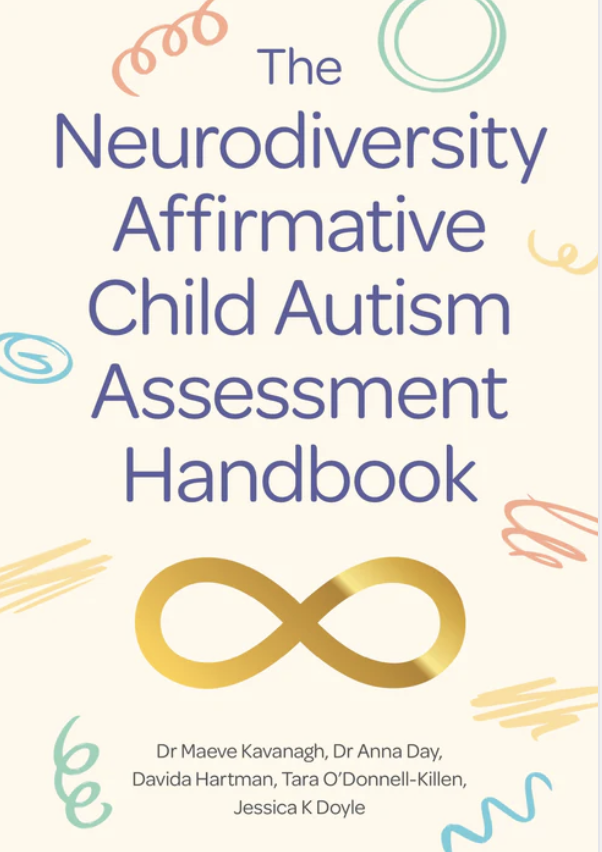
The Neurodiversity-Affirmative Child Autism Assessment Handbook by
Dr Maeve Kavanagh, Dr Anna Day, Davida Hartman, Tara O’Donnell-Killen & Jessica K Doyle
For adults:
The Adult Autism Assessment Handbook: A Neurodiversity-Affirmative Approach by Davida Hartman, Tara O’Donnell-Killen, Jessica K Doyle, Dr Maeve Kavanagh, Dr Anna Day, and Dr Juliana Azevedo.
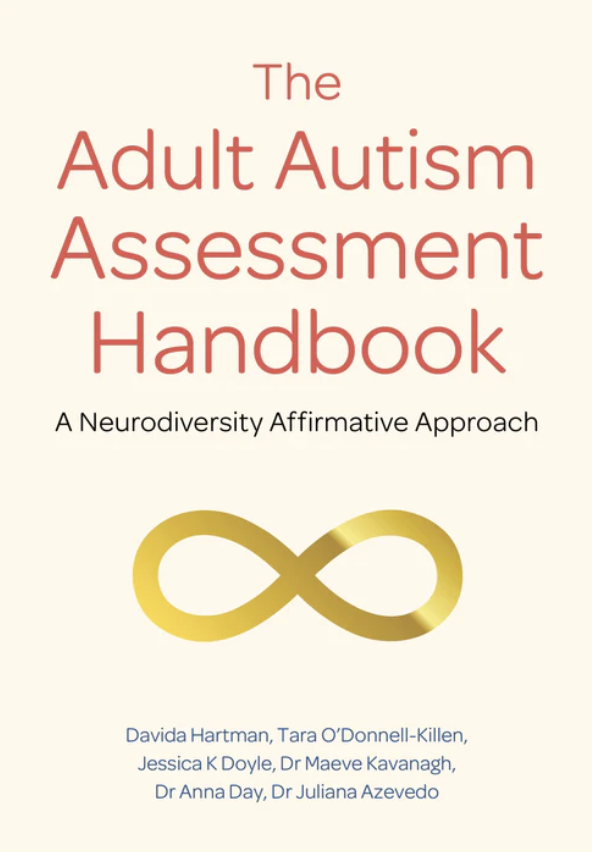
Both are useful for parents/carers, adults, and professionals wanting to avoid outdated deficit models and learn more!
I am honoured to say I contributed a small part to The Neurodiversity-Affirmative Child Autism Assessment Handbook.
Neurodiversity is Political
There is a huge concern at the moment about about Autism and ADHD ‘over-diagnosis’. There is no over-diagnosis, but there is a greater awareness of need.
As Dr Steven Kapp has said on a LinkedIn post (6th Dec, 2025), “The UK Government is trying to co-opt the neurodiversity movement through falsely claiming neurodivergents may simply be different and not disabled, when we advocate we are both (and disability is social-relational). We need more diagnoses”.
Diagnosis can be life-saving for some people.
Read:Identifying As Autistic Without A Formal Diagnosis: Who Self- Identifies As Autistic And Why? (Ahuvia, I. L. et al, 2025)
Read: Yes, it really is possible for everyone to be neurodivergent (Chapman, R. 2025)
Read: The Fascist Echo in Labour’s “Over-diagnosis” Inquiry (Chapman, R. 2025)
If you are questioning if you may be Autistic or ADHD, then that is a valid reason to explore a bit more, so you can get the support you deserve.
To resist late health fascism we need a mass politics of solidarity that centres people who are disabled or with mental ill-health alongside race, class, and gender. And we need a politics that recognises that many of our increasingly dominant health discourses—from those about overdiagnosis of ADHD to long COVID denialism—are a core part of the contemporary fascist and ruling class offensive…..To miss the health element of the current fascist global offensive is to miss a core part of that offensive—we ignore late health fascism at our peril.
https://substack.com/home/post/p-180869012
Robert Chapman, 2025
Community Matters: Join Us in NeuroHub
“Community is magic.
Community is power.
Community is resistance.”
Alice Wong
Whether you self-identify, seek formal identification or continue to explore for now, your experience is valid. Your needs are real, and there is a wonderful community to support and connect with along your journey!
Come join me and David Gray-Hammond in our new NeuroHub Community Space
Community Support
Exclusive Training Courses
Resources
and more!
Unsure of what being neuro-affirming really means, why it is important and how to find safe spaces?
Down load the FREE e-book I created for The PDA Space based on the webinar delivered by Jess Garner from GROVE:
Articles about Autism & ADHD identification and diagnosis
https://www.theguardian.com/stage/2022/mar/19/hannah-gadsby-autism-diagnosis-little-out-of-whack