This interview was first shared in April 2023. Since then, PAPYRUS Prevention of Young Suicide has entered administration and its HOPELINE247 service is no longer running, so I have updated the support links at the end of this post.
For Autism Acceptance Week 2023, I was invited by Spectrum Gaming to answer some questions for a blog series with PAPYRUS Prevention of Young Suicide. The aim was to shed light on the challenges Autistic people face, as well as the strengths that come with being Autistic. The very fact that we need an “acceptance” week says a lot about how deep the misunderstanding of Autism still goes.
How has being identified as Autistic impacted your life?
I have a much better understanding of myself and of my children, who are also Autistic. Everything I thought was “wrong” or a difficulty is actually just a different way of being. It is OK. I am learning to turn the narrative around and give myself more time and space, in the right environment, with people who understand. So many of the things that trigger anxiety and overwhelm can be made much easier once you start to view life through a neurodivergent-affirming lens. It helps that, as a family, we are all on this journey together, with a shared and growing understanding of each other’s needs.
What is the most important thing people should know about Autism?
There is no single “Autism”. Autism is not linear; it is multidimensional, fluid and dynamic. It is a unique way of bodyminds sensing, responding, interacting and communicating with the world. Whatever our neurology, everyone’s physical, sensory, social and communication needs are different, but for Autistic people those differences can have a more intense impact.
Autism is not an illness. It is a different way of thinking and responding. I feel it is so important to value difference by building good relationships, especially in schools and for young people. Unless people understand individual needs and the impact of the environment, they cannot make the changes that lead to better outcomes and support good mental health.
How can society be more accepting and accommodating of Autistic people?
Generally, we need more understanding and acceptance of all differences in society. For Autistic and disabled people, I would argue this matters even more, because the barriers are higher.
If non-Autistic people understood that Autistic differences are not deficits, it would be a start. Autistic people do not need to be “treated” or to have “interventions” to make us less Autistic. There may be co-occurring conditions and needs that need extra support, but most difficulties come from a lack of understanding between people, or from environmental and sensory factors.
What are some misconceptions about Autism?
Stimming helps us regulate our senses and emotions. It should not be stopped or inhibited.
Meltdowns and shutdowns happen when the sensory or social environment is not meeting someone’s needs and they can no longer manage. They are a sign that a person has gone past their capacity, not a behaviour to be managed. With more understanding, this overload would be less intense and happen less often. Over time, repeated overload can also lead to Autistic burnout.
“Restricted and repetitive behaviour”: our passions, deep interests and hyperfocus need to be embraced, not reduced.
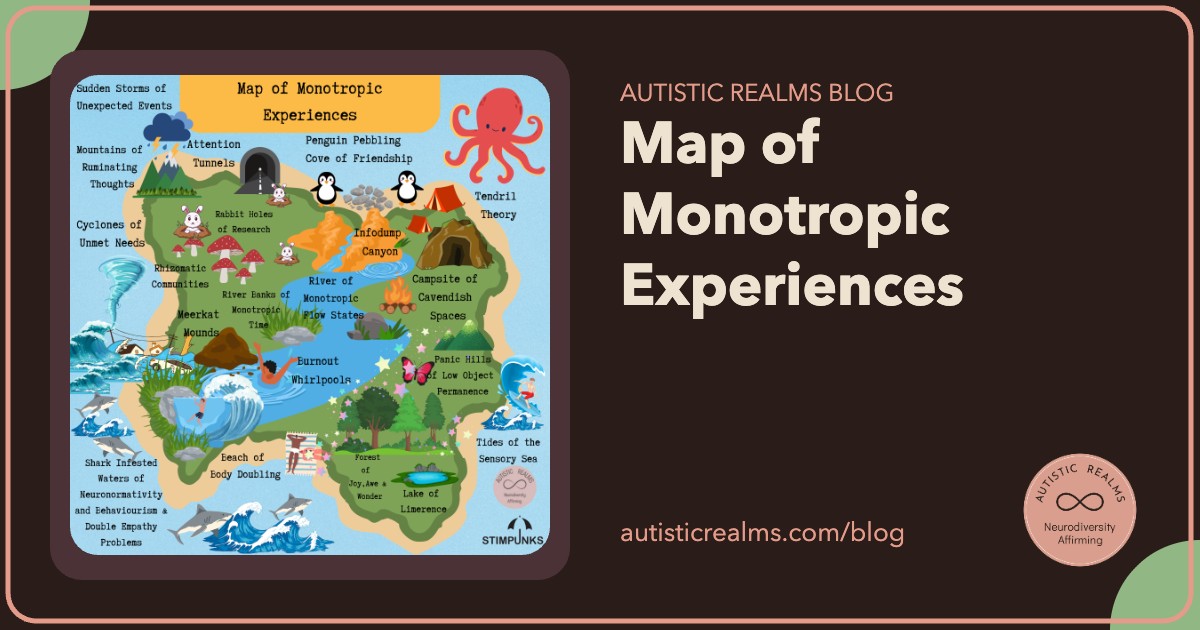
Monotropism is thought to be central to Autistic experience (Murray et al., 2005). When we embrace monotropism, we embrace flow. It allows deeper thinking, and it can be predictable, calming and joyful. Extra time and support may be needed for transitions, for moving attention onto other tasks and for executive functioning, but again this comes down to time, space and positive connections with people who are compassionate and understand the need for flexibility.
“Social and communication difficulties”: what may be seen as antisocial may simply be an environment that isn’t meeting someone’s needs, or the wrong way of communicating for that person. Are they more comfortable texting, emailing or talking? In small groups, large groups or one to one? Do they need an alternative way to communicate? In the right environment, with the right people, Autistic people can be very sociable in our own ways. Communication difficulties also run both ways, which is the heart of the double empathy problem (Milton, 2012).
What advice would you give to someone recently identified as Autistic, or to their family and friends?
Join a neurodiversity-affirming, neurodivergent-friendly support group. There is an amazing online community out there, so please reach out if you need support.
“Let’s work together towards a more inclusive and accepting world for everyone.”
My guide, Autistic Burnout: A Family Guide, is available in the Autistic Realms shop. You might also like Rewriting My Story: Understanding Myself Through Monotropism.
Support and signposting
If you are struggling, or worried about a young person, these UK services are free and confidential:
- Samaritans: call 116 123, any time, day or night.
- Shout: text SHOUT to 85258 for 24/7 text support.
- Childline: call 0800 1111 if you are under 19.
- In an emergency, call 999 or go to A&E.
Other resources:
- Spectrum Gaming: an online community created by Autistic adults for Autistic young people.
- Spectrum Gaming’s Padlet of affirming Autism resources, updated regularly.
- Barriers to Education: free resources for supporting Autistic young people who struggle to attend school.
Written from my lived experience as an Autistic parent and teacher, and from knowledge gained through personal research and neurodivergent communities. I am not a medical professional or therapist.
References
Milton, D. E. M. (2012). On the ontological status of autism: The ‘double empathy problem’. Disability & Society, 27(6), 883–887. https://doi.org/10.1080/09687599.2012.710008
Murray, D., Lesser, M., & Lawson, W. (2005). Attention, monotropism and the diagnostic criteria for autism. Autism, 9(2), 139–156. https://doi.org/10.1177/1362361305051398