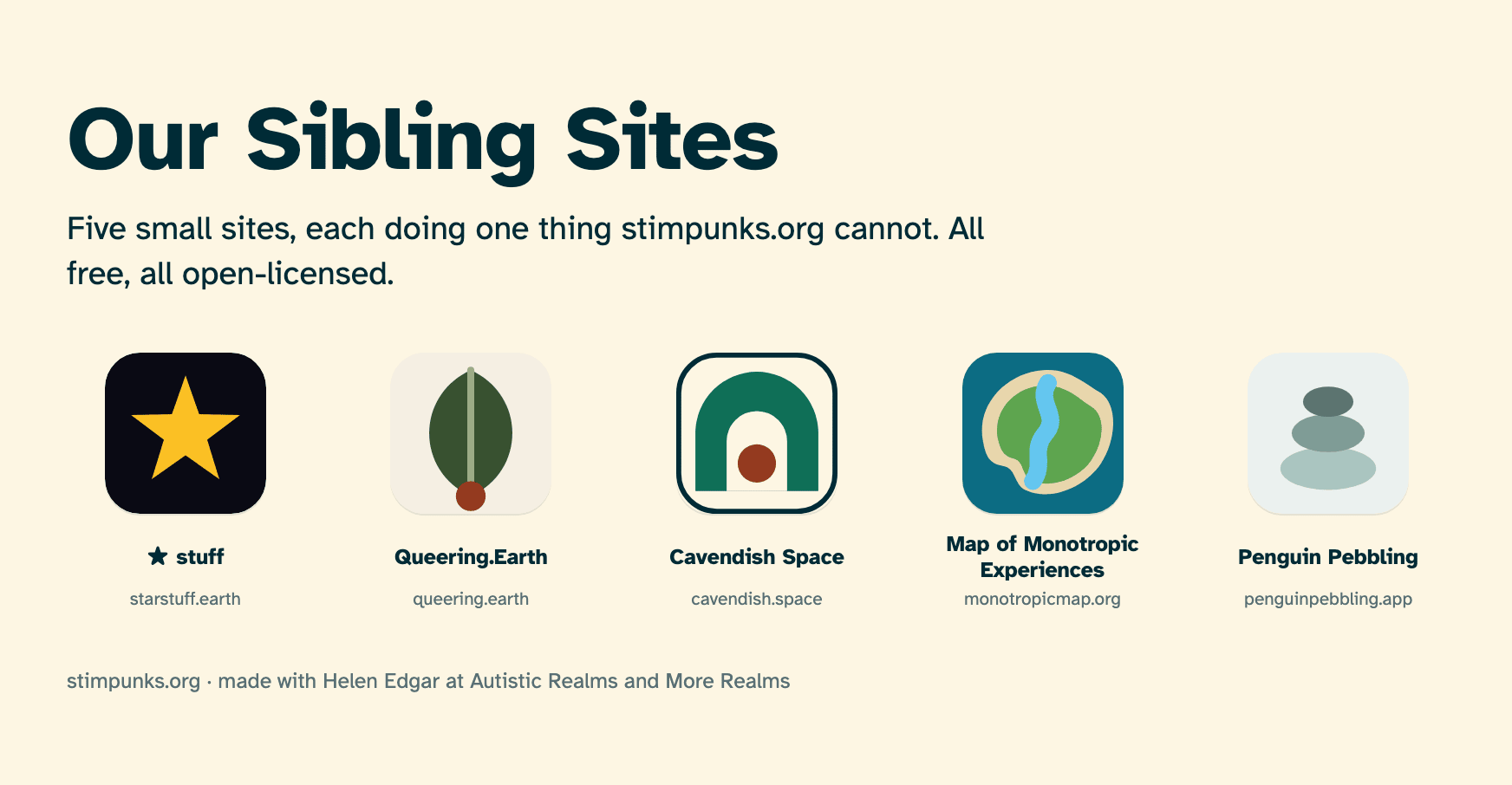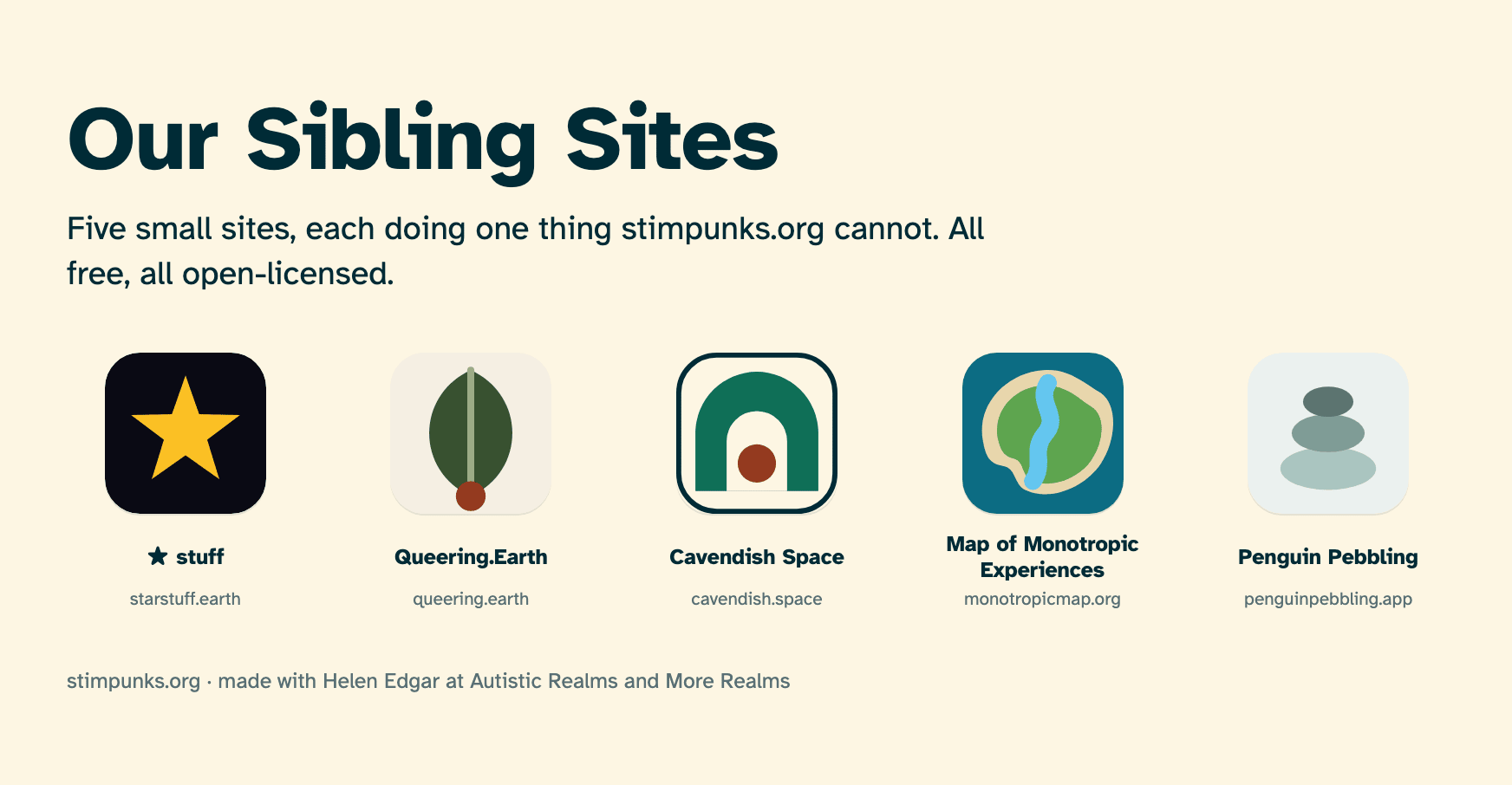
"Graphic titled 'Our Sibling Sites' on a cream background, with the subtitle: 'Five small sites, each doing one thing stimpunks.org cannot. All free, all open-licensed.' Below are five app-style icons in a row, each with a name and URL: a black square wit

5 New FREE Resources

Autistic Realms

Helen Edgar
Autistic Advocate, Author & Consultant

Neurodiversity-Affirming
Supporting Autistic People To Grow & Thrive

Welcome to Autistic Realms Newsletter!

I have been busy with Stimpunks Foundation!

Huge credit to the genius of Ryan Boren and his epic ability to draw on his tech background to turn some of my ideas into websites, zines, and interactive online games.

It is an ongoing joy and honour to collaborate and explore all these ideas with Stimpunks Foundation community. I am learning so much from everyone sharing their experiences – none of this is owned by us, every page and idea has been formed by everyone and everything we have ever met and worked with, human and non-human.

Stimpunks is not only stimpunks.org. Over the past year we have built five smaller sites, each doing one thing the big site cannot.

All five are free and open-licensed.

★ stuff

https://starstuff.earth/

Zines and field guides on stellar nucleosynthesis, piezoelectric bones, and the neurodiversity paradigm. Every atom heavier than hydrogen was forged in a star — which means you belong here as your differences, not despite them. We love you down to your star stuff.

Queering.Earth

https://queering.earth/

Close readings of the canon — art, literature, poetry, politics, people, history — asking what else any of it could have been, so the arrangements we were handed stop looking like the only ones available. Queering is a verb.

Cavendish Space

https://cavendish.space/

Places built to fit bodyminds, not the other way round. Cavendish Cards lets you point at a picture instead of explaining — no reading needed, no scoring, nothing shared until you turn a card up. Zone a room works out which zones a room you actually have can hold, and prints signs for the door, because a cave only works if people know not to talk in it.

Map of Monotropic Experiences

https://monotropicmap.org/

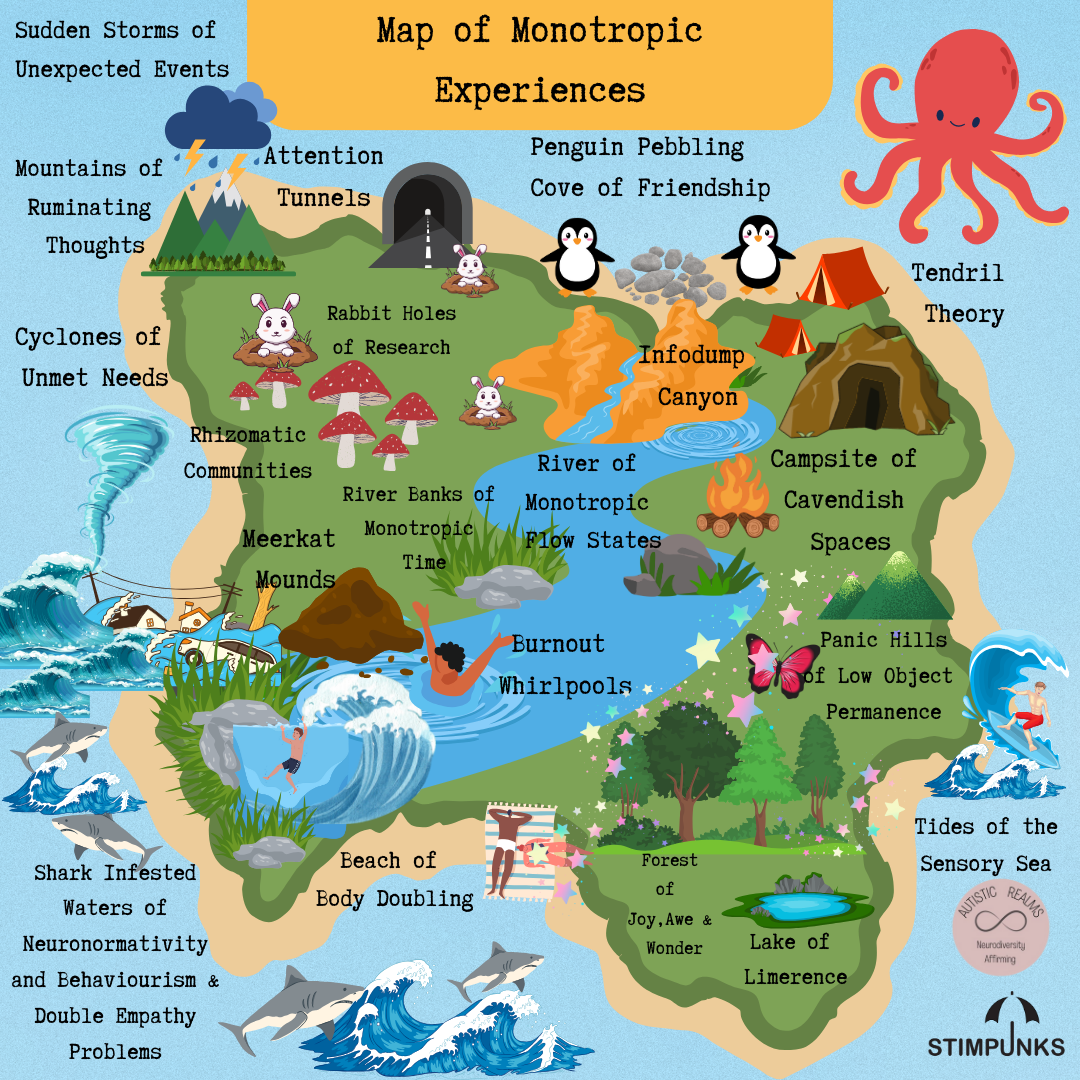
Twenty places a monotropic mind goes. Some of them are where the good work happens; some of them are the weather that other people make. This is based on my own map of my Autistic and ADHD experience, and it turned out that a great many of us live here too.

Penguin Pebbling

https://penguinpebbling.app/

A game of creating belonging, built on the Five Neurodivergent Love Locutions. No winners and no pressure to perform. Draw a card, share in whatever way feels right, pass a real pebble when something lands, and leave whenever you need to.

Every one of them is free to use, free to share, and free to steal for your own classroom, clinic, or kitchen table. That is the point of building them.

Broken systems, not broken people.

All sites and pages are in a process of ongoing iteration with changes logged openly.

Check it out – it is all VERY exciting!

Hope you enjoy!


If you find this news letter valuable please do share and encourage people to sign up and visit Autistic Realms & More Realms.

Best Wishes,

Helen

“Community is magic.
Community is power.
Community is resistance.”
Alice Wong


Latest Posts

  • Autistic Burnout – Supporting Young People At Home & School

    Autistic Burnout – Supporting Young People At Home & School

    Autistic burnout in young people is real—and recovery starts with understanding. This post offers neuroaffirming ways to spot the signs, reduce demands, and truly support. 💛 #AutisticBurnout #Neuroaffirming #Monotropism #AutisticSupport


  • Monotropic Interests and Looping Thoughts

    Monotropic Interests and Looping Thoughts

    The theory of monotropism was developed by Murray, Lawson and Lesser in their article, Attention, monotropism and the diagnostic criteria for autism (2005). ​ Monotropism is increasingly considered to be the underlying principle behind autism and is becoming more widely recognised, especially within autistic and neurodivergent communities. Fergus Murray, in their article Me and Monotropism:…


  • Map of Monotropic Experiences

    Map of Monotropic Experiences

    Monotropism seeks to explain Autism in terms of attention distribution and interests.  OSF Preprints | Development and Validation of a Novel Self-Report Measure of Monotropism in Autistic and Non-Autistic People: The Monotropism Questionnaire This map highlights 20 common aspects of my personal monotropic experiences. How many do you experience? Where are you on the map…


  • Autistic Burnout – Supporting Young People At Home & School

    Autistic Burnout – Supporting Young People At Home & School

    Being autistic is not an illness or a disorder in itself, but being autistic can have an impact on a person’s mental and physical health. This is due to the often unmet needs of living in a world that is generally designed for the well-being of people who are not autistic. In addition, three-quarters of…


  • The Double Empathy Problem is DEEP

    The Double Empathy Problem is DEEP

    “The growing cracks in the thin veneer of our “civilised” economic and social operating model are impossible to ignore”, Jorn Bettin (2021). The double empathy problem (Milton, 2012) creates a gap of disconnect experienced between people due to misunderstood shared lived experiences. It is “a breakdown in reciprocity and mutual understanding that can happen between people…


  • Top 5 Neurodivergent-Informed Strategies

    Top 5 Neurodivergent-Informed Strategies

    Top 5 Neurodivergent-Informed Strategies By Helen Edgar, Autistic Realms, June 2024. 1. Be Kind Take time to listen and be with people in meaningful ways to help bridge the Double Empathy Problem (Milton, 2012). Be embodied and listen not only to people’s words but also to their bodies and sensory systems. Be responsive to people’s…


  • Autistic Community: Connections and Becoming

    Autistic Community: Connections and Becoming

    Everyone seeks connection in some way or another. Connections may look different for autistic people. In line with the motto from Anna Freud’s National Autism Trainer Programme (Acceptance, Belonging and Connection), creating a sense of acceptance and belonging is likely to be more meaningful for autistic people than putting pressure on them to try and…


  • Monotropism, Autism & OCD

    Monotropism, Autism & OCD

    Exploring similarities and differences between Autistic and OCD monotropic flow states. Can attention tunnels freeze, and thoughts get stuck?


  • Monotropism Questionnaire & Inner Autistic/ADHD Experiences

    Monotropism Questionnaire & Inner Autistic/ADHD Experiences

     Post first published 28th July 2023 Over the past few weeks, there has been a sudden surge of interest in the Monotropism Questionnaire (MQ), pre-print released in June 2023 in the research paper ‘Development and Validation of a Novel Self-Report Measure of Monotropism in Autistic and Non-Autistic People: The Monotropism Questionnaire.‘ by Garau, V., Murray,…


  • Penguin Pebbling: An Autistic Love Language

    Penguin Pebbling: An Autistic Love Language

    Penguin Pebbling is a neurodivergent way of showing you care, like sharing a meme or twig or pretty stone to say “I’m thinking of you,” inspired by penguins who gift pebbles to those they care about.


  • 5 New FREE Resources

    5 New FREE Resources

    Autistic RealmsHelen Edgar Autistic Advocate, Author & ConsultantNeurodiversity-Affirming Supporting Autistic People To Grow & Thrive Welcome to Autistic Realms Newsletter! I have been busy with Stimpunks Foundation! Huge credit to the genius of Ryan Boren and his epic ability to draw on his tech background to turn some of my ideas into websites, zines, and…


  • Bagpuss: Lost Things. Holding Space for Emergence & Joy

    Bagpuss: Lost Things. Holding Space for Emergence & Joy

    Exploring Bagpuss through a neurodivergent lens: monotropism, slow attention, and the quiet beauty of restoring meaning to lost and overlooked things.


  • The Neurodivergent Community Standing in Solidarity Against Racism and Ableism

    The Neurodivergent Community Standing in Solidarity Against Racism and Ableism

    Solidarity Against Racism & Ableism in the Autistic & Neurodivergent Community


This website stores cookies on your computer. These cookies are used to provide a more personalized experience and to track your whereabouts around our website in compliance with the European General Data Protection Regulation. If you decide to to opt-out of any future tracking, a cookie will be setup in your browser to remember this choice for one year.

Accept or Deny

WordPress Cookie Plugin by Real Cookie Banner