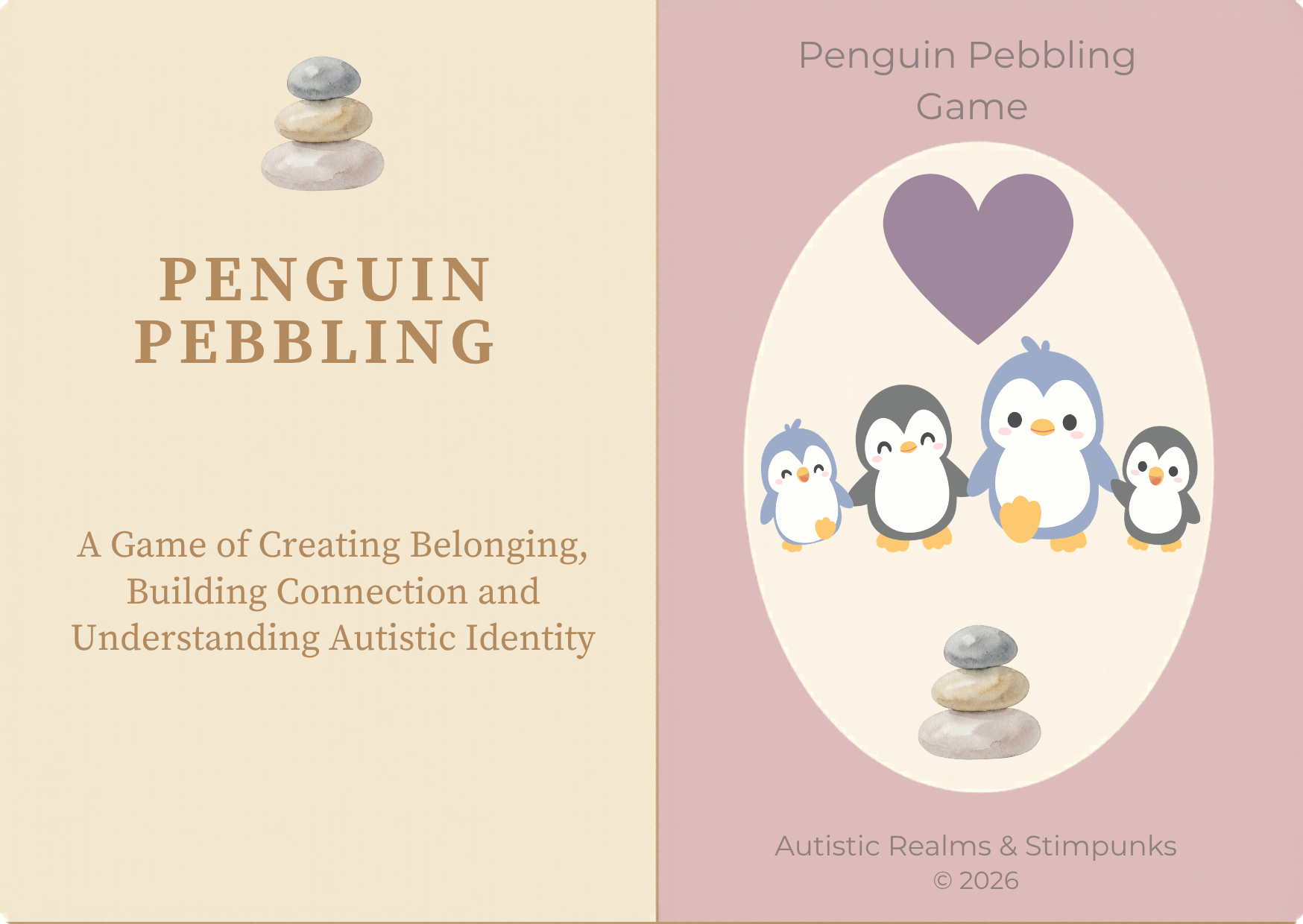
Penguin Pebbling: A Game of Creating Belonging, Building Connection and Understanding Autistic Identity
Developed by Helen Edgar, Autistic Realms & Ryan Boren, Stimpunks (2026).
Penguin Pebbling is a neuro-affirming card game built around the Five Autistic Love Locutions — infodumping, parallel play, support swapping, deep pressure, and penguin pebbling itself.
Play together in person or online, explore the prompts as a group, or use them for quiet, solo reflection and journalling. However you engage, it is an invitation to understand Autistic identity, celebrate the ways we connect, and build genuine belonging and meaningful connections together.
What is Penguin Pebbling?
Penguins pass pebbles to those they care about, to show love and to form a connection.
Penguin Pebbling is one of the Five Autistic Love Locutions, which you can find out more about here.
Many neurodivergent people also pass ‘penguin pebbles‘ to each other as an act of love. You may share a twig you picked up on your walk, a meme about something you know your friend loves — not because you have to, not because it is necessarily useful, just because it says: I thought of you. I wanted you to have this. I care.
Penguin Pebbling is a neuro-affirming card game built around the Five Autistic Love Locutions — infodumping, parallel play, support swapping, deep pressure, and penguin pebbling itself.
Play together in person or online, explore the prompts as a group, or use them for quiet, solo reflection and journalling. However you engage, it is an invitation to understand Autistic identity, celebrate the ways we connect, and build genuine belonging and meaningful connections together.
There are no winners.
There is no wrong way to play.
All you need are the cards, a few real pebbles (or whatever other item you may be drawn to or have a collection of).
You can play online using the interactive widget below, or download and print the cards to use with real pebbles or other items of interest.
Want to understand more about the Five Autistic Love Locutions and where this game came from?
Read the full blog here
How to Play
What you need
A handful of pebbles — or any other items of interest — enough for everyone to start with 3.
Keep a small pile of extra pebbles in the centre — this is the pebble bank.
The cards — use the widget above, or print and cut the card set below.
Before you begin
Find a comfortable place to be together.
Everyone takes 3 pebbles and holds them.
Feel the weight. Notice the texture. They are yours — to keep, pass, or just hold throughout the game.
Place the remaining pebbles in the centre as your shared pebble bank.
Taking turns
One person draws a card and reads it aloud — or asks someone else to read it for them.
Then choose: — Speak your response — Write or draw it and pass it around — Use AAC or any other communication tool — Just be — some cards ask nothing of you except presence
You can always pass on a card.
No explanation needed.
Passing a pebble
When something someone shares lands with you — when you feel heard, or recognise something in what they said, or just want to say I’m glad you’re here — pass one of your pebbles to them.
If you want to pass a pebble but don’t have one left, you can take one from the pebble bank.
No words needed unless you want to express more.
The pebble can hold the meaning.
No one ever runs out of a way to show they care.
Share in whatever way feels right for you — speaking, writing, drawing, AAC, gesture, or any other form of communication
Pebbles keep moving
There is no limit to how many pebbles you can give or receive.
Pebbles circulate freely for as long as the game does.
The bank means no one is ever without a way to connect.
Ending the game
There are no words needed to end the game, unless you decide on an ending as a group or maybe set a time limit.
Simply set your pebbles down.
Your group may like to agree on their own signal before you begin — a gesture, a word, another object placed in the centre, do whatever feels natural for your group.
The cards, the pebbles, and the prompts are yours to return to whenever you need them.
If something a card brings up stays with you — you are welcome to continue reflecting by yourself, in your own time, in whatever way feels right.
The game ends when everyone feels complete and finished for now.
Penguin Pebbling:
A Game of Creating Belonging, Building Connection and Understanding Autistic Identity
How to play
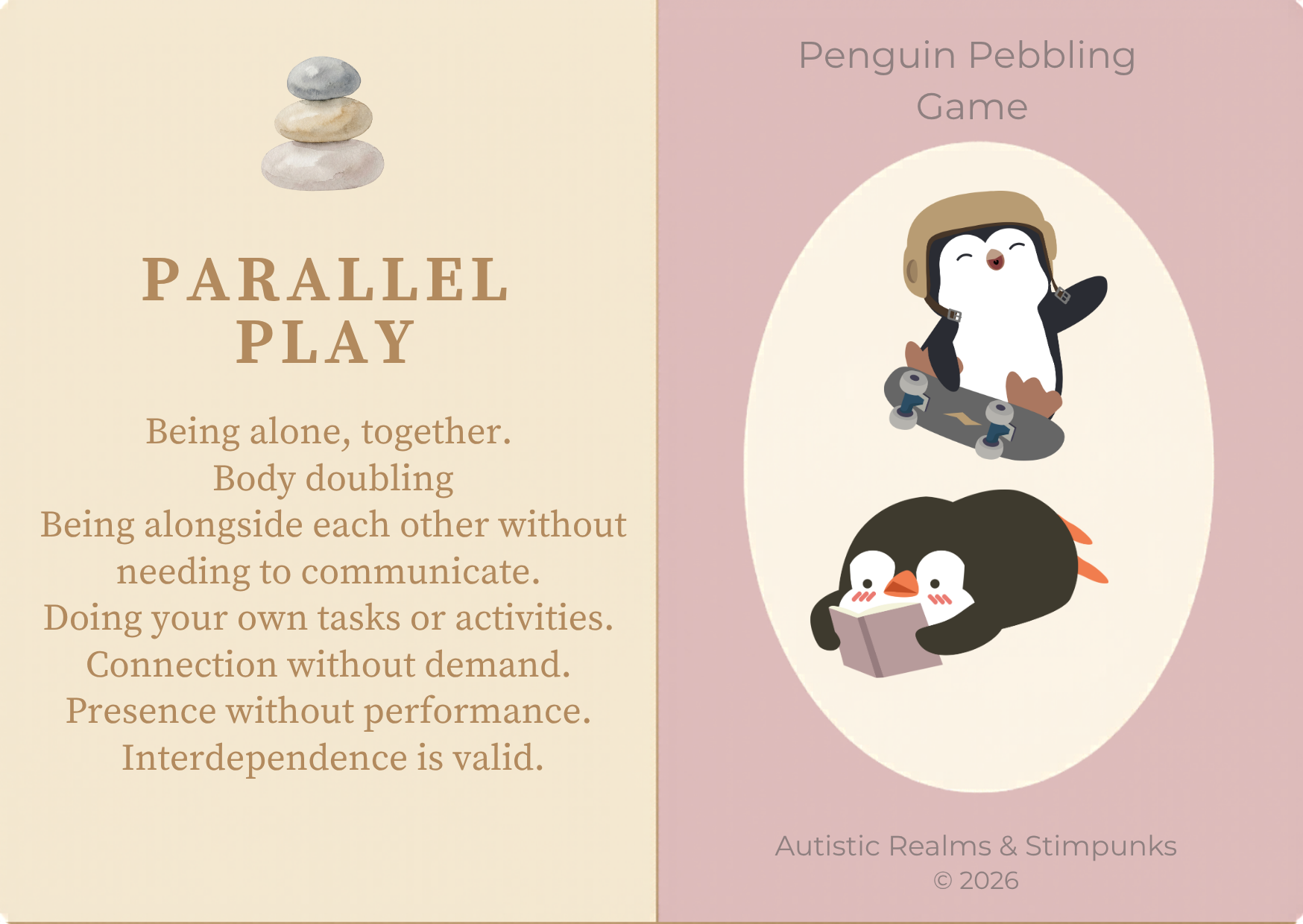
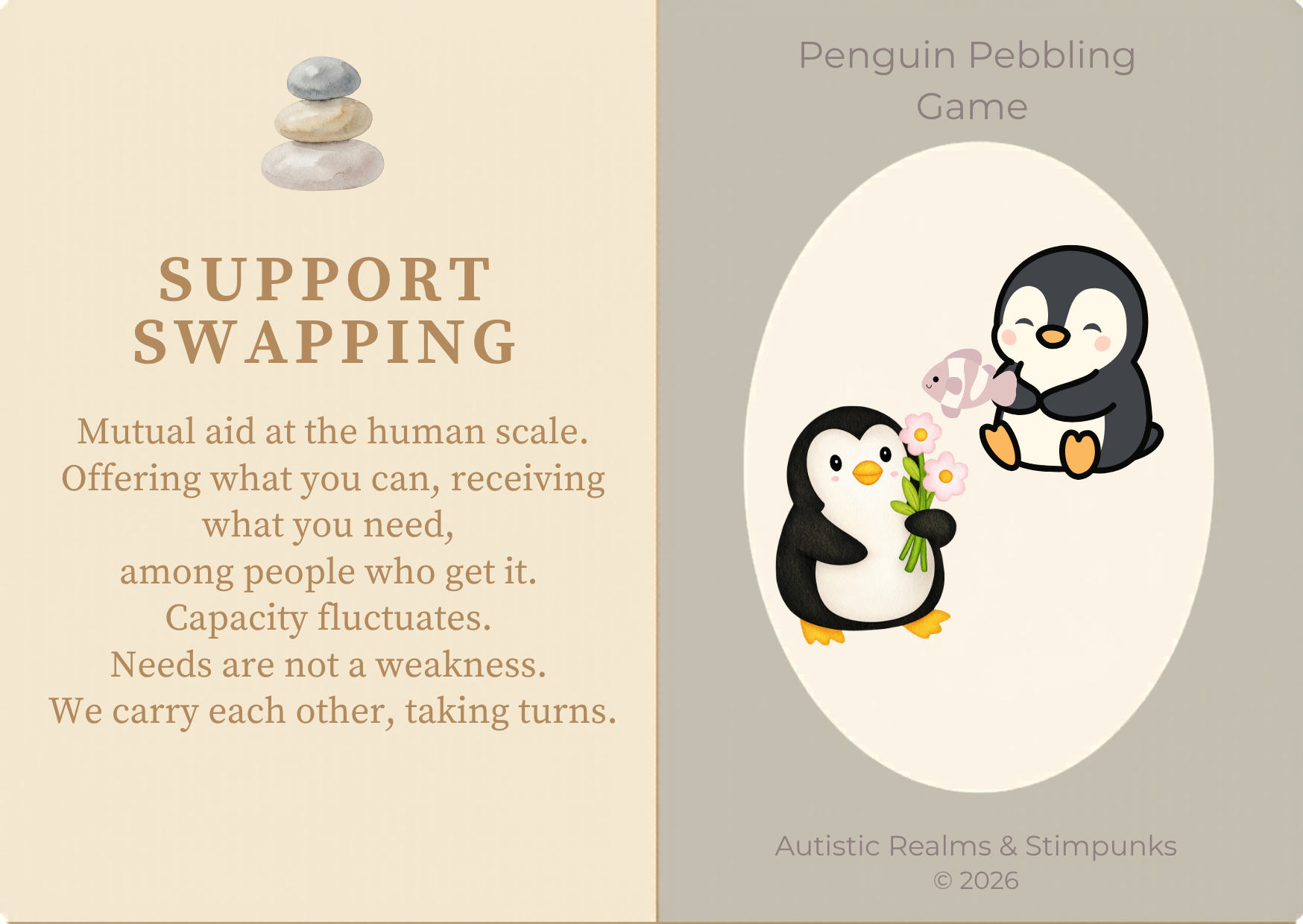
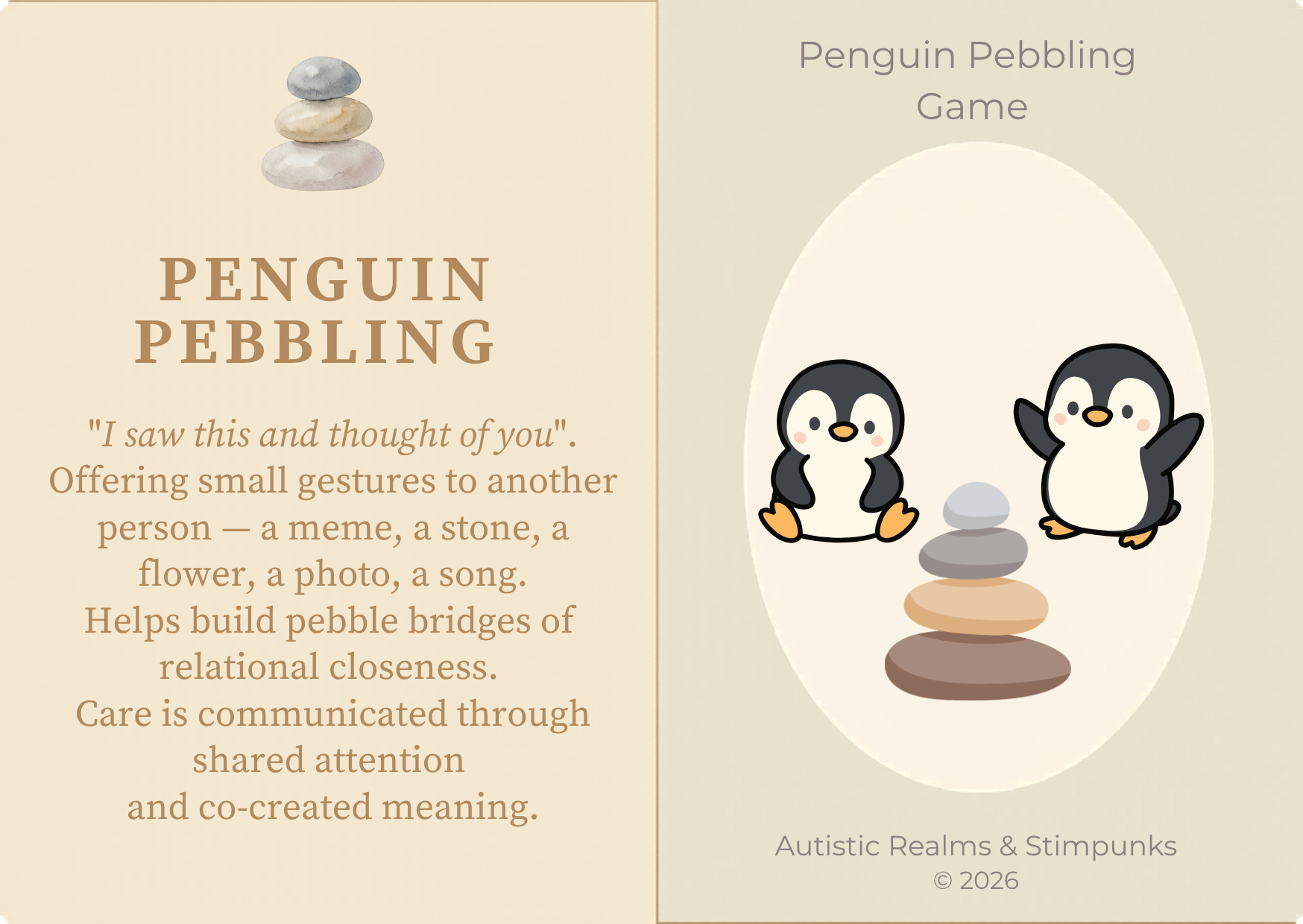
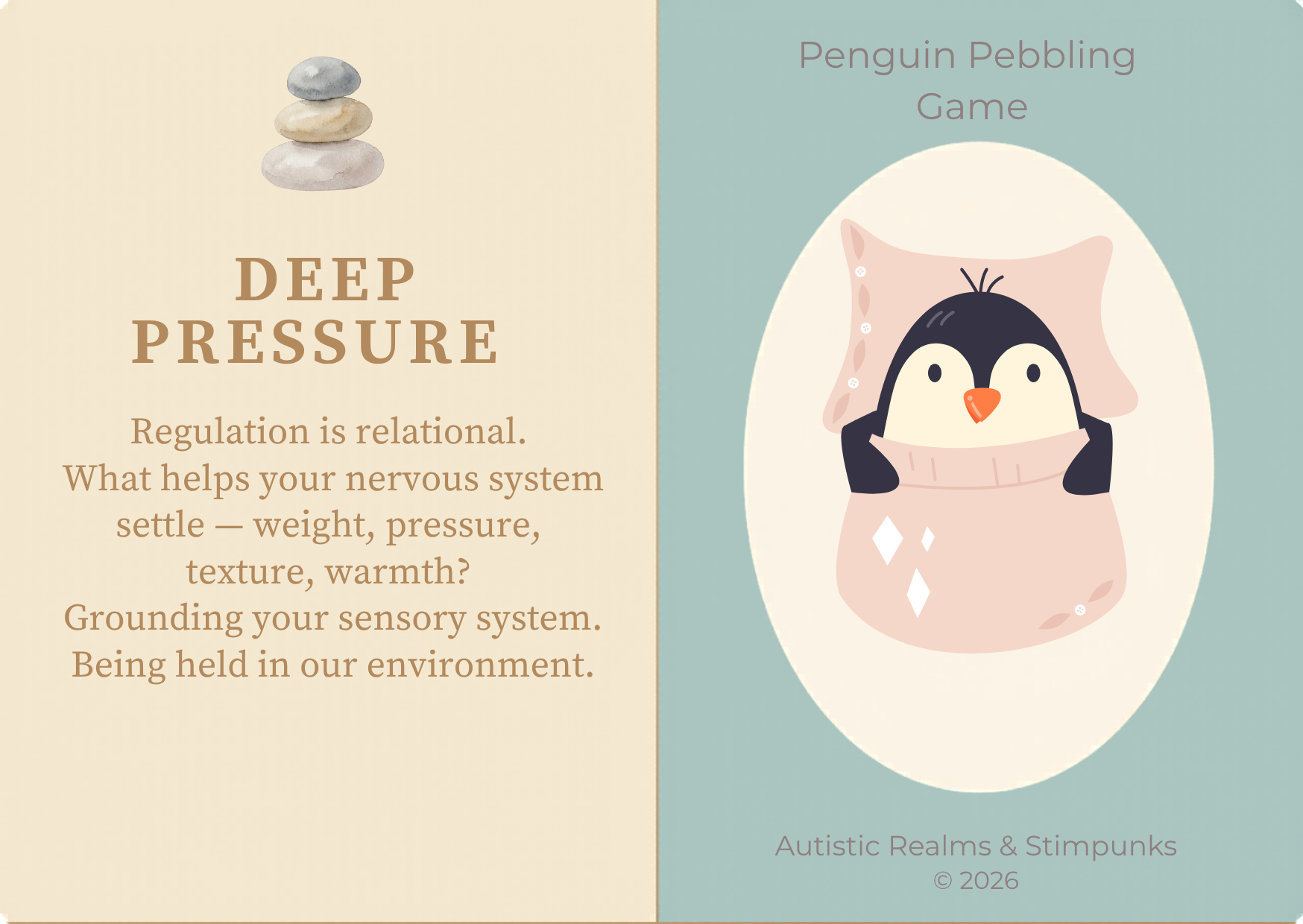
Penguin Pebbling — A Game of Creating Belonging, Building Connection and Understanding Autistic Identity was developed by Helen Edgar at Autistic Realms & Ryan Boren at Stimpunks (2026), grounded in the Five Neurodivergent Love Locutions coined by Amythest Schaber (Neurowonderful) and documented by Stimpunks Foundation (2022). The penguin pebbling locution draws on Helen Edgar’s writing at Autistic Realms (Edgar, 2023), framed through Milton’s Double Empathy Problem (2012) and monotropism theory (Murray, Lesser & Lawson, 2005). Free to use and share for non-commercial purposes. Please credit Autistic Realms & Stimpunks and link back.
Download the printable Plain Language Guide
Download the printable Easy Read Guide
Penguin Pebbling Game — Printable Card Deck
Download and print the full double-sided card set.
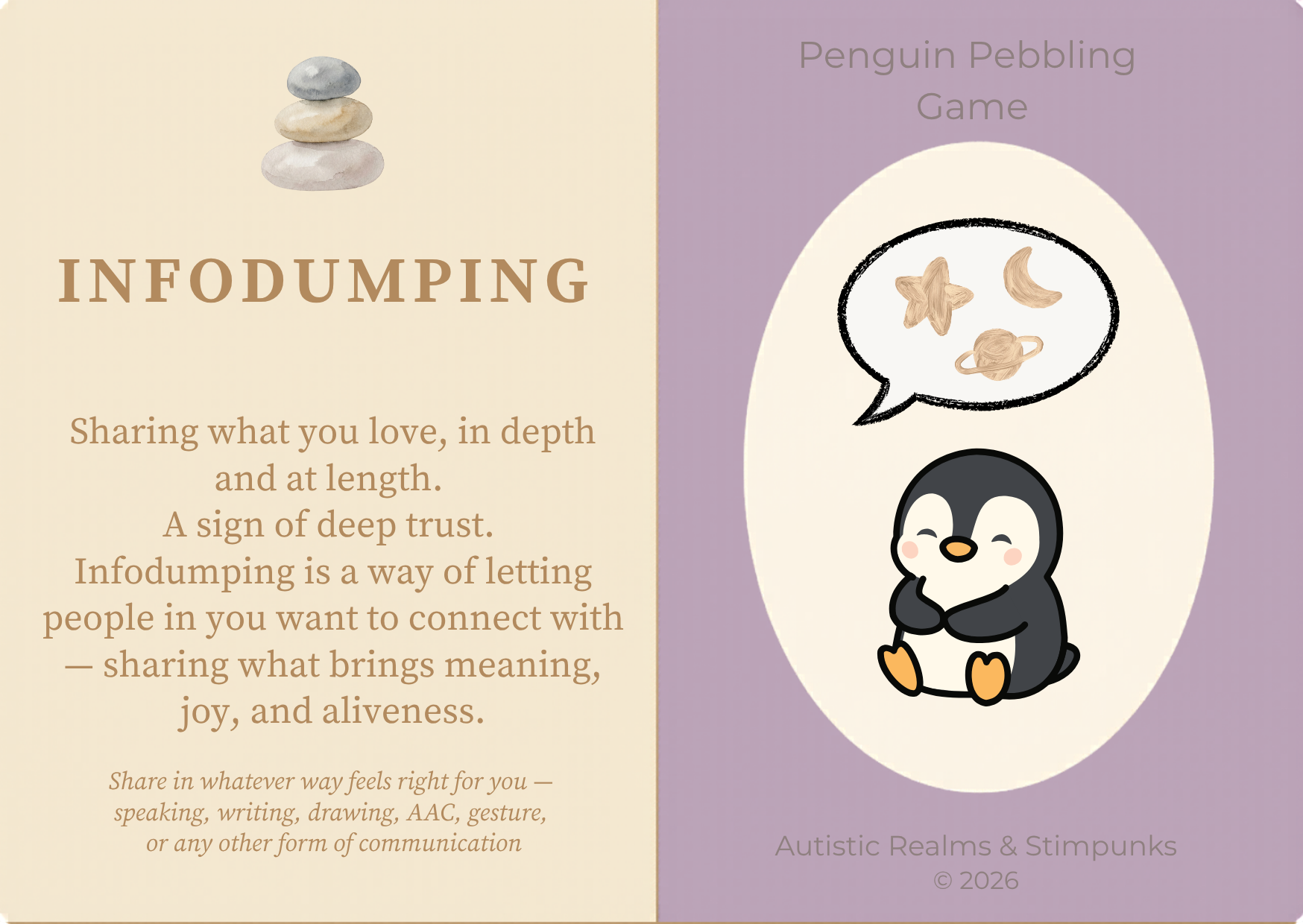
There is a Love Locution theme card, followed 6 invitations to an activity or reflection on the reverse of each card.
Cut them out (laminate them if you want).
Find some pebbles or other items of interest for your group.
Invite people to play, or use it as a reflective journaling tool on your own.
The Five Love Locutions — A Quick Guide
Infodumping: Sharing what you love, in depth and at length. A sign of deep trust. Infodumping is a way of letting people in who you want to connect with — sharing about your passions, what brings meaning, joy, and aliveness.
Parallel Play: Being alone, together. Body doubling. Being alongside each other without needing to communicate. Doing your own tasks or activities. Connection without demand. Presence without performance. Interdependence is valid.
Support Swapping: Mutual aid at the human scale. Offering what you can, receiving what you need, among people who 'get it'. Capacity fluctuates. Needs are not a weakness. We carry each other, taking turns.
Penguin Pebbling: "I saw this and thought of you." Offering small gestures to another person — a meme, a stone, a flower, a photo, a song or whatever brings meaning and joy to the person you are thinking of. Helps build bridges of relational closeness. Care is communicated through shared attention and co-created meaning.
Deep Pressure: Regulation is relational. What helps your nervous system settle — weight, pressure, texture, warmth? Grounding your sensory system. Being held in our environment.
A Note for Therapists, Educators, and Practitioners
If you are using Penguin Pebbling: A Game of Creating Belonging, Building Connection and Understanding Autistic Identity in a therapeutic, educational, or professional setting — a clinic, a classroom, a support group, a training — we warmly invite you to consider purchasing a printable PDF card set from the Autistic Realms Shop or making a donation to support our work.
Autistic Realms and Stimpunks are community-led initiatives. Everything we create is grounded in lived experience and made freely available because we believe access matters. Your support helps us keep creating resources like this one — for individuals, families, educators, and communities who need them.
Read the guide for practitioners
Penguin Pebbling Game — Printable Card Deck
Thank you for using this resource with care and for crediting the community it came from.
About This Game
Penguin Pebbling: A Game of Creating Belonging, Building Connection and Understanding your Autistic Identity was developed by Helen Edgar at Autistic Realms & Ryan Boren at Stimpunks (2026).
It is grounded in the Five Neurodivergent Love Locutions originally coined by Amythest Schaber (Neurowonderful) and documented by Stimpunks Foundation (2022). The penguin pebbling locution draws on Helen Edgar's earlier writing at Autistic Realms (Edgar, 2023), framed through Damian Milton's Double Empathy Problem (2012) and monotropism theory (Murray, Lesser & Lawson, 2005).
The game is free to use, share, and adapt for non-commercial purposes. Please credit Helen Edgar, Autistic Realms & Ryan Boren, Stimpunks, and link back to this page.
References
Edgar, H. (2023). Penguin pebbling: An Autistic love language. Autistic Realms. https://autisticrealms.com/penguin-pebbling-an-autistic-love-language/
Milton, D. (2012). On the ontological status of autism: The 'double empathy problem'. Disability & Society, 27(6), 883–887.
Murray, D., Lesser, M., & Lawson, W. (2005). Attention, monotropism and the diagnostic criteria for autism. Autism, 9(2), 139–156.
Stimpunks Foundation. (2022). The five neurodivergent love locutions. https://stimpunks.org/2022/01/22/the-five-neurodivergent-love-languages-2/