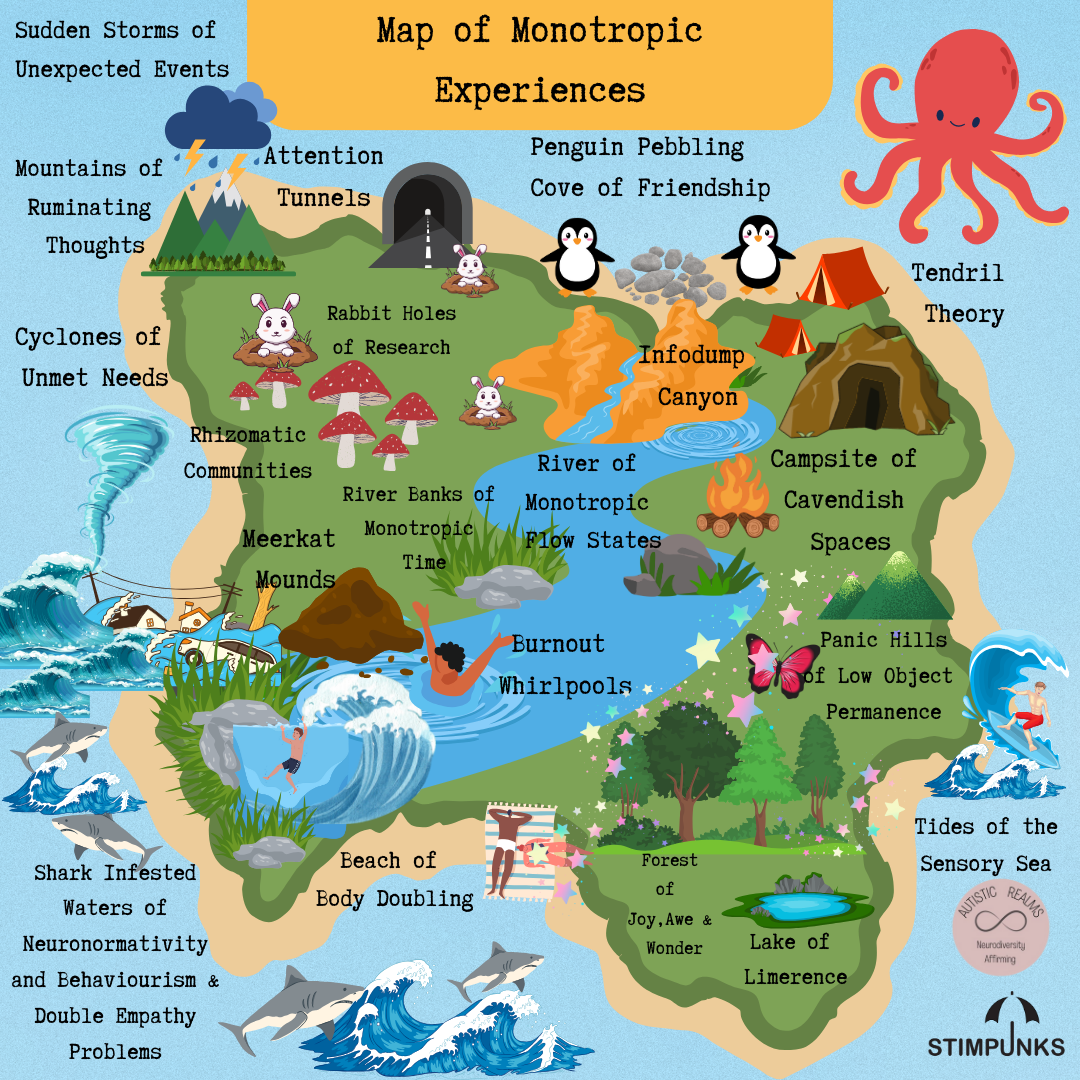
In collaboration with Ryan Boren, Chelsea Adams and Norah Hobbs from Stimpunks I have created: Autism & The Map of Neuronormative Domination. We hope that this will help frame the Map of Monotropic Experiences and provide insights as to why it is important to change the narrative that is causing so much harm to Autistic people; from the children who are unable to get the education they deserve to the adults who are struggling to get health, social and workplace needs met. As a monotropic (Autistic/ADHD) person, you need flow states to thrive; if you can’t access safe spaces, engage in your interests and feel connected, then you are more likely to enter a stuck state.
We need to move away from deficit-based views of Autism and instead embrace neuro-affirming theories led by Autistic people such as the theory of Monotropism. By embracing neurodiversity and validating the lived experiences of Autistic people and listening to stories shared in community spaces, we can create an ecology of care and equity that supports everyone so we all have a chance to thrive.
The Harmful Highway to Destination Neurotypical Bay: Difficulties of Neuromornative Domination

Historically, Autism research has been carried out mostly by non-Autistic people with the goal of fixing or curing them. Vast quantities of money have been invested into eugenics and ‘cures’, trying to make Autistic people more ‘normal’ so they can then fit into society, instead of thinking about how we can change society’s values and the environment people live in. It has been a one-way track, a Harmful Highway, with the aim of getting to Destination Neurotypical Bay.
People generally think it is easier and that Capitalist society will run more smoothly if everyone fits into certain expectations, follows the norms and just gets on with the rules set up by the neuromajority. This has left many neurodivergent, disabled and other marginalised groups at the edges, stuck in the liminal zones, feeling unsupported and with hurdle after hurdle to climb over and battle after battle just to survive. Increasing numbers of children are left with no access to education, eroded like sea glass by the tides sweeping around Behaviorism Bay, blinded by the Sandstorms of Stigma and Mountains of Misinformation and left feeling helpless and lost by the Dunes of Deficit Metaphors that engulf ‘Autism’.
The Marsh of Masking covers most of the landscape. Masking is a survival mechanism of suppressed needs that so many Autistic people feel they have to perform just to get through their days. Not having enough safe spaces or safe people around you to enable you to be your authentic self has severe consequences on mental health and well-being.
Society is rich and beautiful with limitless potential, but it is currently dominated by values entrenched in neuronormativity. Progress is restricted, and it feels like everyone who doesn’t fit in is being cast further away, towards the edges.
Stuck States vs Flow States
Monotropism is a neuro-affirming theory of Autism. Everyone benefits from flow states, but for Autistic people, flow is even more important. Everyone has a certain amount of energy and capacity to get through their days. For monotropic people (Autistic/ ADHD), their energy and attention resources are more focused on fewer things at any one time and flow states are essential to help you get through the day and balance your mind and body. Being engaged in a flow state if you are monotropic can feel like your energy is being restored. Being a monotropic person in a world that is designed for the benefit of the majority of polytropic people is exhausting. As a monotropic (Autistic/ADHD) person, if you can’t access safe spaces, engage in your interests and feel connected, then you are more likely to enter a stuck state.
Stuck States

If you are in a stuck state, it will affect your well-being. A stuck state affects everything, from how you experience and are able to understand and interpret your sensory needs (including interoception) to how well you can function and live the life you want. Stuck states are states of inertia, unable to start or may be unable to stop. You may feel trapped in a constant loop of ruminating thoughts.
Our original Map of Monotropic Experiences highlighted the dangers of Shark Infested Waters which is full of Behaviourism and Double Empathy Problems (Milton, 2012). The domination of neuronormative ideals creates a Cyclone of Unmet Needs for Autistic people and can be even more intense for other intersections of society depending on where they lie on the wheel of intersectionality (See Tracy Duckworth’s Wheel of Power and Privilege based on Kimberle Crenshaw’s work). It can lead to pools of burnout, and a dysregulated, stormy and unpredictable sensory system that affects both body and mind.
Flow States

By embracing monotropism, we can help gain a better understanding of Autistic/ ADHD people’s needs. Having a deeper understanding of monotropism enables a reframing of Autistic people’s needs and helps us to think about what changes we can make to the environment to meet our needs. We need to provide space, time and flexibility for Autistic/ADHD people to infodump, dive into rabbit holes of research and attention tunnel their passions and interests. This is in contrast to previous deficit or medical model theories of Autism, which sought to change or fix the person to fit into the environment. If you are monotropic, it takes a lot of energy to try to fit into a polytropic system. It can feel like you are being pulled in the opposite direction to where you want to go and feel you need to be.
We need to embrace flow states and our authentic Autistic identity. This will enable the river of monotropism to run through society, so Autistic people can thrive and not feel like they are constantly trying to swim upstream against the tide. By making changes to the environment in schools, workplaces, and other settings and providing opportunities that honour authentic ways Autistic people communicate and adaptations that may need to be in place to meet sensory needs it will benefit everyone.
Really getting to know young monotropic people’s passions and centring their learning around their interests can be hugely beneficial. It enables greater academic progress and supports their bodymind, communication skills and sensory system.
A happy monotropic bodymind = a happy flow state!
Monotropic Socializing & Importance of Environment

Sharing joy about your interests as a monotropic person is more than just sharing your hobby with someone; it can create deeper connections, which also allows your sensory system to become more regulated. A happy mind in a flow state generally means a happier body, and vice versa! Interest-led groups have been shown to be really beneficial for many Autistic people (Wood, 2018) Strategies such as Penguin Pebbling, Body Doubling and being in supportive environments such as Cavendish Space can really help support well being and strengthen communities.
By rejecting The Map of Neuronormative Domination that has been created by having a pathological view of Autism, we are lessening the impact of the stuck states that Autistic people may experience. Stuck states can lead to burnout and an inability to contribute to society and lead meaningful lives.
Embracing neurodiversity means embracing and validating the lived experience of everyone, including Autistic/ ADHD and other marginalised people. Enabling flow states and providing an environment where everyone’s well-being is supported will help whole communities to thrive. We need to listen to Autistic/ ADHD people and create a sense of pride around monotropic experiences one way of doing that is by sharing our lived experiences and stories.
Map of Monotropic Experiences: Community Story Project
This map is a reflection of my own personal experiences as a monotropic person. We want to capture glimpses of what your map may look like. In collaboration with Stimpunks, we have begun a community-led story community project based on The Map of Monotropic Experiences.

Map of Monotropic Experiences
Community Story Project
What has your journey been like navigating a system dominated by neuronormativity?
Where are you on the map today?
Where have you been?
Where do you want to go?
You may find, like myself, that you are often scattered across many points of the map at any single moment – how does that feel and how does it impact you or your family, work and relationships?
Want to join in?
If you’d like to join in, pick a point (or a few points) on the map to write / draw/ sing (take part in anyway that you’d like ) to share your own lived experience with us so we can expand our community space.
This will help other Autistic/ADHD people feel more connected, create a deeper understanding of monotropic experiences and help non-Autistic people gain a better understanding of monotropism.
Many thanks, we look forward to hearing from you.
Submit your stories about being monotropic to Stimpunks!
Spaces can be real and imagined.
Spaces can tell stories
and unfold histories.
Spaces can be interrupted,
appropriated and transformed
through artistic and literary practice.
bell hooks, (1989). Choosing The Margin As A Space For Radical Openness.